
The Kars Museum was created above all to display finds from the nearby excavations at Ani. Considering that Ani was once the capital of medieval Armenia, it is rather surprising how few Armenian artifacts are on view. Most of the objects date from the city's Seljuk period after 1064, presenting Ani as a large and prosperous Seljuk Turkish city—which, to be fair, was certainly one of its many faces.
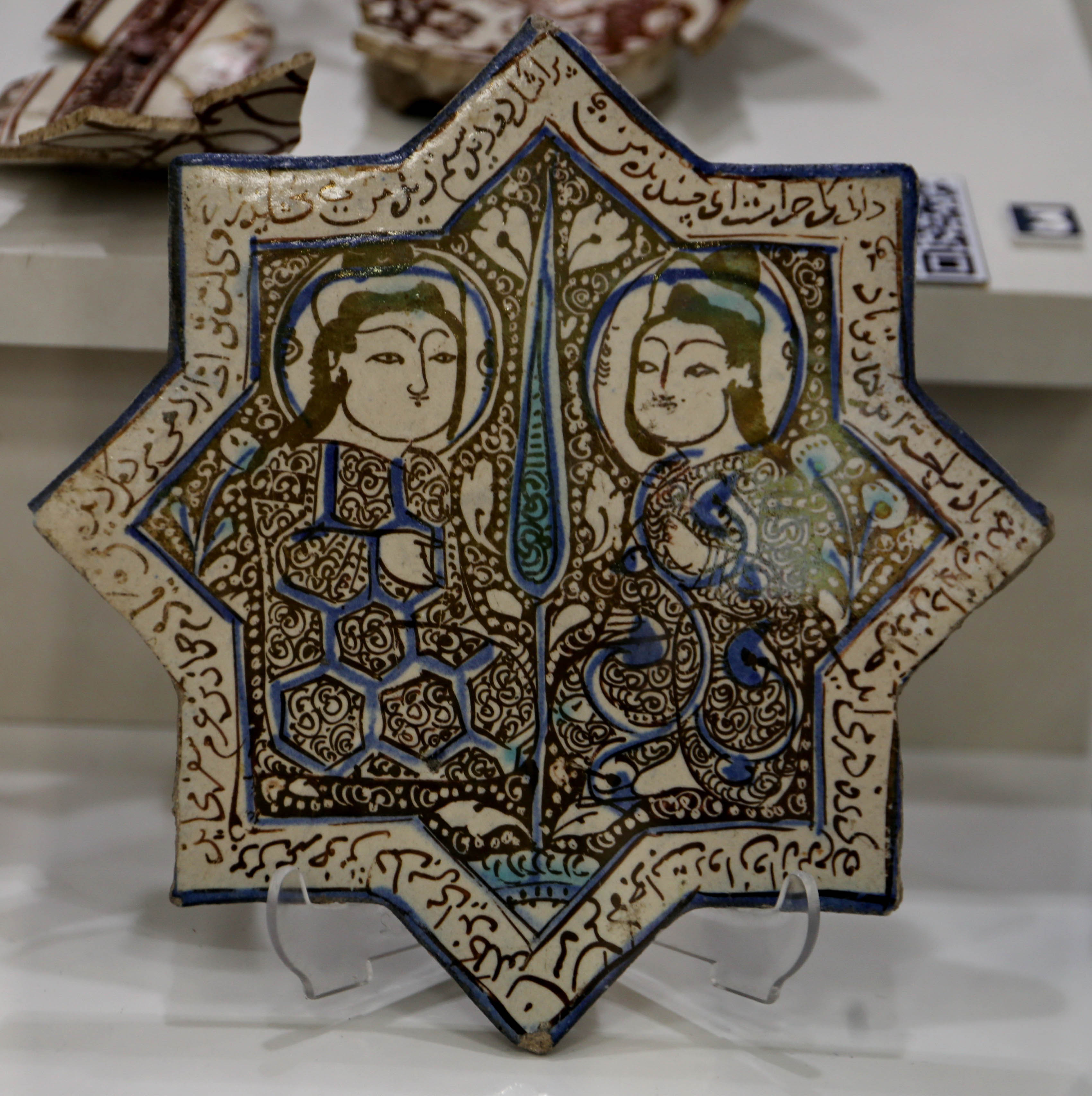
One of the highlights of the exhibition is a beautiful eight-pointed star tile depicting a man and a woman seated on either side of a cypress tree, while a Persian inscription runs around the border. According to the museum label, it is a "Seljuk tile" dating from 1266.
Anyone even slightly familiar with Iranian collections will immediately recognize this tile as one of the masterpieces of Persian ceramics. Luxury ceramics of this type, shape, and design were produced in Kashan between 1170 and 1340. They became so famous that the Persian word for tile, کاشی kâshī, is itself derived from the name of the city.
The tile is not made of clay but of stonepaste, or fritware, a material developed by Kashan's potters—including the most celebrated among them, Abu Zaid—as a local alternative to expensive Chinese porcelain. The body consisted of roughly 80% finely ground quartz (sand and pebbles), 10% frit (quartz melted into glass with plant ash and then ground into powder, serving as a binder), and 10% white clay to improve workability. Since the material was difficult to knead and shape, it was pressed into pre-made wooden or clay moulds. This explains why tiles from the same workshop are often identical down to the millimetre.
Once shaped, dried, and fired, the tile was first coated with a tin glaze, which produced a completely opaque, milky-white, perfectly smooth surface after firing. Onto this surface the painters applied cobalt blue and copper-turquoise pigments, after which the tile was fired a second time. It was then painted with copper and silver oxides and fired for a third time in a special kiln at a lower temperature (around 600–700°C). During this firing the air supply was cut off and smoke was introduced into the kiln, forcing the fire to draw oxygen from the metallic oxides themselves. As a result, an microscopically thin layer of pure metal fused onto the surface of the glaze, producing the characteristic golden shimmer known as lustre.
This third firing was extremely risky. Too much oxygen and the metal would burn black. Too strong a reduction atmosphere and smoke would penetrate the glaze. Too high a temperature and the glaze would melt again, absorbing the lustre pigments; too low and the metal would fail to bond properly and later flake away. Rapid cooling could crack the tiles or craze the tin glaze. The organic carriers used in lustre pigments released toxic and potentially explosive gases during firing, sometimes causing kilns to burst open when unsealed. Because of all this, the final colour and brilliance of a tile remained unpredictable until the very last moment. Contemporary writers therefore compared the work of Kashan's masters to alchemy—a comparison that greatly enhanced the prestige and value of lustre ceramics.
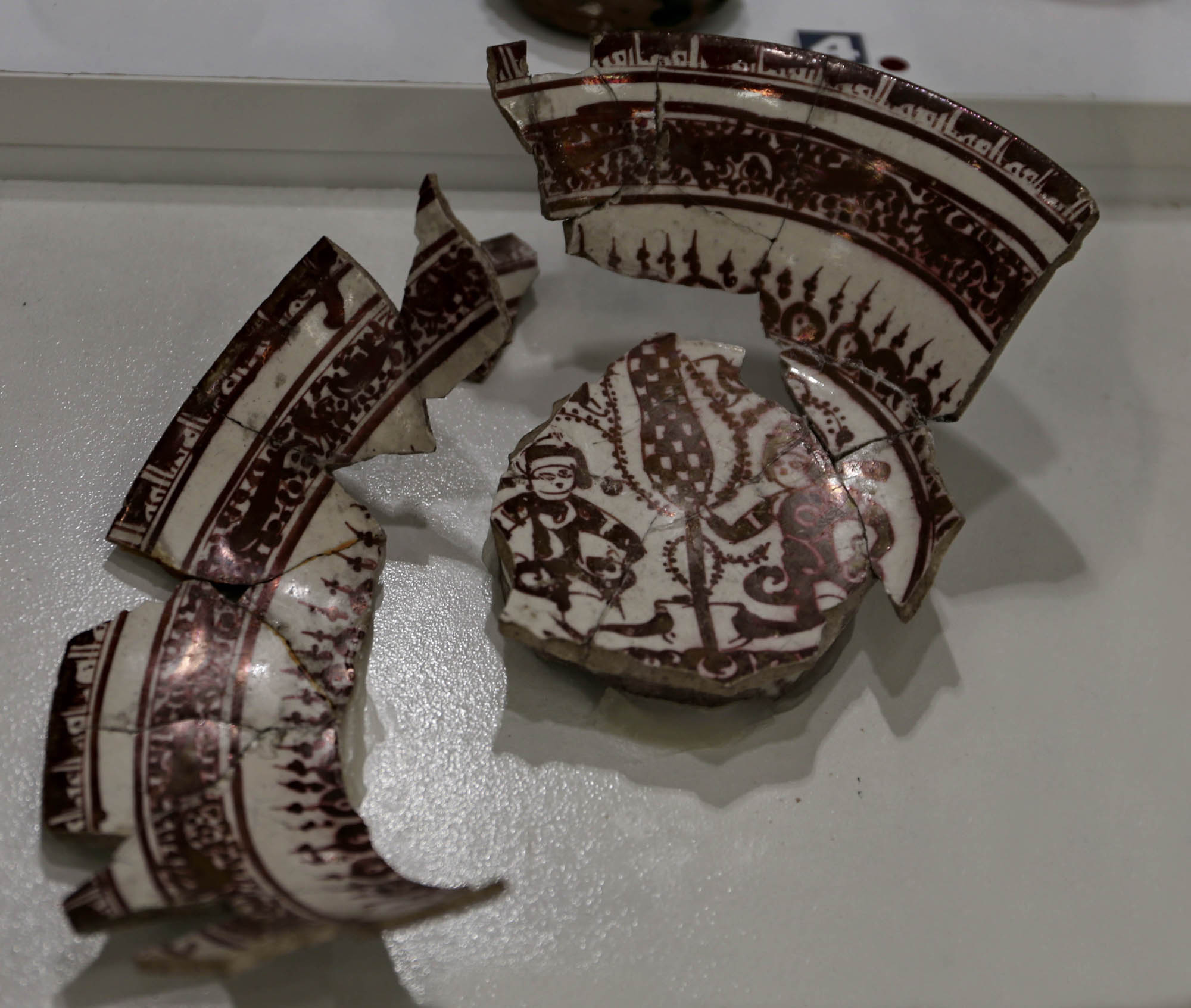
Lustre decoration was used not only on tiles but also on bowls, jugs, and luxury ceramic objects, as demonstrated by a fragmentary bowl in the Kars exhibition. Yet tiles occupied a special place, since they were commissioned for rulers and shipped across great distances to clad entire audience halls. One such revetment was produced in 1266 for the Seljuk Palace of Ani, originally built around the turn of the eleventh and twelfth centuries.
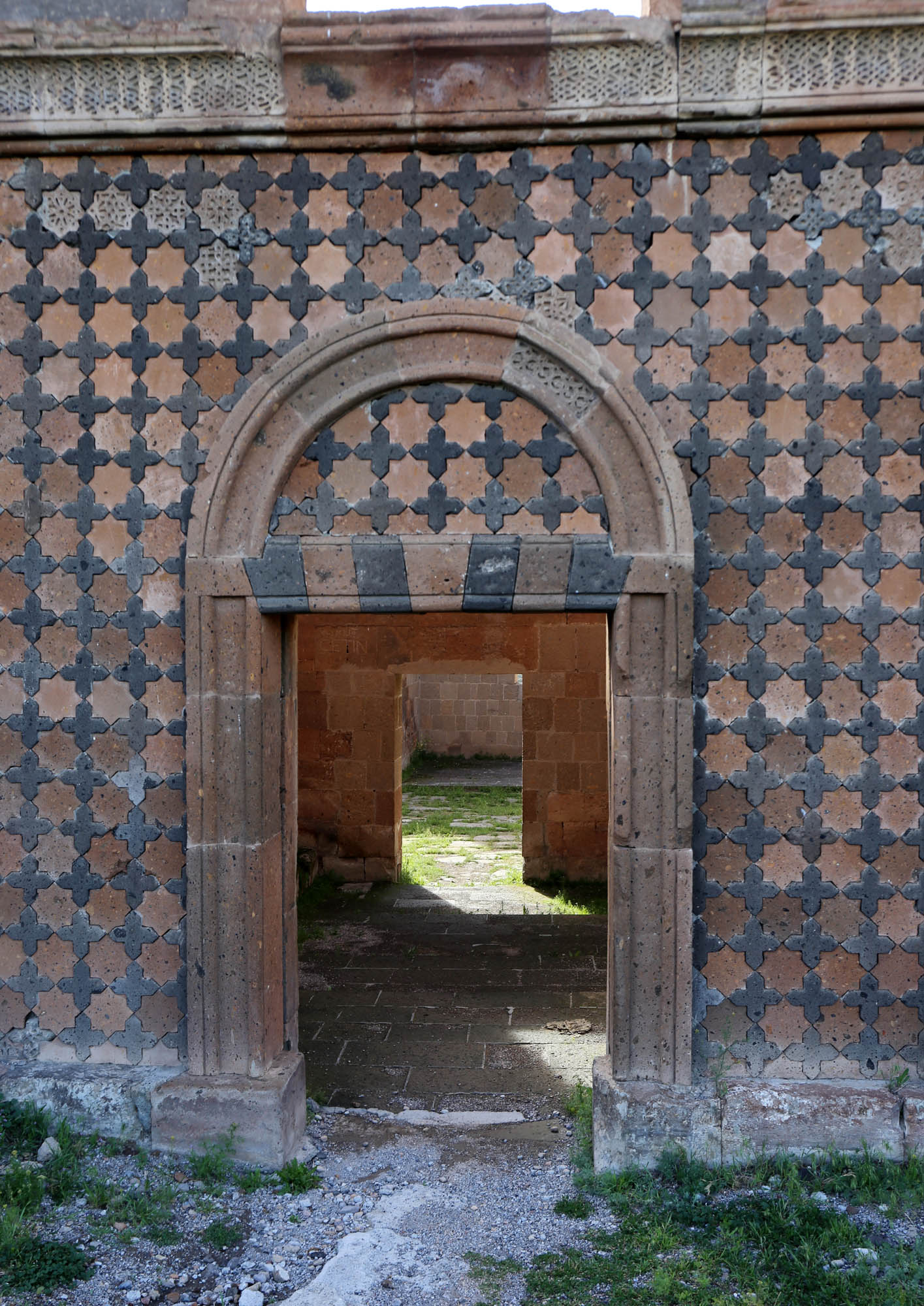
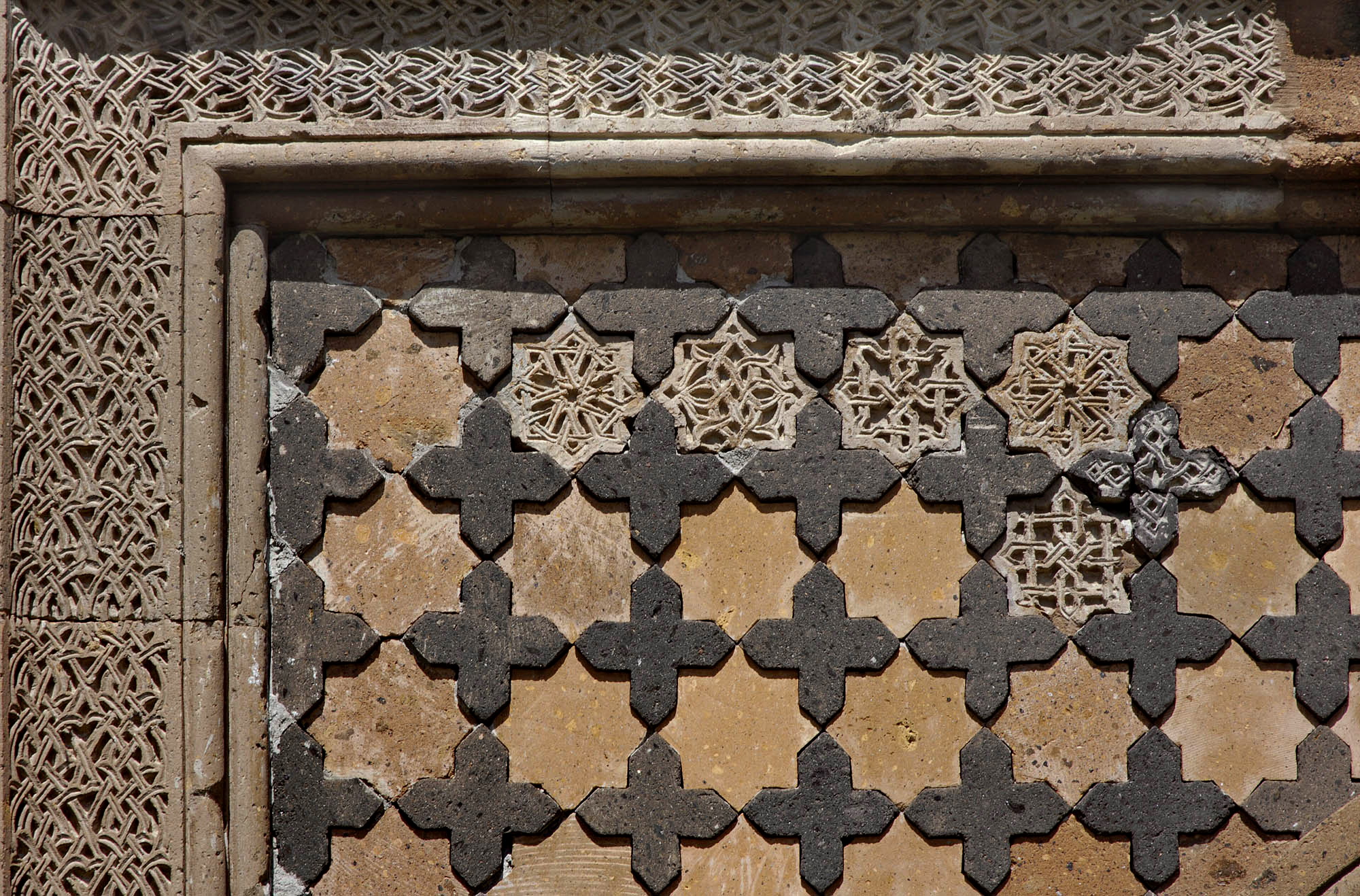
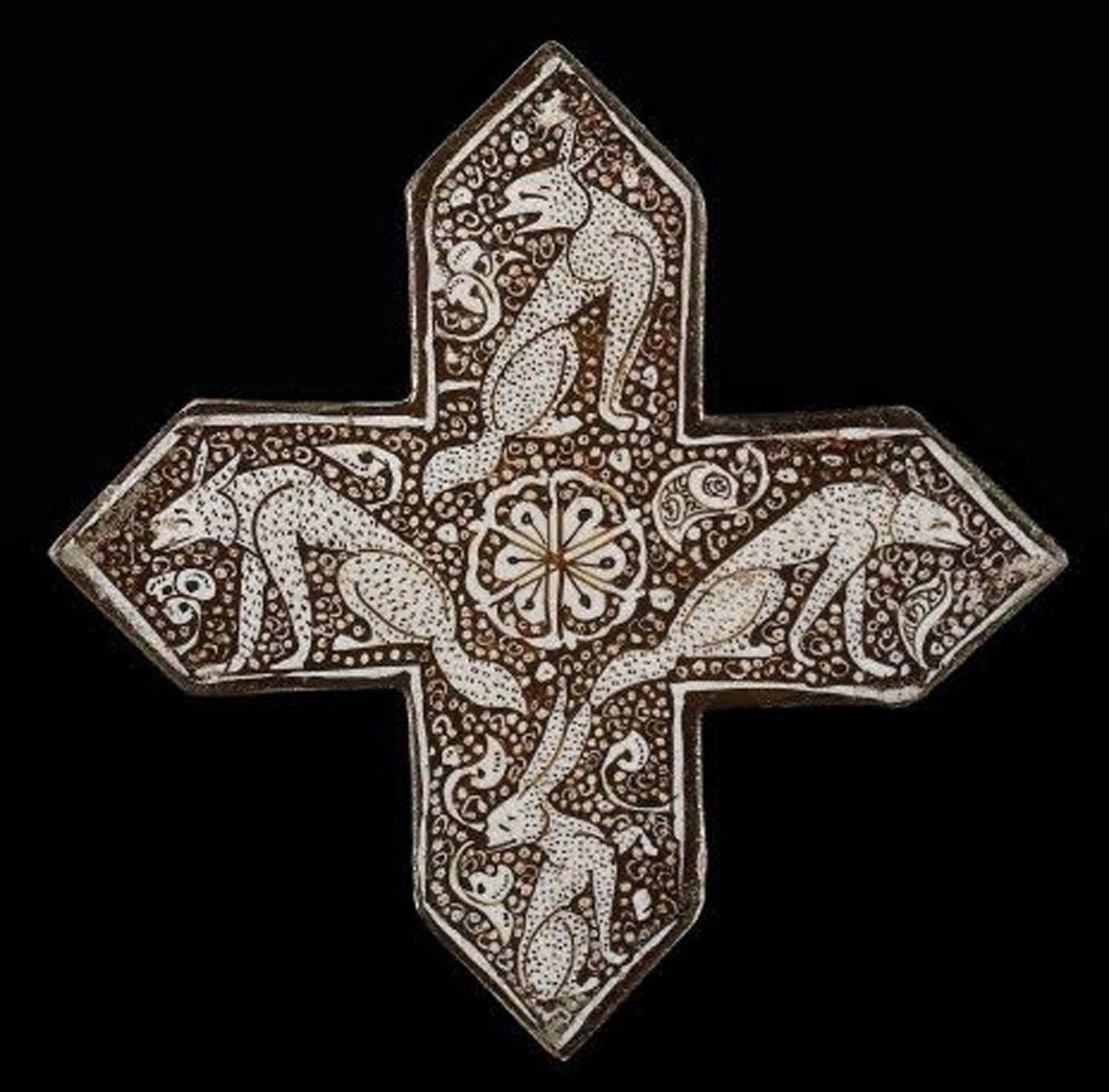
The palace gateway—although decorated not with Kashan lustre tiles but with stucco panels of exactly the same shape—gives a good idea of how such revetments were assembled. Between the eight-pointed stars, craftsmen inserted cross-shaped spacers, which were also richly decorated. Here is one such cheerful lustre-painted spacer from the British Museum, showing three scent-tracking hunting dogs and a rabbit trying to stay hidden:
And here are several Kashan tiles assembled in this way, from the National Museum of Iran:
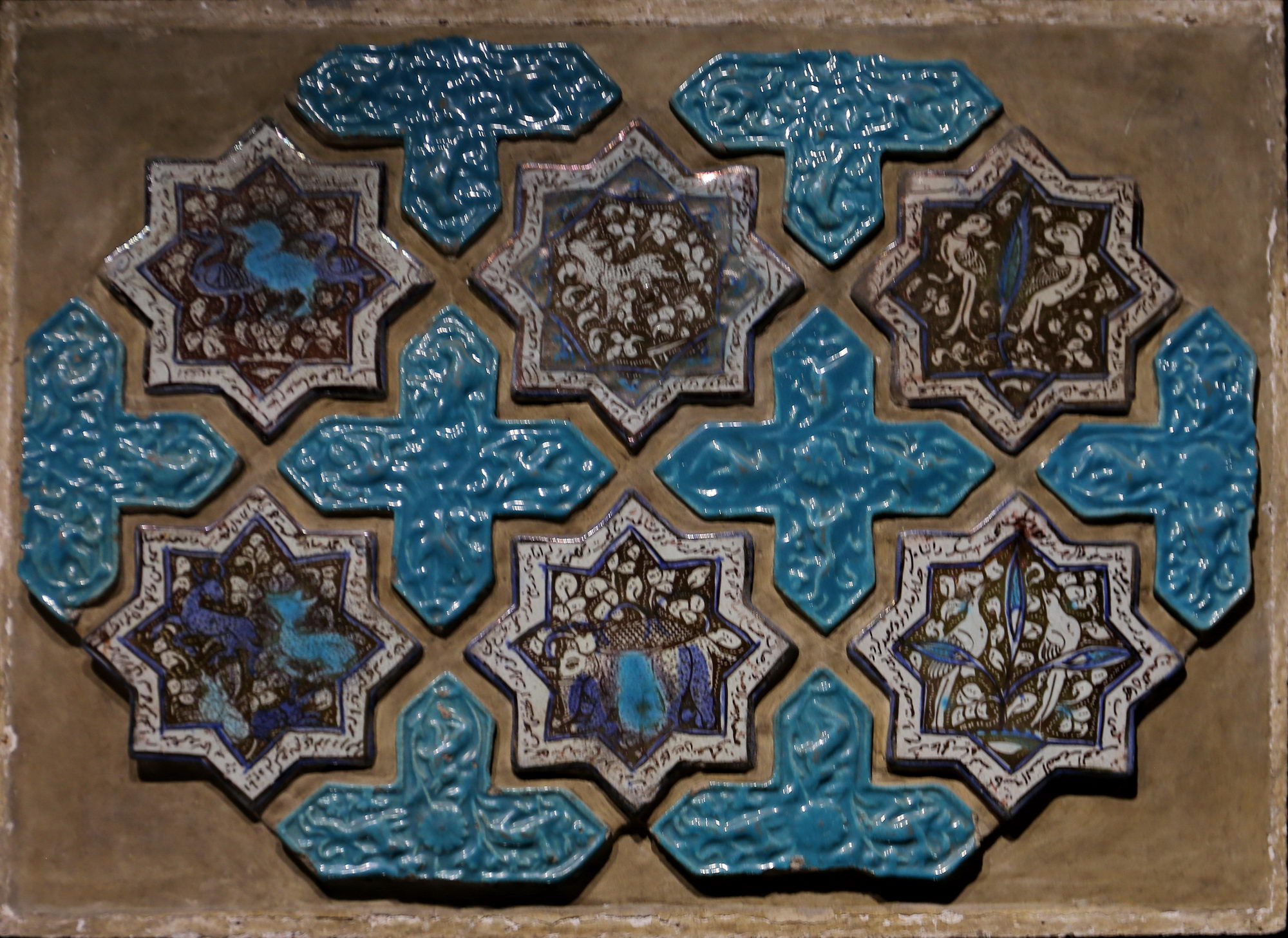
The walls of the audience hall, covered with hundreds of star-and-cross tiles shimmering in cobalt blue and gold, must have projected a truly royal splendour. Their surfaces caught and reflected sunlight or candlelight in a constantly shifting, almost mystical glow. Walking along the walls, guests could admire the images as allegories of their host's magnificence while reading aloud the Persian rubāʿīyāt written around them—short poems of four or six lines.
Reading them was made easier by the fact that the inscriptions were written in naskh script, which was just beginning, from the 1250s onward, to replace the older angular and often difficult-to-decipher Kufic script on monumental architectural inscriptions. Naskh was the everyday script of books and correspondence, making these inscriptions readily legible to the educated members of the courtly elite.
The authors of these verses are not named. In the Persia of the time, such poems belonged to the repertoire of court and urban singers—something like the popular hits of the day, built around familiar themes and recurring motifs. A calligrapher decorating the tiles could probably improvise a suitable verse depending on the available space, the image being illustrated, or any number of other factors. Indeed, slightly different versions of the same poem often appear on different tiles.
The poem on this tile reads:
|
Ey dūst, nadânī ke cherâ dīde por-âb ast? |
ای دوست، ندانی که چرا دیده پر آبست؟ |
O beloved, do you not know why my eyes are filled with tears?
Because both my eyes and my heart are forever hurrying toward you.
And when I remember all the hardships of this long journey,
my eyes drink from your lips and my heart rejoices.
My tears run like blood upon my pale face,
for it is the burden of longing for you that has left me so broken.
Poems of this kind often carried a double meaning. On one level they expressed earthly love—the longing of the depicted couple for one another. On another, they conveyed a Sufi religious message, in which the “beloved” represented God himself, toward whom the soul yearns. Even the act of reading contributed to this symbolism: to follow the inscription around the tile, the viewer had to slowly turn their head, recalling the ritual movements of Sufi dervishes.
The lovers together in a garden beside a lake likewise point simultaneously to the atmosphere of festive banquets (bazm) in the period, to earthly love and fidelity, to Sufi mystical devotion, and to the Paradise itself—an idea that again reflects the banquet hall shimmering in blue and gold light as its earthly allegory.
That the lovers represent the elite filling the reception hall is suggested not only by their richly ornamented Mongol-style robes, but also by their round, Uyghur-Mongol facial features. From the 1220s onward, after the Mongol conquest, Persian figures in painting were increasingly replaced by these Central Asian types, known as mâh-rū, “moon-faced,” which became the ideal of feminine beauty in Persian poetry. The nimbus around their heads derives from Central Asian Buddhist art and signals their elevated, almost transcendent status.
The cypress tree standing between them is equally multivalent. Because it is evergreen, it symbolizes enduring love. Because it bears no fruit, it also signifies selfless, non-utilitarian love—hence its Persian name sarv-e azâd, the “free cypress.” It was also seen as a metaphor for the perfect human body, which is why poets often describe their beloved as “cypress-statured.” Since Zoroastrian times it has been revered as a sacred tree, offering spiritual protection to lovers, and functioning as a tree of life—an axis mundi placing them within a paradisiacal, cosmic order.
This “Lovers” tile type was extremely popular in Kashan-commissioned palace decorations, and many variants survive in museums around the world. One of the best-known examples is this piece from the Cleveland Museum of Art:
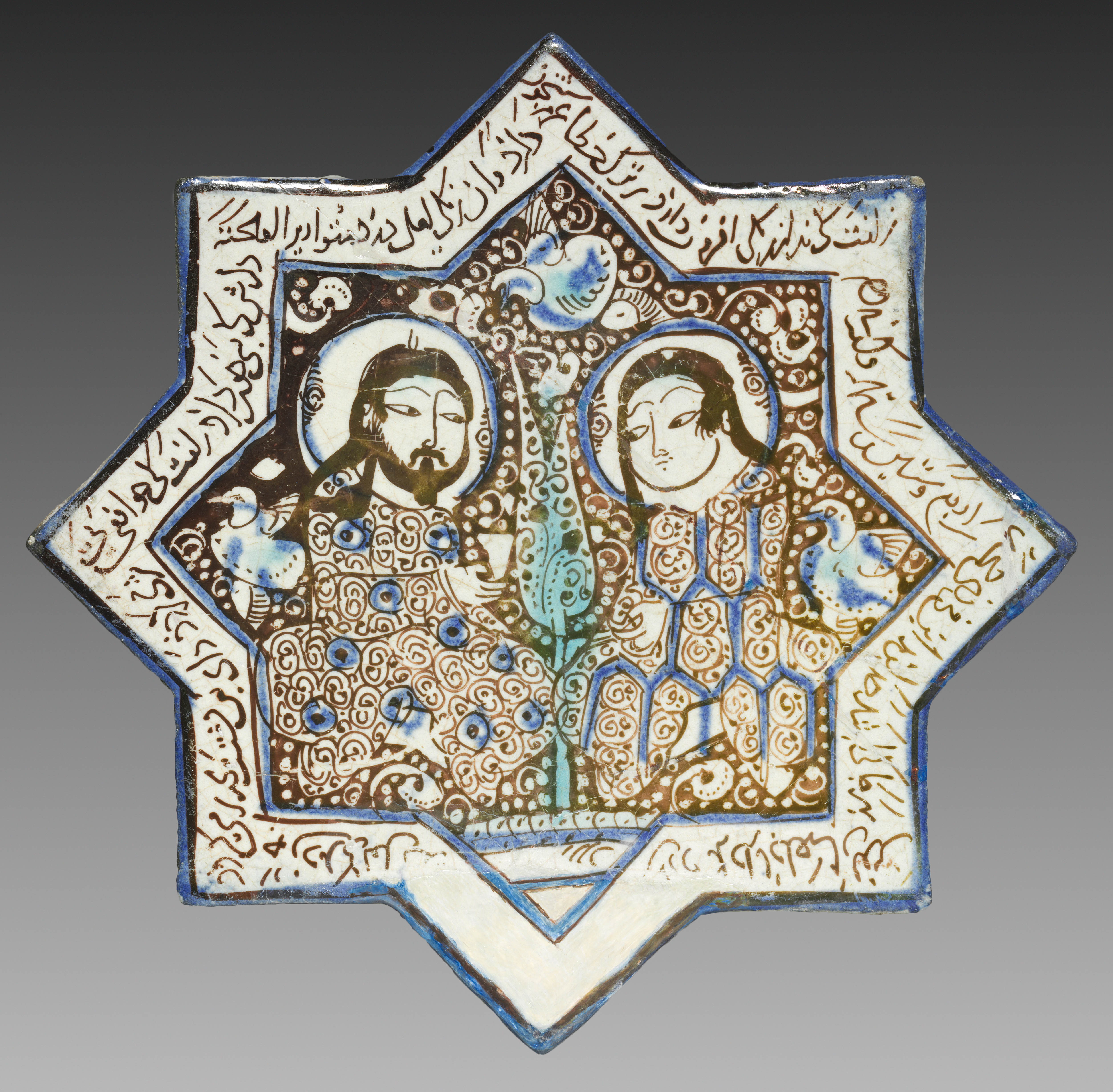
Along its border runs a two-couplet poem:
|
Zânast ke nowbahâr gol afruzad |
زانست که نوبهار گل افروزد |
It is because of you that spring sets the roses ablaze;
from your face even the rose learns how to bloom its beauty.
My heart is with you, my soul is with you, even the hem of my garment is with you;
if I draw my last breath, I am with you still.
This poem, too, can be read on both a worldly and a mystical level. Here, the male figure holds a cup in his hand, which in Sufi poetry—from Rumi to Hafez—symbolizes the life-giving wine of the divine Cupbearer. As in: آن یم جان افزای را برریز بر جان ساقیا ân jâm-e jân afzâi-râ barriz bar jân sâqia, “pour the life-giving cup into my soul, O Cupbearer!”
A mirrored Andalusian copy of this Cleveland “Lovers” tile, which I bought in an antique shop in Ronda, still hangs in plain sight on our wall.
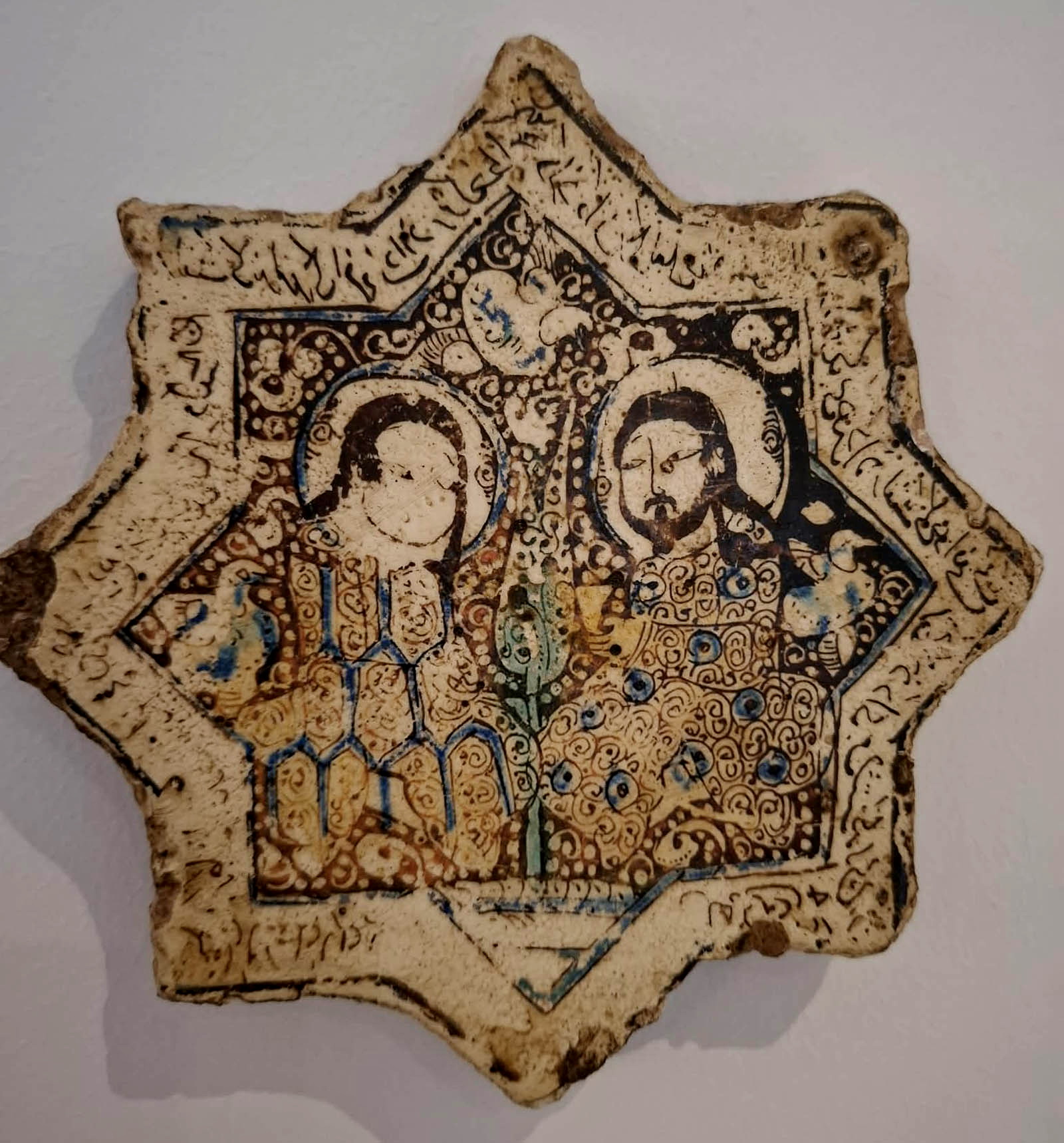
The Cleveland tile was made, according to its inscription—which these tiles almost always carry with date and signature—in the same year as the Kars piece, 1266, by the same master, Ali ibn Muhammad ibn Abu Tahir, of the Abu Tahir family. This dynasty of craftsmen dominated Kashan ceramics from 1205 to 1333, passing down the secret technology of lustre glazing through four generations. The last head of the family, Abu’l-Qasim al-Kashani, who also gained fame as a historian at the court of Öljeitü Khan, even included the secret recipe for ceramic production and lustre glazing in the final chapter of his 1301 work on gemstones and perfumes.
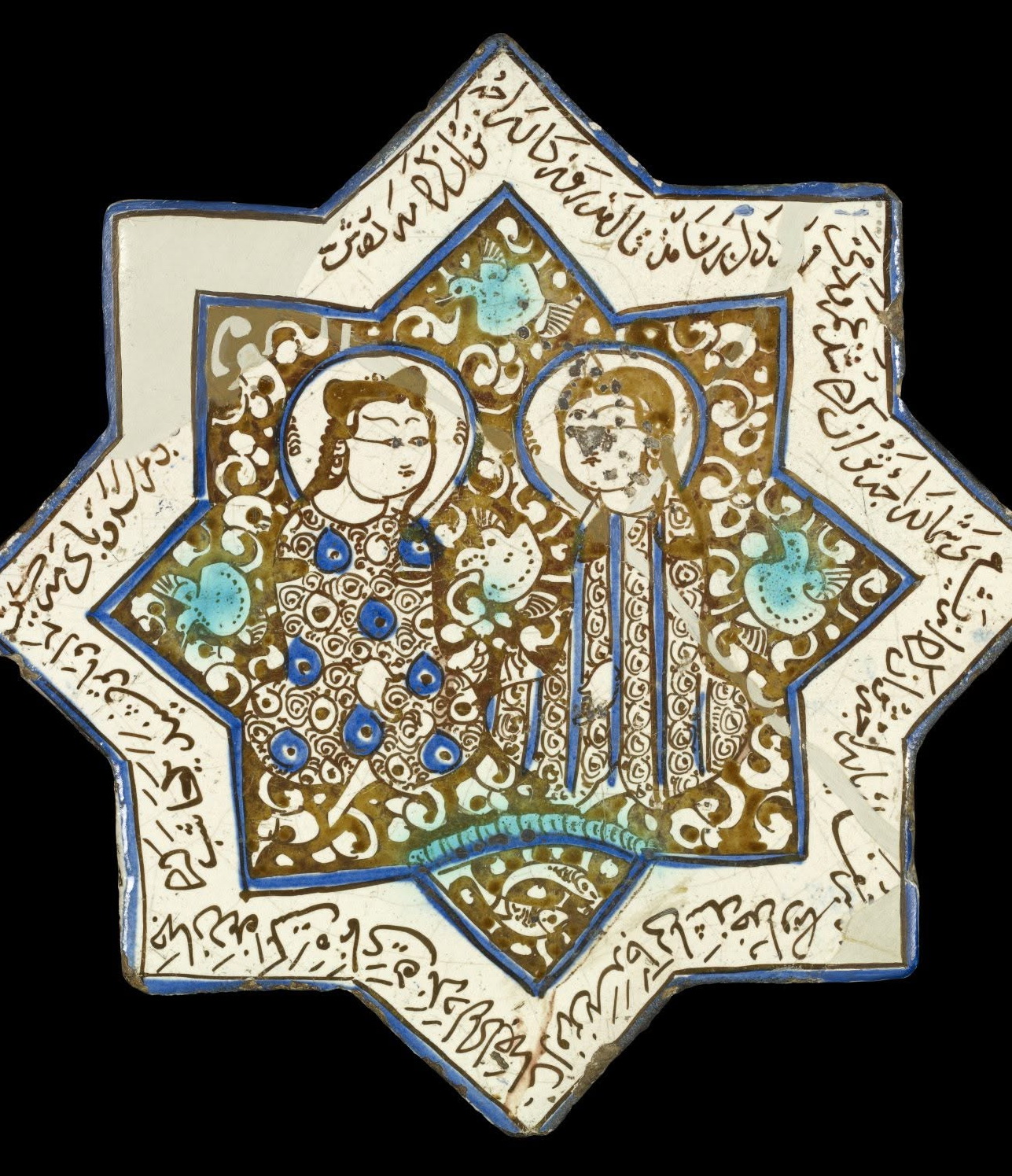 The “Lovers” tile preserved in the British Museum is slightly later, dating from around 1290–1310. Here, instead of a cypress tree, we see fish and birds, which together with the human figures represent the three realms of the world. In Sufi interpretation, birds symbolize the soul seeking freedom from the prison of the body, while fish—unable to survive outside water—represent the mystic immersed in the ocean of divine love. The poem surrounding the image refers to the ideal of the “moon-faced” beloved:
|
Dush mâh âmad ba khâna-ye to, |
دوش ماه آمد به خانه تو |
Last night the moon came to your house,
and in my jealousy I wanted to drive it away:
who is the moon, that it should sit in your place?
The Abu Tahir workshop fulfilled at least two major commissions in 1266. One of them was the decorative revetment of the Seljuk Palace of Ani. In this case, however, the term “Seljuk” is misleading on three counts. Although the palace was built after the Seljuk conquest of the city in 1064, its original patrons were the Kurdish Shaddadid dynasty, themselves vassals of the Seljuks. The tile revetment was later commissioned after the Mongol conquest by the Georgian-Armenian Zakarid (Mkhargrdzeli) rulers, who governed the city at that time as Mongol vassals. And finally, as we have already seen, there is nothing specifically Seljuk about the Persian-Mongol cosmopolitan style of the tiles themselves. The label is nevertheless convenient in a museum context that prefers to project a retrospective “Turkish medieval” narrative onto a province whose medieval reality was far more complex.
The other major patron was the Mongol Great Khan of Persia, Abaqa (1265–1282), who commissioned a summer palace on the ruins of an ancient sacred lake and Zoroastrian fire temple known as Takht-e Soleyman (“Throne of Solomon”). His chief minister was the Armenian prince Sadun Artsruni, for whom the “Saviour of All” khachkar of Haghpat was made in 1282—another sign of the many overlapping artistic languages coexisting at the cosmopolitan Mongol court.
With the gradual decline of Mongol rule in Persia in the 14th century, the palace at Takht-e Soleyman was abandoned. Its highly valuable wall tiles were prised off by locals and either reused in other buildings or sold on the market. Through many such transactions, they eventually made their way into major Western collections, including not only the Cleveland Museum but also the Victoria and Albert Museum in London and the Museum of Islamic Art in Berlin.
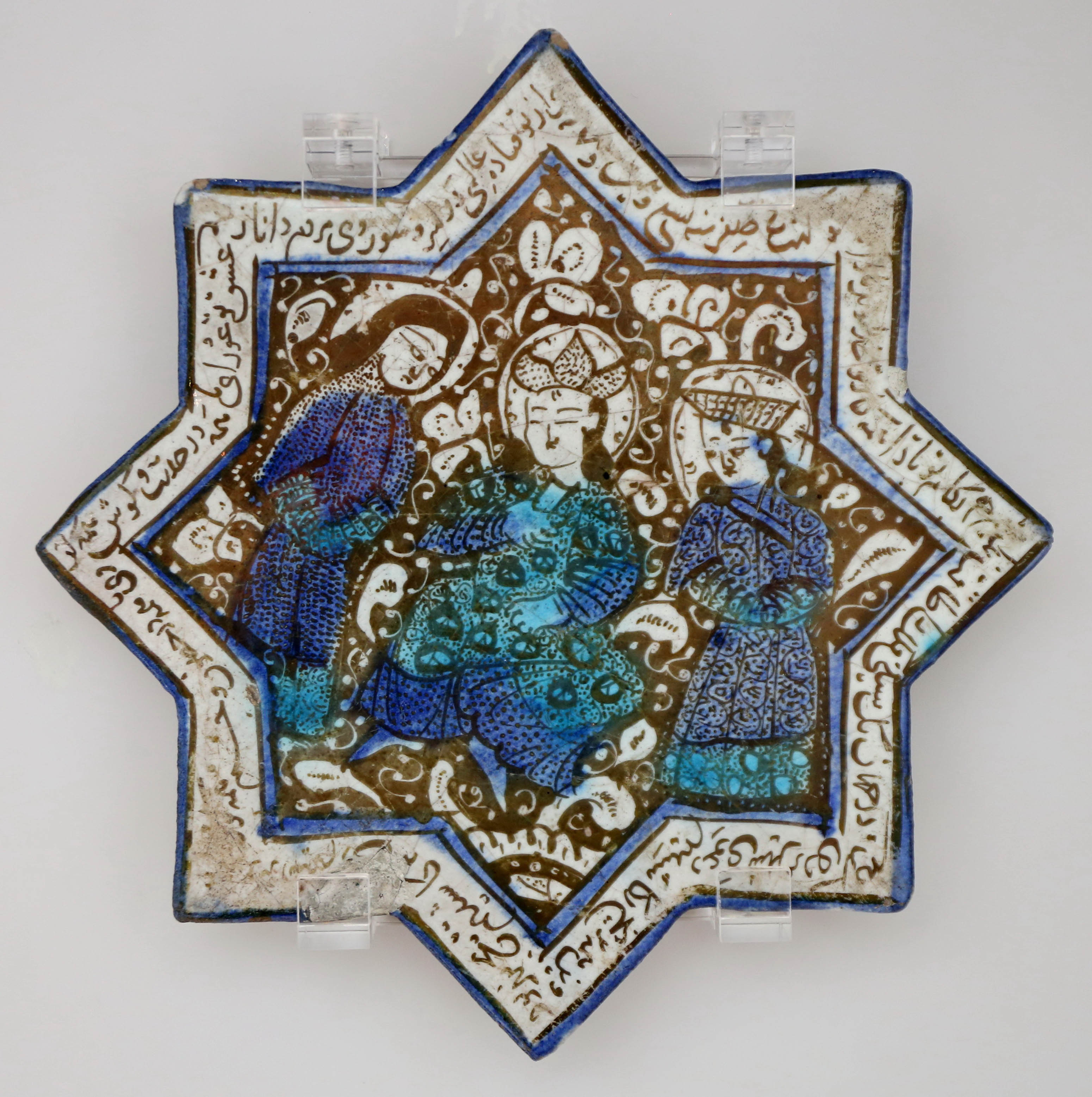 On this Kashan tile in the Berlin Museum of Islamic Art we see not a pair of lovers but a ruler flanked by two courtiers. This clearly refers to the courtly banquet (bazm) held in the reception hall. Around it, however, runs once again a love poem. This shows, on the one hand, that the verses do not always directly comment on the imagery. On the other hand, the same poem can be read both as mystical love addressed to the Sufi God and as praise directed toward a worldly ruler:
|
‘Eshq-e to ‘azâb-e del-e dânâyân ast, |
عشق تو عذاب دل دانایان است |
Your love is the torment of the hearts of the wise,
your union the joy of the souls of the yearning.
Though my life is worn by the sorrow of your love,
the pain you give is better than a thousand cures.
We have already encountered the motif of the final line here.
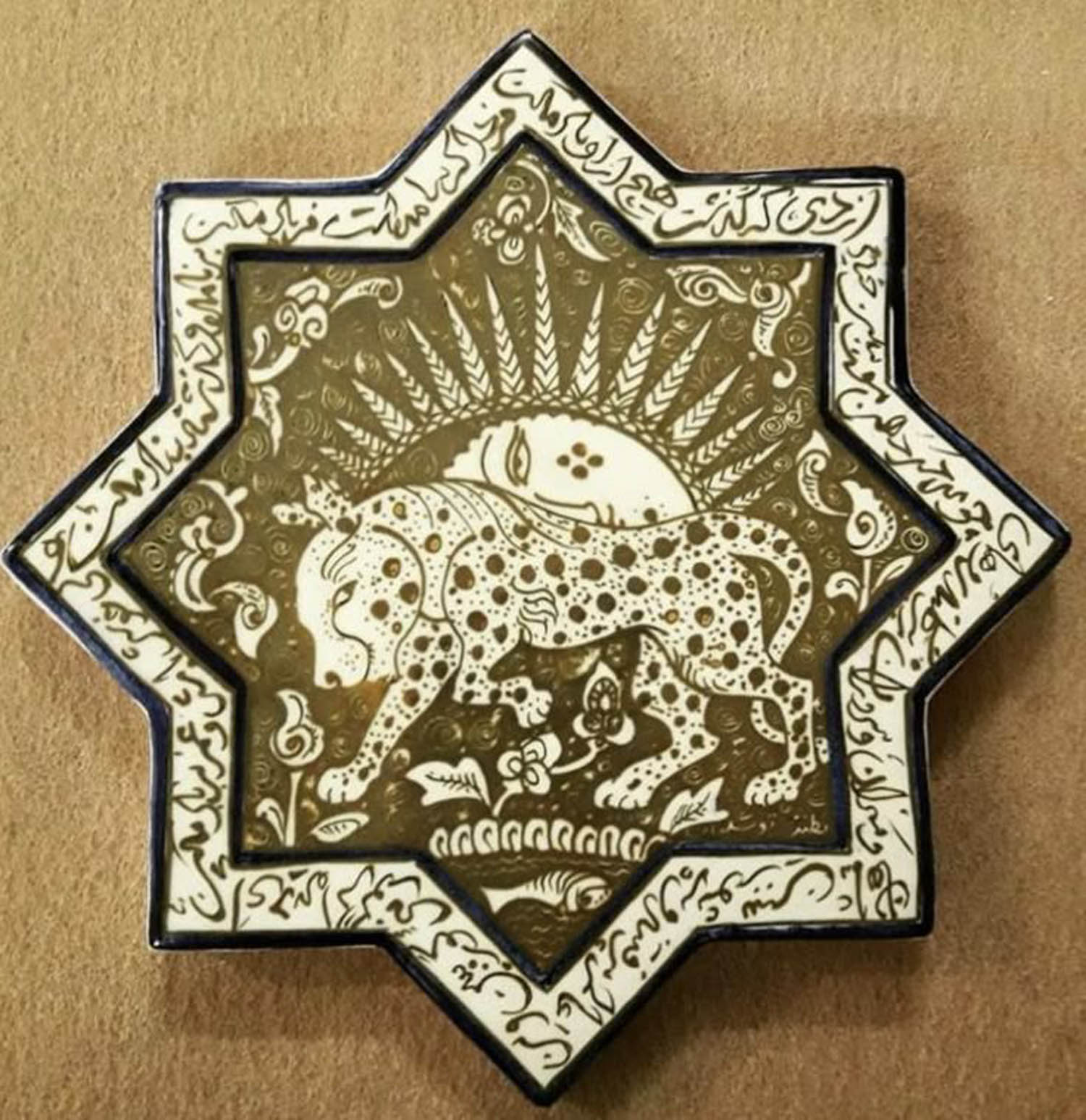 On this tile preserved in the Louvre collections, whose central image shows the shir-o-khorshid—the Lion and Sun symbolizing kingship, cosmic order, and radiance—the poem makes even more explicit the devotion addressed equally to the beloved, the ruler, or God:
|
Gham bâ lutf-e to šâdmânī gardad, |
غم با لطف تو شادمانی گردد |
Sorrow, by your grace, turns into joy;
life, by your gaze, becomes eternal.
If the wind were to carry the dust of your street to hell,
even fire there would turn into the water of life.
With the decline of Mongol rule, the Ani palace hall met its end. The city was shaken by sieges and political upheavals. Knowing the extraordinary value of the lustre-glazed tiles of the reception hall, its inhabitants removed the finest pieces—thirty-two in total—and hid them in a large clay vessel beneath the floor of the hall. Earthquakes in the 14th century covered the floor with debris, and the vessel was only discovered during archaeological excavations in 2001. This is how the tiles eventually ended up in the Kars Museum.
The remaining 31 tiles most likely share the general fate of Ani’s finds, waiting in storage for a moment when, like many other excellent Turkish museums, the Kars Museum will finally shed its provincial constraints and nationalist corset, and present to the wider world what it preserves from one of the most brilliant cities of the medieval world.
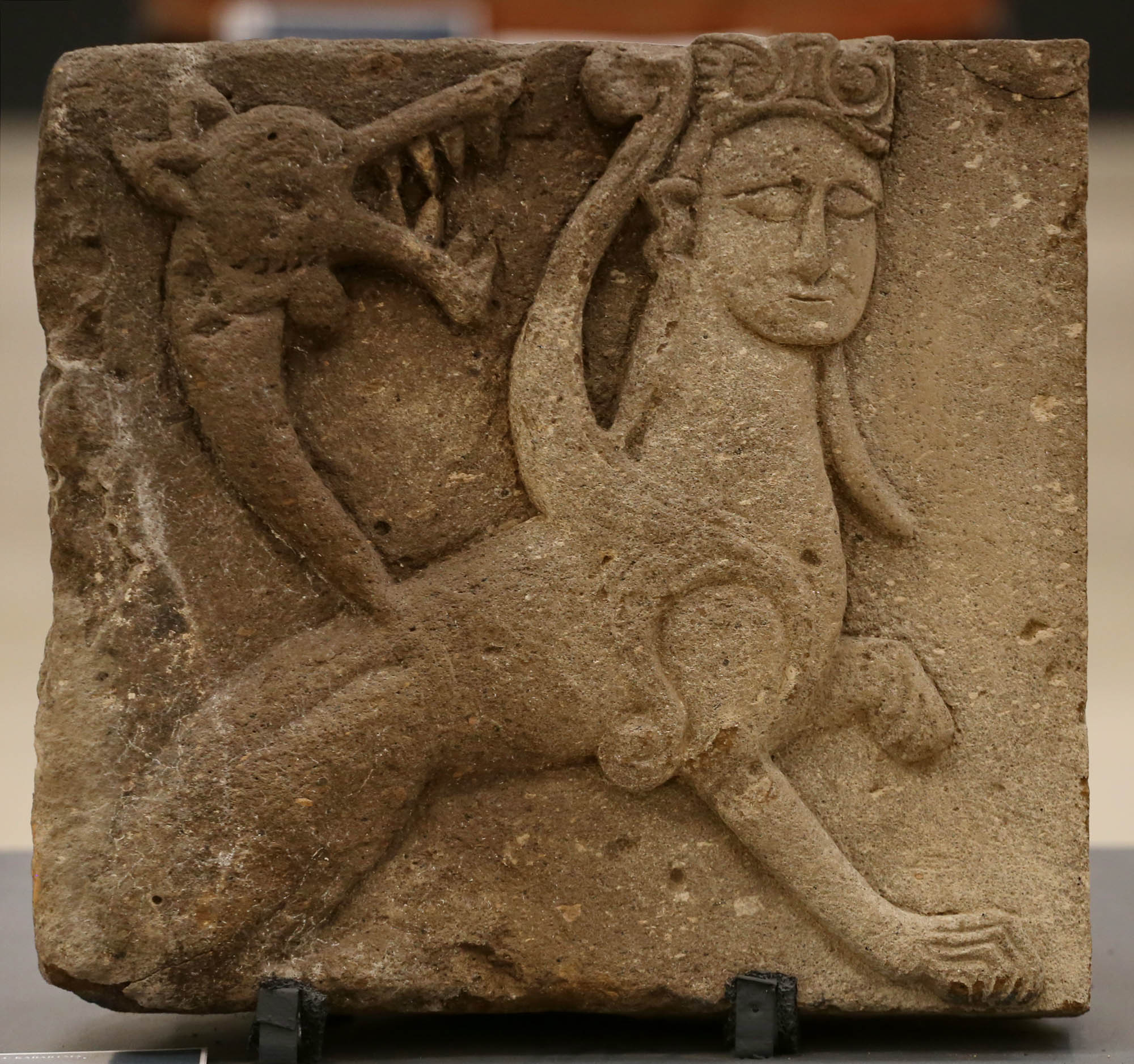 One of the earliest Persian depictions of the Shahmaran, dating from the 1200s, in the Kars Museum, excavated near Ani Cathedral in 2016.
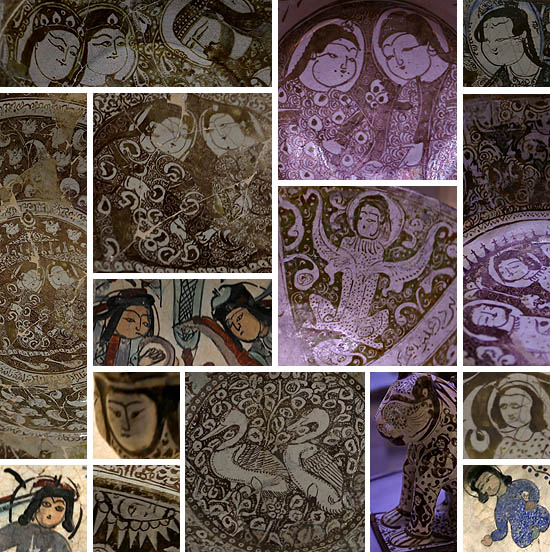
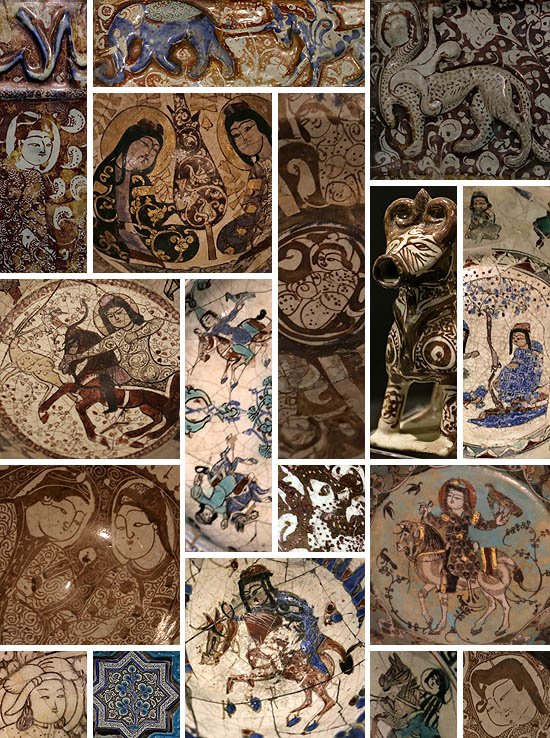
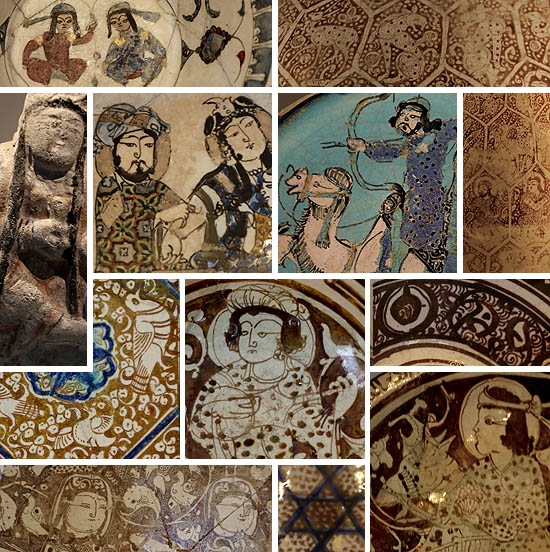
Below: lustre-glazed and/or “moon-faced” figural Kashan ceramics from the Ceramics Museum of Tehran, the National Museum of Iran, and the Museum of Islamic Art in Berlin:



Add comment