

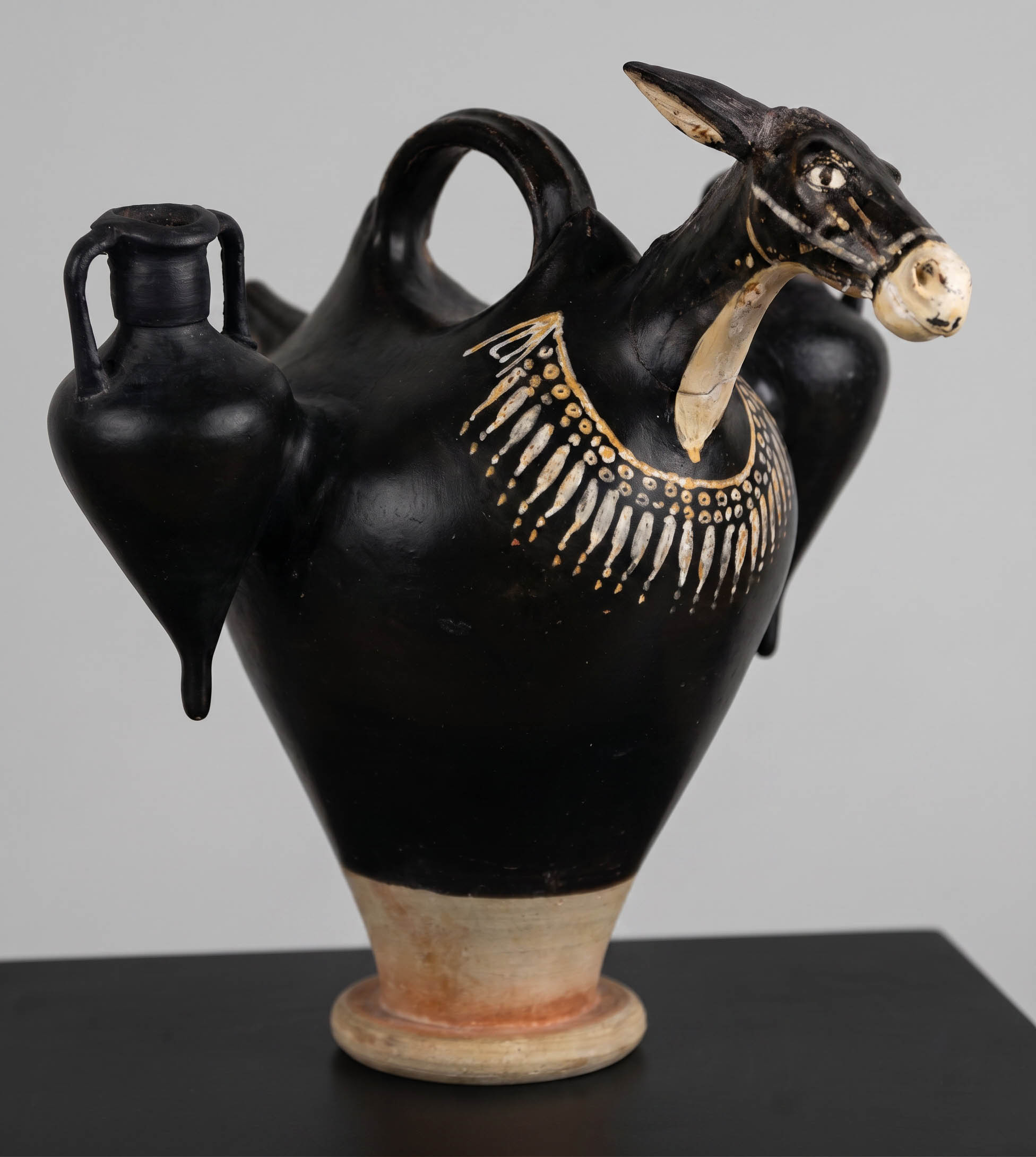
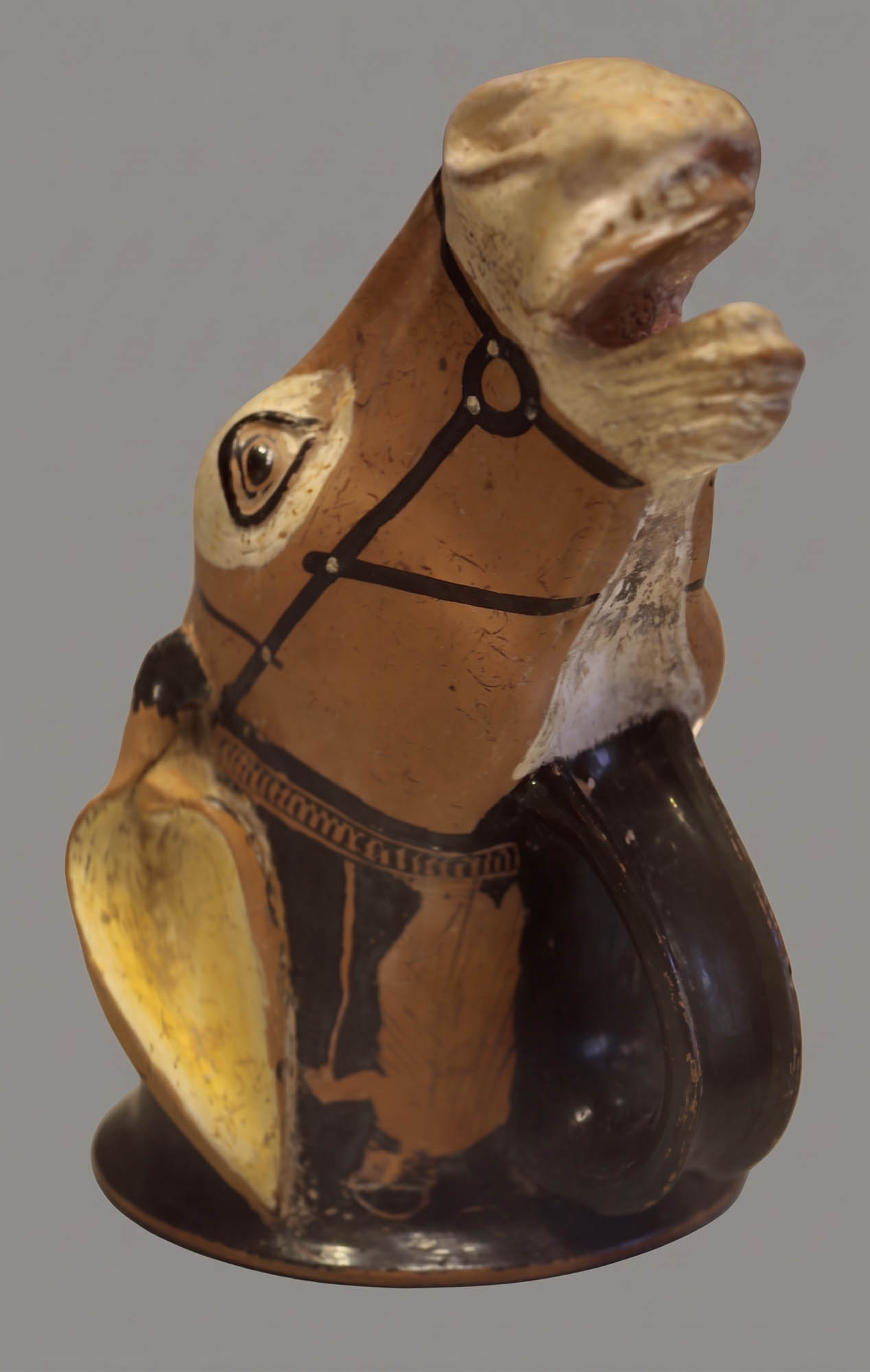
Besides the lyre made from a tortoise, the Archaeological Museum of Taranto preserves another “transformed” animal. This one is a donkey carrying a wine amphora on each side, yet it is itself also an amphora. More precisely, it is an askos, a vessel used for storing oil or ointment. Why not wine? Because the donkey’s head functions as a precisely shaped pouring spout, allowing precious oils to be dispensed very slowly, almost drop by drop, without waste. Such a consideration simply did not arise when it came to wine.
Yet the donkey is unmistakably associated with wine—not only because of the two wine amphorae it carries, but also because around its neck it wears a wreath woven from ivy, myrtle, and laurel, like those worn by the human and animal participants in the Dionysian procession, the thiasos.
Dionysus was the god of nature’s elemental power, of liberation from the constraints of civilisation, and of crossing boundaries, and wine was the obvious companion of his cult. The natural beast of burden of his processions was the donkey, an animal considered stubborn and impossible to discipline, to which unbridled sexuality was attributed—the very qualities celebrated by the thiasos.
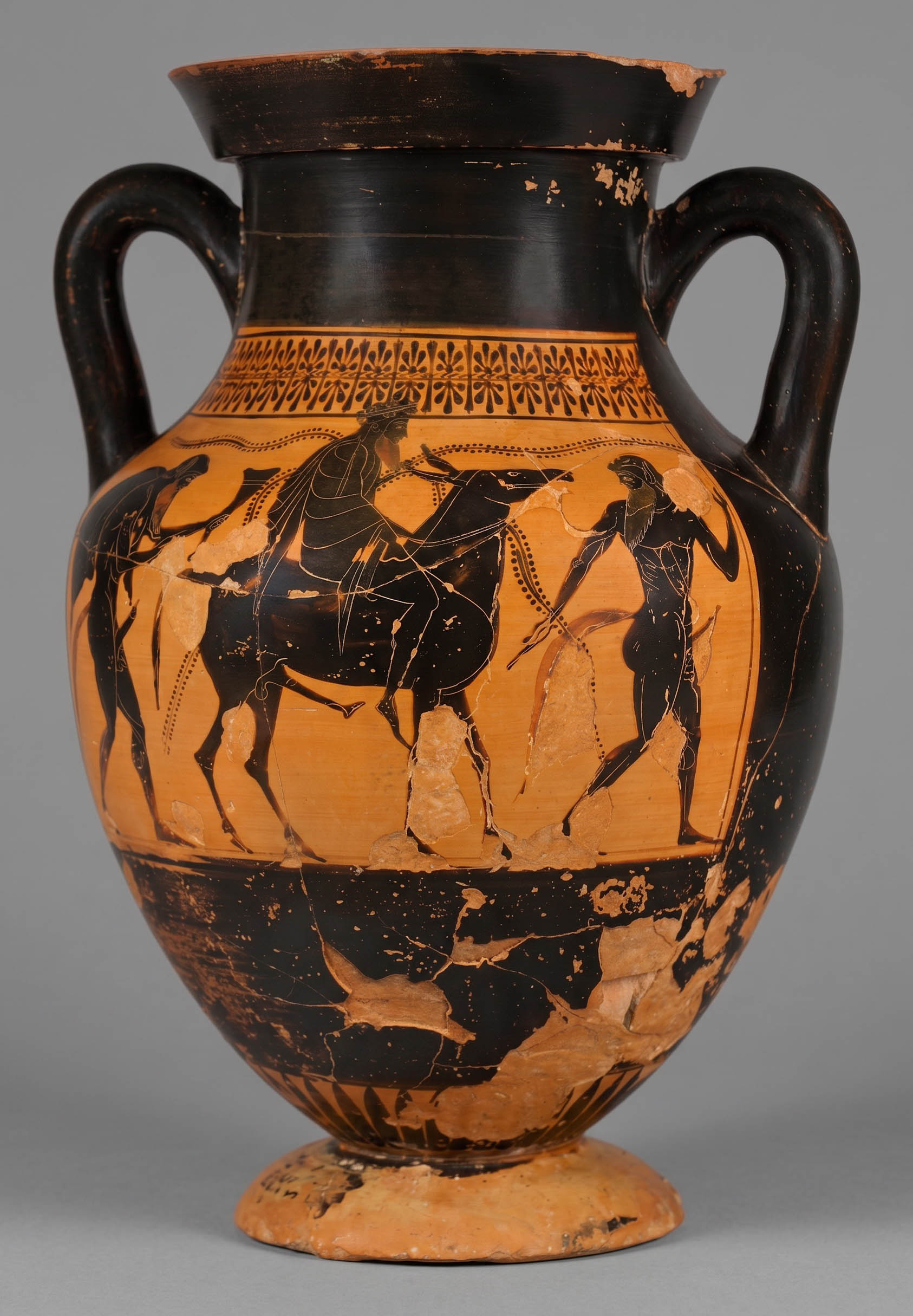
On another Athenian black-figure wine amphora in the Taranto museum, dating from 525–500 BC, Dionysus himself rides on the back of his favourite animal in the middle of the procession, while before and behind him marches a naked satyr with an enormous erect phallus.
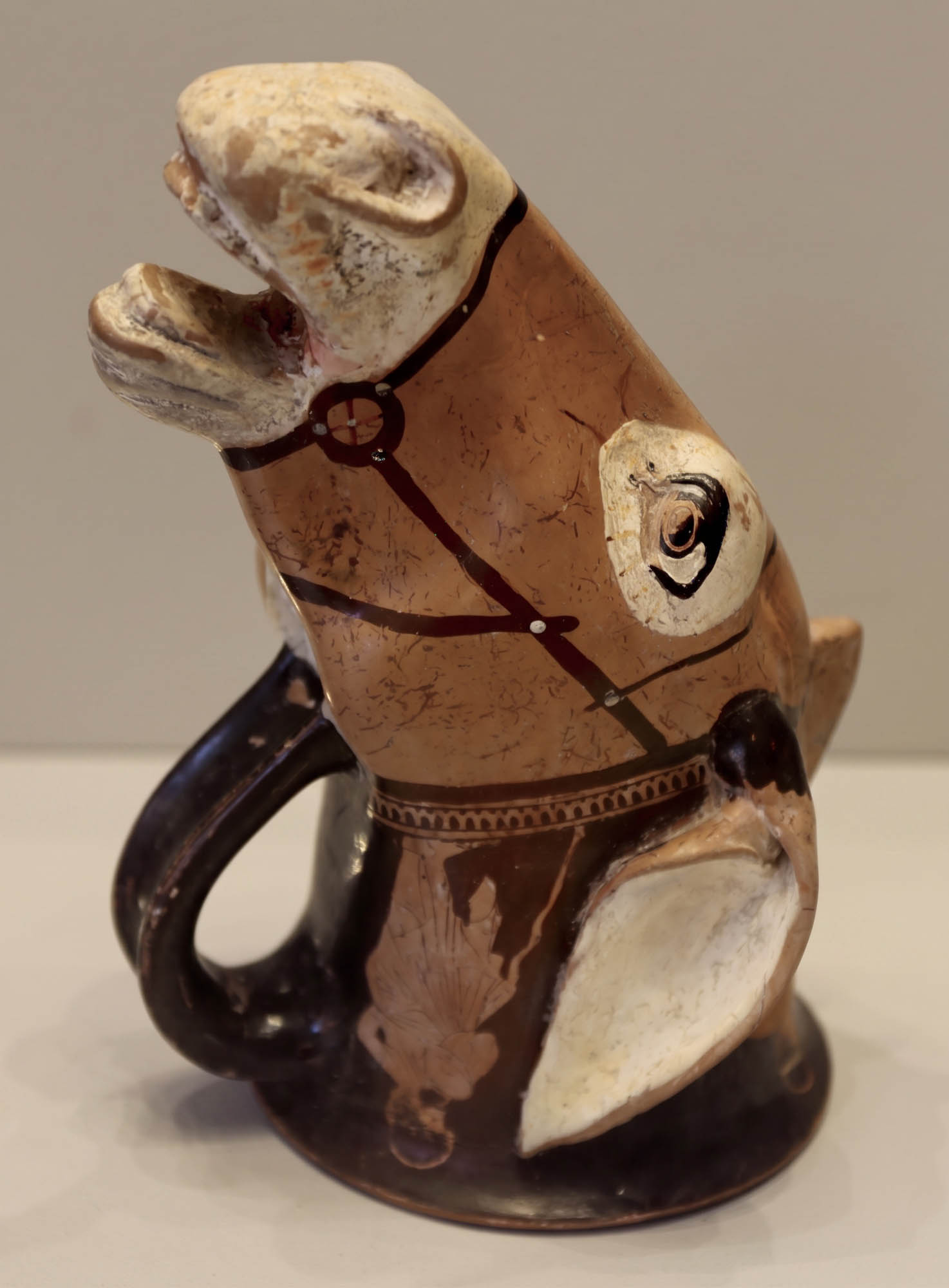
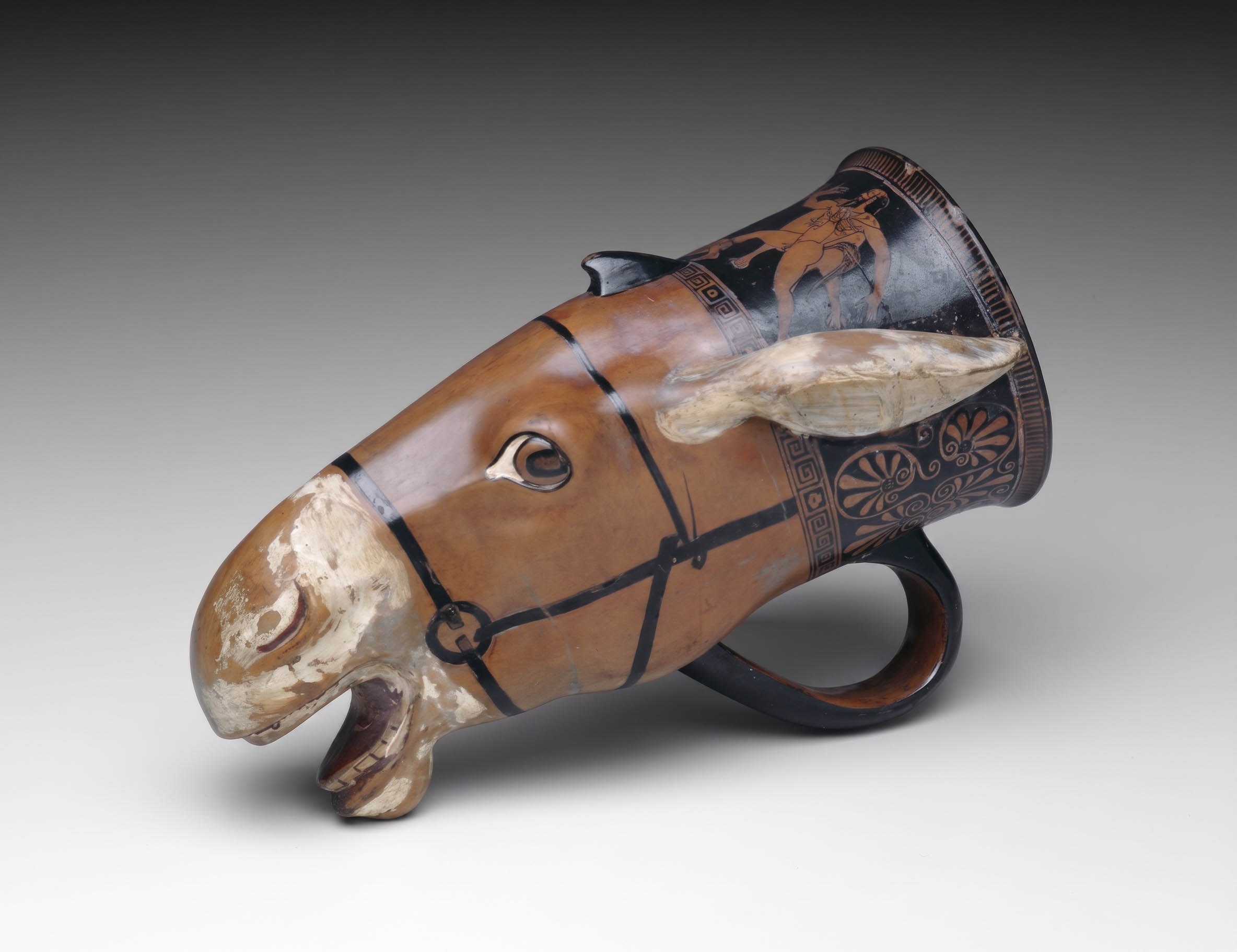
The donkey also played a prominent role in the design of drinking vessels. A rhyton was a drinking cup that could not be set down while it still contained wine: the entire contents had to be drained in one go, much like a Georgian drinking horn today. Such vessels were often shaped as animal heads, especially the head of the donkey, one of Dionysus’ sacred animals, as in this Attic example from around 410–400 BC, also preserved in the Taranto museum. At the base of the donkey’s neck stands a figure wrapped in a long cloak (himation) and leaning on a staff (bakteria). Naturally, the figure stands upright only when the rhyton itself is in its “proper” position, mouth upwards and filled with wine. Dressed in this manner, the figure reflects the respectable citizen arriving at a symposium, whose calm, civilised dignity forms a striking contrast with the braying, untamed instincts of the animal.
A similar donkey-headed rhyton is preserved at the Art Institute of Chicago. It was made in Athens between 480 and 470 BC, in the circle of the vase painter Douris. Its neck is already decorated with a Dionysian scene, showing a satyr pursuing a maenad.
But when the occasion demanded it, Dionysus was generous enough to lend out his donkey. This is the basis of one of the favourite comic scenes in Greek vase painting: “Hephaestus Returns to Olympus.”
Hephaestus, born ugly and lame, was cast down from Olympus by his mother, Hera. He fell into the sea, where the sea goddesses Thetis and Eurynome took him into their care. Raised in an underwater cave, he mastered the craft of the smith and became the greatest artisan in the world. He then sent his mother a magnificent throne of pure gold on Olympus. Delighted, Hera sat down upon it, whereupon countless fetters sprang out and bound her fast so that she could no longer rise from the seat.
Every Olympian god tried to free her, but all failed. Zeus then sent word to Hephaestus, asking him to come and release his mother, but the deeply offended Hephaestus replied that he had no mother.
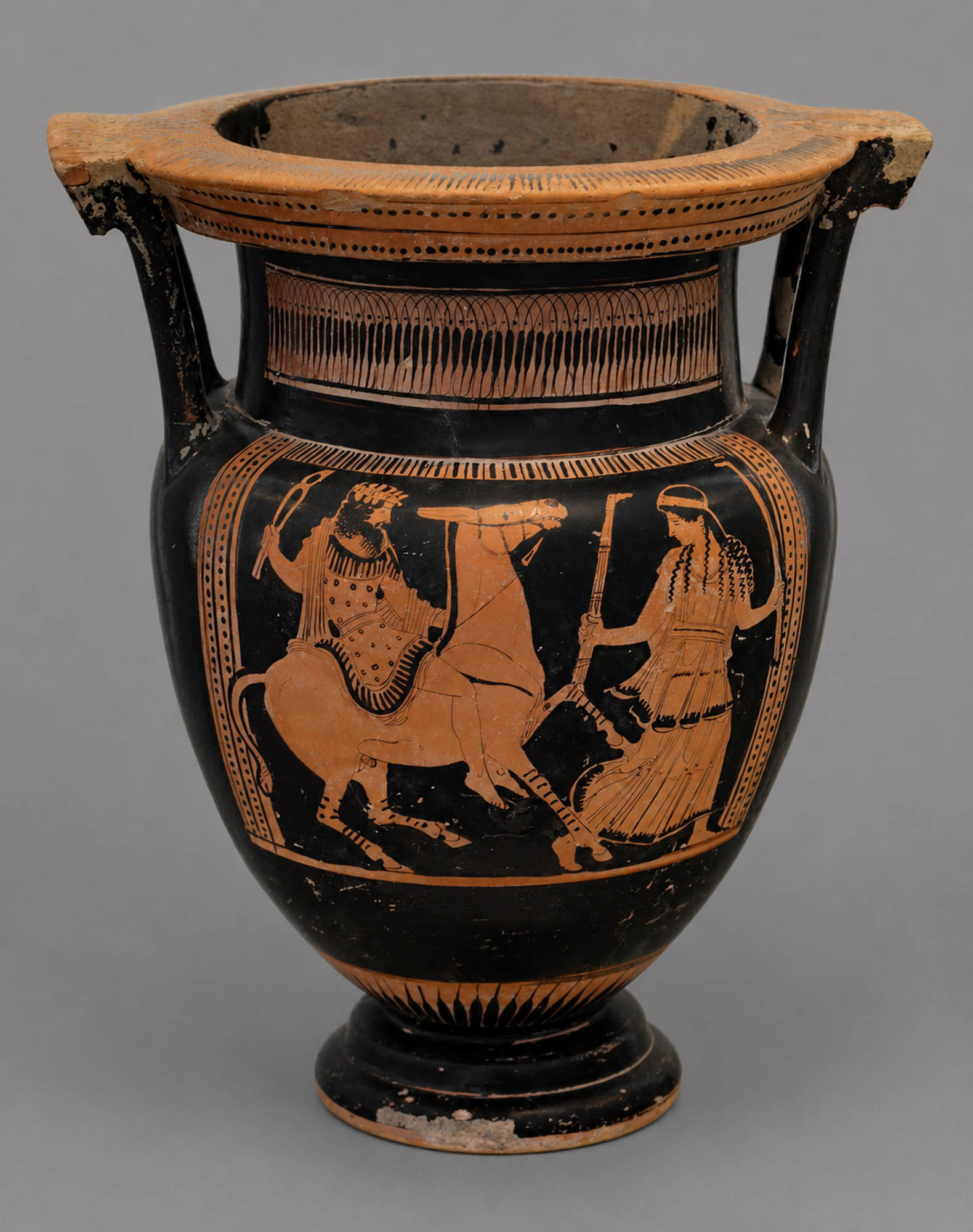
One after another, the gods tried by their own means to bring Hephaestus back to Olympus, but every attempt failed. Dionysus, however, chose persuasion of a different kind: instead of pleading, he offered him his finest wine. Hephaestus became thoroughly drunk, whereupon Dionysus seated him upon a donkey and, amid a jubilant thiasos, led him up to Olympus. There, once the smith-god had sobered up, he finally agreed to free his mother from the throne—but only on very harsh terms.
This is the scene depicted on the column-krater, a vessel for mixing wine and water, in the museum of Lecce. It was produced between 450 and 425 BC in Attica, in the circle of the so-called Orpheus Painter. The maenad walking ahead of the drunken smith-god's donkey carries two torches, lighting the way to Olympus.
This pairing adds a new dimension to the symbolism of the donkey. Greek citizens despised the donkey not only for its stubbornness and its reputation for excessive sexuality, but also because, unlike the noble horse, it was the beast of craftsmen and peasants. That is precisely why it could become the mount of Dionysus in the topsy-turvy world of the thiasos, a parody of civilisation itself.
Hephaestus is the only god who performs manual labour. The donkey is his animal: both work hard, both are looked down upon by the aristocracy, yet both are indispensable.
By making this stubborn, despised, yet indispensable creature the central figure of his retinue and processions, Dionysus mocked the social elite. Riding on a donkey became a hymn to Dionysian freedom: a symbol that in the realm of wine and ecstasy the last may become first, and that even the most scorned of creatures may find itself in the immediate presence of the god.



Add comment