

Earlier, when discussing Hagia Sophia as church title, we specifically mentioned its depiction in Russian iconography.
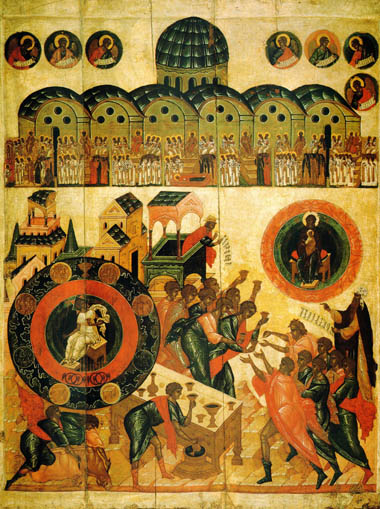
In Russia, Saint Sophia has three main iconographic types. All three first appear in Novgorod, whose cathedral – Russia’s oldest, built between 1045 and 1050 – was dedicated to Hagia Sophia following the Byzantine model.
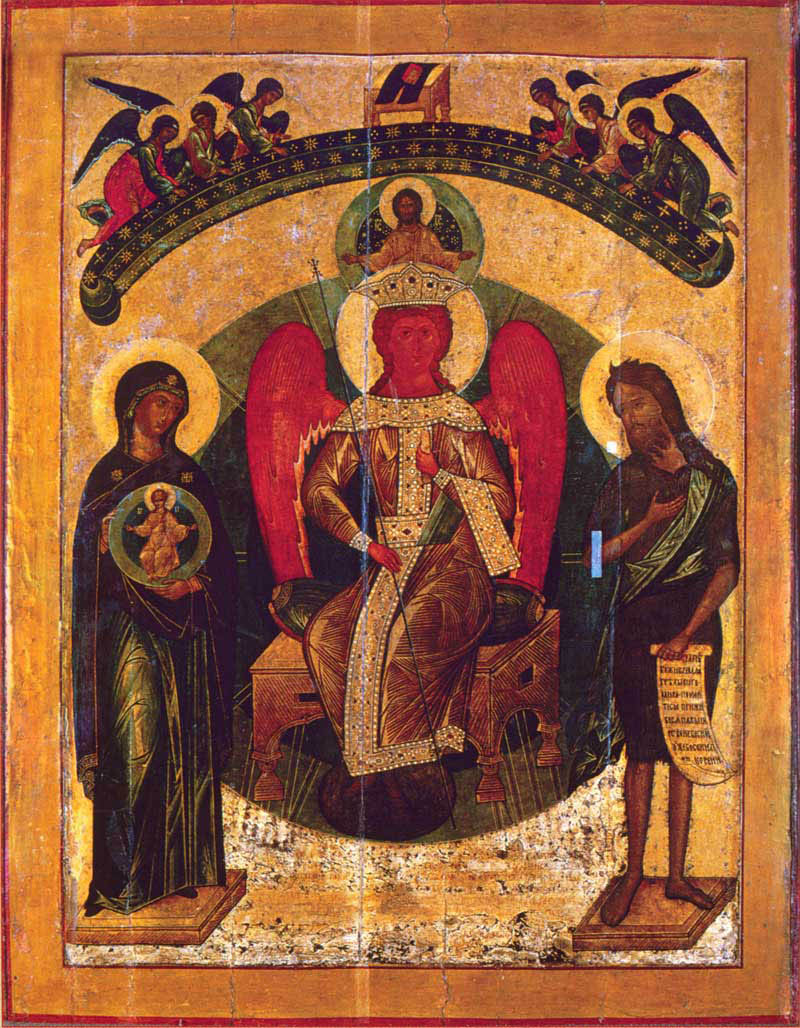
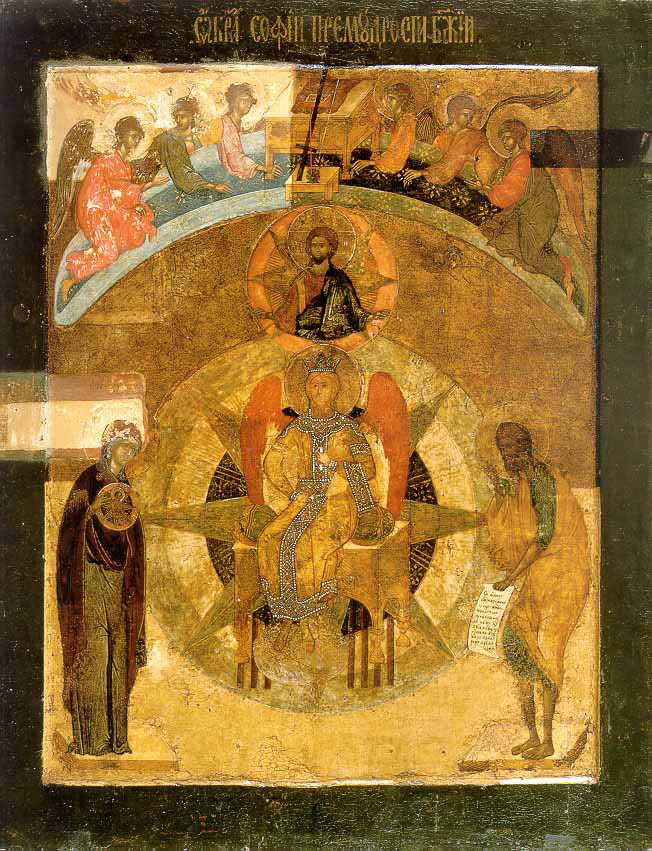
The first type shows Wisdom as a fiery-winged – огнекрылой – angel seated on a throne, flanked by the Virgin Mary and John the Baptist in supplication. These two saints usually appear beside the Pantokrator in a similar pose, indicating that this depiction of Wisdom corresponds, in the patristic tradition, to Christ (1 Cor 1:24, "Christ, the Wisdom of God"). You can see this on the 16th-century Novgorod cathedral icon, or even earlier on the 15th-century icon from the Moscow Annunciation Cathedral, which is a copy of a now-lost Novgorod original. Hungarian researcher Ágnes Kriza recently published an excellent monograph on this type, * which I plan to write about in more detail.
The second type interprets Proverbs 9:1 ("Wisdom has built herself a house") as an incarnation of Christ, with the “house” represented by the Virgin Mary. The best-known early example of this type is the 1548 icon from the Kirillov Monastery in Yaroslavl (now in the Russian Museum, St. Petersburg), which inspired numerous variations up to the late 18th century.
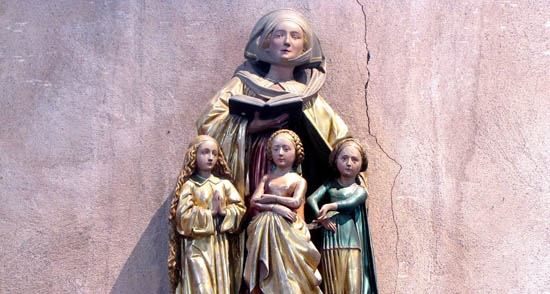
The third and most widespread type stems from a devout misunderstanding, depicting Hagia Sophia as “Saint Sophia” accompanied by her three daughters, Vera, Nadezhda, and Lyubov, that is, Faith, Hope, and Love, which, as the so-called 'divine virtues,' truly originate from Divine Wisdom according to theology. According to Orthodox tradition, they lived and suffered martyrdom in 3rd-century Rome. Their veneration is first mentioned in 6th-century Rome. They entered the Roman martyrology in the 16th century, and were later removed from it as historically unverifiable. The Orthodox Church still honors them, celebrating their feast on September 30. Their earliest known Russian depiction is a 16th-century Novgorod icon now in the Tretyakov Gallery.
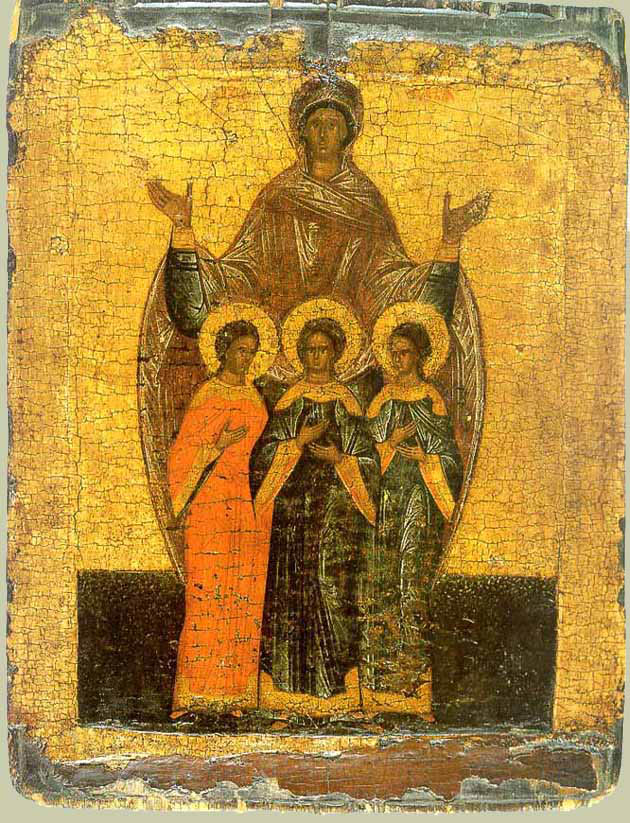
These three saintly daughters became extremely popular from the 17th century on, forming a fundamental motif in Russian imagery. Their triad stands behind Chekhov’s Three Sisters and appears as references in Silver Age poetry, including Bunin, Blok, and Akhmatova, as well as in socialist works like Arbuzov’s The House in Cherkizovo.
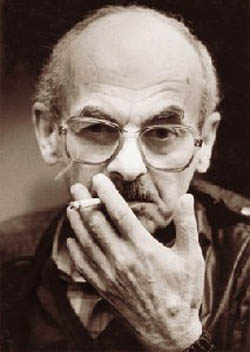
But their most famous modern incarnation was staged by the great heir of Silver Age poetry, Okudzhava, in his song Three Sisters, where, awakening on a hospital bed and taking stock of his life, he realizes how indebted he remains to these three virtues.
Bulat Okudzsava: Три сестры (Three Sisters, 1959)
|
Опустите, пожалуйста, синие шторы.
Раскошелиться б сыну недолгого века,
И еще я скажу и бессильно и нежно,
Протяну я Любови ладони пустые,
Но какие бы руки тебя ни ласкали,
Чистый-чистый лежу я в наплывах рассветных, |
Please draw down the blue curtains.
The short-lived son would try to shell out some money,
Then I say, powerless and tenderly,
I stretch my empty hand toward Love,
And whatever hands caressed you,
Spotlessly I lie in the dawn’s tide, |



Add comment