

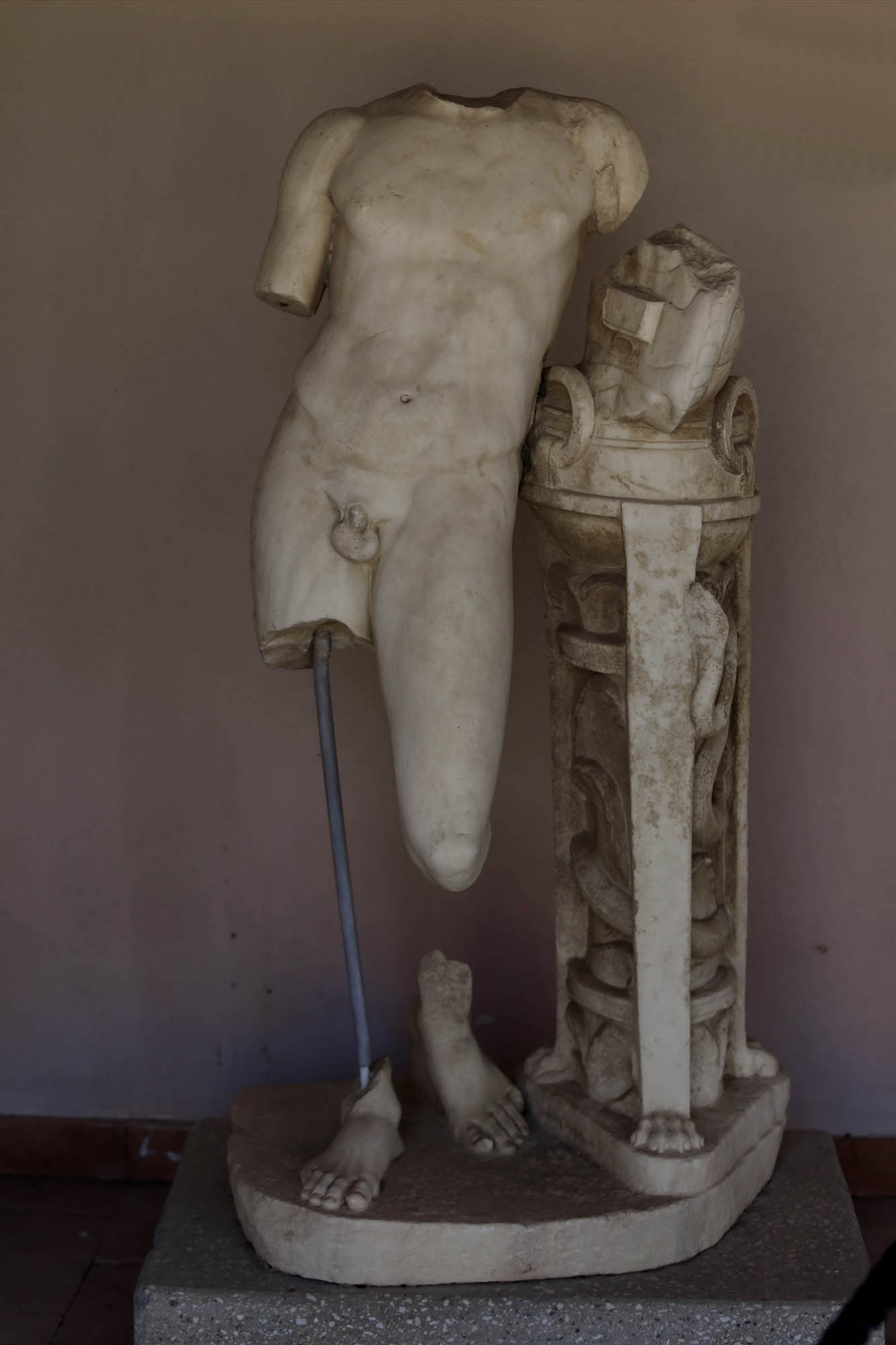
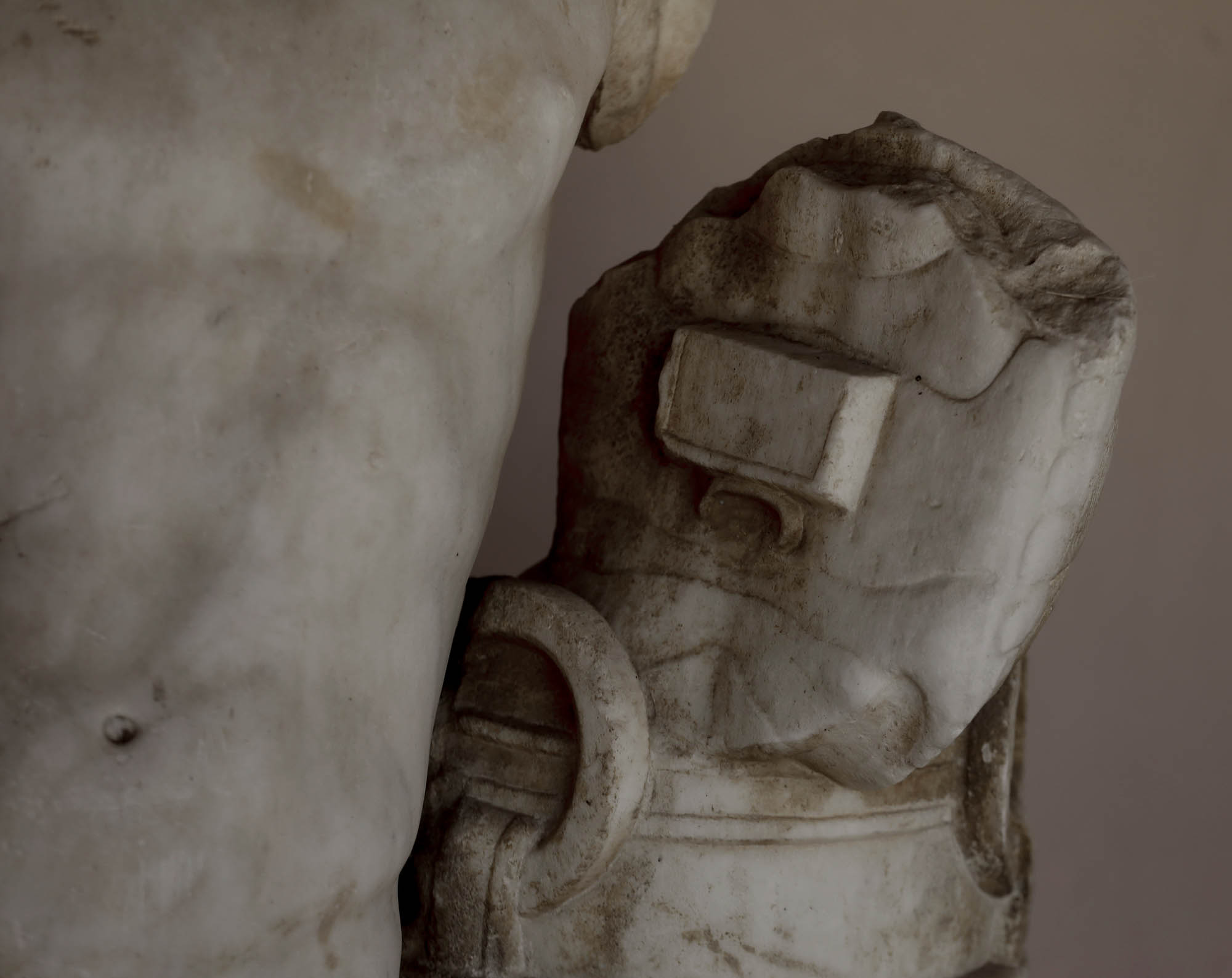
In the lapidarium of Apollonia—where we have previously seen ancient stelae—a magnificent male torso leans against a column. The "column" is in fact a tripod entwined by a serpent. This immediately reveals the man's identity: he is Apollo, who slew the serpent Python that guarded Delphi and made the sanctuary his own oracle. The tripod served as the seat of the Pythia—not the small ring at its top, but the broad circular disc placed upon it—from which she uttered her prophecies after inhaling the intoxicating vapours rising from the earth.
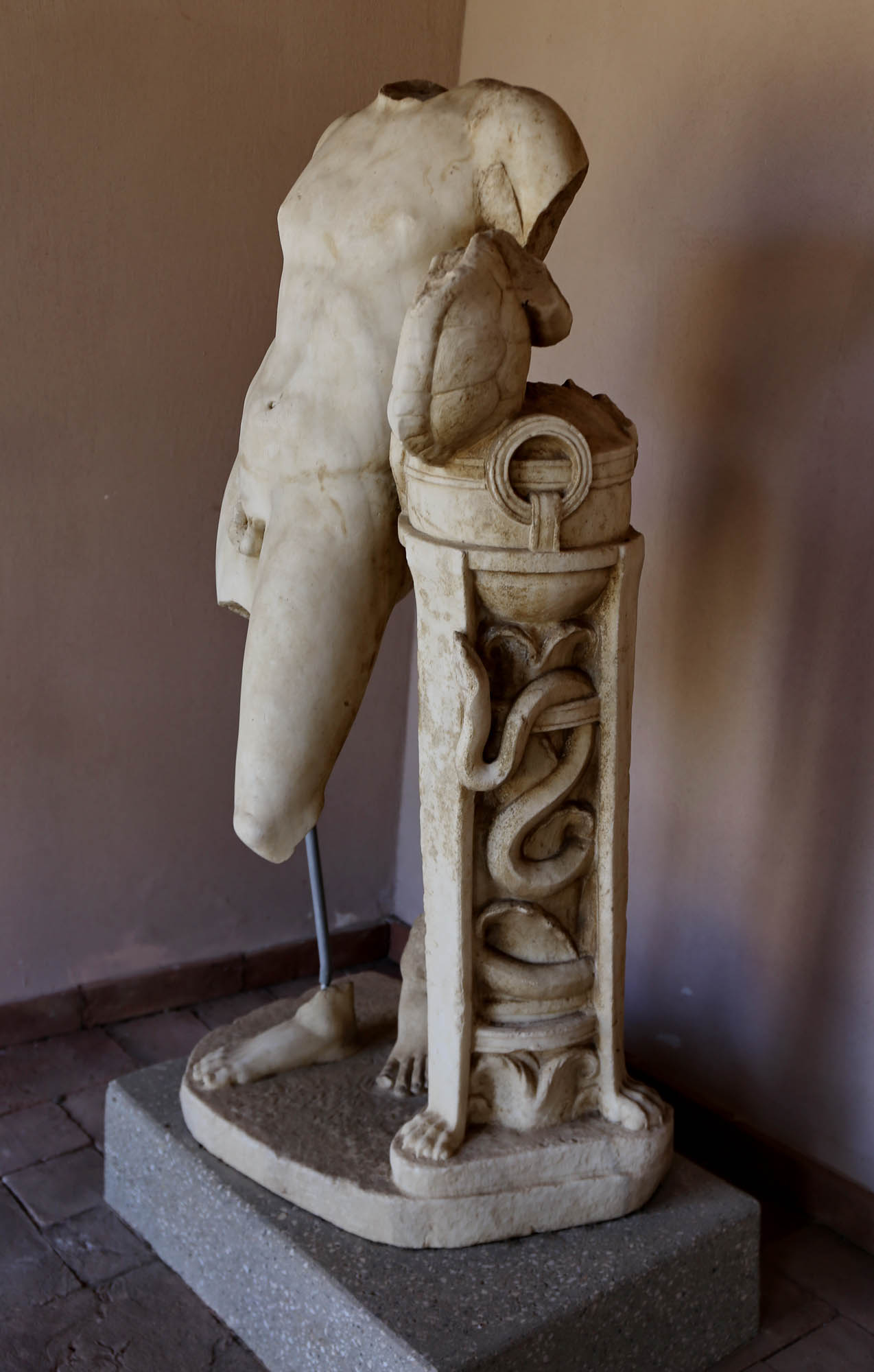
But there is another attribute here: a tortoise standing upright on its hind legs atop the tripod, as if rubbing affectionately against Apollo.
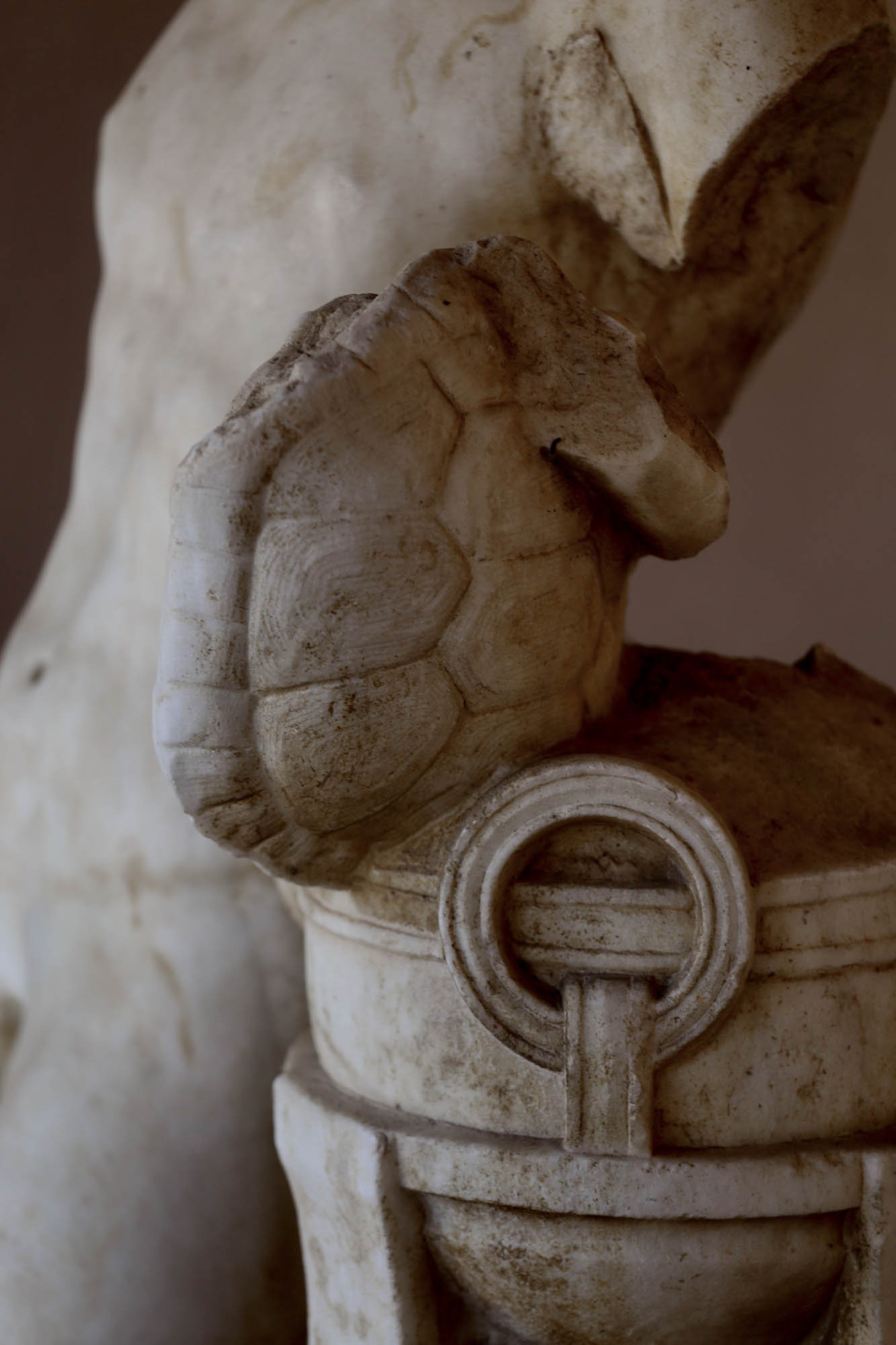
Appearances are deceptive. Just as we mentally restore the missing arms and head of Apollo's statue, we also imagine the tortoise's head and limbs attached to its shell. In reality, however, it had lost them long before the sculptor ever carved the statue.
The tortoise had been deprived of them by Hermes when he was only a few days old—the son of the nymph Maia and Zeus, and Apollo's half-brother. Hermes stretched an oxhide over the empty shell, fastened strings to it, and played the new instrument so wonderfully that he even softened his elder brother's heart when Apollo burst in to demand an explanation for his stolen cattle. The story is told in detail in the Fourth Homeric Hymn to Hermes (7th–6th century BC), while Apollo himself gives a shorter version in Lucian's comic Dialogues of the Gods, where he is speaking with Hephaestus about everything the infant Hermes had already managed to steal:
“He picked up a dead tortoise somewhere or other, and contrived an instrument with it. He fitted horns to it, with a cross-bar, stuck in pegs, inserted a bridge, and played a sweet tuneful thing that made an old harper like me quite envious.”
A deal is struck: the stolen cattle are never mentioned again, Apollo receives the instrument known as the lyre, and the poets under his divine patronage perform their verses to its accompaniment—thus giving the entire genre named after the instrument a rather questionable pedigree.
In the statue, the tortoise is itself a torso: only the shell survives, while the wooden frame of the instrument has broken away. The only trace left is the remnant of the wooden support, still visible on the underside of the shell.
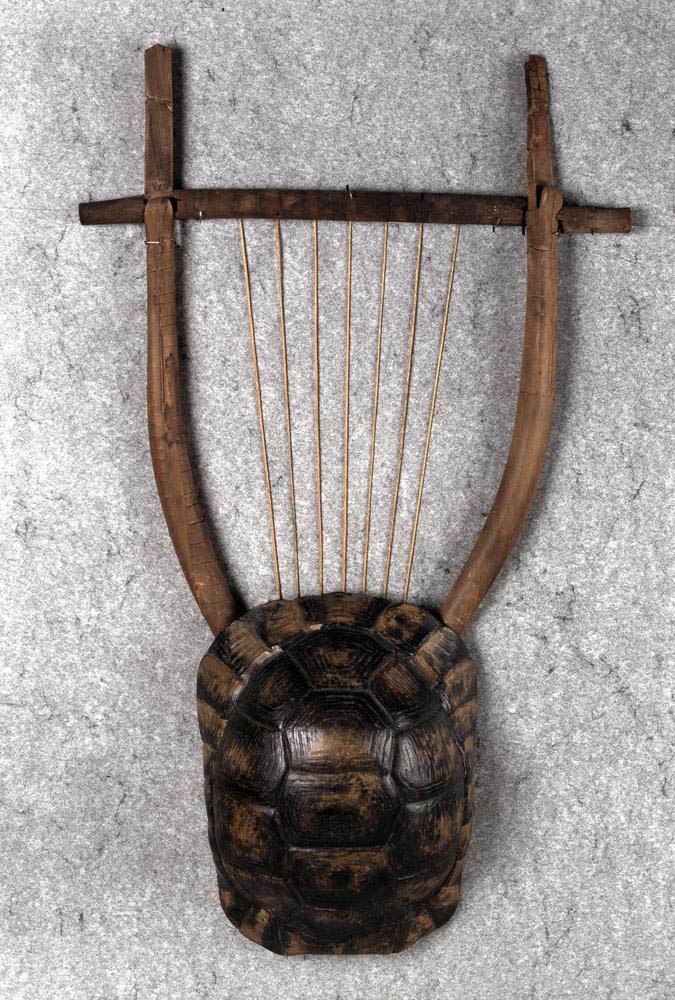
Fortunately for us, however, two lyres have survived as grave goods that have more or less preserved their original condition, allowing us to interpret the Apollonian fragment. The more complete one, the 5th–4th century BC Elgin lyre, found in an Athenian grave, is kept in the British Museum. In this case, however, the tortoise shell is actually a ceramic imitation, a practice that was common in ancient Greece: this allowed the makers to create a larger, more resonant and more durable instrument body.
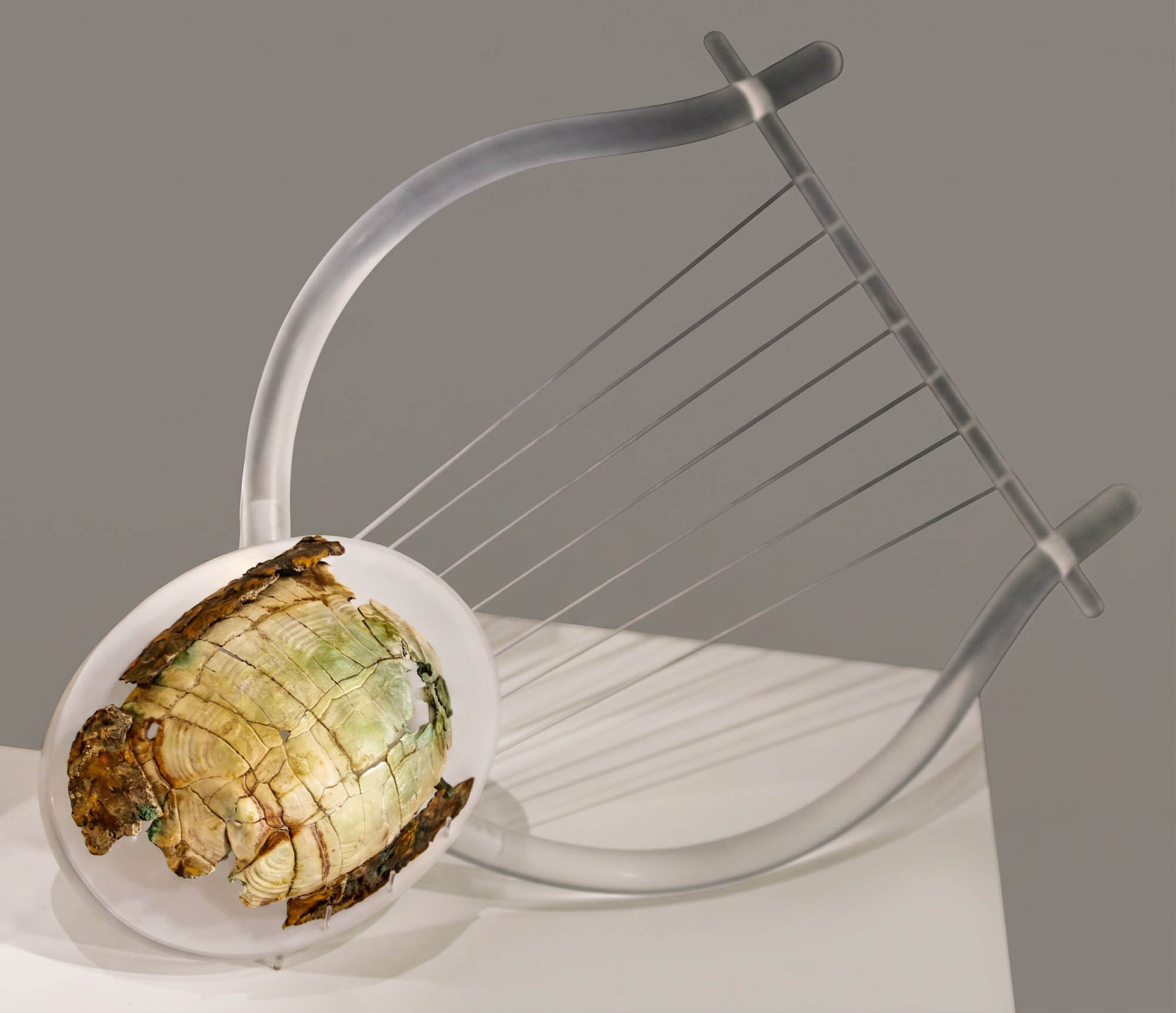
The other one, however, which I saw yesterday in a less complete state in the Archaeological Museum of Taranto, is made from a real tortoise shell. This dried-out shell was reinforced with an iron band to protect it against the threatening cracks, and the band has survived on it to this day.
The shell of a dead tortoise, with the wooden frame attached around it, gives a rather primitive impression, which does not correspond to our lofty ideas of Greek culture. And our intuition is correct. The Greek word λύρα has an ancient pre-Indo-European Mediterranean origin: the immigrant Greeks may already have found the instrument ready-made among the indigenous peoples whom they called Pelasgians, whom they then subjected and plundered just as Hermes did the tortoise.
The museum in Taranto also provides visual information about the use of the lyre on a black-figure vase, painted in Athens around the same period, between 500 and 475 BC, by the so-called Diosphos Painter, when the Elgin lyre was also in use in the same city. The workshop of the Diosphos Painter was extremely successful on the export market; its works were shipped in large quantities to Magna Graecia, that is, southern Italy, including this elegant vase, which ended up in an aristocratic grave.
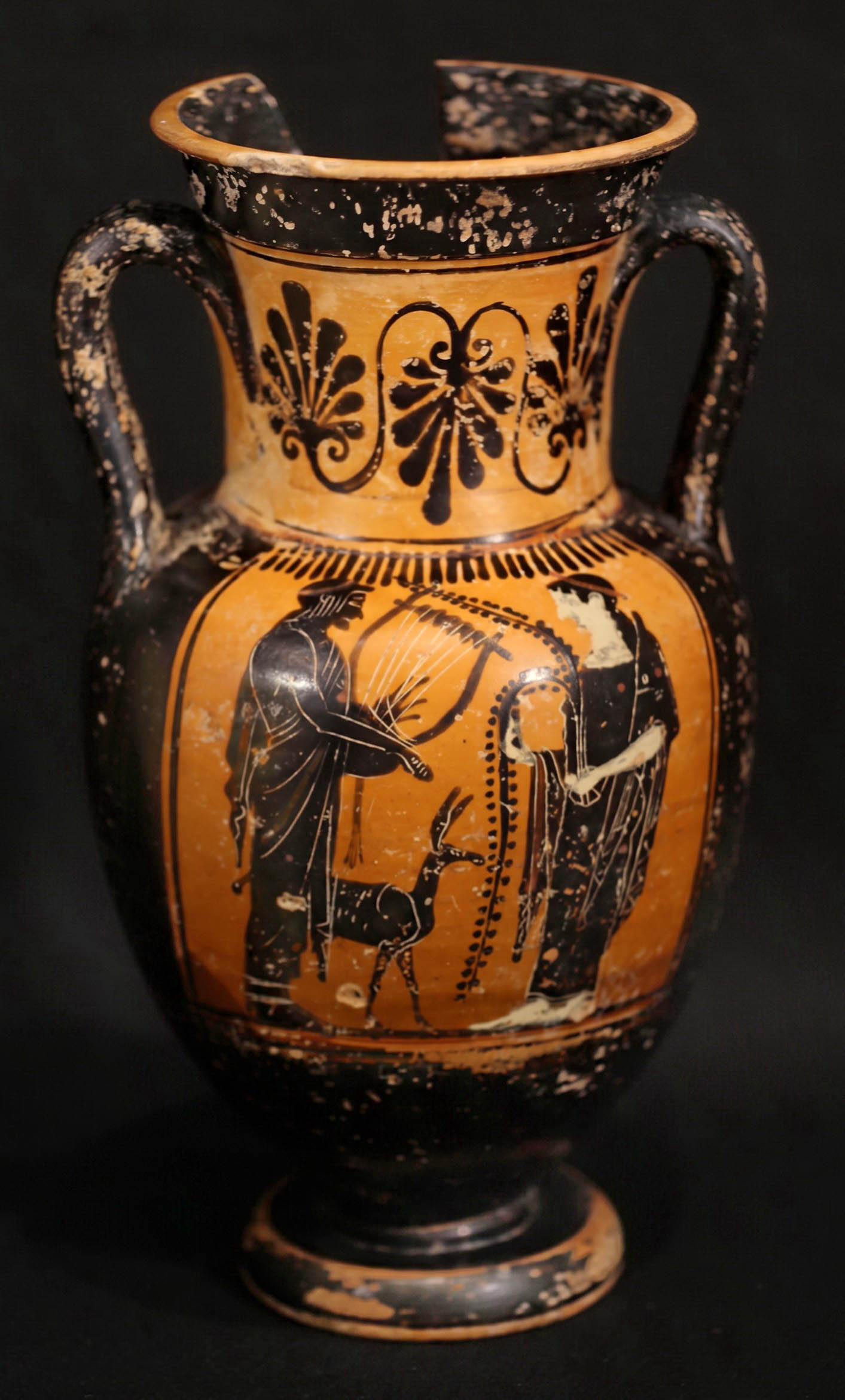
On the vase, Apollo himself plays the lyre before his twin sister Artemis, who is about to perform a libation or pour a drink for her brother from the oinochoe (wine jug) she holds in her hand—an act that has remained closely associated with the lyric genre ever since. Between them stands a young fawn. On the one hand, it is Artemis’s companion, a symbol of nature and the forest; on the other, it represents the wilderness tamed by Apollo’s art. Its presence alludes to a state of divine harmony, an epiphany. In any case, it fared far better through poetry than the poor tortoise.
Reconstructed ancient Greek lyre and aulos duet performed by Callum Armstrong and Rosa Fragorapti, who also contributed to the music of Nolan’s Odysseus



Add comment