

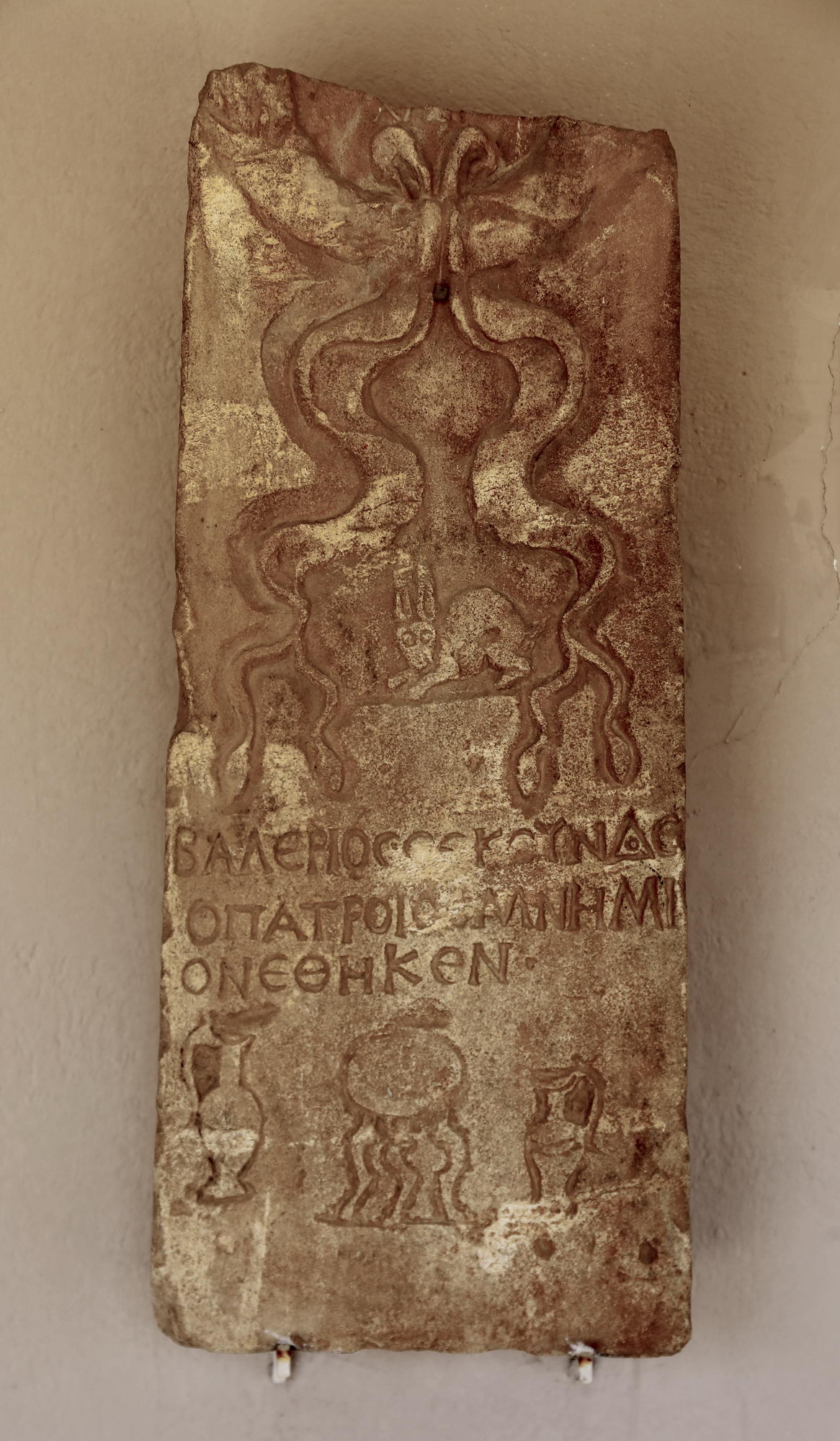
Among the many tombstones preserved from the extensive necropolis of Apollonia, besides the one discussed previously, several others are equally intriguing. One of them is this 1st-century AD Roman funerary stele, with a hare crouching at its center.
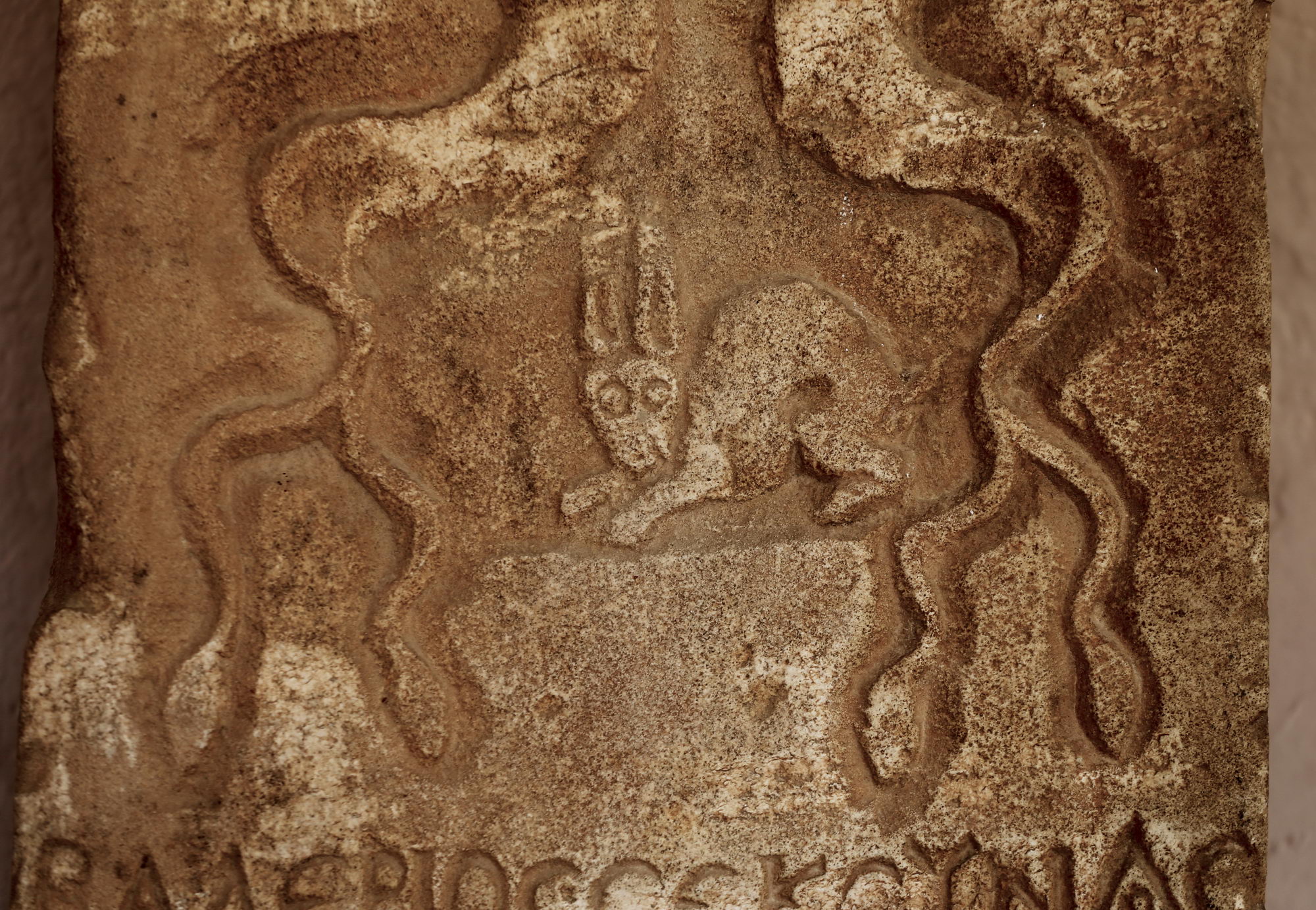
A hare—the very symbol of timidity—on a Roman tombstone, where we might instead expect to find an eagle, a lion, or perhaps a horse?
Let’s take a closer look at what we are actually seeing.
At the top of the stone sits an unmistakably charming, wide-eyed hare. The curved forms around it may at first glance resemble the entrance to a burrow, but on closer inspection they are in fact ribbons hanging down from a wreath above. Together they form a protective canopy of the kind placed over a freshly made grave in Roman funerary ritual, shielding the soul of the deceased from malevolent spirits on its journey to the Underworld.
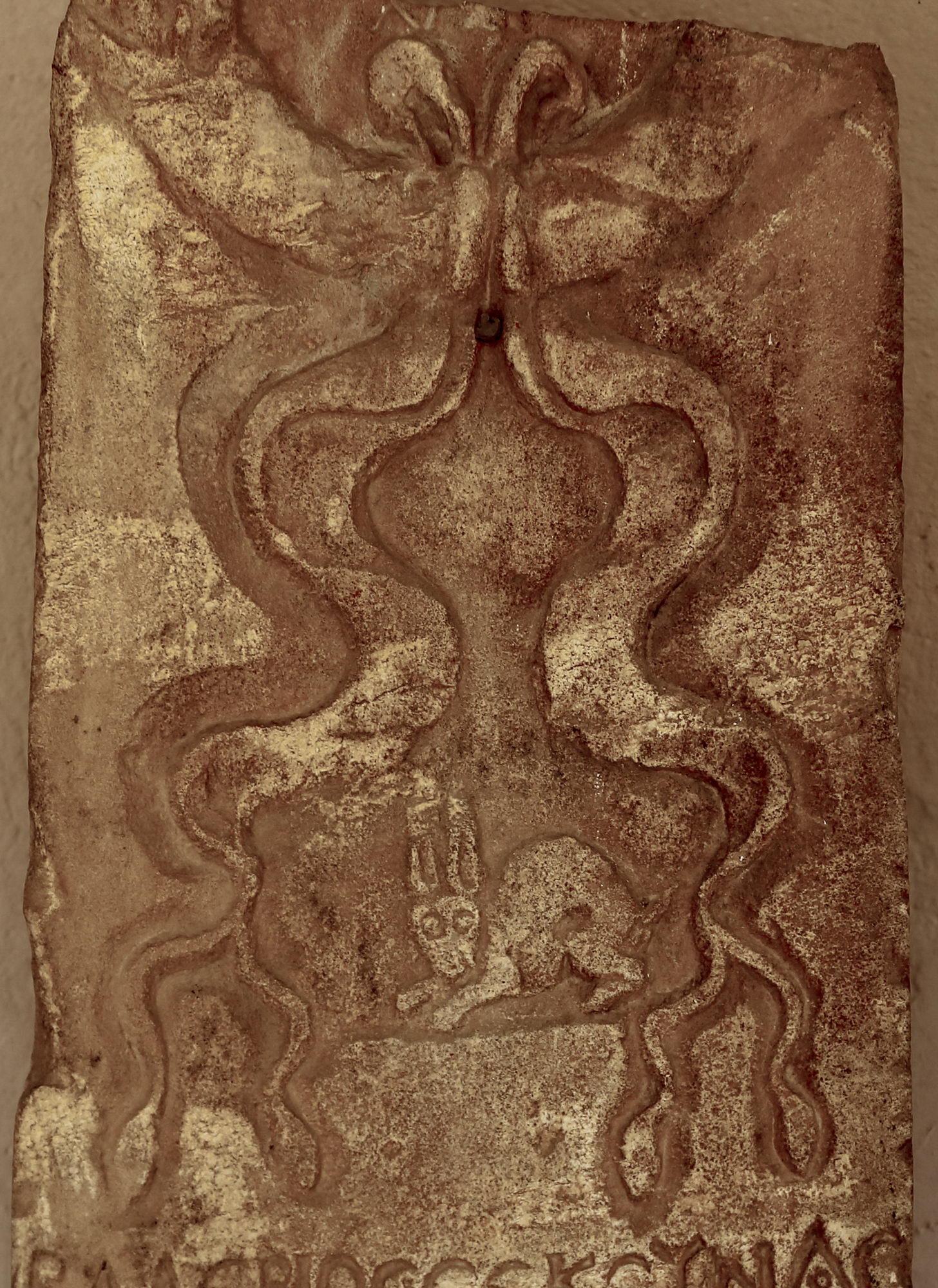
By placing the hare beneath this canopy, the sculptor associates it with the soul while simultaneously separating it from the earthly realm. This part of the relief therefore represents not the world of the living but a sacred, otherworldly space.
Although uncommon, hares associated with the soul and the afterlife also appear on other Roman funerary monuments. One example is a tombstone from Lincoln, where a young man holds one in his hands. Another is found at the top of the tomb of an army physician from Newcastle.
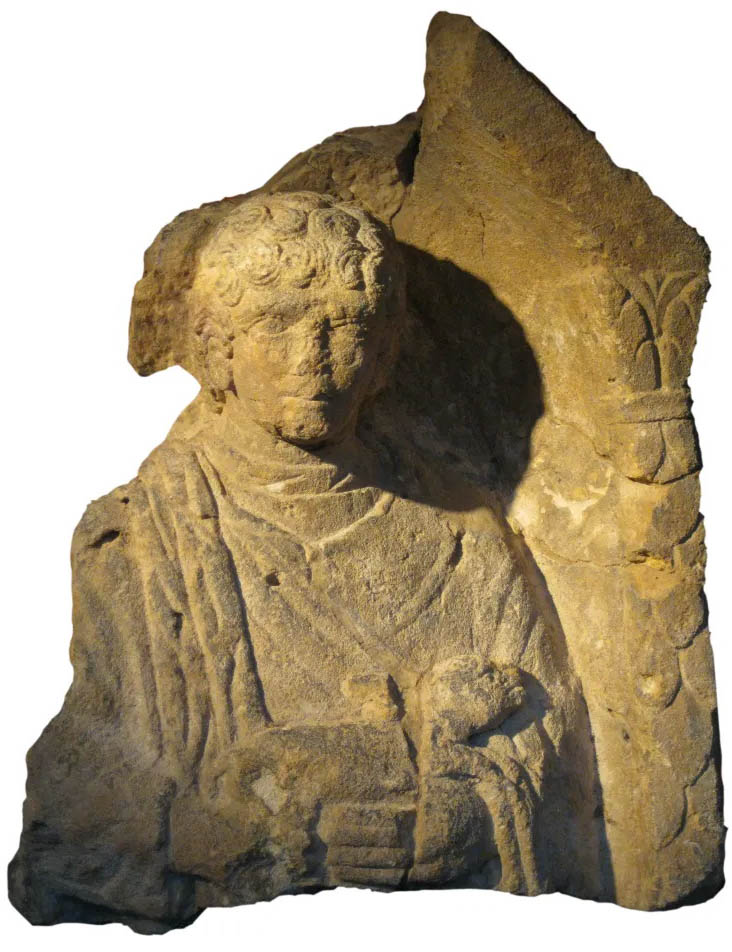
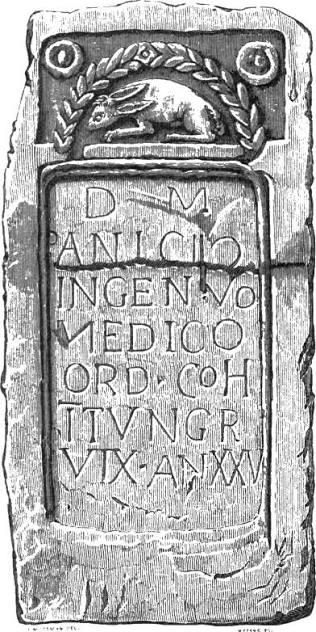
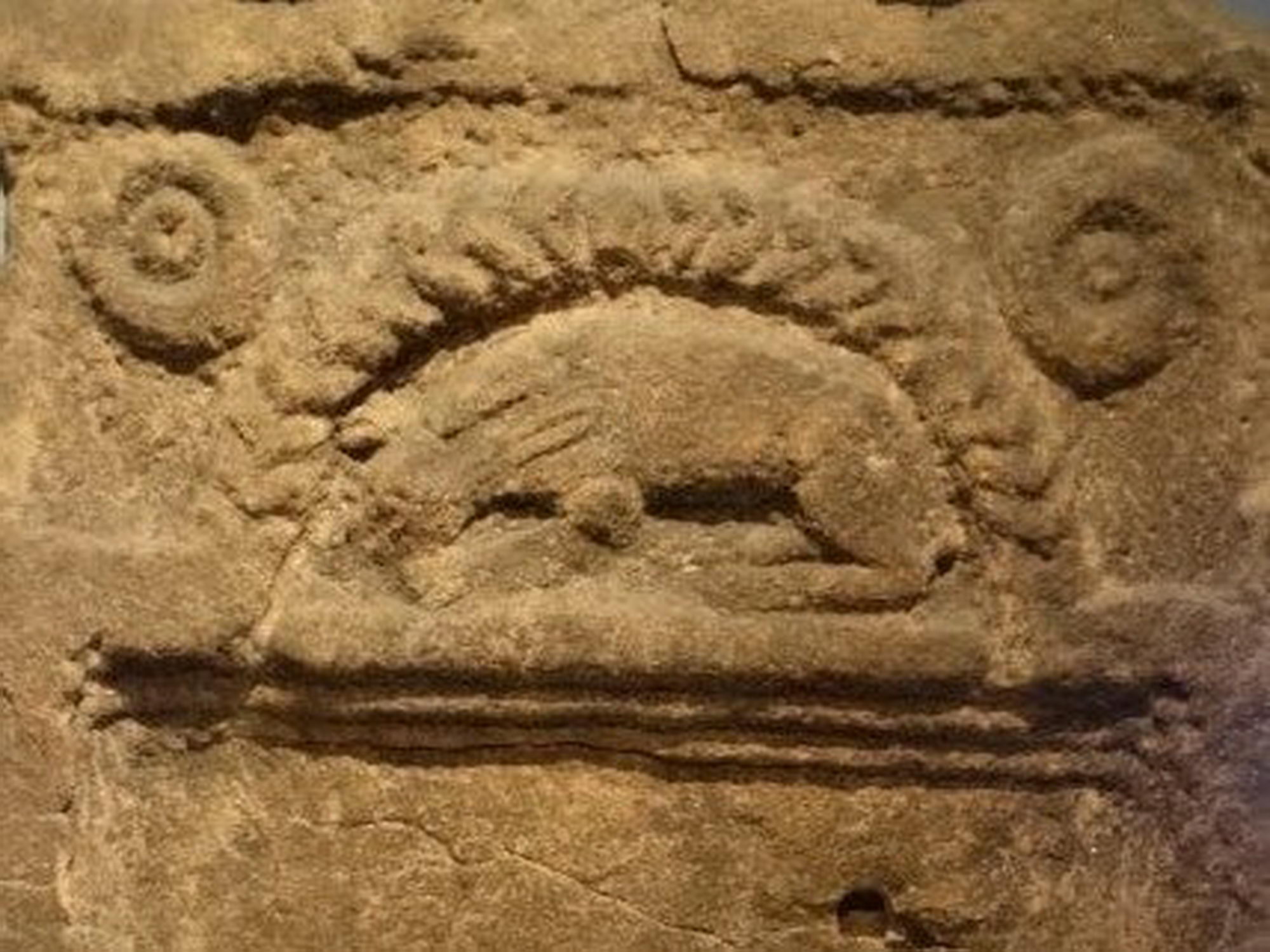
In both cases the hare serves as a psychopomp, a guide for the soul. Its swiftness symbolizes the soul’s rapid journey to its destination in the afterlife, while as a sacred animal of Dionysus (Bacchus), it also evokes the blissful banquet awaiting the blessed dead.
Beneath the hare is a Greek inscription:
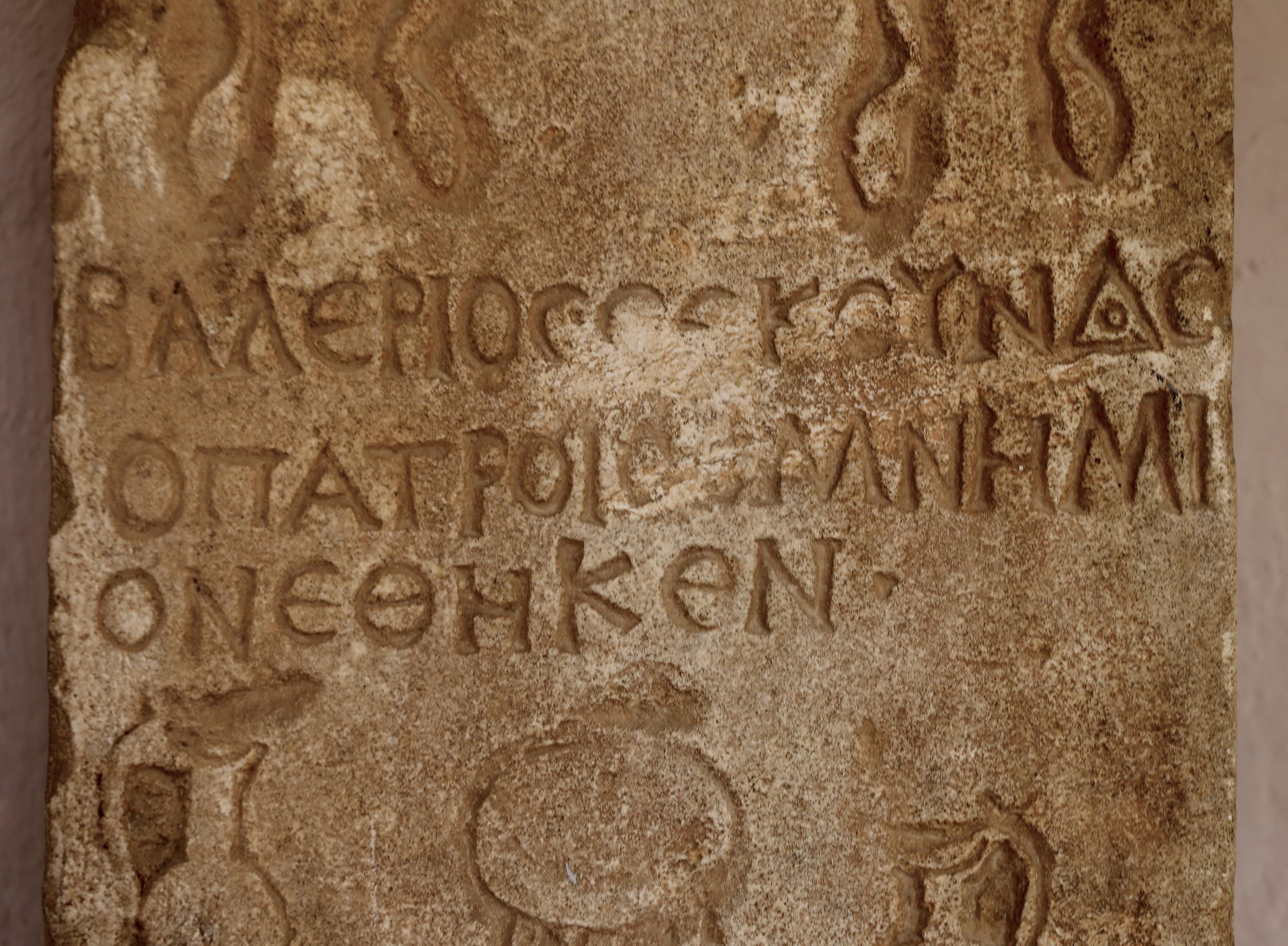
ΒΑΛΕΡΙΟΣ ΣΕΚΟΥΝΔΟϹ
Ο ΠΑΤΡΟΙϹ ΜΝΗΜΙ
ΟΝΕΘΗΚΕΝ
Valerius Secundus erected this funerary monument for his parents.
The inscription Ο ΠΑΤΡΟΙϹ ΜΝΗΜΙ ΟΝΕΘΗΚΕΝ, instead of the standard Greek οἷς πατράσι μνήμης ἐνέθηκεν, may simply reflect relaxed spelling—or perhaps a local dialectal form. More surprising, however, is that the monument records only the name of the dedicator, not those of the deceased. Why?
The stele was, of course, erected in memory of the deceased. Yet this could be done without mentioning their names, just as countless tombstones throughout the East bear no names at all: as long as the family survived, everyone knew who rested beneath the stone, and once the family was gone, who would still need to know? At the same time, the monument served another important purpose: it publicly demonstrated pietas, proclaiming that Valerius Secundus had faithfully fulfilled his filial duty toward his parents. Thus, a memorial to the dead also enhanced the prestige of the living members of the family.
There is another possible explanation. At this time Apollonia was in the midst of its transformation from a Greek-Illyrian city into a Roman one. The name Valerius Secundus clearly indicates Roman citizenship. His parents may still have borne Greek or Illyrian names and may never have acquired Roman citizenship. Their son, however, evidently had, and by prominently displaying his full Roman name he publicly proclaimed his family’s social advancement and newly acquired legal status.
Rome brought Apollonia under its control in 229 BC, following the First Illyrian War. Officially, however, the city was not conquered: it voluntarily surrendered to the Roman fleet in exchange for protection against the pirates and invading forces of the Illyrian queen Teuta. Although it remained nominally an independent ally, in practice it became a Roman protectorate and a permanent bridgehead and military base for the Roman legions in the Balkans.
When King Philip V of Macedon besieged the city in 214 BC, a Roman relief force under Marcus Valerius Laevinus successfully defended Apollonia, firmly securing its allegiance to Rome. Around 146 BC, the city’s harbour became the western terminus of the Via Egnatia, the empire’s principal military road across the Balkans.
During the civil war between Julius Caesar and Pompey, Apollonia sided with Caesar. After his victory, in 48 BC, he rewarded the city with autonomy and exemption from taxation (civitas libera et immunis). In 45 BC he sent his great-nephew Octavian there to gain practical experience in provincial administration and military affairs in preparation for the planned campaign against the Parthians. It was in Apollonia that the future Emperor Augustus acquired much of the political skill and strategic insight that later enabled him to dismantle the Roman Republic and establish the Principate. Here his friendship with Marcus Vipsanius Agrippa deepened, the man who would become his most brilliant general and one of the chief architects of Rome’s military supremacy. Here, too, the astrologer Theogenes read in Octavian’s horoscope that he was destined to rule the world. And it was while Octavian was staying in Apollonia that Julius Caesar was assassinated. Had he been in Rome at the time, he would very likely have shared Caesar’s fate. Instead, the safety of Apollonia and the political backing provided by the nearby legions gave him the crucial advantage that allowed him to prevail in the ensuing civil wars and ultimately become Rome’s first emperor. Augustus later confirmed Apollonia’s privileges, preserving its tax exemption and autonomous status, helping it become one of the most prosperous cities in the region.
Finally, it is also possible that the stele stood above the burial place of an entire family. That would explain why no individual is shown holding the hare, as on the Lincoln tombstone. Here the solitary hare served as the guide of all the souls buried beneath it.
Finally, beneath the inscription three objects are prominently carved: a jug (oinochoe or urceus) for pouring libations; a three-legged vessel (tripus) used for sacrifices or as an incense burner; and a chair (cathedra or klismos), the seat of the head of the household, which was deliberately left empty during the funerary banquet as a place for the spirit of the ancestors. Together these three objects symbolize the proper performance of the commemorative rites for the dead.
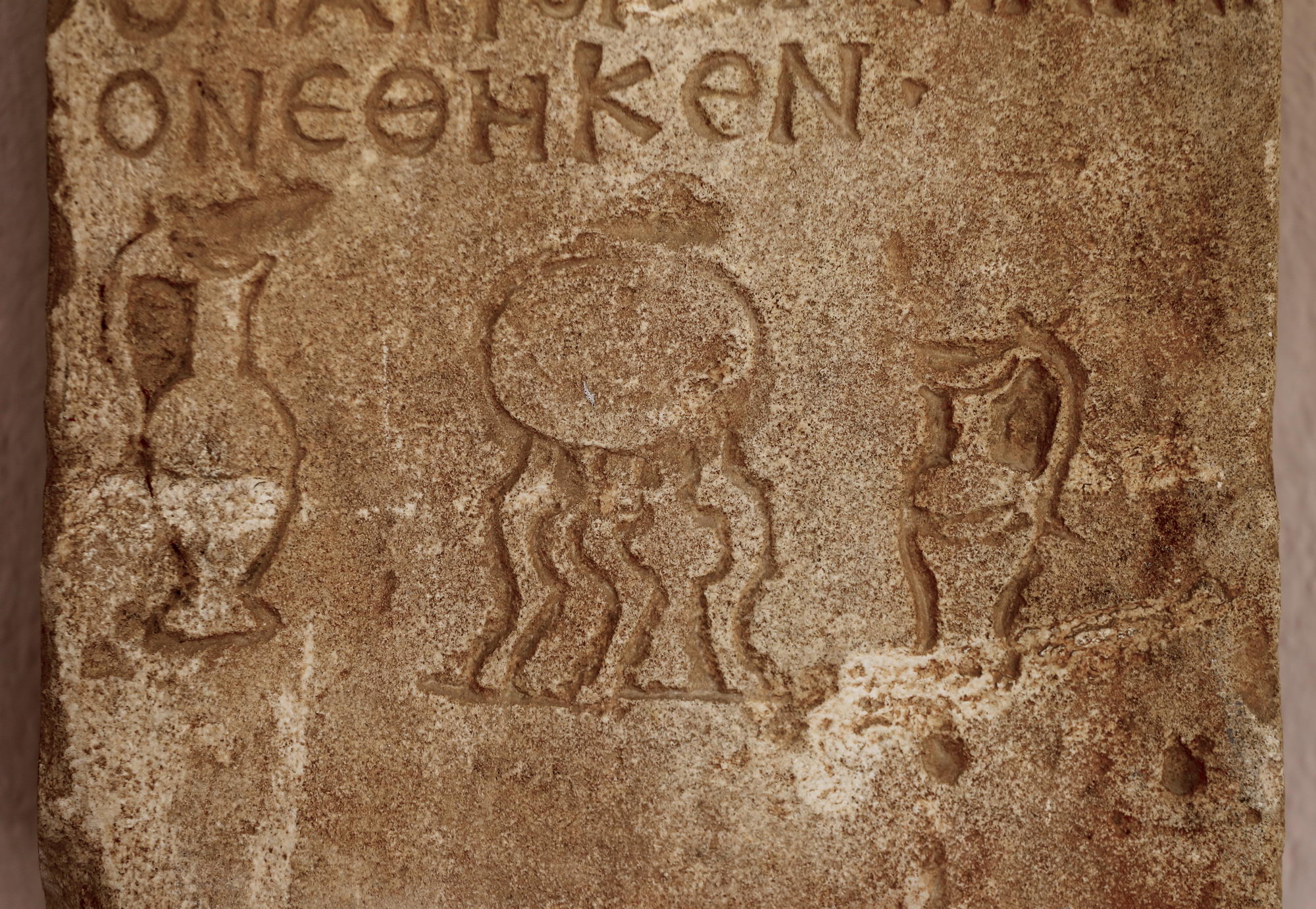
In Roman Apollonia, the funerary banquet (silicernium or cena novendialis) was about far more than mourning. It also served to display social status, reinforce communal bonds, and reconcile the living with the spirit of the deceased.
On the day of the funeral, the immediate family offered a sacrifice at the gravesite, which in Apollonia lay in the northern or eastern necropolis outside the city walls. This usually involved the sacrifice of a pig to the deities associated with the fertility of the earth and the realm of the dead.
After the funeral procession and the cremation or burial, the family immediately held a modest symbolic meal (silicernium) beside the grave. They believed that the spirit of the deceased (manes) was present and shared the meal with them. The carved objects at the bottom of the stele capture precisely this moment. Charcoal was burned in the three-legged vessel, onto which fragrant incense was sprinkled to purify the site. From the jug, wine, milk, or water was poured as a libation onto the ground or into libation tubes built directly into the grave. The mourners sat on carved chairs and benches like those depicted on the monument itself.
The family then returned home and observed nine days of strict mourning. During this period the house was considered ritually impure, family members refrained from shaving, wore no jewellery, and dressed in dark mourning togas (toga pulla).
On the ninth day the family returned to the grave for the formal funerary banquet (cena novendialis). The meal prominently featured eggs, lentils, beans, poultry, seafood, freshly baked bread, and wine. A chair was deliberately left empty in honour of the deceased, with food and drink placed before it, signifying that the departed remained a member of the family. At the end of the banquet the mourners formally laid aside their mourning garments, resumed everyday life, and regarded the deceased as having been fully received among the ancestral spirits (Di Manes).
Nor was this banquet a one-time event. Every February, during the Roman festivals of Parentalia and Feralia, as well as on the anniversary of the deceased's birth, the citizens of Apollonia returned to the grave to repeat the ritual meal, once again using the three-legged vessel and the libation jug.
The stele thus conveys a clear message: “Here is Valerius Secundus, who, having obtained the citizenship of Rome’s new ruling power, fulfilled his duty toward his parents by observing the proper funerary rites, so that their souls might swiftly reach their resting place in the afterlife with the speed of the hare.” And he raised a worthy memorial both to them and to himself. Yet, with the practical economy one might expect of a prudent Roman citizen, he left their names uncarved, allowing the monument to commemorate every member of the family who had died before—or would die after—them, until the end of time or at least until a wandering Hungarian happened to arrive in Apollonia and write this post.



Add comment