

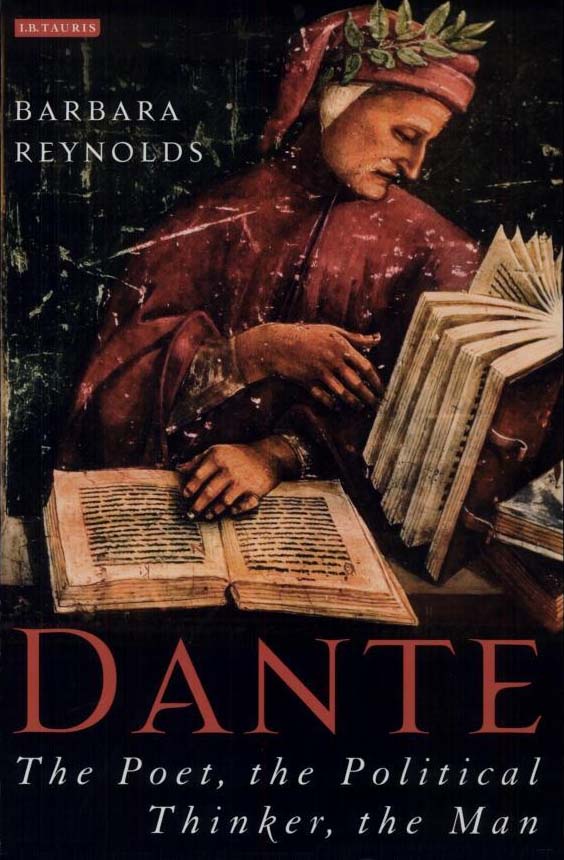
 I'm translating Barbara Reynolds’ latest biography of Dante. (Most of it is readable in English here, and the Hungarian edition will appear at the Christmas book fair from Európa Publishing). It’s a superb book. Its author, who spent her entire life studying and translating Dante—and about whom I’d like to share a few captivating details in a future post—decided at the age of ninety-two to “read through all of Dante’s works once more, free from any preconceptions,” and based on that, “paints a picture of Dante—the poet, the political thinker, and the man—that no one has done before.” She succeeds brilliantly. As a student of Italian, I didn’t learn as much about Dante in three years of “lectura Dantis” as I did from this book. That may not be high praise for anyone familiar with the quality of the Italian Department in Budapest, but even for them, it will be a dizzying leap in quality: at last, there will be one really good book they’ll actually read over five years.
One of the book’s most remarkable—and rare—achievements is that it is enjoyable for both experts and general readers. It presents the hopelessly complex politics of contemporary Italy—fundamentally shaping Dante’s career and writings—clearly and concisely, alongside the poet’s own life and worldview, and it traces the often nearly incomprehensible path and episodes of the Divine Comedy. Anyone who reads this book can approach the Comedy with a light heart. The choking dark forest of unmentioned names and unnamed events no longer intimidates; seeing all clearly, one can fully immerse in the literary and human subtleties of the work, which Reynolds frequently highlights. And, as she notes herself, “almost every chapter contains new ideas and observations, some of which are radical and contradict the current scholarly consensus.” Some of these may be debatable—I’ll return to them in future posts—but most are well-founded and thought-provoking.
While translating the chapter on the Ninth Circle of Hell, I briefly thought I might contribute my own observations. Here Dante and Virgil reach the bottom of Hell, the Earth’s center, where Lucifer, king of demons, personally torments the worst sinners: those who betrayed their benefactors. Among them, the three greatest are Judas, Brutus, and Cassius, who betrayed Christ and the God-ordained empire, and whom Lucifer tears at with his own mouth for all eternity.
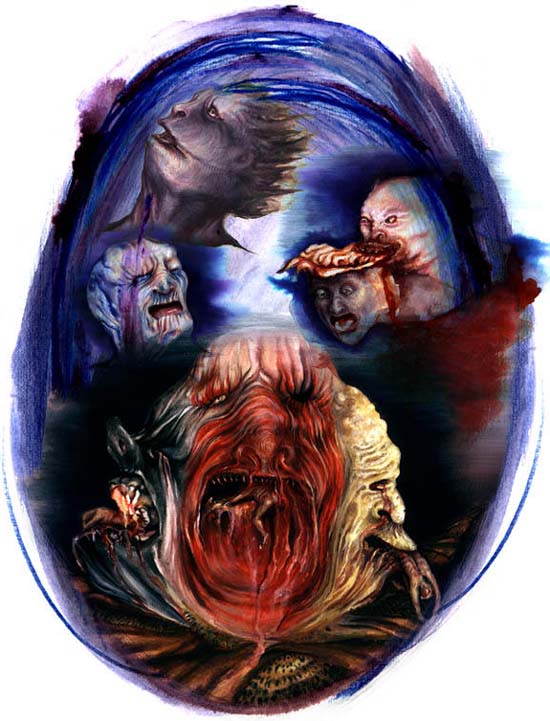 Suloni Robertson: The Ninth Circle of Hell (online version).
Above, the four Tuscan traitors Dante speaks with,
below, the three-faced Lucifer tearing Judas, Brutus, and Cassius.
Virgil introduces the three figures to Dante like this:
|
“Quell’anima là sù c’ ha maggior pena”, |
Reynolds’ British pragmatism can’t resist a practical note here:
Of Lucifer’s enormous size—estimated at over 400 meters tall based on Dante’s guidance—about half rose above the ice, so his three heads towered at least 200 meters above Dante’s own. Here, realistic description and poetic imagination collide: from such a distance and in such darkness, judging Cassius’ stoutness would be impossible.
But then a realization hits me. Silent Brutus… fat Cassius… wait a second. Dante didn’t even need to see this; he could have known from Plutarch. Or doesn’t Julius Caesar say in the Parallel Lives that he feared not jolly, fat Cassius, but silent, grim Brutus? If so, why didn’t Reynolds notice this when Shakespeare literally repeats the same in Julius Caesar?
As I dig out Plutarch and Shakespeare, another thought strikes: Plutarch was only rediscovered in the 15th century and translated from the mid-16th century onwards. Shakespeare read it in Thomas North’s 1579 English version, based on Jacques Amyot’s long-winded 1559 French translation. How could Dante have known this? Could it be the same prophetic intuition with which he identified the Southern Cross in the southern sky two centuries before the Age of Discovery?
The vision dissolves within a minute. The Shakespeare quote actually reads:
|
Let me have men about me that are fat; |
There’s Cassius, there’s corpulence, there’s silence, and soon Brutus too—just… not quite like that.
Like in that joke about German for fork: Gabel, where languages got confused: Babel, who killed Cain: Abel. Uh… well…
One big advantage of blogging over scholarly publishing is that I can report not only discoveries that proved true, but also those that gave purely intellectual delight, even if only for a moment.



Add comment