

Which is the most complicated Chinese character? Even the question needs a bit of unpacking, because what does “complicated” really mean? In character circles, it usually refers to how many strokes a character has. Since the Qin dynasty’s (3rd century BCE) standardization of writing, Chinese characters have been written with a brush, drawing each stroke from top to bottom and left to right, lifting the brush after each stroke to start the next one. Chinese dictionaries traditionally sort characters based on their number of strokes.
Chinese characters originally evolved from pictures, first carved onto bones and cast in bronze, and later written with a brush. Among these simple pictograms—called 象形字 xiàngxíngzì in Chinese, meaning “form-mimicking characters”—the one with the most strokes, sixteen in total, represents the turtle: 龜 guī, drawn like this:
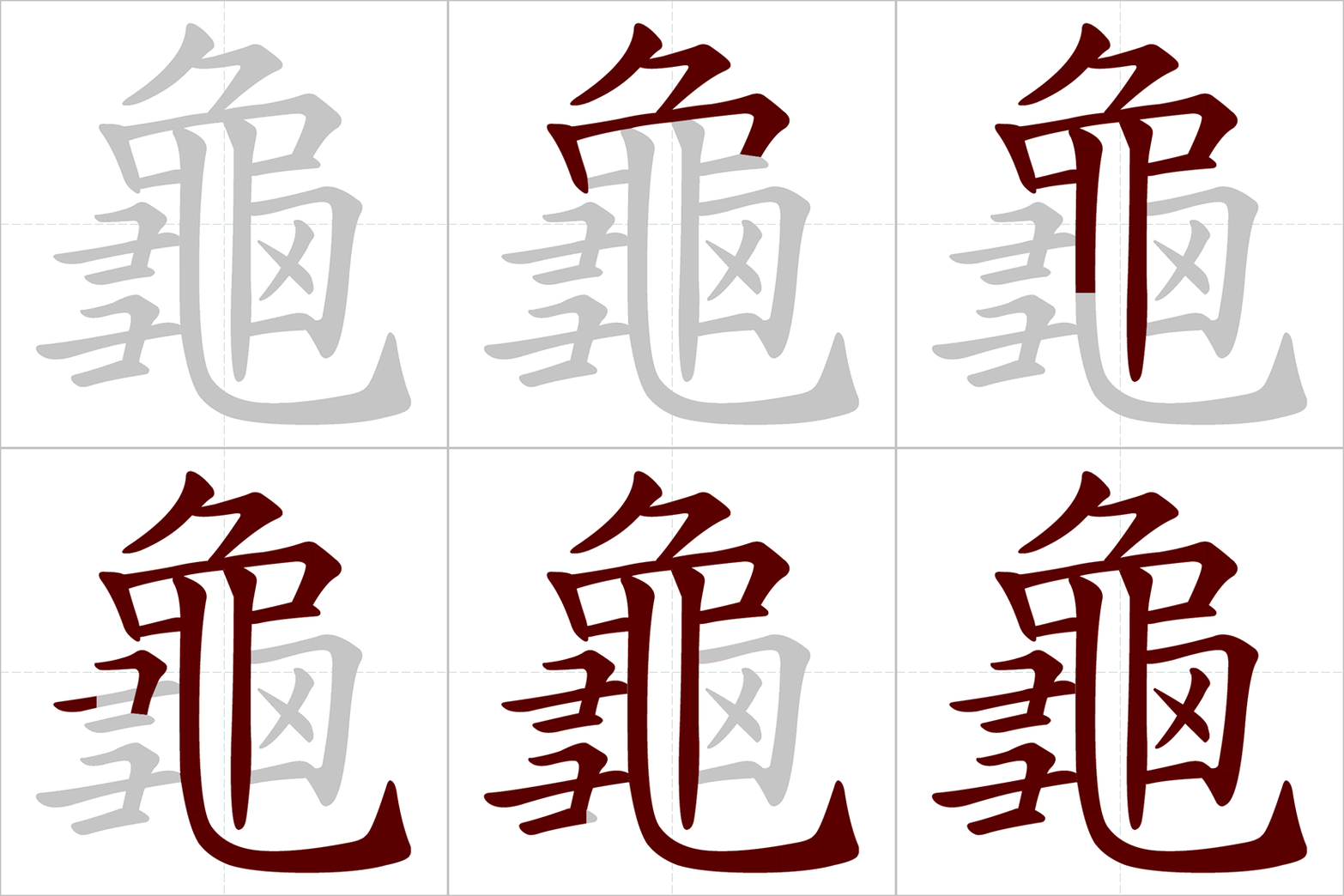
This character also has a simplified form: 龟, officially introduced in the 1950s writing reform in Communist China, though its versions were already in use in cursive handwriting as early as the Ming dynasty. It’s no accident that the original, more complex form persisted for so long. In traditional Chinese symbolism, the turtle represents the model of the world: its upper shell is Heaven, its belly shell is Earth. Together, they carry cosmic order and symbolize stability. Its remarkable longevity makes it a symbol of enduring wisdom and cosmic permanence, which is why it appears on tombstone bases. And since the earliest characters were carved on real turtle shells, it also became a keeper of writing, knowledge, and memory. That’s why its character is duly drawn slowly, elaborately, with many strokes.
Among complex characters, the one with the most strokes—48—is 龘 dá, made of three dragon characters stacked on top of each other, meaning “dragons swirling, great power in motion.” While a classical character, it’s rarely used, mostly as a kind of calligraphic tour de force.
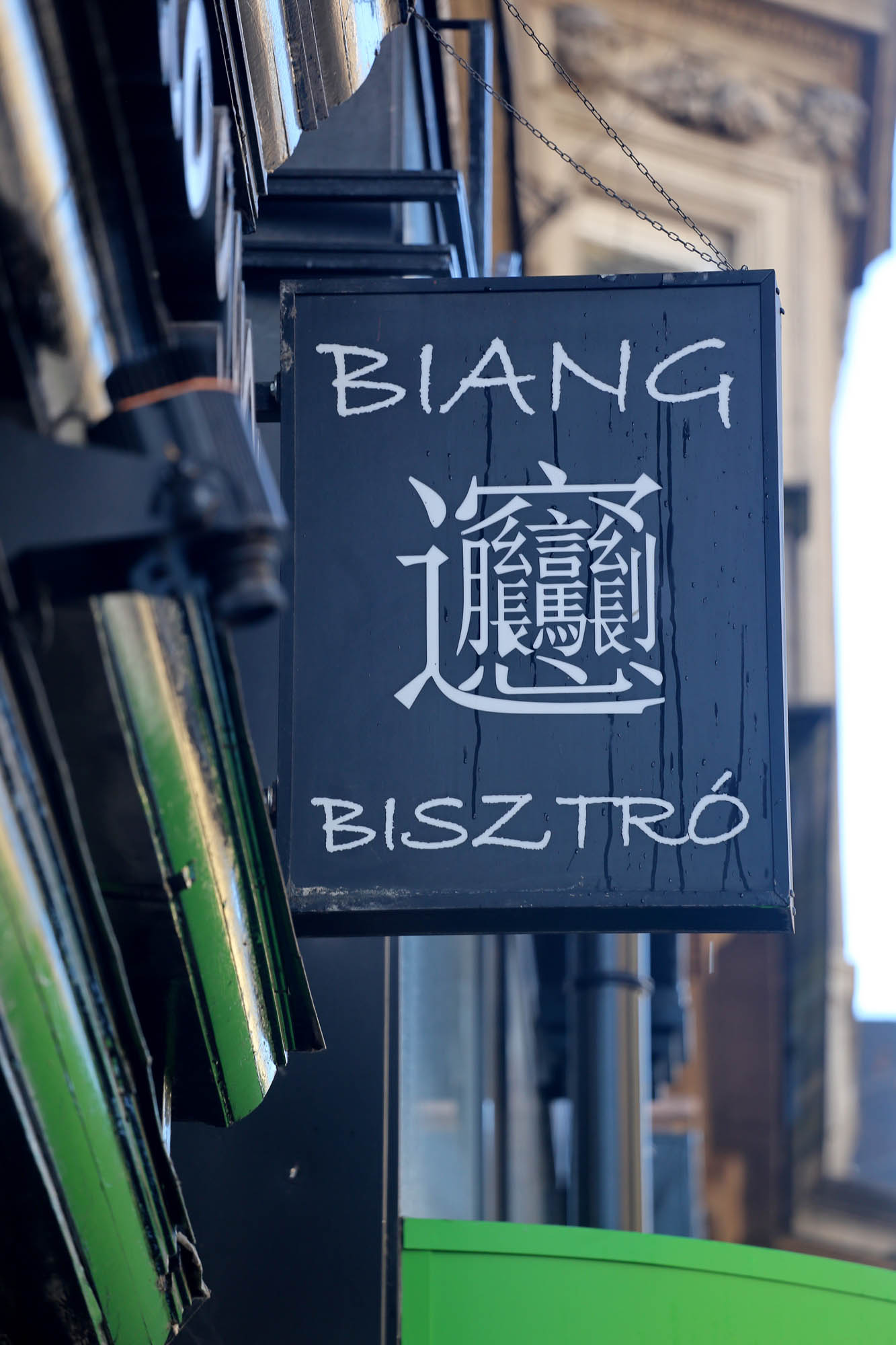
The undisputed king of Chinese characters, however, is one whose status as a true character was debated for a long time, sometimes seen more as a visual joke. This is the character for the traditional Shaanxi noodle from the ancient capital of Chang’an, that is, Xi’an: 𰻝 biáng.
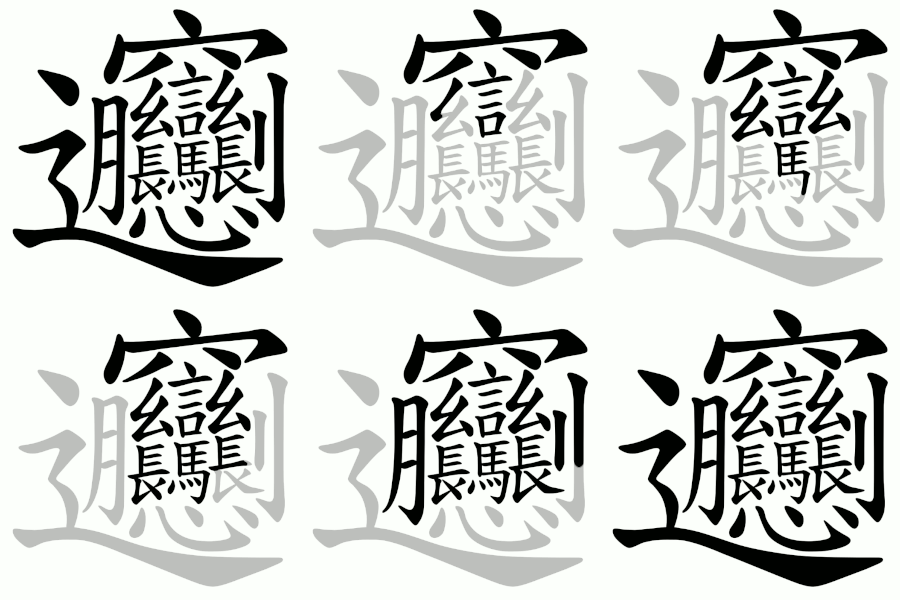
In Chinese writing, noodles are usually represented by a two-part character, where the first part (radical) indicates it belongs to the food 食 / 饣 or grain 麥 / 麦 category, and the second part (phonetic) suggests how it was pronounced back in Qin times—for example, 饺 jiăo for filled dumplings, or 麵 miàn for soup noodles. The biáng, however, is a completely different story: it’s practically a mini collection of symbols, resembling a huge pot full of delicious ingredients cooking together. And indeed, that’s exactly what it is.
According to legend, the character was created when a poor Qin-era student paid for his biáng noodles by promising the illiterate restaurant owner that he would write down the character’s name. Gathering all his knowledge, he composed this character, and the restaurant regulars were left in awe.
The awe probably came from the fact that the character isn’t a regular pictogram or compound; it’s more like a giant advertisement capturing every aspect of the noodle: how it’s wide and long, salty and leavened, kneaded, stretched, slapped (producing the biáng sound that gives the noodle its onomatopoeic name), sliced with a knife, made with big heart, and eaten with delight. There are even rhymes and songs to help memorize and interpret each component. Depending on the ingredients, it has more than twenty variations, with stroke counts ranging from 58 to 70, each with its own rhyme. And since the whole composition rests on the “foot” radical, most rhymes end with something like: “…and go to Xi’an for it.”
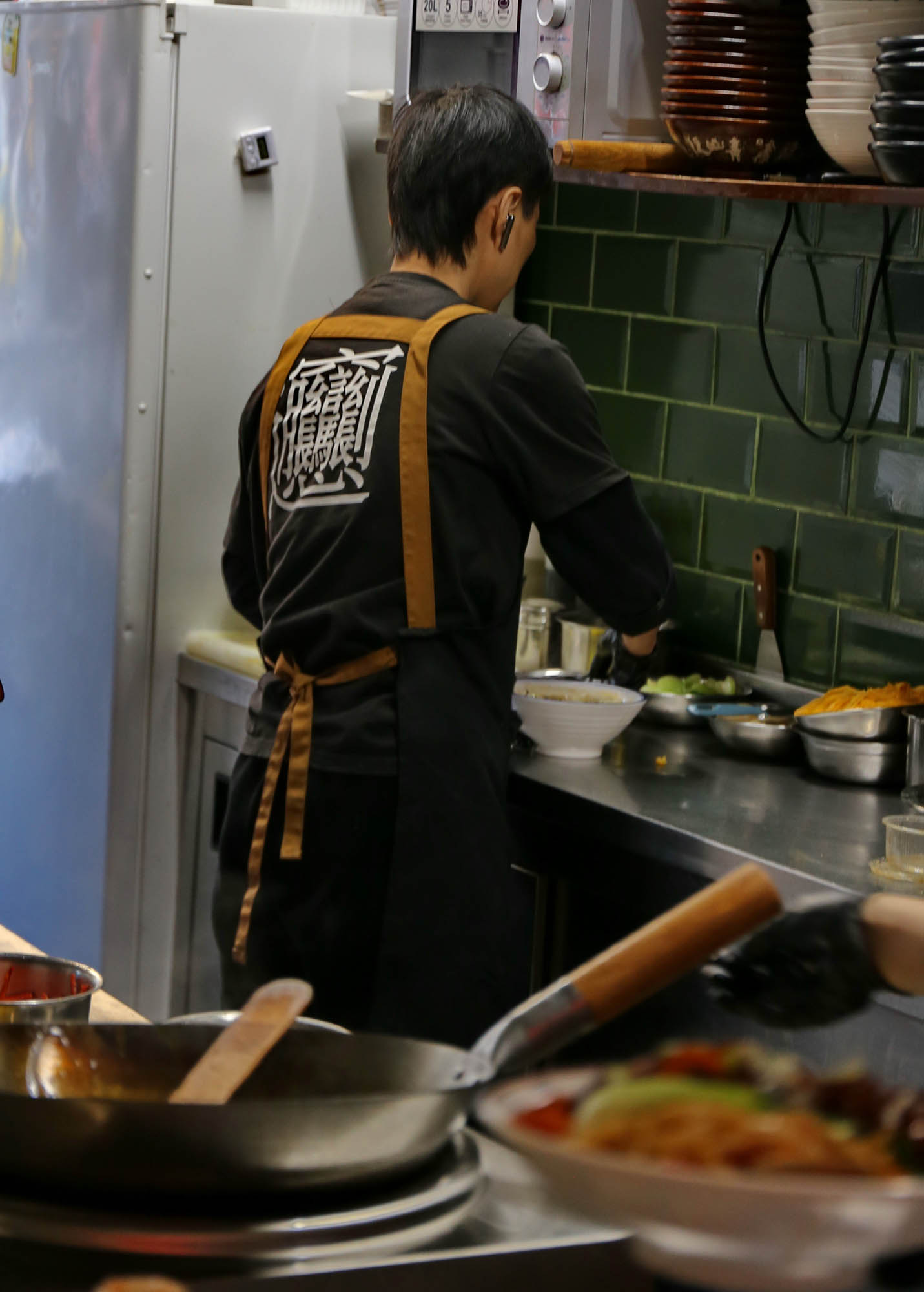
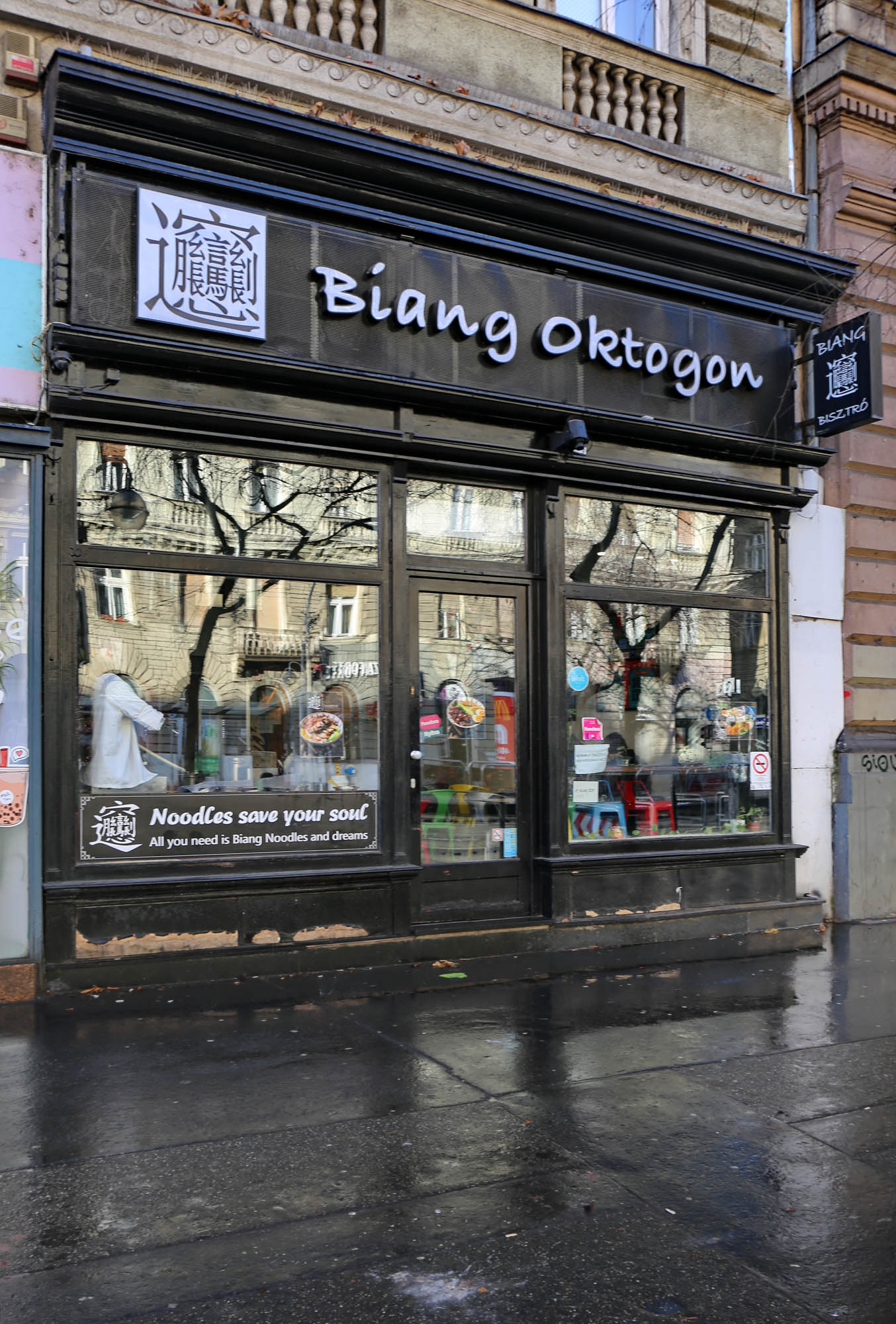
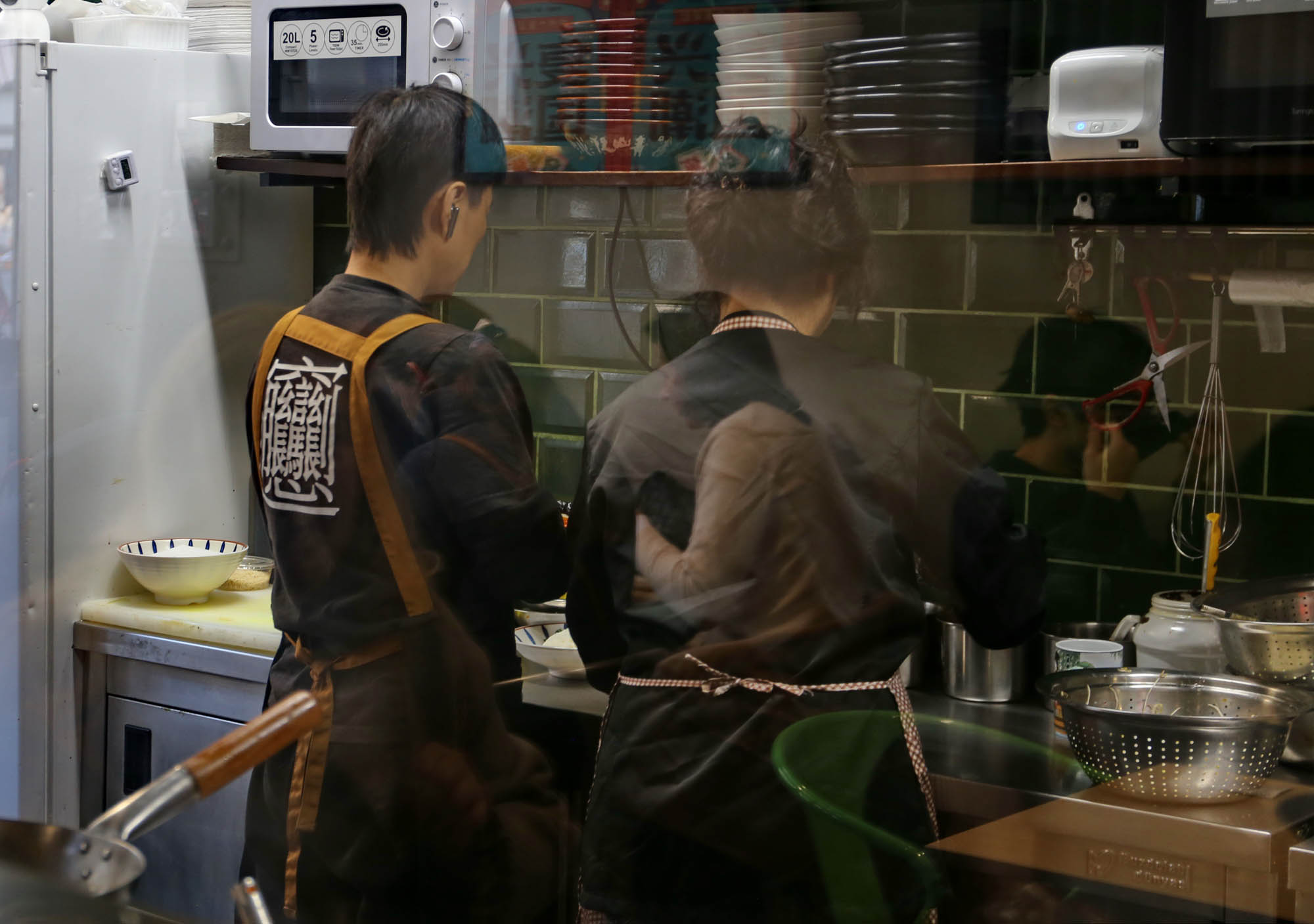
But today, you don’t need to go to Xi’an to taste it; Budapest’s Oktogon corner, at the Biang Bistro on Teréz Boulevard, is enough. Here, real Xi’an—well, more like Uighur—chefs slap and cook the noodles, putting every heartwarming ingredient into the pot. If you go there on the first day of the year—as we did—according to old superstition, you’ll enjoy the same heartwarming experience every day of the year. Even if you visit at another time, it’s worth it, and you’ll probably come back anyway. Who knows—if you can write the 𰻝 biáng character from memory, maybe they’ll even waive your payment.
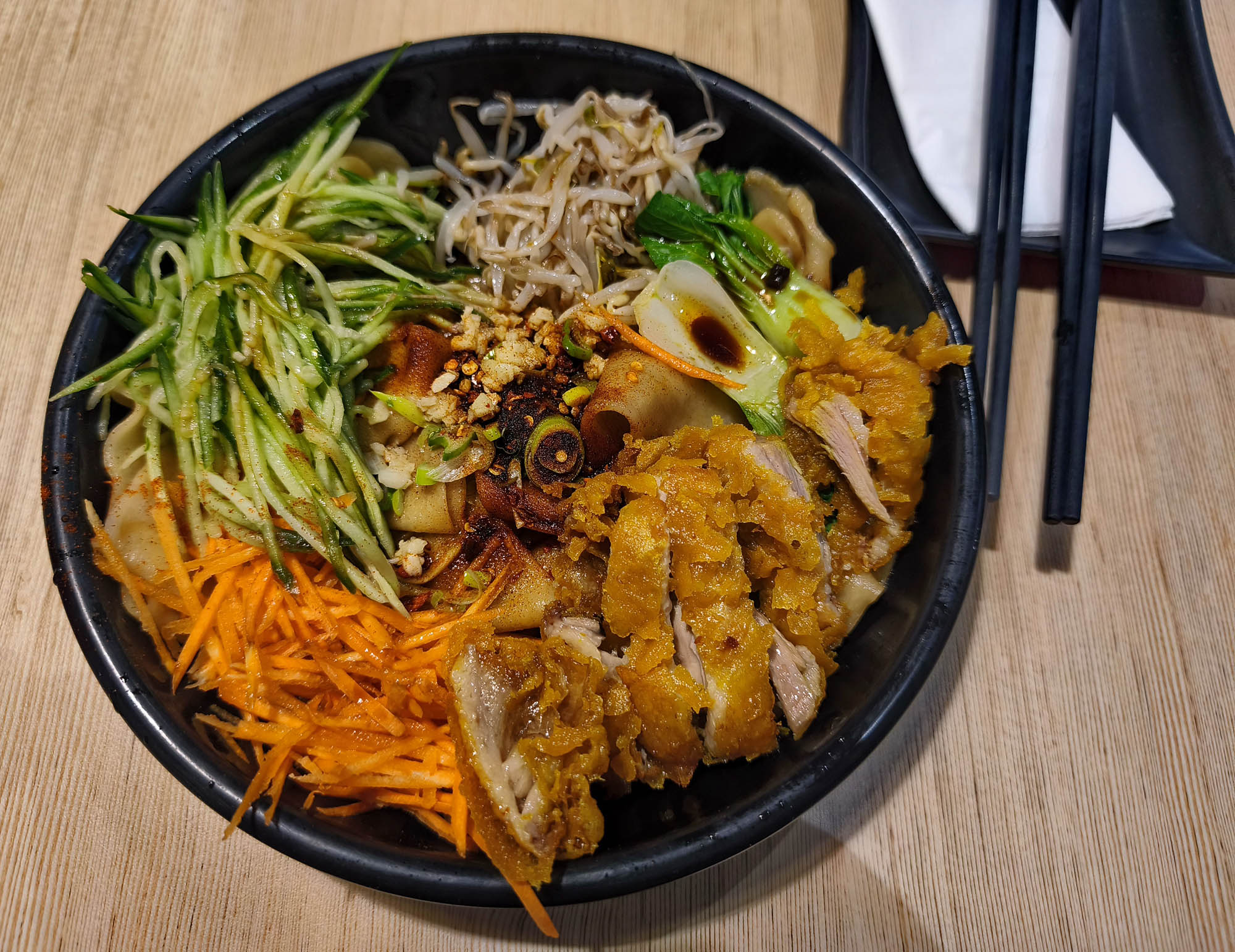 Here, the toppings still cover the noodles…
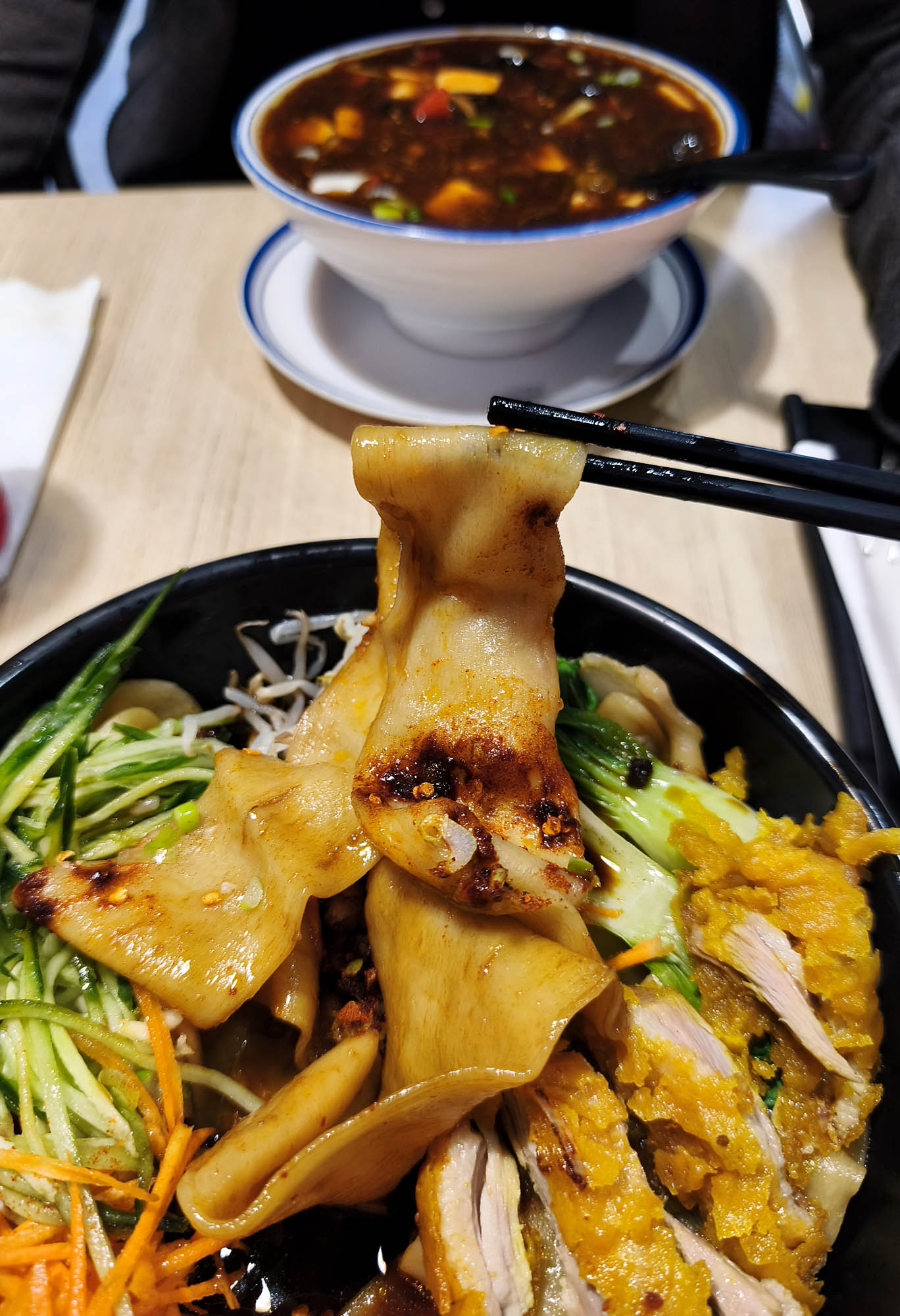 …and here it’s peeking out from under them…
 …and here the toppings are gone, leaving the wide, thick, meaty biáng.



Add comment