


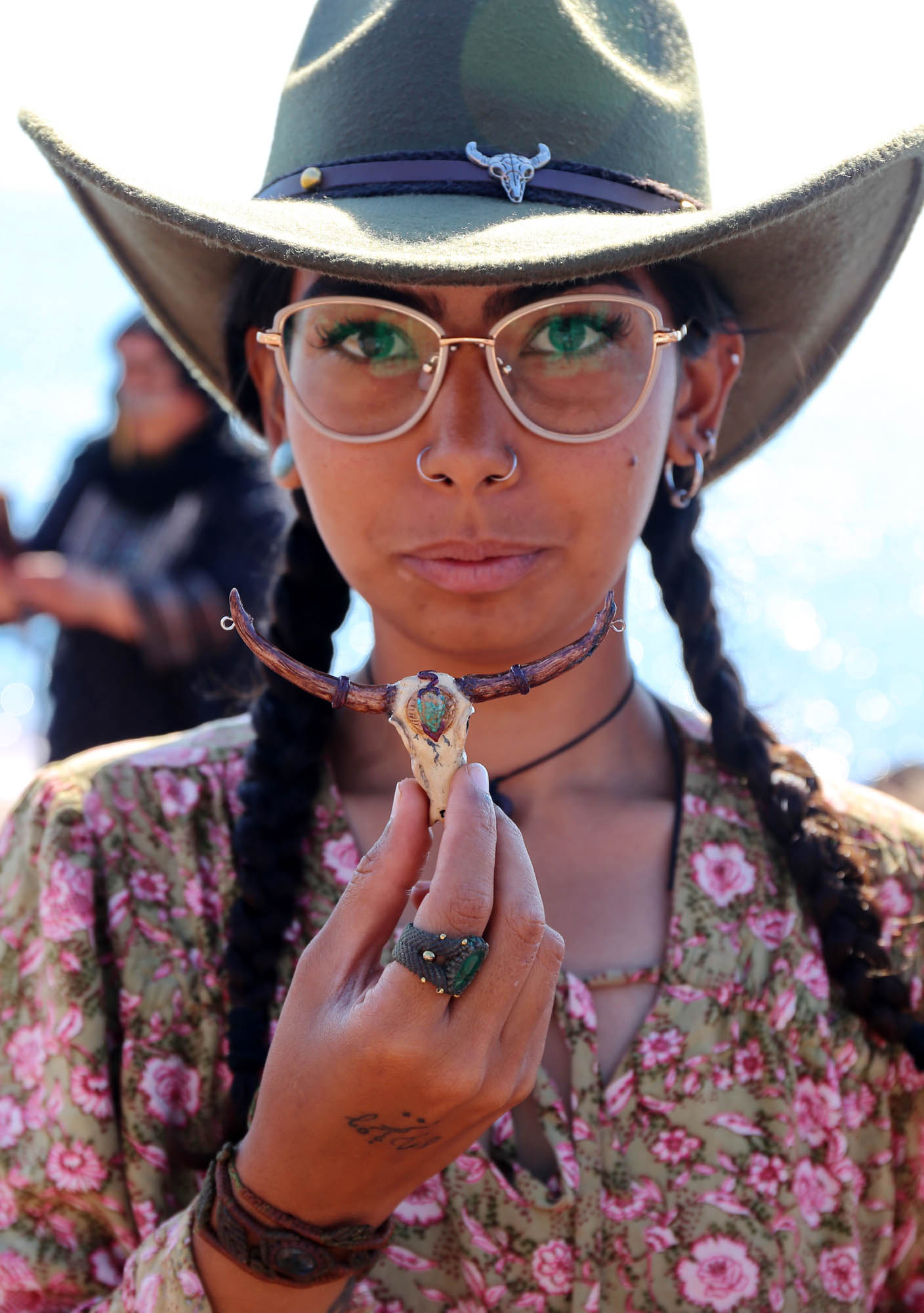
Hormuz is the island of hippies. Here, on the edge of the Persian Gulf, far from power, young people who find it hard to conform to the system have been able to exist for many years, and the system tolerates them and their relative freedom here, rather than letting them stir trouble in the cities.
This girl plays guitar and sings along the path leading to the geological formation called the Salt Sanctuary. What’s unusual about this? Almost everything. In Iran, women are forbidden to sing publicly. She should also wear a hijab in public – well, not a full niqab covering head to neck, but a cowboy hat isn’t exactly what the lawmakers had in mind. And on top of that, what she sings is not modern pop, but a verse by Hafez: “man az ân rûz ke dar band-e to am âzâdam” – “from that day I am free, since you bound me.”
Tourists – all Persians except us – sit beside her to take photos, then move on. She watches in surprise as we sit in front of her and listen quietly for a long while.
This Hafez verse became widely known across Iran through the rendition of the great blues singer Mohsen Namjoo, from his 2007 album Toranj (Orange).
|
zolf bar bâd made tâ nadahi bar bâdam |
زلف بر باد مده تا ندهي بر بادم |
do not let your hair fly to the wind, lest you give me to it too
do not build on coquetry, lest you ruin my foundation
do not drink with everyone, lest I drink my liver’s blood
lift my head, so my cry does not reach the sky
do not become the town’s celebrity, so I need not hide in the mountains
do not be Shirin, so I need not become Farhad
have mercy on me, poor one, and heed my cry
lest it falls to the earth before reaching the Wise One.
Hafez will not turn his face from your harshness
for from that day I am free, since you bound me.
Do not become a stranger, lest you take away my essence
do not bear the sorrows of others, lest you make me unhappy
shine your face upon me, so I may not care for my rose’s petals
lift your stature, so I may not care for the height of the cypress
do not be a candle in every gathering, lest you burn me
do not remember every people, so I do not vanish from your memory
do not let your hair fly to the wind, lest you give me to it too
do not build on coquetry, lest you ruin my foundation
“Őrt állok, mint mesékbe / Bebújtattál engemet talpig nehéz hűségbe,” “I stand guard, as in fairy tales / You cloaked me in the armor of loyalty”, diagnoses Attila József. In Hafez, this is self-evident, appearing precisely at the midpoint of his ring-structured poem, in the thesis statement. But the poem itself is about how he would fully cloak his beloved in an armor of loyalty. One could call this typical Eastern male chauvinism, until one realizes that Hafez’s verses are Sufi poems: they speak both of a worldly beloved and of God. It’s easy to understand for someone raised in a deeply religious context, where the two were considered one, until he got slapped in the face by one of them. And from that point on, it is no longer merely male chauvinism, but an astonishing hubris—the human urge to fully cloak even God Himself in complete loyalty.



Add comment