

Recently we saw, in connection with a stele from Daskyleion, how an ancient gesture can live on for millennia. Now I’d like to show the very same thing through another stele from Daskyleion.

Daskyleion/Dascylium, the vanished medieval capital of Hellespontine Phrygia in the Persian Empire, began to be excavated in 1952. In 1965, three finely carved stelae were discovered here. On stylistic grounds, they are dated to the second half of the 5th century BC, to the reign of Artaxerxes I (465–424), grandson of Darius. All three are now preserved in the Istanbul Archaeological Museums.
We already encountered the first stele — showing Persian magoi performing an animal sacrifice — in the previous post.
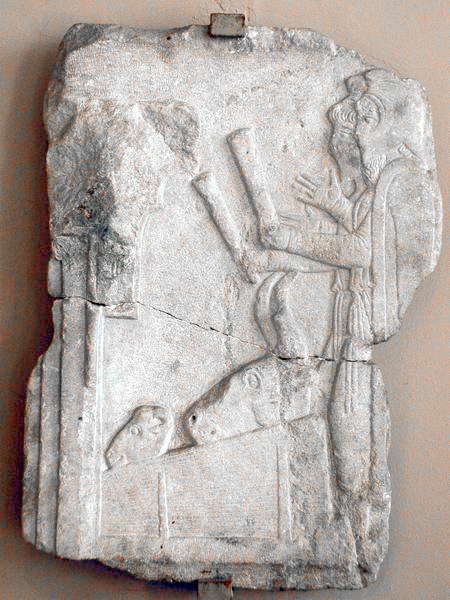
The second stele features two scenes. In the lower one, a nobleman reclines on a klinē at a banquet while servants offer him food and drink; beside him on the couch sits a woman in a long veil, wearing a crown, who likewise presents one or more emphatically rendered — perhaps symbolic — items of food. She herself may even be a symbolic or otherworldly figure. In the upper scene, a horse-drawn cart, accompanied by two figures, carries a large chest or sarcophagus.


The third stele, tall and slender, repeats the cart scene, this time with the load clearly identifiable as a sarcophagus. Above it marches a procession of Persian helmeted horsemen, of whom only the heads and the horses’ hooves survive; below runs a four-line inscription in Aramaic. The text was first published by André Dupont-Sommer in 1966, and its translation was revised by André Lemaire in 2001:


𐡀𐡋𐡄 𐡎𐡋𐡌𐡄 𐡆𐡉 𐡀𐡋𐡍𐡐 𐡁𐡓 𐡀𐡔𐡉
𐡄𐡅 𐡏𐡁𐡃 𐡋𐡍𐡐𐡔𐡄 𐡄𐡅𐡌𐡉𐡕𐡊
𐡁𐡋 𐡅𐡍𐡁𐡅 𐡆𐡉 𐡀𐡓𐡇𐡀 𐡆𐡍𐡄
𐡉𐡄𐡅𐡄 𐡏𐡃𐡄 𐡀𐡉𐡔 𐡀𐡋 𐡉𐡌𐡋
’lh ṣlmh zy ’lnp br ’šy
hw ’bd lnpšh hwmytk
bl wnbw zy ’rḥ’ znh
yhwh ’dh ’yš ’l y‘ml
“This is the bas-relief of Elnap, the son of Ashay.
He himself made his funerary stele. I adjure you
by Bel and Nabu, you who would pass the road,
let nobody do harm [to it]!”
Taken together, the three stelae present three different registers of elite self-representation in the Persian empire: the third foregrounds written self-definition, the second expresses elite status and lifestyle, while the first provides religious legitimation. Against this background, it may seem surprising that the inscription is not in Persian, but in Aramaic, both in language and script.
Persian began to be written under King Darius (522–486 BC), first using cuneiform adopted from Sumerian-Akkadian via Elamite mediation, and then in a simplified cuneiform devised on Darius’s orders, whose 34 signs largely represented sounds. This script, however, was mostly confined to monumental royal inscriptions and seals. For everyday administration, a far simpler script took over: Aramaic.
The Persian Great Kings inherited an already “Aramaized” empire from the Assyrians. In the 8th century BC, Assyrian rulers deported the populations of conquered Aramaic city-states in Mesopotamia and its surroundings — such as the Kingdom of Israel — into the heart of the empire, to Anatolia and Media. As a result, Aramaic became the empire’s ubiquitous lingua franca, and, thanks to its well-trained and multilingual scribes, the language of administration as well. The Neo-Babylonian Empire, which overthrew the Assyrians in the 7th century, adopted the same system; and by the time Cyrus the Great became ruler of Babylon in 539 BC, it was only natural for him, too, to formalize Aramaic script across the rest of the Persian Empire.
The Persian satrapies were entrusted by the Great Kings to local elites. Judging by the archaeological finds, Daskyleion must have been a multicultural metropolis: inscriptions have been uncovered in Babylonian, Greek, Lycian, Old Persian (royal seals), and Aramaic — the latter in by far the greatest number. This suggests that at least the urban elite was Aramaic-speaking. Even the name Elnap, in Aramaic, means “El [the god] has protected.” And this is the earliest known monument on which the imperial Persian elite uses an Aramaic inscription.
It did not take long before the Aramaic script was applied to the Persian language itself. Alexander the Great conquered the Persian Empire in 330 BC. The Persian kings and the cuneiform they used disappeared, but Aramaic literacy lived on alongside Greek. When, around 250 BC, a new Persian dynasty rose to power — the Parthians, who drove Alexander’s Greek-speaking Seleucid successors out of Iran — they entrusted the administration of the revived Persian Empire to multilingual Aramaic scribes. The language of administration was Persian, but it was now written in Aramaic letters: this gave rise to the Pahlavi script, named after the Persian term for Parthia, Parθava. This script was adopted by the Sasanian dynasty, which replaced the Parthians around AD 220, and remained in use until the Arab conquests of the 7th century, when another descendant of Aramaic script — Arabic — took its place.
 The 3rd-century fire altar preserved in the museum of the Naranjestan Palace in Shiraz was commissioned by Ebneon, head of the harem, as an offering of thanks for the Great King Shapur’s victory over the Romans, as recounted in its Persian inscription written in Pahlavi script.


The Pahlavi script continued to be used for some time by the Persian émigré communities. Traces of it survive in China, where some of the royal princes sought refuge, and—more surprisingly—in South India, where Persian Nestorian Christians went on erecting Pahlavi-inscribed crosses for several centuries.
 Nestorian Syriac cross in the church of the so-called Knanaya Christians in Kottayam, in the Indian state of Kerala, dating from between the 7th and 10th centuries
Yet Pahlavi never disappeared entirely from Persia either. In the 3rd–4th centuries, the Sasanian kings had the Zoroastrian priesthood compile the written corpus of their religion, naturally recording it in Pahlavi script. And religion is a powerful conservative force. Just as Armenian religious texts were written in Armenian letters, and Jewish ones in Hebrew, for two millennia even in diasporas speaking other languages, so Zoroastrian texts have been written—and later printed—in Pahlavi characters for some fifteen hundred years, even as secular Persian texts shifted to the Arabic script. We saw a vivid example of this in Kerman, in the small museum opened beside the still-active local Zoroastrian temple.




Add comment