

I found these photos on a Persian blog that has since disappeared. The splendid lily is Fritillaria imperialis, known in European languages as the crown imperial, and in Persian as لاله واژگون lâle-ye vazhgun, meaning “inverted lily/tulip,” since the Persian word lâle refers to both. It grows wild in the Zagros Mountains of western Iran.


It’s an astonishing sight when, in April, a carpet of flame-red bells perched atop meter-high stems sweeps over the barren mountain slopes in just a few days—suddenly giving a whole new dimension to the biblical line: “Consider the lilies of the field, how they grow… even Solomon in all his glory was not arrayed like one of these.” Which, quite unexpectedly, also turns out to be a pretty good justification for the flower’s European name.

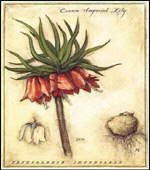 True to its name, the flower made its way into European ornamental gardens through the good offices of two emperors—and two uncrowned kings of Renaissance botany. One of those emperors was Suleiman the Magnificent, who died during the siege of Szigetvár in 1566—il Magnifico to the Italians, al-Qanuni, the Lawgiver, to Turkish and Persian chroniclers. He consolidated and completed the conquests of his father and grandfather, and his long reign marked the golden age of Ottoman culture. A major part of this flowering came from Persian literature and art, including the art of gardens. Bread feeds the body, but flowers feed the soul, says a saying attributed to Muhammad, and in that spirit Suleiman established Istanbul’s Flower Market, still operating in its original location near the Spice Bazaar in the Eminönü district, not far from those wonderful fish grills. Here, for the first time, all the flowers of the empire were sold—from the Field of Blackbirds in Kosovo to the Armenian mountains, from the Pontic coasts to the Syrian deserts. A market like that is every botanist’s dream.
 Sultan Suleiman after the Battle of Mohács (Istanbul, Topkapı Sarayı)
And before long, the botanist to match the dream appeared as well. The Flemish Ogier Ghiselin de Busbecq negotiated in Istanbul in 1554 and again in 1556 as envoy of Ferdinand I over the delicate question of the Transylvanian frontier. The talks dragged on for months, and alongside writing the famous Turkish Letters, one of the earliest European accounts of life in Istanbul, Busbecq found time to collect plants unknown in Europe from the flower market. He was the first to send home many species we now assume have always grown here—some even thought of as ancient Hungarian flowers: tulips, horse chestnut, lilac, mock orange, hibiscus, hyacinth, and of course the crown imperial—thus opening the “Oriental period” of European ornamental gardens that lasted into the 1620s.
 The Great Mosque of Istanbul, 1570
The recipient of Busbecq’s botanical shipments was another Flemish botanist, the greatest of his age, Carolus Clusius, whom—on Busbecq’s recommendation—the other emperor, Maximilian II, invited to Vienna in 1573. There he established Europe’s first exotic imperial garden, from which the crown imperial itself took its name. Clusius was also an avid plant collector who first described the mountain flora of Austria and western Hungary. He was a friend of Boldizsár Batthyány, that enigmatic figure of the Hungarian Renaissance, who likewise imported exotic flowers via high-ranking Ottoman captives—among them a “thirty-six-petaled double narcissus” from Constantinople—and whose ornamental garden at Németújvár/Güssing was designed by Clusius himself and frequently mentioned in his writings. Drawing on observations made on Batthyány’s estate, Clusius compiled the first great encyclopedia of Pannonian mushrooms, complete with exquisite illustrations, which after centuries finally appeared in print only a few years ago.
 Pieter van Kouwernhoorn: Crown Imperial, detail from a florilegium, c. 1620
Yet Clusius’s true specialty remained the exotic flora arriving from Istanbul, above all the tulip, which he was the one to naturalize in Europe. After returning home to Leiden, he founded the Hortus Academicus, Europe’s first ornamental plant garden, where he sold the tulip bulbs from his collection at outrageously high prices. In their desperation, local gardeners eventually banded together and broke into the garden, expertly sampling every single variety. This marked the beginning of the fashion for Dutch tulips, from which the next generation’s notorious tulip mania and its famous tulip still lifes would grow. In these still lifes, the imperial crown often appears as well—truly as the crown of the composition—and because of its imposing size it became a favorite cut flower in grand Baroque halls. Its flamboyant appearance later made it a natural favorite of Art Nouveau, too.
 Jan Brueghel the Elder: Large Bouquet, 1603
 Van Gogh: Imperial Fritillaries in a Copper Vase, 1886
In Persian the flower is also called لاله اشک lâle-ye ashk, the weeping lily. According to tradition, it bears this name because it witnessed the murder of the pre-Islamic Iranian hero Siavush, and ever since—unlike other lilies—it mourns him with bowed head. But in a more widespread version of the legend, the flower itself sprang from Siavush’s blood, which was poured out upon barren rocks by order of a tyrant. So tells Ferdowsi as well in The Book of Kings.
Siavush, the innocent hero unjustly slain—whose figure preserves the traits of the murdered Tammuz and foreshadows the cult of Husayn, the supreme Shiite martyr massacred at Karbala—remains for Iranians one of the most powerful symbols of freedom crushed yet reborn from the blood of martyrs. It was his blood that the mujahideen rebelling against the Shah sang about, and his name is borne by one of modern Iran’s key novels, Simin Daneshvar’s Savushun. Although its plot unfolds during the British occupation of 1941, it continued to be read with undiminished relevance. The novel’s hero, the young Yusof, head of a distinguished landowning family from Shiraz, is killed by the British because, as the organizer of the city’s passive resistance, he prevents the army from buying up food supplies—an action that would have caused famine among the peasants. The novel’s final sentence is the message sent to Zari, Yusof’s widow, by an Irish poet serving as an interpreter in the British army and a friend of Yusof:
Don’t cry, my sister. In your home a tree will grow, and other trees in your city, and many more ones in the whole country. And the wind will bring messages from tree to tree, and the trees will ask of the wind: “Have you met the dawn on your way?”
And it is this lily—the symbol of freedom sprouting from the blood of martyrs—that inspires one of Iran’s greatest singers, Shahram Nazeri, in his album Lâle-ye bahâr (Spring Lily), released in Iran only a few months ago.
Shahram Nazeri: Lâle-ye bahâr (Spring Lily), from the album Lâle-ye bahâr (2009). The poem was written by Malek o-Sho‘arâ Bahâr, the same author who wrote the lyrics to Shajarian’s Dawn Bird. The music was composed and performed by the greatest santur player, Parviz Meshkatian, who passed away in Tehran just a month ago, on September 21.
|
lâle khunin kafan az khâk sar âvarde borun
âtashin âh-e foru morde-ye madfun shode ast
yâ be taghlid-e shahidân-e rah-e âzâdi |
لاله خونین کفن از خاک سر آورده برون
آتشین آه فرو مرده مدفون شده است
یا به تقلید شهیدان ره آزادی |
the lily draws a blood-colored veil from the depths of the earth
the earth reveals the hidden soul of humankind
the grieving mother’s heart mourns the dead
son, whose burning heart sprouts from the soil
the buried dead has turned to fire; from the blood
of his heart the earth is wrapped in red flame:
as if with a thousand tongues the homeland proclaimed
that the tyranny of fate will come to an end
as if, a martyr of freedom,
it wore a red plume upon its green robe
as if the burning spring upon the homeland’s gravestone
spread the silk of the tormented heart’s blood




Add comment