


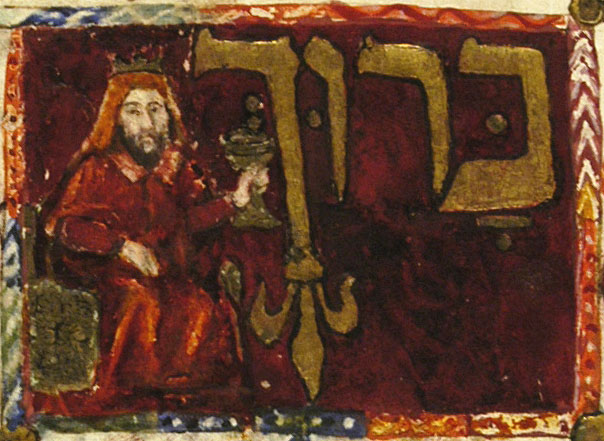
The initial in the so-called Kaufmann Haggadah, created in 14th-century Catalonia, depicts a king lifting a cup to offer a blessing: BRWK, that is, Baruk Adonai, “Blessed be the name of the Lord.” The king is almost certainly David, since the image appears right after Psalm 113 in the Haggadah summarizing the liturgy of the Seder night:
Praise the Lord!
Praise the name of the Lord!
Blessed be the name of the Lord, now and forever!
From the rising of the sun to its setting, let the name of the Lord be praised!
The Lord is high above all nations,
his glory above the heavens.
David Kaufmann (1852–1899), born in Bohemia, won by competition the very first professorial chair at the Budapest Rabbinical Seminary, founded in 1877. To take up the post he mastered Hungarian to perfection, and he eventually bequeathed his invaluable collection of medieval Hebrew manuscripts to the Hungarian Academy of Sciences. We are now working on its online edition in Studiolum.
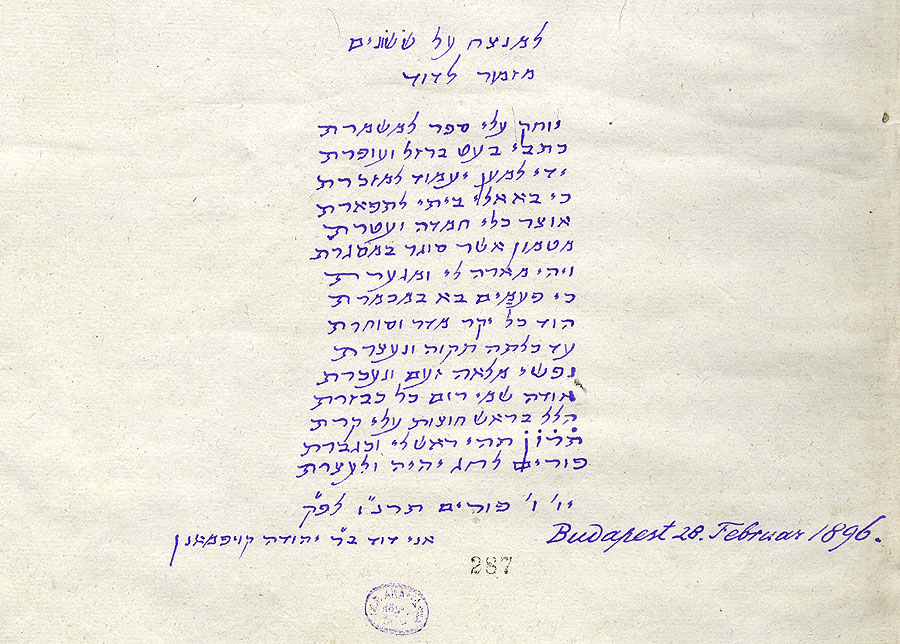
We chose this blessing initial from the collection’s most famous manuscript as the emblem of the edition. After all, Kaufmann himself—if only for a brief moment—became one with King David when, overjoyed at acquiring the oldest surviving Mishnah manuscript (copied in 10th-century Palestine), he inscribed his own thanksgiving poem on the flyleaf under the title “Psalm of David.”
Seen through the eschatological lens of the Seder night, this depiction of King David also anticipates the figure of his descendant, the Messiah, just as the lovely Hasidic song below describes him:
|
A string of pearls, a golden banner, |
Shnirele perele, gildene fon |
Kata recalls that when the Klezmatics gave a concert in Budapest at the very end of the ’80s—one of the first signs of the political opening—they spent the evening playfully storming through modern klezmer numbers like
Klezmatics: Man in a Hat (3'03") (from the album Jews with Horns)
and then, right at the end, they unexpectedly fell silent—and quietly began this one: This year the Messiah will come.
Klezmatics: Shnirele perele (6'11") (from the album Rhythm & Jews)
The audience—second- and third-generation secularized Jews—listened in deeply moved silence.



Add comment