

Saint George is an important patron saint for Armenians too, not just for Georgians. In fact, his body was even buried in an Armenian church, at Mughni, from where, in the 13th century, it was transferred to the Armenian monastery church of Saint George of Mughni in Tbilisi — or at least the saint’s skull was. True, the saint’s body is also venerated in the church of Lydda in the Holy Land, and many of his relics are scattered among many other churches as well, but for the Armenians what mattered was that they too could proudly claim him, just as one body of Saint Bartholomew the Apostle is kept in an Armenian church in Iran, while another rests in Rome, on Tiber Island.
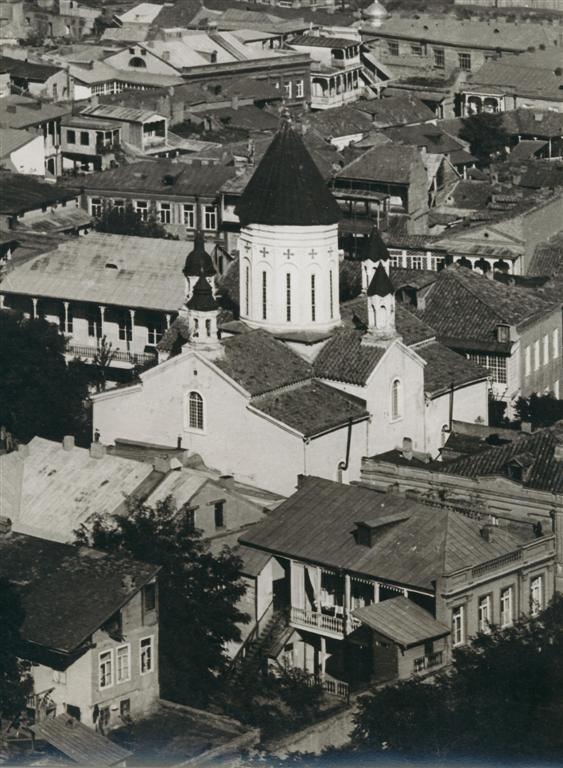 The Armenian Church of Saint George of Mughni in Tbilisi at the end of the 19th century. Photo by Dmitry Yermakov
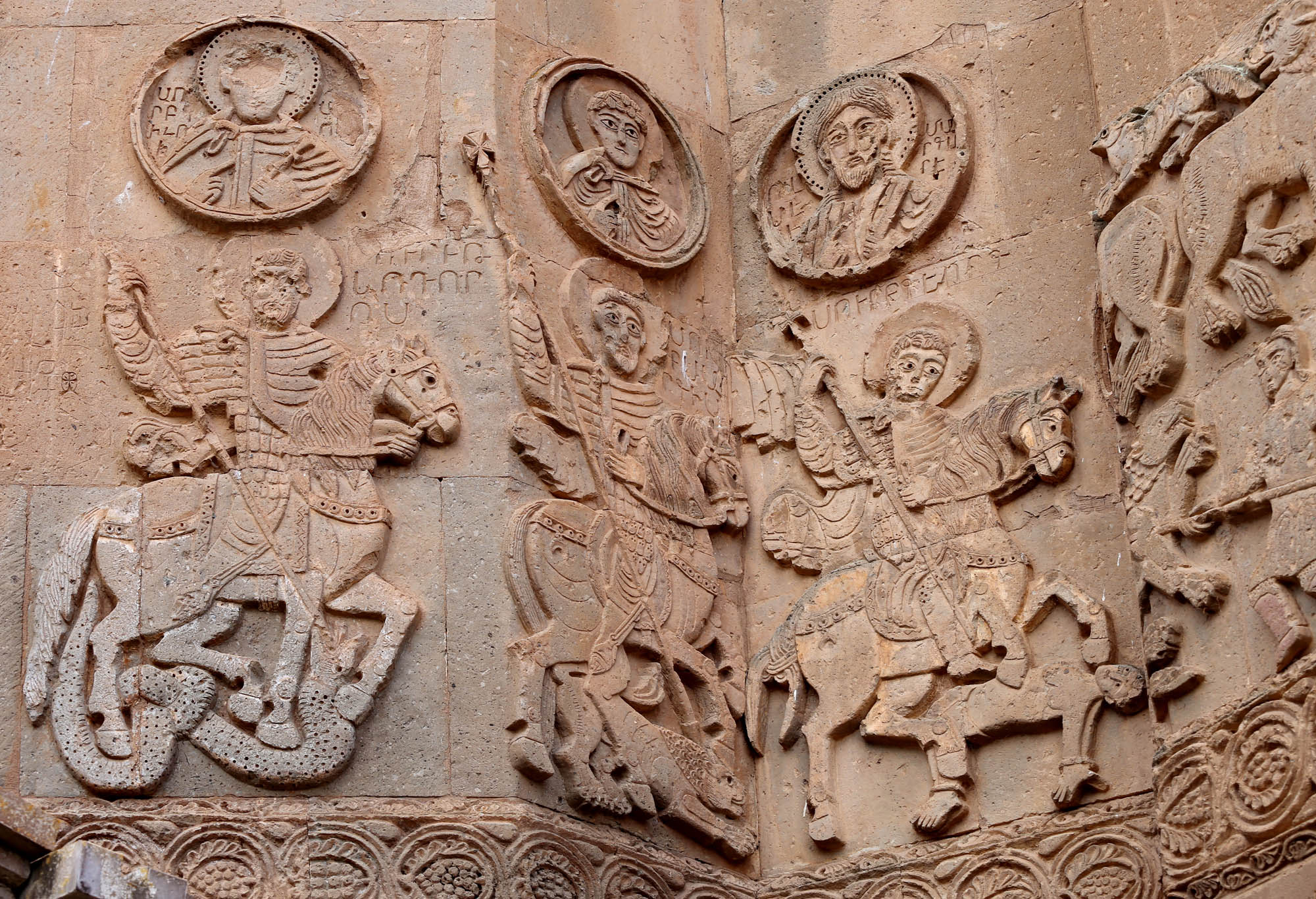
Saint George, together with his fellow warrior saints Theodore and Sarkis, also watches over one of the most famous Armenian monasteries, the church of Akhtamar on an island in Lake Van, which from its foundation until 1915 served as a seat of the Armenian Catholicos. Although, as I wrote earlier, Saint George only mounts a horse in 10th-century Georgia in order to spear the enemy — first the emperor persecuting Christians, then the man-eating dragon — the earliest known example of this image nevertheless appears precisely on the northern outer wall of the Armenian church of Akhtamar, built between 915 and 921.
And Saint George also protects the gate of a third Armenian monastery, the famous Msho Arakelots, the Church of the Holy Apostles of Mush. According to tradition, the monastery was founded in 312 by Saint Gregory the Illuminator, converter of the Armenians, and it housed the relics of three apostles — Saints Peter, Paul, and Andrew — hence its name. In 1125, the Tornikian family, old Armenian aristocrats and landowners of the region, rebuilt the monastery. Around this time its gate was also created, one of the masterpieces of medieval Armenian art, carved in 1134 by Toros, Grigor, and Ghukas according to its inscription.
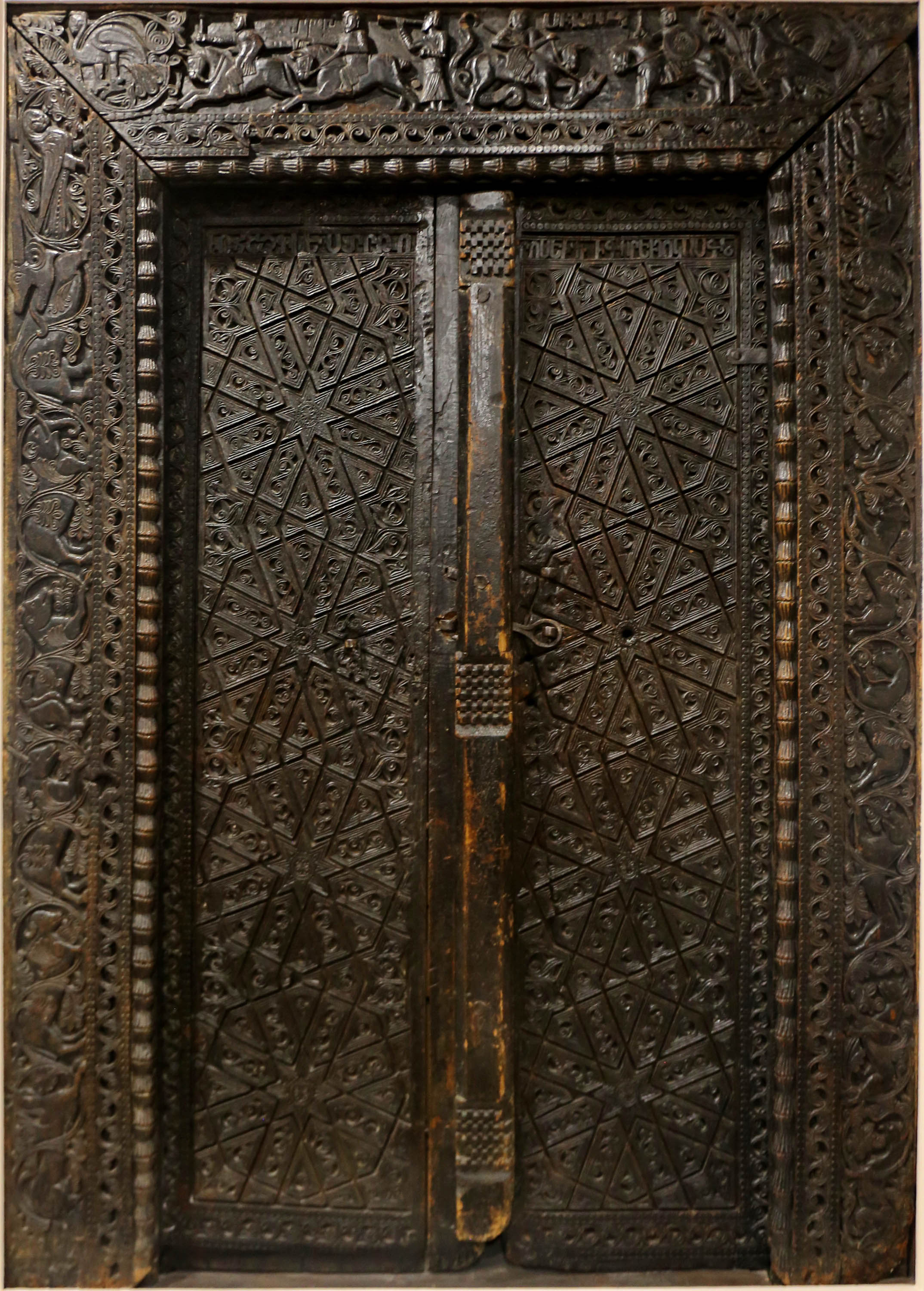

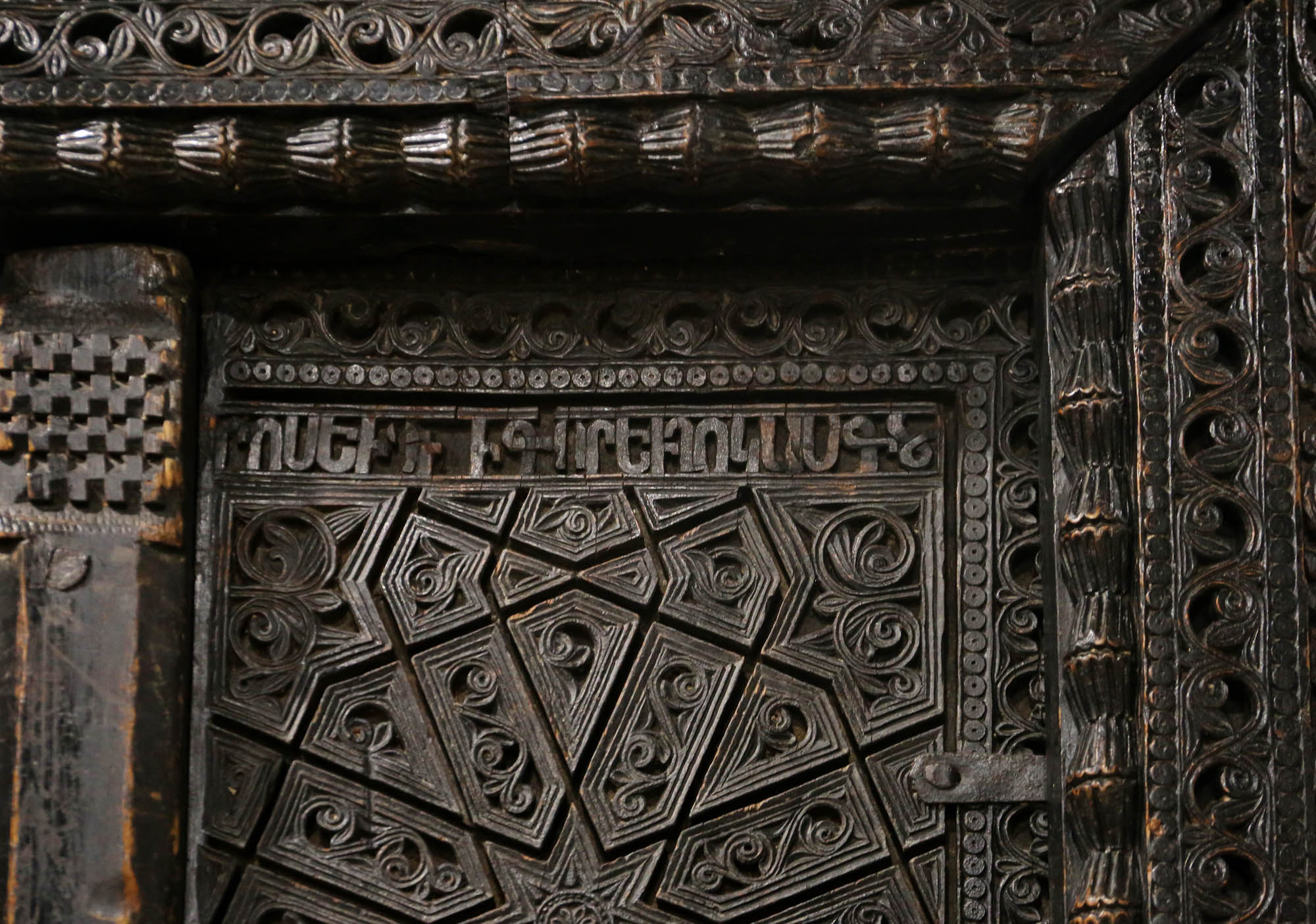
The frame of the two-meter-high gate is covered with human and animal figures, while its two inset panels are decorated with geometric and palmette-like vegetal motifs. The designs clearly derive from Armenian manuscript art. Since Armenians, as monophysites, did not exactly forbid public figural representation but considered it theologically problematic, their figurative art flourished mostly hidden away on the pages of manuscripts. Only in exceptional periods did it spill out onto public surfaces, icons, woodcarvings, and stone sculpture — something I will write more about in another post. A perfect example is the fantastic creatures on the gate’s frame, whose natural habitat is unmistakably the margins of medieval manuscripts.

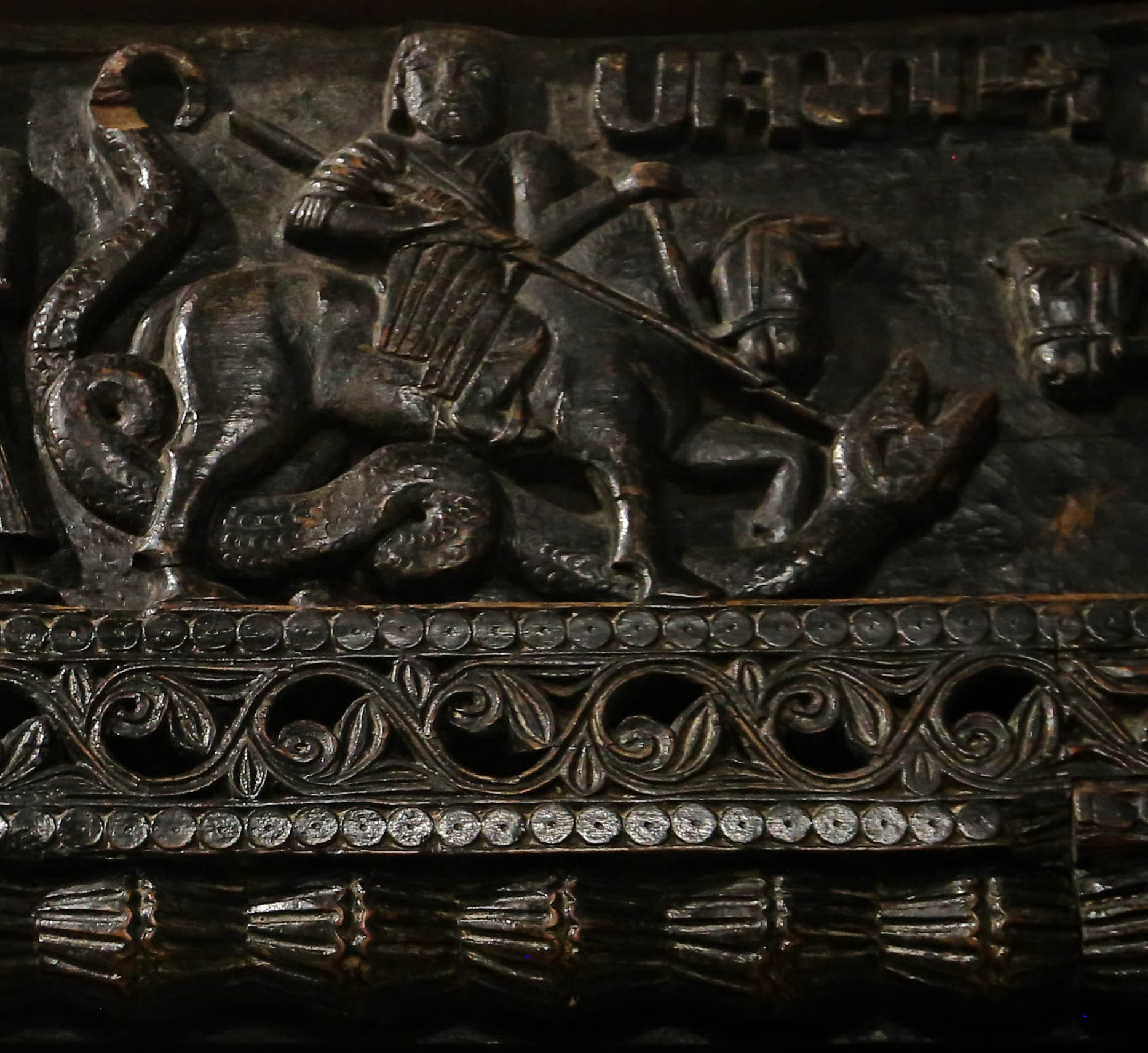
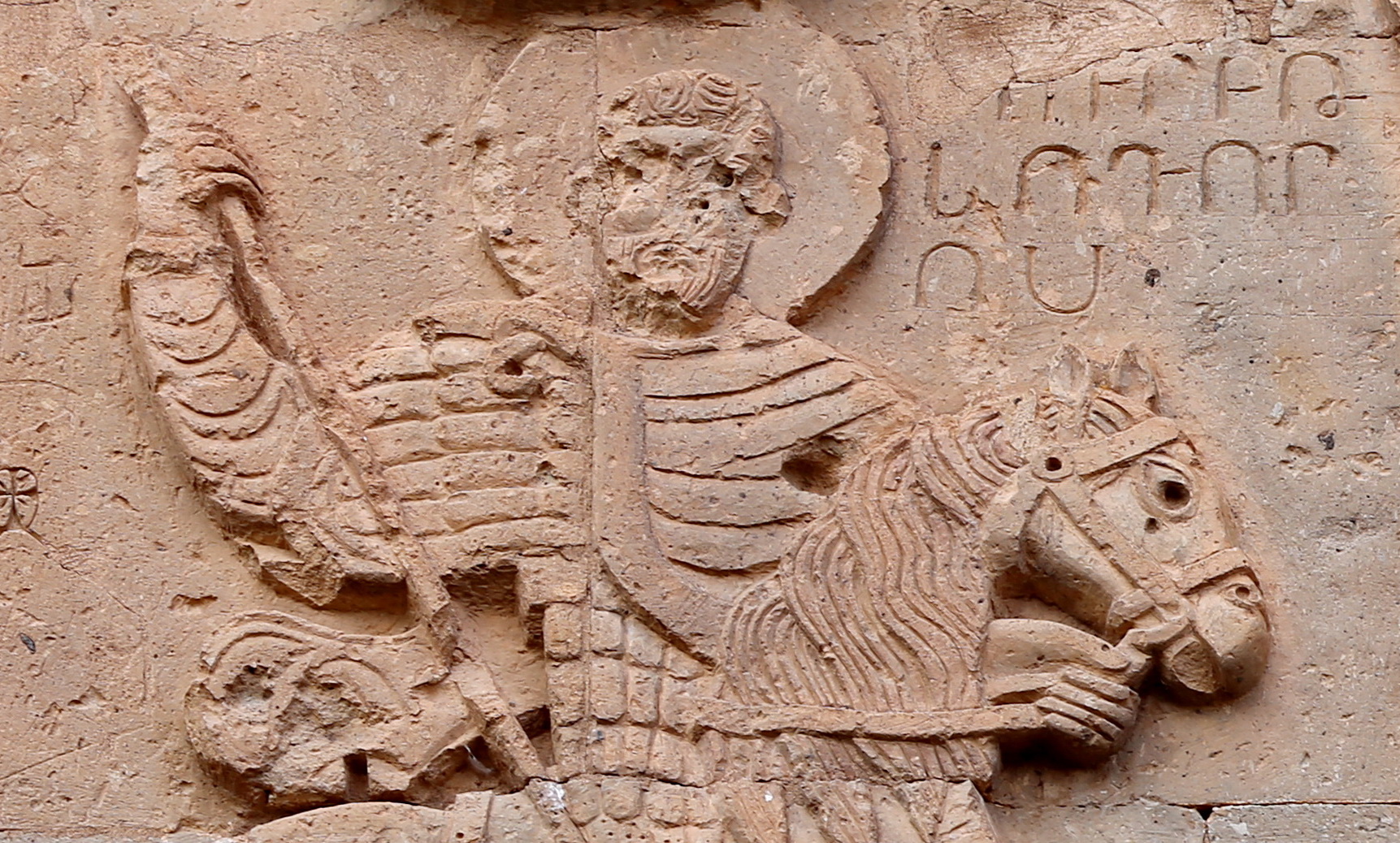
Near the middle of the gate’s upper frame rides Saint George, spearing a writhing dragon. To the right of his head, his name was also carved so he could be distinguished from the other mounted warrior saints—Saint Theodore, Sarkis, or Demetrius: ՍԲ Գ[ե]ՈՐԳ, Sb. G[e]org. Around him unfolds a bloody battle scene. On the left, an Armenian soldier blows a trumpet, while a mounted warrior gallops after another rider and pierces him through with his sword. On the right stands another mounted soldier representing the army from which the victorious warrior has charged forward.
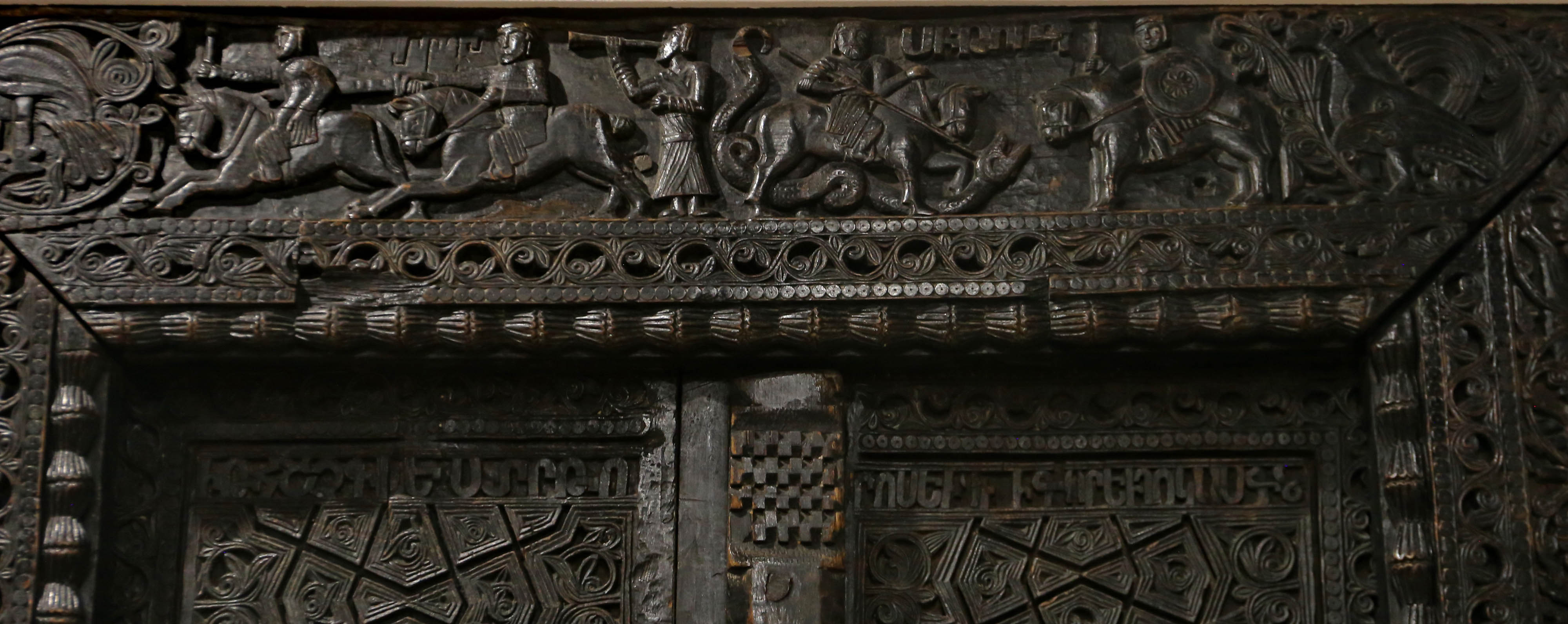
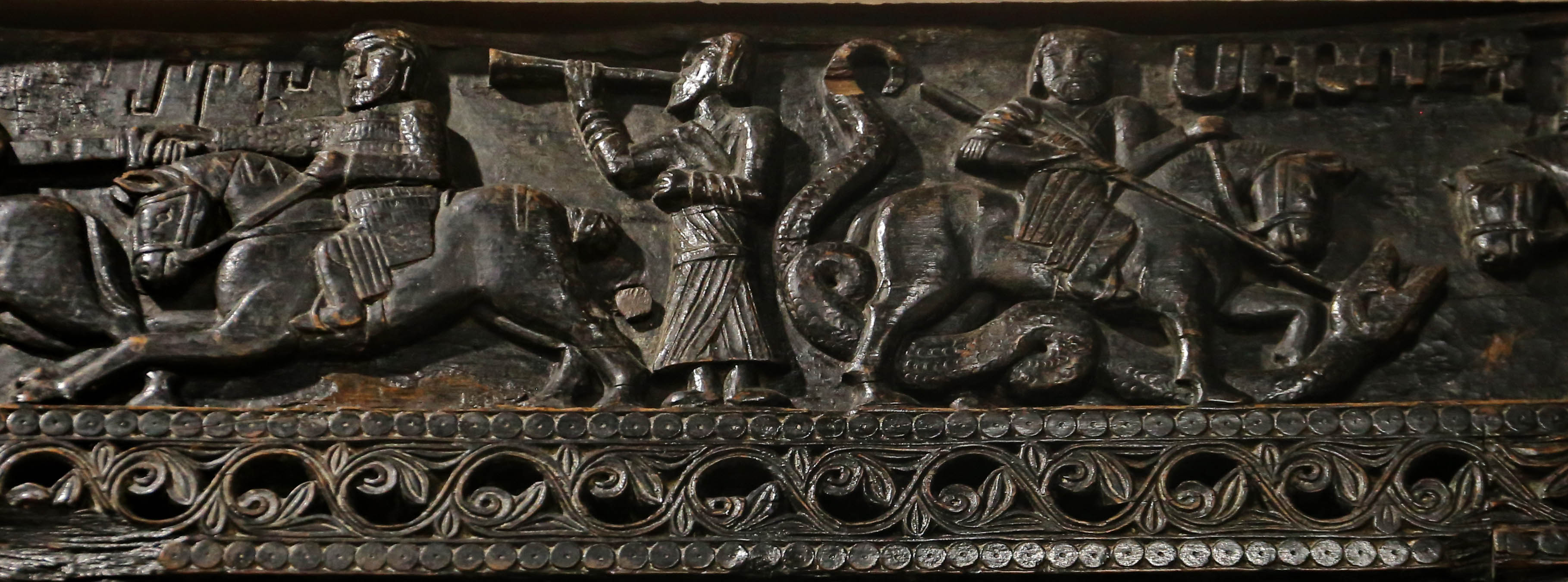


The victorious warrior is David of Sassoun (Davit Sasunc’i), and the scene depicts one of the climactic moments of the popular 8th-century Armenian heroic epic about him. In the epic, the Arab conquerors of the 7th century reach Lake Van as well, but the king of the Armenian province of Vaspurakan defeats them after fierce struggles, with David of Sassoun playing the decisive role by personally killing Melik, the Egyptian sultan leading the Arabs. Alongside David’s bravery, victory over the pagans was clearly aided by heavenly intervention too, and this is symbolized by the figure of Saint George woven into the battle scene—or rather projected into a transcendent layer of commentary above it—promising similar divine help to the Armenians in other moments of existential danger.
The Msho Arakelots monastery itself was rebuilt in just such a troubled era. In 1064 the Seljuk Turks conquered the Armenian Bagratuni Kingdom and established several emirates on its territory. One of them, north of Lake Van, was Shah-Armenia, centered on Ahlat, which is still adorned today with tombstones carved by Armenian stonecutters for Muslim patrons. For a while, the Christian landowners were not expelled, and they sought to counter the growing Islamization by founding monasteries and churches. Among them was the Tornikian branch of the Mamikonian clan, long celebrated for defending the Armenian people and faith for a thousand years. Lords of the region of Taron—today’s Muş—they renovated and enlarged the Msho Arakelots monastery in 1125, originally founded in 312. During the 11th–13th centuries it became one of the leading centers of Armenian culture and education. It was here that the gigantic illustrated manuscript known as the “Homilies of Mush” eventually came to be preserved before its adventurous journey led it to the manuscript museum of Yerevan. And it is hardly accidental that the wooden gate they commissioned in 1134 was decorated with motifs of Armenian national defense—David of Sassoun and Saint George.
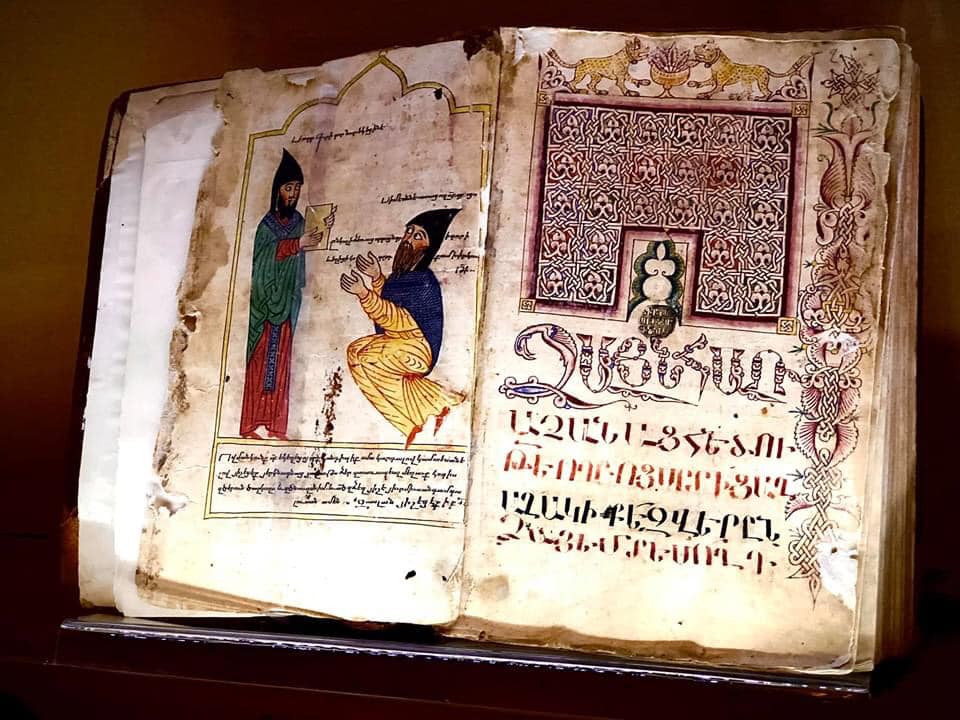 The colophon of the manuscript of the Homilies of Mush. The 28-kilogram manuscript was written between 1200 and 1202 on the skins of 600 calves by Vardan Karnetsi and illustrated by the monk Stepanos in the Avag Monastery near Erzincan, destroyed in 1915, commissioned by a merchant named Astavtsur. Astavtsur died a year later during the Mongol invasion, and the manuscript was stolen by the Turkish judge of Ahlat, who then offered it for sale. The monks of Msho Arakelots collected the negotiated price of 4,000 silver coins (around 20 kilograms of pure silver) from Armenian believers, and after purchasing the manuscript, they added the story of its recovery to it. In 1915, after the monastery was plundered, two Armenian women fleeing the massacres sought shelter there for the night and discovered the manuscript. They cut it in half and each carried away one part. One of them soon reached Echmiadzin, where she donated her half to the monastery. The other died while fleeing near Erzincan, but before her death she buried the second half in the garden of a local monastery. There it was later found, guided by local villagers, by the officer Nikolai De Goberti of the advancing Russian army, who took it to Tbilisi and donated it to the Armenian museum there. The two halves of the manuscript were reunited only fourteen years later in Echmiadzin. Today it is preserved in the Matenadaran manuscript museum in Yerevan, although seventeen pages ended up in the Armenian monastery of San Lazzaro in Venice, and one in the Austrian National Library in Vienna.
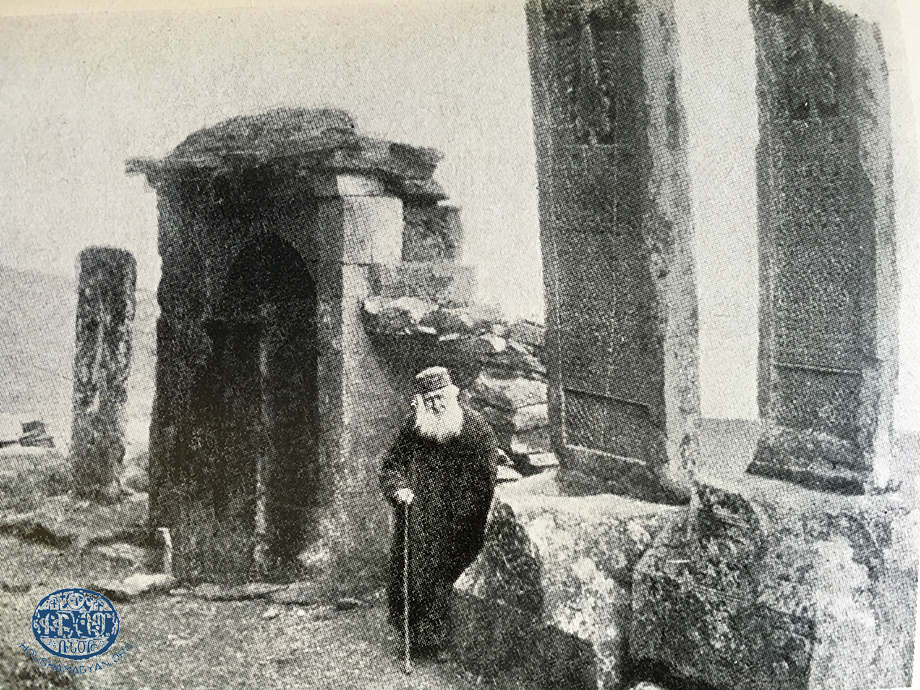 The cemetery of Msho Arakelots monastery before 1915. From a 1953 Viennese Mekhitarist publication
In 1915, the frontal assault against the Armenians also began on Saint George’s Day. That night, the Ottoman authorities arrested nearly three hundred leading Armenian intellectuals in Constantinople, preemptively preventing any centrally coordinated Armenian resistance. Most of those arrested were later murdered.
The monastery of Msho Arakelots was occupied by the Turkish army in May 1915. The monks and the abbot, Father Yovhannes Vardapet Muratian, were massacred, and the monastery was looted and set on fire. The buildings that still remained more or less intact were blown up in 1960 on the orders of the governor of Muş. Today only the ruins of the central section of the main church, dedicated to Saint Thaddeus, the first apostle of Armenia, stand on a barren hillside near Muş, unreachable by road. The monastery now survives only in the memories of refugees, such as in Vigen Galstyan’s story, where Aunt Angin, after much encouragement, recites her life story in a monotonous voice, all in one breath:
“…she spoke of a prosperous family living in a large village next to Mush not far from Lake Van in a stone house with two floors where five siblings grew up playing in an olive grove after coming back from school that taught arithmetic and needlework to prepare girls as clever housekeepers much like the mother who wove carpets and organized large feasts when the family went to Msho Arakelots monastery during festivals where the villagers sang and danced together until one day in 1915 they packed whatever they could in a cart and fled under the cover of the night from the Turkish army that chased them over the rocky mountains where Angin's mother had to leave her newborn under a rock so they wouldn't get caught and somehow reached Baghdad to find shelter in date palm orchards in which two of the boys died from fever before the father took them on the road again with other survivors shuffling from Iraq to Iran until their caravan arrived in Soviet Armenia in 1922 to rebuild their shattered lives on the other side of the Holy Mountain…”
 The remains of the Saint Thaddeus church of Msho Arakelots today
The monastery of Aghtamar was likewise attacked in May 1915 by the Turkish army and Kurdish marauders. The monks were massacred. From then on, the island was used as a military firing range, during which the exterior reliefs and interior frescoes suffered severe damage. In 1951, only Yaşar Kemal, the Kurdish-Turkish writer later nominated for the Nobel Prize, managed to prevent the church’s already prepared demolition. Then, in 2010, the Turkish state carried out a spectacular restoration of the church, explicitly presenting it as an example of Turkish ethnic and religious tolerance and respect for monuments—a claim richly contradicted not only by the thousands of destroyed Armenian, Greek, and Syriac villages and churches, but also by our own former Hungarian villages. Many Armenian and Turkish sources alike have criticized the tendentious nature of the restoration. Numerous reliefs had to be recarved, but the bullet-shattered faces of Saint George and his fellow mounted saints still illustrate the “special care” long shown toward Armenian monuments.
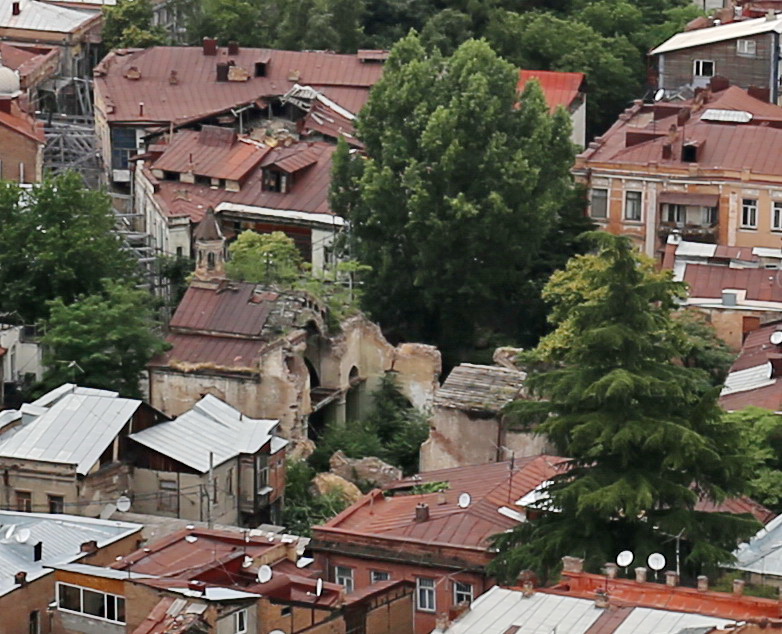
Saint George’s skull relic disappeared from the Saint George church of Mughni in Tbilisi in 1921, after the Bolsheviks entered the city. Yet the Armenians of Tbilisi continued to venerate the church deeply, and after Georgian independence, when the Georgian Church claimed all the churches of Tbilisi for itself, they refused to surrender it. In the early 2000s the church was vandalized, and in 2009 its dome was struck by lightning. It still stands there today, split open like a skull cleaved by a sword, with a forest of tree-of-heaven pouring from the crack.
After the destruction of the Msho Arakelots monastery, German archaeologists—still present in the Ottoman Empire because of their alliance with the Turks—noticed the monastery gate. They requested permission to transport it to Berlin, much as thirty years later Christian neighbors would request allocation of the pianos of deported Jews. The gate, however, only made it as far as Bitlis—the Armenian Baghesh. The Russian army’s offensive reached the city, and the Turkish soldiers who had looted the monastery fled before them. The gate, left behind among the spoils, was discovered by the outstanding Armenian historian and archaeologist Smbat Ter-Avetisian, who accompanied the Russian army in an effort to rescue the Armenian cultural heritage not yet destroyed. He arranged for it to be transported to Tbilisi for a future Armenian museum, and from there it was moved to Yerevan in 1925, once the Armenian Historical Museum had actually been established.
“He saved others; himself he could not save,” they mock Jesus hanging on the wood of the cross in the Gospel. Saint George, triumphantly enthroned upon the wood of the gate of Msho Arakelots, could not save others—but he did save himself. The gate still stands today in the section devoted to Western Armenian relics in the Historical Museum of Yerevan.



Add comment