

“The boundary of our world does not lie in the distance, nor along the horizon or in the depths; it flickers faintly much closer, along the blurred edges of our most intimate spaces. One morning someone finds a writhing starfish on the damp carpet of the living room, or a stubborn-looking little idol, bird- and turtle-shaped devices that occasionally hum with a red bulb blinking where their eyes should be, or books printed in unknown letters, filled with rainbow-colored illustrations of jungle temples and tigers. These things have merely washed up by accident on our shores, and we promptly wrap them in substitute meanings derived from false analogies drawn from our own experience. The protective arm of the careful and cunning deity of grammar shields us, concealing from us the faces of the monsters.”
Michal Ajvaz: Druhé město (The Other City), Brno 2005
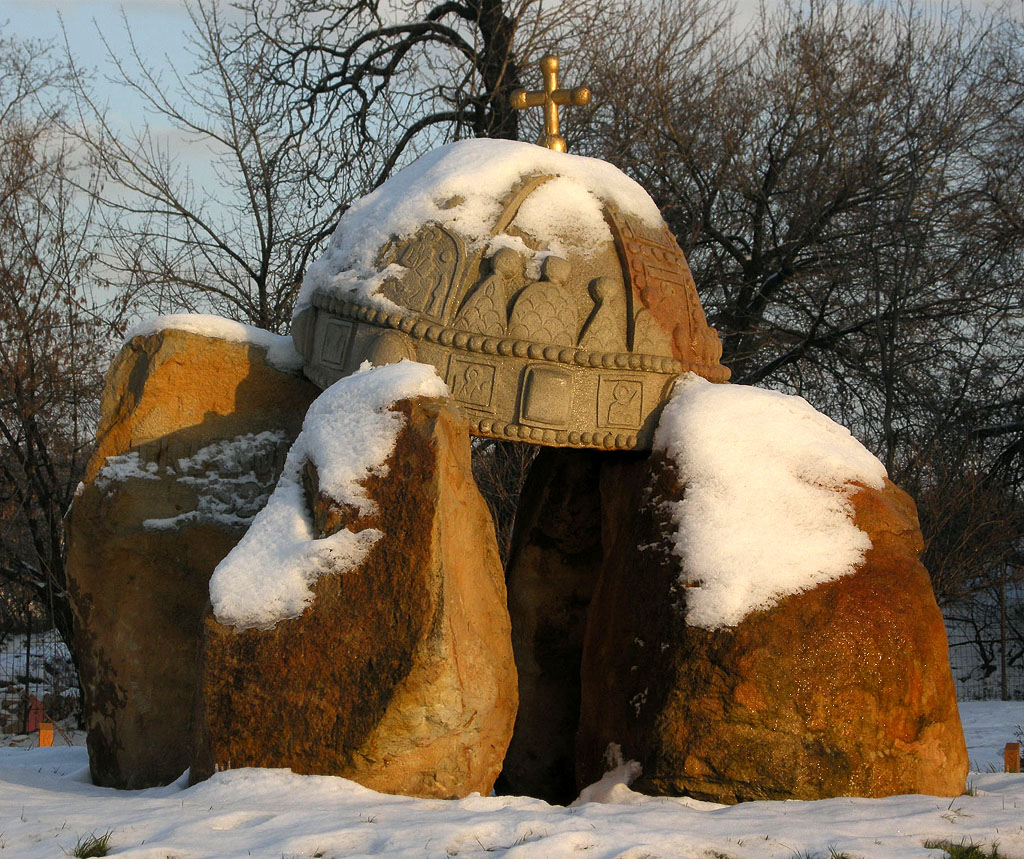
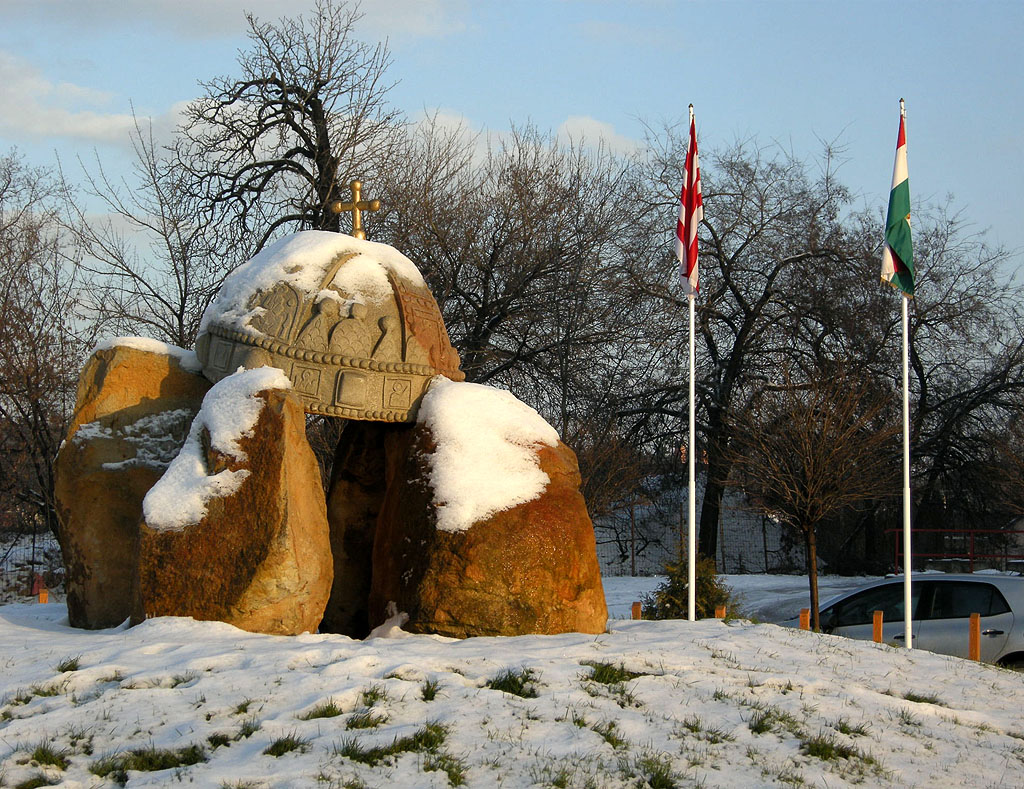
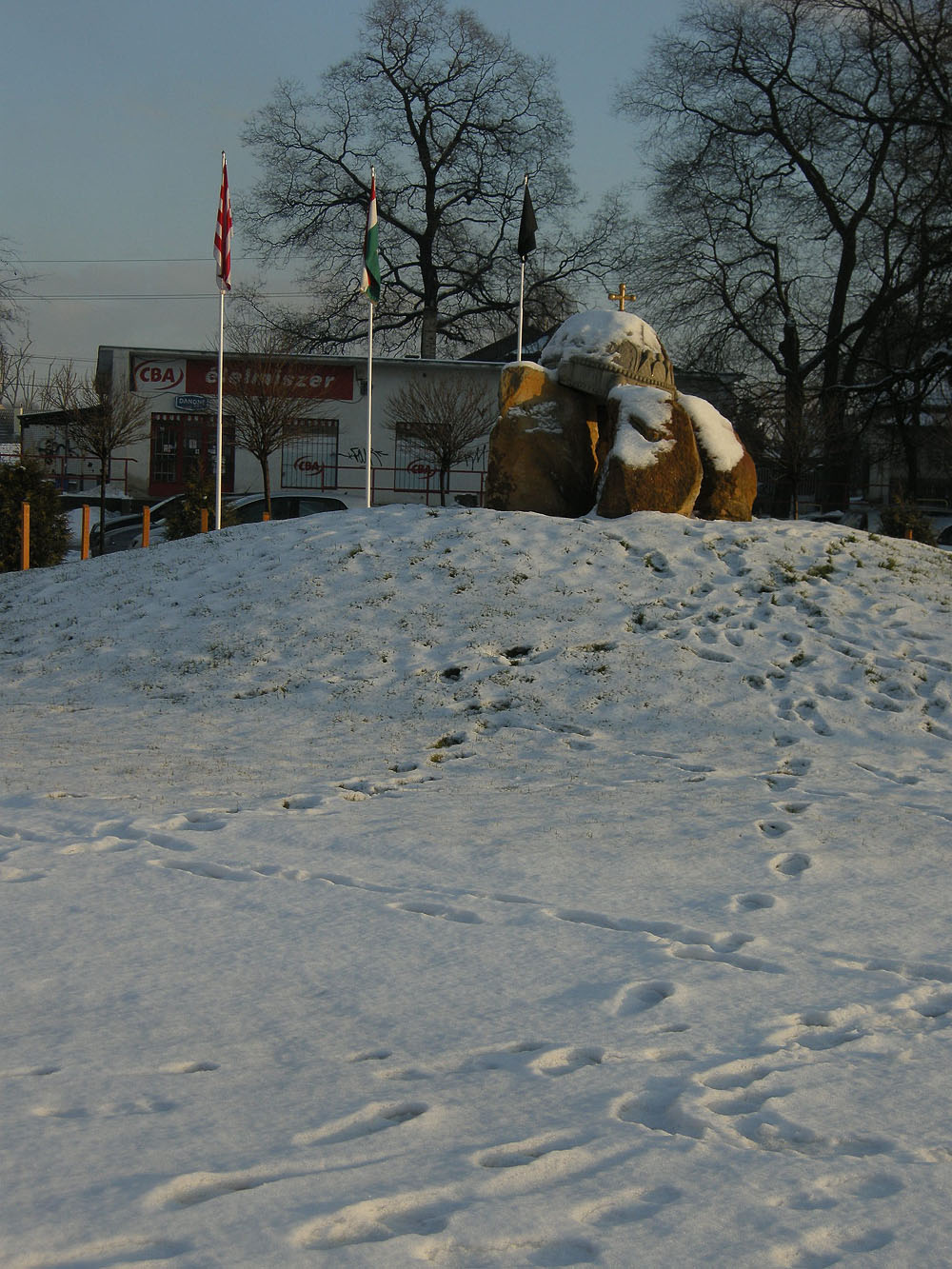
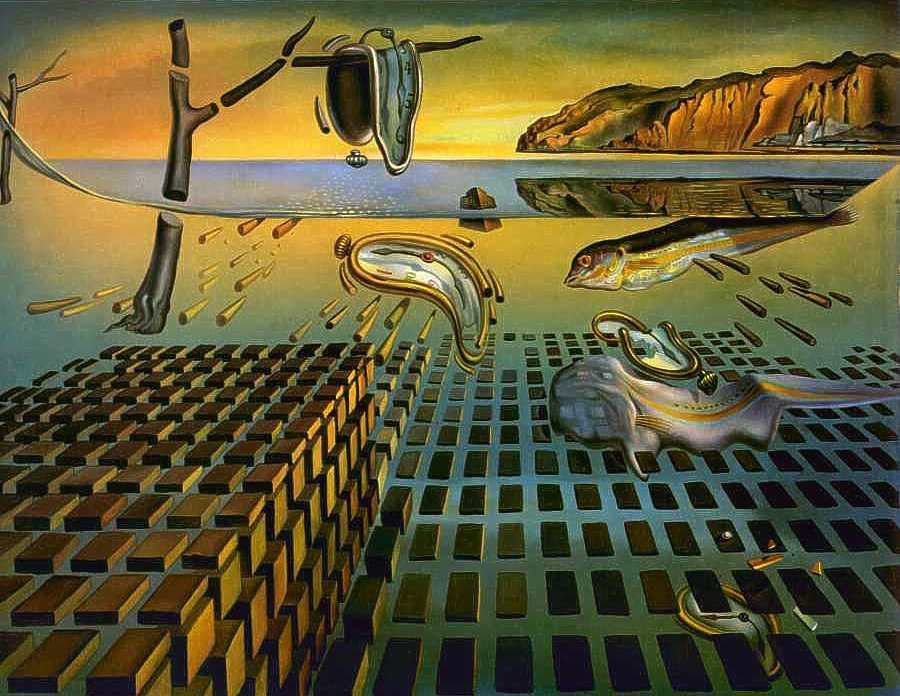
Just as the random objects intruding into our own world from the dim, irrational and surreal “other city” hidden behind familiar, everyday Prague—objects through which Michal Ajvaz gradually awakens to its existence—turn out not to be what they seem (the sandpit on Petřín Hill is in fact the skylight of an underground pagan cathedral, and the last door of the basement restroom in Café Slavia opens onto an endless jungle cut through by a vast river, where members of a tiger-worshipping sect slaughter their own heretics), so too the Hungarian crown standing in the small square opposite the Dunakeszi railway station—melting over its supporting Stonehenge-like dolmens like Dalí’s clocks, dissolving and invalidating time—is not identical with the Hungarian crown we saw in the previous two posts, even though it looks uncannily similar. The latter is the regalia used by Hungarian kings since the 12th century, whose variously sourced components, its fine 11th-century Limoges and 12th-century Byzantine cloisonné enamels, the portrait of Emperor Michael Doukas inserted—perhaps indeed—where an image of the Virgin Mary once stood, the cross perched proudly askew on top for reasons unknown, and its entire turbulent history together form a faithful mirror of a thousand years of Hungarian statehood. The crown modeled in Dunakeszi, however, is presented as a many-thousand- or even tens-of-thousands-year-old ancient Inner Asian Hun—or perhaps Sumerian (which, ultimately, is said to be the same)—magical model of the universe, an energy center, the sum of infinite knowledge stemming either from extraterrestrial origins or from humanity’s collective unconscious, the tabernacle of the highest religion ever to have existed or even to be imagined. *
The priests and followers of this religion walk among us, just like the nocturnal high priest of the Dargus faith in Ajvaz’s novel, who by day is a waiter in a Pohořelec bistro. Stubborn Calvinists who scornfully denounce papist idol worship, yet pronounce the name of the Holy Crown with reverence. Daily communicant Catholics who, with the devoted support of their parish priest, spread the Gospel of the Holy Crown week after week at prayer-circle gatherings. Department heads of the Széchényi National Library who open the grand hall of the nation’s library to the preaching of the cult. Architects—the leading knightly order of this religion—from whom one would hope for structurally sound houses, and instead receive blueprints of the Holy Crown’s world-embracing energy lines. Goldsmiths, sculptors and applied artists who, on the one hand, lend their names to guarantee the authenticity of the cult object’s myth of origin, and on the other fill community centers, public squares, institutions and publications with artworks inspired by that myth. Their presence is more palpable in the countryside, where I too live, than in the city, where— as Ajvaz puts it—the protective arm of the careful and cunning deity of grammar more effectively conceals from our eyes their networks and local congregations, whose regular gatherings are nourished spiritually by the religion’s itinerant prophets.
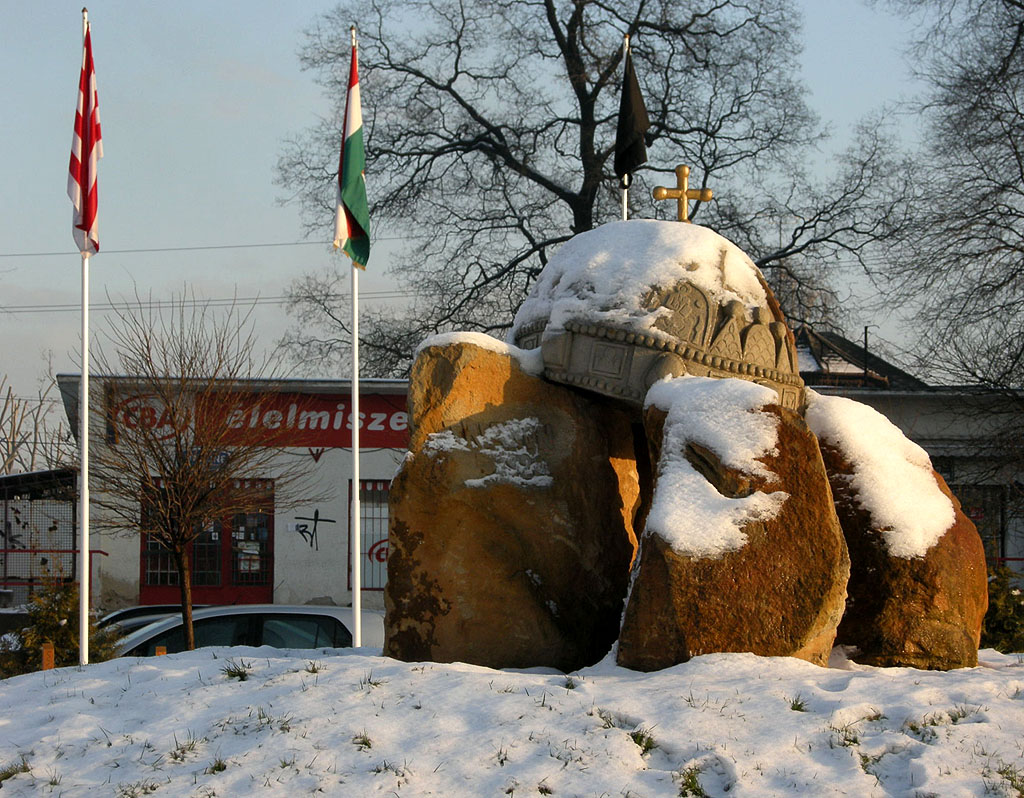
The Dunakeszi crown points clearly toward this still-concealed other world not only through its characteristic stylistic features—rigid, idol-like execution, rustic dolmens, a kurgan-like substructure—but also by embodying one of the cult’s key doctrines: that the angle of the cross atop the crown—or, according to certain denominations, of the turul bird that originally stood in its place—precisely matches the Earth’s axial tilt, that is, the angle between the plane of the ecliptic and the Earth’s axis. To emphasize this, the sculptor slid the crown onto the dolmens in such a way that now everything upon it stands askew except for the one element that is truly tilted, the cross, which thus rises vertically toward the sky, parallel to the Earth’s axis, like a tiny magical antenna aimed straight at the North Star.
|
|
In order to make realistic |
Still concealed, I say. For while Michal Ajvaz maps how an “other world” quietly fills the cavities of everyday reality, another Czech writer, Karel Čapek, already described in his novel War with the Newts what happens when, in a destabilized situation, that other, dark and surreal world pushes forcefully into ours.
God save us from that.



Add comment