

Our Israeli friends gave us this book as a gift. I suppose there’s no need to transliterate the title into Latin letters. The knight of the sorrowful countenance and his faithful squire—especially with a few windmills in the background—are foundational memes of our culture. And surely there’s no need to mention the author’s name either; everyone knows it, right? Let’s open the book. There it is, in the colophon: the very first name, above that of the illustrator (יאנוֺש קאש, János Kass) and the translator (הגר אנוש, Hagar Enosh) מיקלוֺש רַדנוֺטי, that is to say—Miklós Radnóti! Uh… this is not exactly what I had in mind.

Miklós Radnóti is known in Israel as the poet of the Holocaust. When, on the centenary of his birth, his ninety-seven-year-old widow, Fanni Gyarmati, donated his handwritten literary estate to the Library of the Hungarian Academy of Sciences, I prepared its online presentation, and the statistics show just how many visitors come from Israel. But was he also the author of the most famous Spanish novel of the seventeenth century? That would require the ability to travel back in time and soar through space—perhaps like the power Hasidic tradition attributes to the Baal Shem Tov, the holy man of the mountains, who would journey at night from the Carpathians to Eretz to converse with saints of long ago about the Kabbalah. Of course, we know that great poets live forever. But time moves in only one direction.
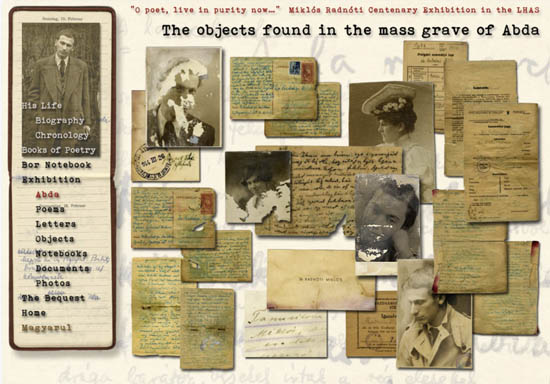
What’s more, Hungarian library records clearly show that Miklós Radnóti was at least a co-author of that Hungarian version of Don Quixote which today is the only one available on the book market in this language. But just compare the page counts: the original Spanish Quixote runs to seven hundred pages, while the Hungarian version bearing Radnóti’s name rarely exceeds one hundred and eighty—even with all the full-page illustrations included.

Why does Radnóti’s name appear in the colophon of Don Quixote? Dániel Végh’s article on Hungarian translations of Cervantes, published in the May 2009 issue of Forrás, sheds light on the matter. Radnóti did not know Spanish, but the Spanish Civil War of 1936 sparked his interest in the country. He mentions it in several writings, and he translated some of García Lorca’s poems into Hungarian from György Bálint’s rough translations. Even in his First Eclogue, written in a labor camp shortly before his death, he has his Virgilian characters say the following:
Pásztor:
Hallom, igaz, hogy a vad Pirenéusok ormain izzó
ágyucsövek feleselnek a vérbefagyott tetemek közt,
s medvék és katonák együtt menekülnek el onnan;
asszonyi had, gyerek és öreg összekötött batyuval fut
s földrehasal, ha fölötte keringeni kezd a halál és
annyi halott hever ott, hogy nincs aki eltakarítsa.
Azt hiszem, ismerted Federícót, elmenekült, mondd?
Költő:
Nem menekült. Két éve megölték már Granadában.
Pásztor:
Garcia Lorca halott! hogy senki se mondta nekem még!
Háboruról oly gyorsan iramlik a hír, s aki költő
így tünik el! hát nem gyászolta meg őt Európa?
Költő:
Észre se vették. S jó, ha a szél a parázst kotorászva
tört sorokat lel a máglya helyén s megjegyzi magának.
Ennyi marad meg majd a kiváncsi utódnak a műből.
Shepherd:
I hear it’s true, on the wild Pyrenees’ heights,
that blazing cannon mouths volley amid the blood-frozen corpses,
and bears and soldiers flee together from there;
women, children, old men, running with bundles tied,
lie flat on the ground when Death begins to circle above,
and so many dead lie there that no one can clear them away.
I think you knew Federico—did he escape, tell me?
Poet:
He did not escape. Two years ago he was already killed in Granada.
Shepherd:
García Lorca is dead! And no one told me yet!
News of war races so fast, yet a poet disappears thus!
Did not Europe mourn him?
Poet:
They did not notice. And it is well if the wind, stirring the embers,
finds broken lines upon the pyre and takes note of them.
This is all that will remain for the curious heir from the work.
He read an abridged French version of Don Quixote in Paris in 1937. A letter to István Vas reveals that in October 1943, after returning from his second term of forced labor service, he was working on a similarly shortened edition for young readers during his creative retreat in Mátraháza: “I am toiling away at Don Quixote, I hope to take it home finished I haven’t written any poems; the Knight of the Sorrowful Face has completely devoured me.” The book was published at Christmas 1943 by the editor Imre Cserépfalvi, with a foreword by Sándor Márai, who later fled communist Hungary. After the war, the volume was nearly destroyed because of the “treason” of its prologue’s author, but the all-powerful ideological pope György Lukács defended it, and in 1953 it was allowed to appear again. Since then it has gone through ten more editions—without the foreword and with illustrations by János Kass. This is the version translated into Hebrew.

The colophon of the 1943 edition states that Radnóti “made fruitful use of Vilmos Győry’s complete Hungarian translation of Cervantes’ masterpiece, as well as the French adaptation for young readers.” Győry’s 1926 translation was itself far from complete, yet it was still much more substantial than Radnóti’s brief text, which amounts to barely a quarter of the original Don Quixote.
And yet both Győry’s and Radnóti’s versions omit so much of the original Don Quixote that they fundamentally distort its meaning.
Hungarian readers who grew up with Radnóti’s version tend to remember Don Quixote as the story of an eccentric knight who, in the seventeenth century, tries to revive the spirit of the chivalric romances popular since the fifteenth century—only to have his lance shattered again and again against the windmills of modern reality.

It’s a fascinating and endlessly recycled metaphor—but the complete novel, which Hungarian readers cannot read in their own language, is about something else. About many other things. At its heart stands an author who, as a retired soldier crippled in his left hand at the Battle of Lepanto, decides in old age to write a novel—specifically a chivalric romance—despite having no prior narrative experience beyond a pastoral novel, La Galatea. The resulting story, seven hundred pages long and published in two parts ten years apart, unfolds along two threads: while narrating the episodes of the outdated knight and his squire, the author constantly reflects on his own activity, makes excuses, disguises himself within a tangle of supposed authors, explains, ironizes, consults sources and blends them together into a grand lesson in literature. In this novel there are many Quixotes: the protagonist, of course, but also the author himself—quixotic in his own way, presenting himself as a reading fanatic, yet uncertain about the very work he has brought into being.

The introduction opens with the author explaining that he would like to create something truly great—but finds it impossible:
“Idle reader, without any oath you may believe me that I would wish this book, as the child of my understanding, to be the most beautiful, the most gallant and the most discreet that could be imagined. But I have not been able to contravene the order of nature; for in it each thing begets its like.”
So he turns for advice to a well-read friend, who shows him how to pad the text with classical references, famous names, quotations, and marginal notes. In this way he delivers a satirical blow to the literature of his own time—much as Frigyes Karinthy does in his celebrated collection of literary parodies Így írtok ti (This Is How You Write, 1912). Between the introduction and the first chapter, a whole series of sonnets and epigrams pays tribute to Don Quixote and his author. Long-dead heroes of chivalric romances appear—Amadís de Gaula, Ariosto’s Orlando—and there is even a dialogued sonnet between Babieca and Rocinante, the horse of El Cid Campeador and the famously melancholy steed of Don Quixote himself. It is as if a historical work on the Turkish period in Hungary were introduced by epigrams from Gergely Bornemissza, the aga of Koppány, and Jumurdzsák—all imaginary heroes of twentieth-century romantic historical novels.

After the introduction and the poems omitted by Radnóti, the first sentence of the first chapter—often ranked among the great opening lines of world literature—appears: “In a village of La Mancha, whose name I do not wish to recall, there lived a gentleman ” The story and the author’s reflection begin at the very same moment. Radnóti completely omits the reflection and removes the clause “whose name I do not wish to recall,” thereby castrating the great sentence—and, in truth, the author’s entire voice.

Cervantes is present in his text in countless ways: he comments on it, critiques it, makes playful references, and keeps his distance. One of his strokes of genius comes after narrating the first adventures. Before the novel turns into a more or less random sequence of comic or picaresque episodes (as happens in Radnóti’s version), he pauses to reflect on how to continue. And then organized chance comes to his aid:
“One day, as I was in the Alcaná of Toledo, a boy came by selling some notebooks and old papers to a silk merchant; and as I am fond of reading—even scraps of paper picked up in the streets—carried away by this natural inclination of mine, I took up one of the notebooks the boy was selling and saw that it was written in characters I recognized as Arabic. And though I knew the script, I could not read it, so I looked around to see whether there might be some Morisco who could read it for me, and it was not very difficult to find such an interpreter; indeed, even had I sought one of some better and more ancient tongue, I should have found him. [Interesting allusion to Hebrew, which the crypto-Jews living in Toledo were likely to know] In short, fortune provided me with one; and when I told him what I wanted and put the book into his hands, he opened it in the middle and, after reading a little, began to laugh.
I asked him what he was laughing at, and he replied that it was something written in the margin by way of annotation. I asked him to tell me, and he, still laughing, said:
—Here in the margin, as I have said, is written this: ‘This Dulcinea del Toboso, so often mentioned in this history, they say had the best hand at salting pork of any woman in all La Mancha.’
When I heard the name “Dulcinea del Toboso,” I was struck dumb with astonishment, for it instantly occurred to me that those bundles of papers must contain the story of Don Quixote. With that thought, I urged him to read the beginning; and doing so, translating the Arabic into Castilian on the spot, he said it read: History of Don Quixote of La Mancha, written by Cide Hamete Benengeli, Arab historian. I needed all my self-control to conceal the delight I felt when the book’s title reached my ears; and snatching it from the silk merchant, I bought all the papers and notebooks from the boy for half a real. Had he been shrewd and known how much I wanted them, he might easily have charged—and received—more than six reales. I immediately withdrew with the Morisco into the cloister of the main church and begged him to translate into Castilian all the notebooks dealing with Don Quixote, without adding or omitting anything, offering him whatever payment he wished. He was satisfied with two arrobas of raisins and two fanegas of wheat, and promised to translate them well and faithfully, and with all possible speed; but to make matters easier and not let such a fine find slip from my hands, I brought him to my house, where in little more than a month and a half he translated the whole work, exactly as it is set down here.” (Q, I.9)
From this point on, Cervantes can refer to the text as something independent—supposedly the work of a Moorish historian (that is, thoroughly unreliable) and translated into Spanish by someone other than himself. He can criticize it, allude to it, argue with it—and he frequently does.
“He who translated this great history from the original written by its first author, Cide Hamete Benengeli, says that upon reaching the chapter of the adventure of the Cave of Montesinos, he found written in the margin, in Hamete’s own hand, these very words: ‘I cannot persuade myself nor make myself believe that everything set down in the preceding chapter truly happened to the valiant Don Quixote. The reason is that all the adventures so far have been possible and plausible; but this one of the cave I can find no way to accept as true, for it lies so far beyond the bounds of reason. Yet to suppose that Don Quixote lied—he being the most truthful gentleman and noblest knight of his age—is impossible; he would not have told a lie even had they shot arrows at him. On the other hand, I consider that he recounted it with all the circumstances here described, and that he could not in so short a time have fabricated so vast a machine of absurdities; and if this adventure seems apocryphal, I am not to blame; and thus, without affirming it to be false or true, I set it down.’”
Sansón Carrasco, the bachelor, refers to Benengeli’s book as if it had already been published—even though he himself appears in it:
“Give me your hand, Your Grace, Señor Don Quixote of La Mancha; for by the habit of Saint Peter which I wear—though I have taken no orders beyond the first four—I declare that you are one of the most famous knights-errant that have ever existed, or ever shall exist, in all the round of the earth. Blessed be Cide Hamete Benengeli, who left the history of your great deeds in writing, and blessed again the curious man who took the trouble to have them translated from Arabic into our common Castilian, for the universal delight of mankind.”
Even Sancho Panza spots the falsification:
“Believe me, Your Graces,” said Sancho, “the Sancho and the Don Quixote in that story must be different from the ones who appear in the history composed by Cide Hamete Benengeli—that is, from us: my master, brave, discreet, and in love; and I, simple and witty, but neither a glutton nor a drunkard.”
“So I believe,” said Don Juan; “and if it were possible, it ought to be decreed that no one should dare treat the affairs of the great Don Quixote unless it were Cide Hamete, his original author—just as Alexander ordered that no one should dare paint him but Apelles.”

Cervantes’ Don Quixote is a work that has been called genuinely “postmodern” ante festam, with an author who narrates in multiple voices and perspectives. The story is not only about an anachronistic knight, but also about a one-handed writer trying to compose a respectable chivalric romance, while attributing his failures (and sometimes his successes) to a shadowy Moorish author.
“He helped him to rise, and Don Quixote said: ‘In that case, is it true that there is a history of me, and that it was composed by a Moor and a learned man?’
‘It is so true, sir,’ said Sansón, ‘that I believe more than twelve thousand copies of that history are printed today. Let Portugal, Barcelona, and Valencia speak for it, where it has been printed; and there is even talk that it is being printed in Antwerp; and I have a feeling there will be no nation or language into which it is not translated.’”
“Life is a dream,” as his great contemporary Don Pedro Calderón de la Barca would later write—or at least, it is a literary construction. This plural, self-aware authorial voice, open to multiple perspectives and constantly accompanying the plot, is what makes Don Quixote such a great modern novel. And it is precisely this that is entirely missing from Radnóti’s popular version.

Borges has a story in El Aleph about a fictional author, Pierre Menard, who in the 1930s rewrote Don Quixote. That is to say, he did not copy it, but reconstructed Cervantes’ mental state: “to be a Catholic again, to forget everything that happened between 1601 and 1930,” and to recreate the text from vague childhood memories. The final version coincides word for word with Cervantes’ work. “But what a tedious and anachronistic work it is.” In 1930 one could no longer write a book that truly belonged to the seventeenth century.
In the 1930s Radnóti wrote a Don Quixote that fit the twentieth century—the age of two-page novel summaries. And in doing so, he ruined a great work. Unless a Hungarian reader learns Spanish perfectly and devotes the time to read the seven hundred incomparable, baroque pages, they will never understand why this novel is so great. Not because it parodies the chivalric genre, but because while writing that parody, Cervantes brilliantly critiques the limits of an author’s “authority” and simultaneously reassesses all the literature of his time. The original Don Quixote is the Így írtok ti of its age. Radnóti—who likely enjoyed Frigyes Karinthy’s Így írtok ti—almost certainly failed to grasp what an immense parody and model of literature he was withholding from future Hungarian readers: a work without which the evolution of the modern novel—from Tristram Shandy to, to name a fully “postmodern” example, The Sot-Weed Factor—cannot truly be understood.




Add comment