


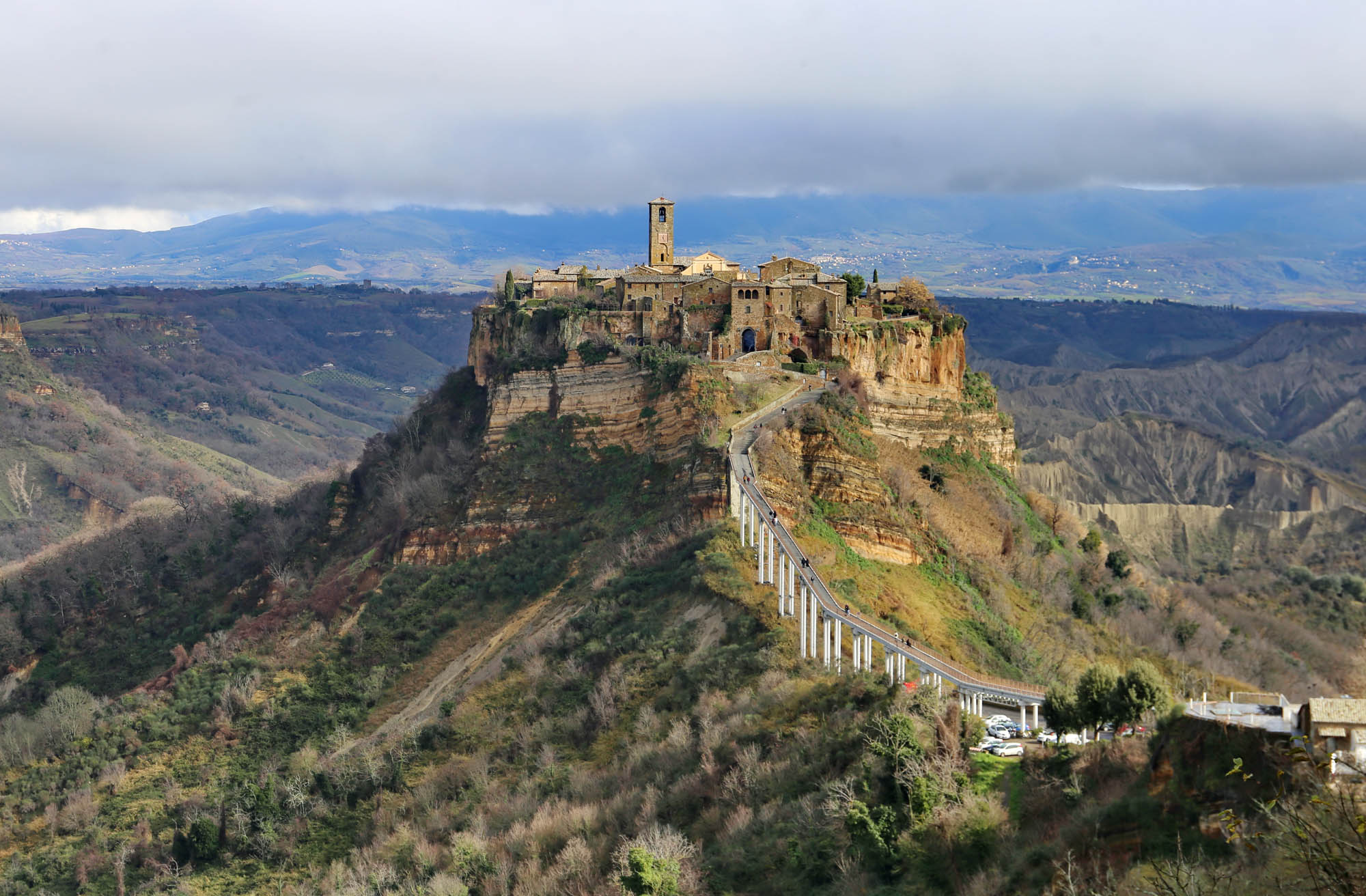
The expression “la città che muore” – “the dying city” – was first used by Bonaventura Tecchi for his hometown, Civita di Bagnoregio, in the late 1940s. The phrase stuck so firmly that by 1950 a documentary was already being filmed under this very title about the town slowly undermined by erosion.
But in Northern Lazio’s Tuscia region there are several such towns. The geology of the area is peculiar: layers of clayey marine sediments are capped by volcanic formations, mainly tufa rock. Tufa is extremely vulnerable to erosion. Water seeps into its fissures, hollowing out cavities that eventually collapse. As the unstable ground shifts, cracks open along the edge of the cliff, which then begins to peel away in vertical layers. What once seemed like a brilliant idea – settling atop a naturally well-defended tufa cliff – gradually turns into the town’s slow disintegration.
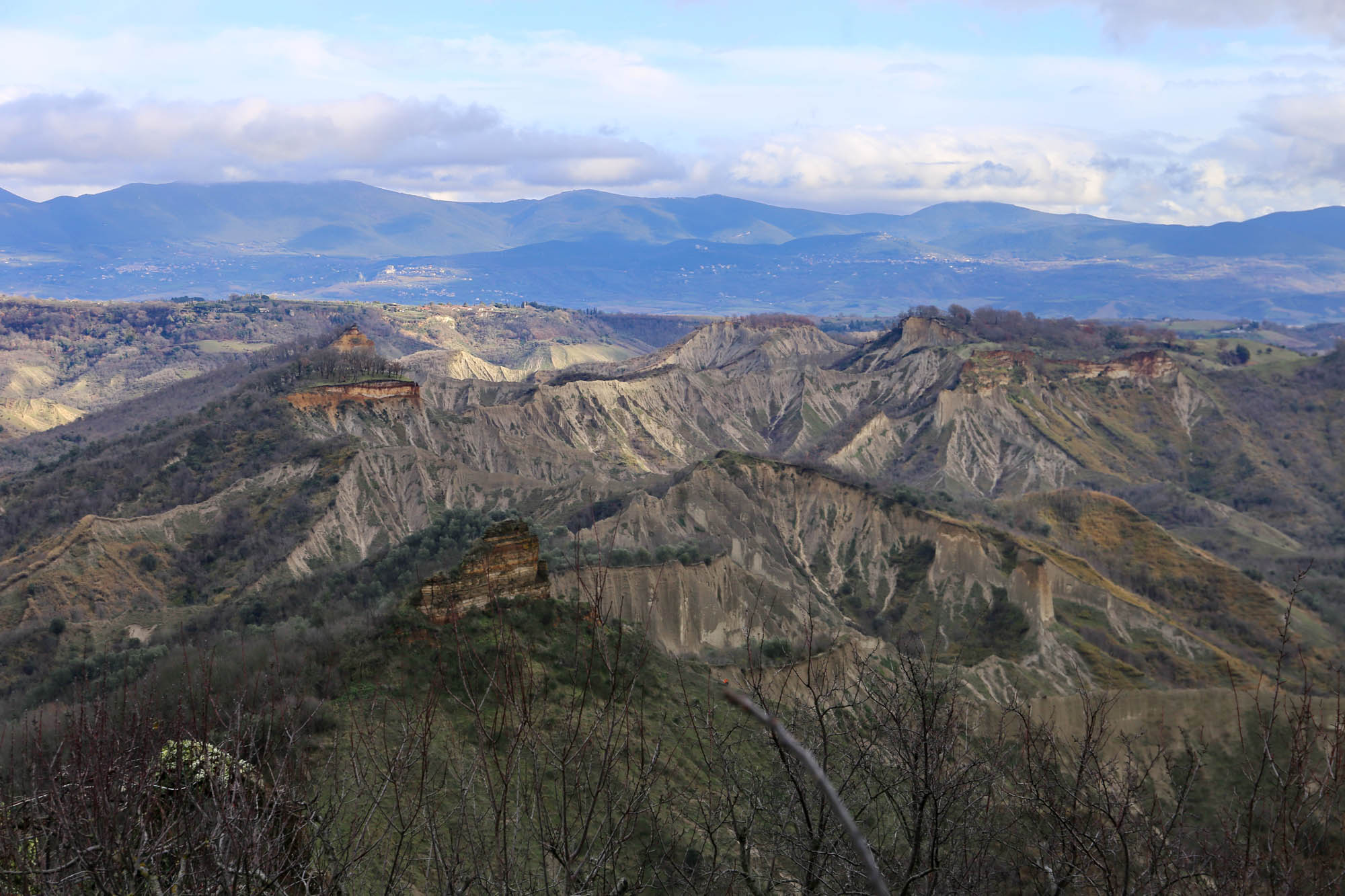 Calanchi, erosion valleys seen from the walls of Civita di Bagnoregio
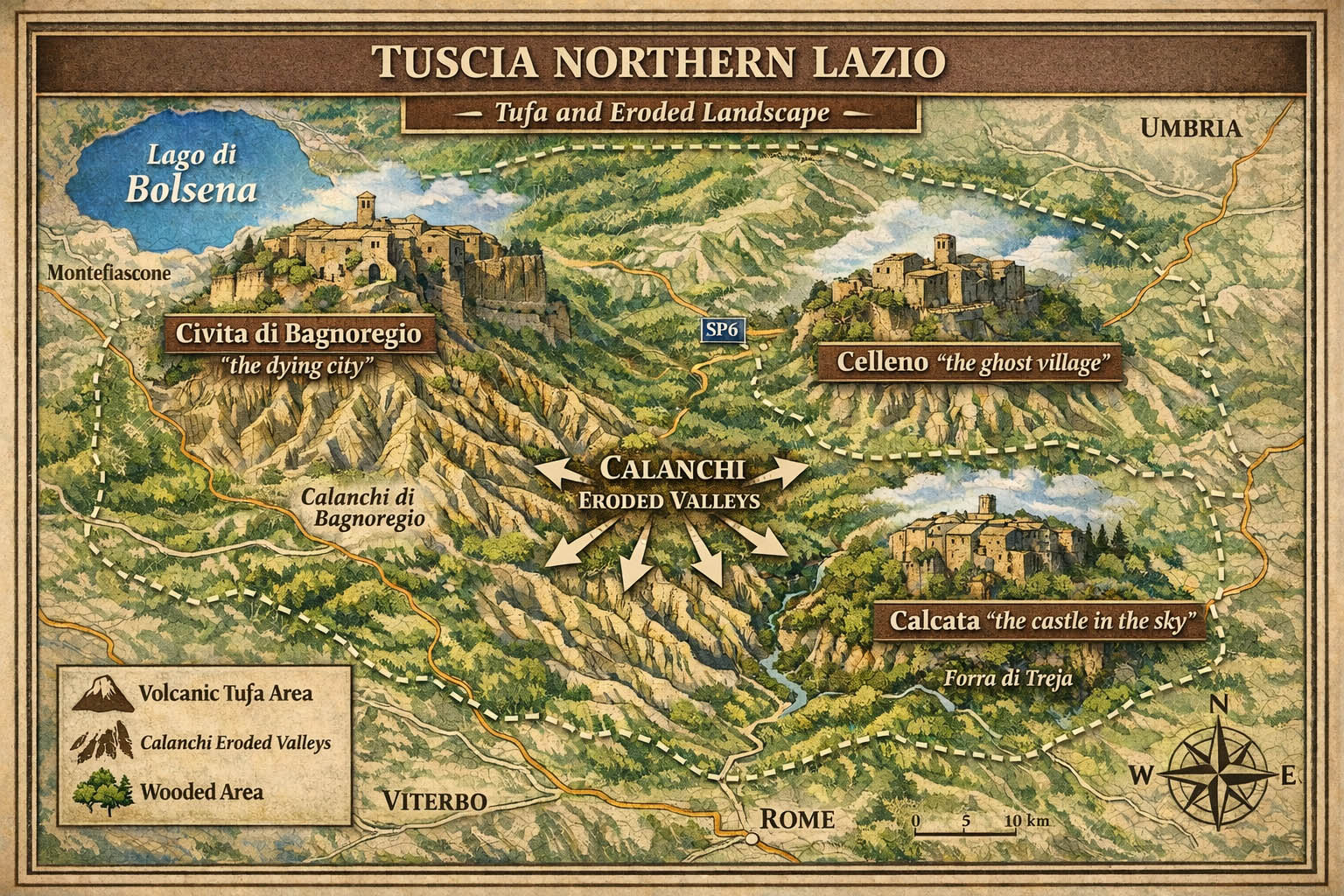
In the area of Tuscia known as Vulcani della Sabina there are three such towns: Civita di Bagnoregio, Calcata, and Celleno. All three are threatened by the same danger. In the 1930s each was officially declared uninhabitable, and the exodus began. Yet after that, the local communities – municipalities and residents alike – chose different strategies in each place, leading to three very different destinies.
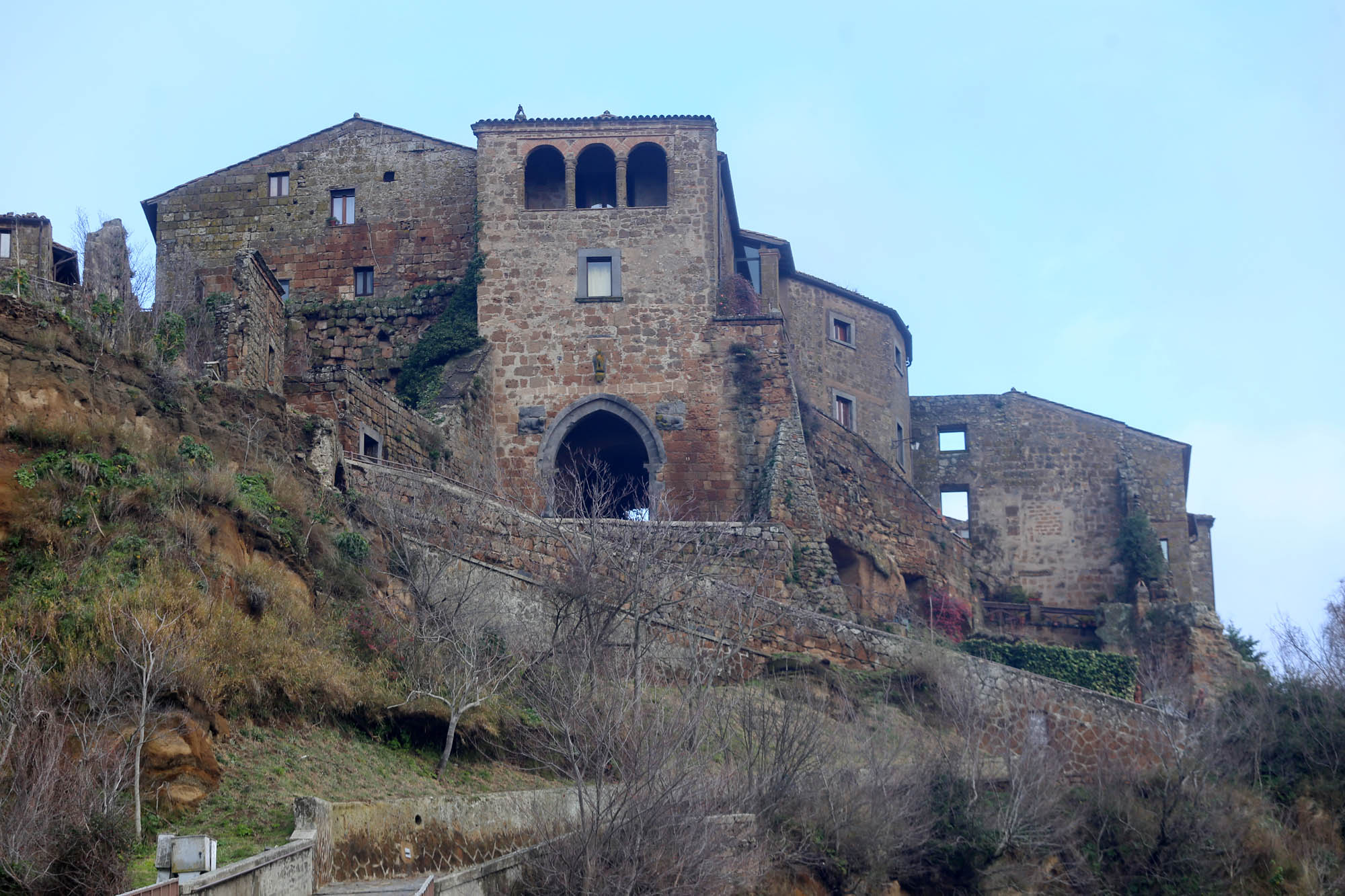
Civita di Bagnoregio was founded by the Etruscans in the 6th century BC; from them remain the chessboard-like street grid and a small necropolis. The town’s most famous son, Saint Bonaventure of Bagnoregio (1217–1274), the Franciscan Doctor of the Church, used to withdraw for prayer into a “cave” that had originally been an Etruscan burial chamber. After the Roman conquest of the Etruscan regional center Velzna (modern Orvieto) in 264 BC, Roman settlers followed.
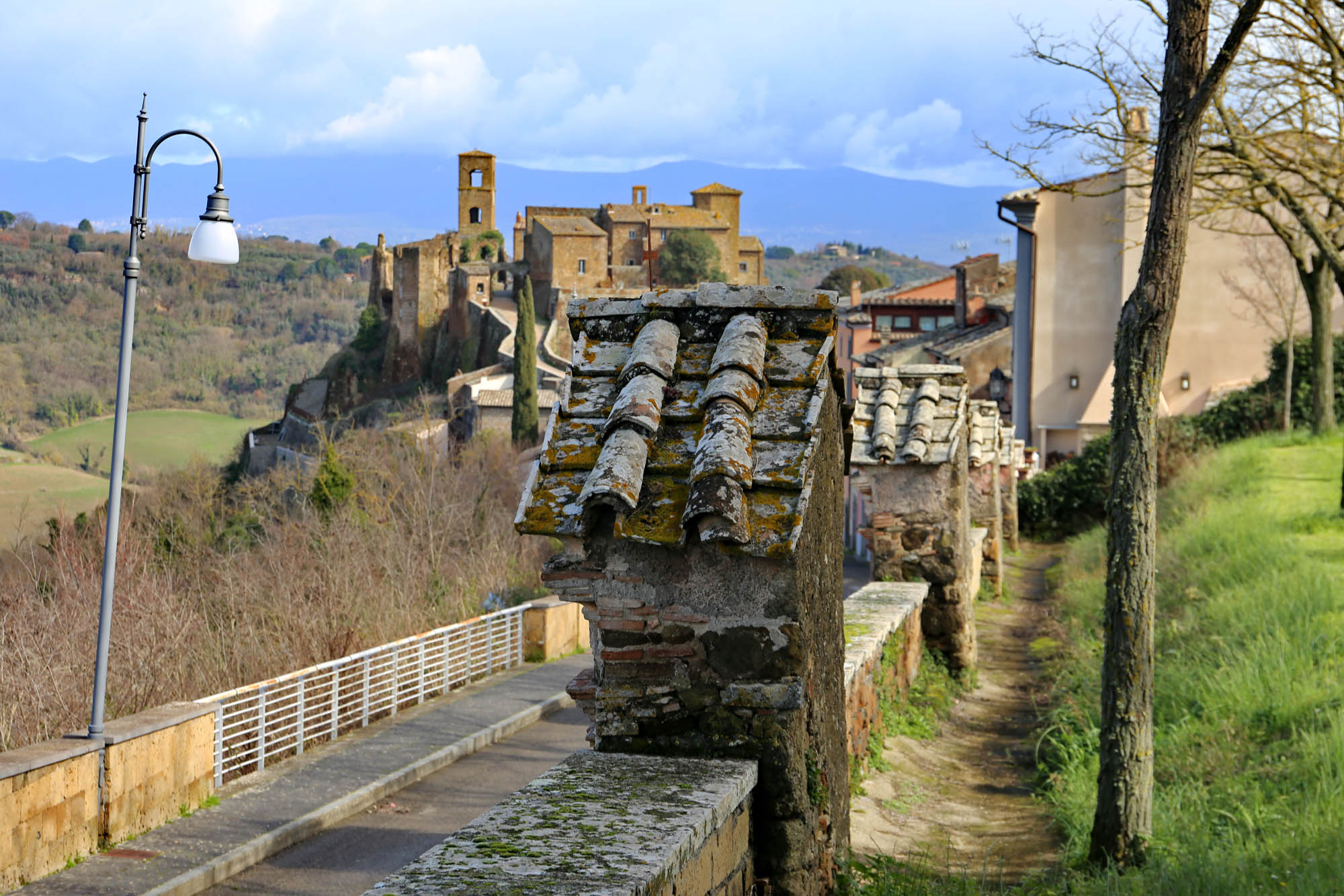
Even the Romans noticed the problem and attempted to channel rainwater away from the town to prevent it from undermining the tufa. This undoubtedly slowed the process, but it did not stop it. The medieval town was surrounded by walls with five gates and access roads leading up to them. Today, due to erosion along the cliff’s edge, only fragments of the walls survive; none of the roads remain, and of the five gates only one still stands: the Porta di Santa Maria.
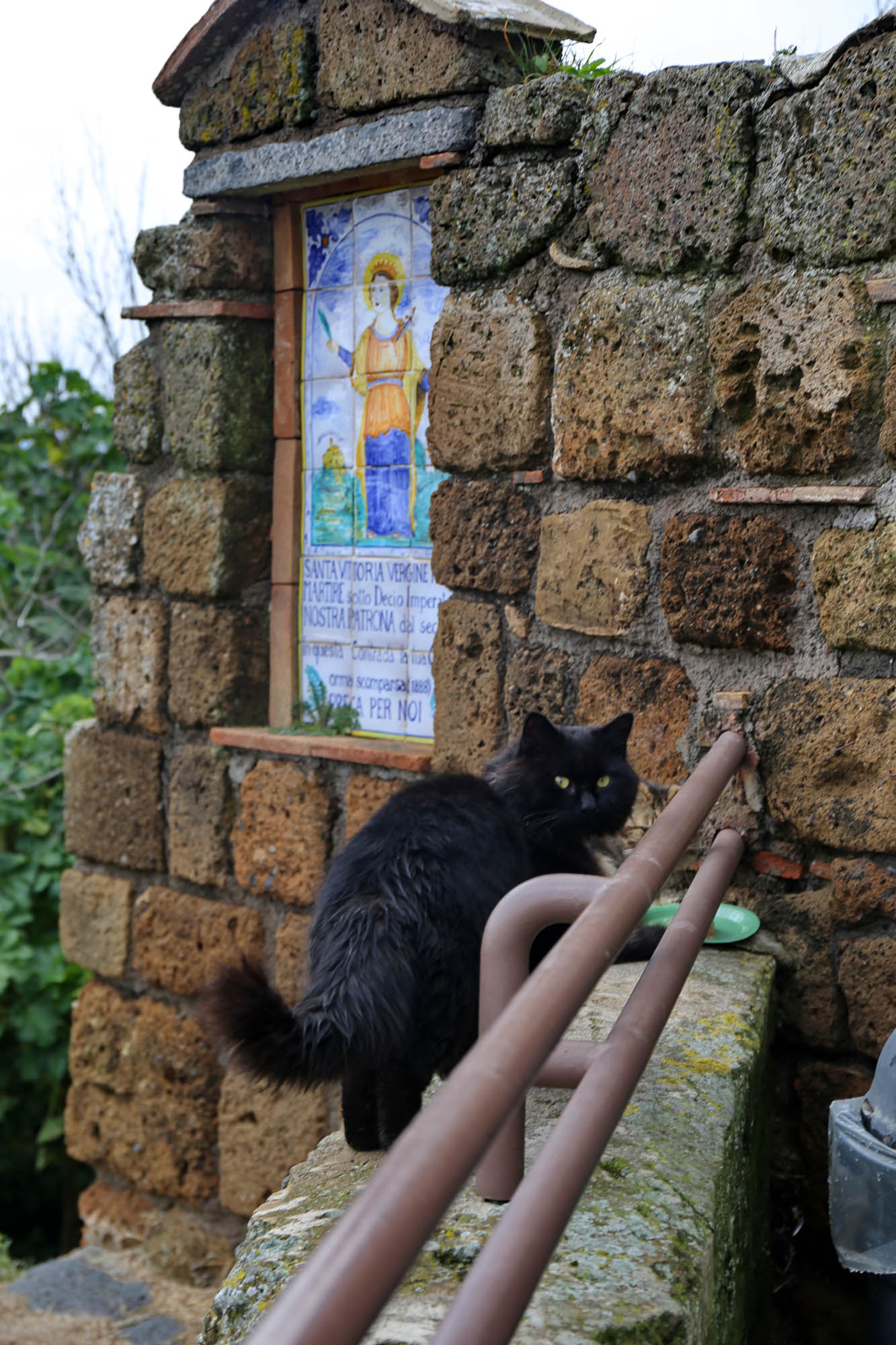 A ceramic image of Saint Victoria, the town’s patron saint, inserted into the collapsed city wall next to the gate. The relic of the virgin martyr was once kept in the church, but it was stolen in 1888. The inscription on the image refers to this: “…even if you have vanished, pray for us.”
In the 1930s, based on local expert reports from the Ministry of Public Works, the Ministry of the Interior declared the settlement life-threatening, and the provincial prefect ordered its evacuation and eventual demolition. Today most of us would be horrified at the idea of tearing down a 2,500-year-old town, yet at the time this fit neatly into Fascist heritage policy, which placed little value on modest medieval monuments. In Rome itself, ancient remains were aggressively “cleansed” of the medieval additions, dwellings, and shops that had accumulated over two millennia – a process popularly known as the sventramento di Roma, the “gutting of Rome” – to which we owe the vast, sterile, lifeless ruin fields in the historic center today.
The demolition was delayed by the war, but aware of the verdict hanging over them, residents tried to secure better homes in the surrounding towns. After the war, impoverished Italian municipalities had far more pressing concerns than carrying out the previous regime’s demolition orders — not to mention providing new housing for those to be evicted. And so, by the 1960s, around 120 inhabitants still remained in the town, down from 1,200 at the turn of the century.
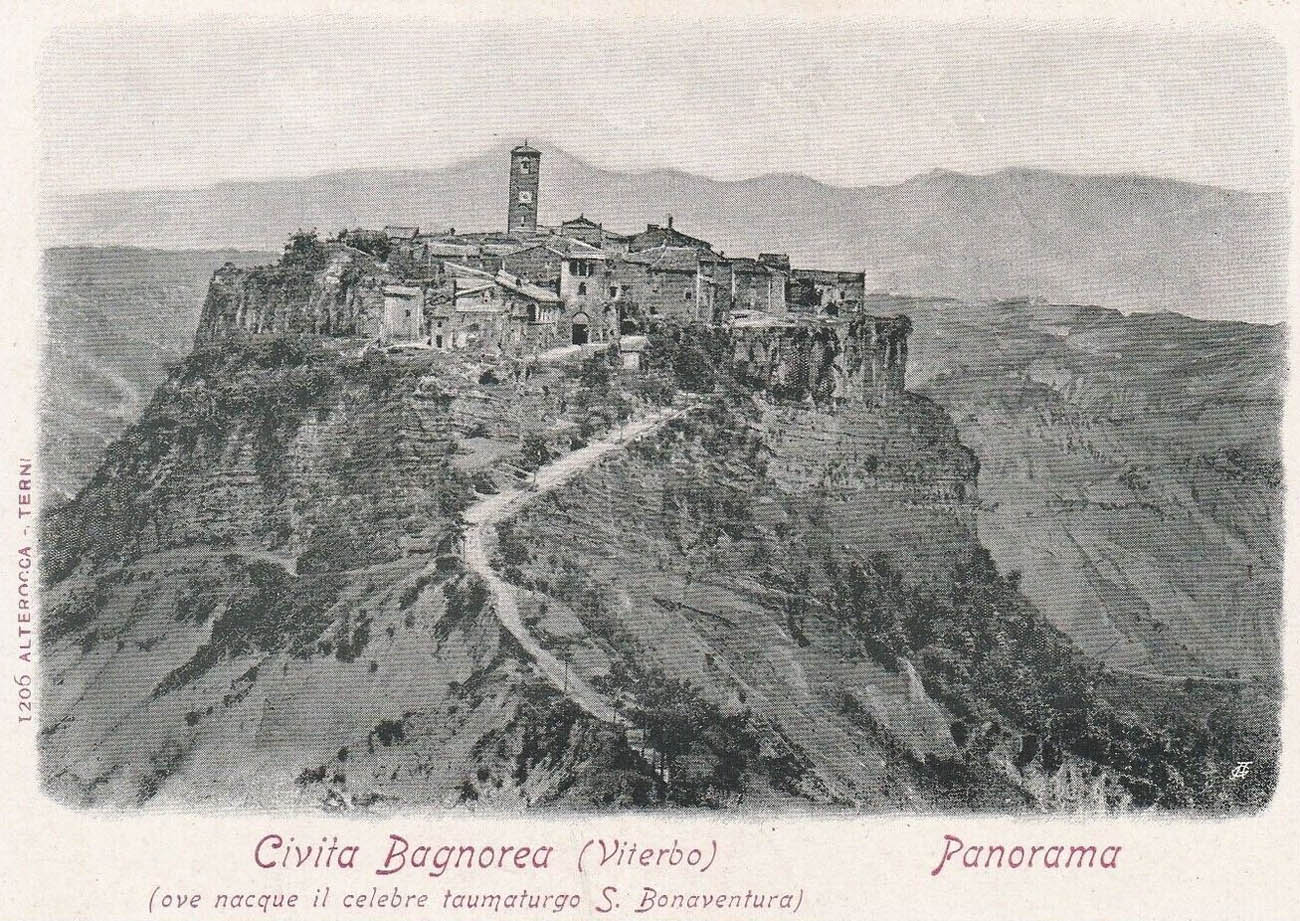 The town around 1900. The old road was still in use.
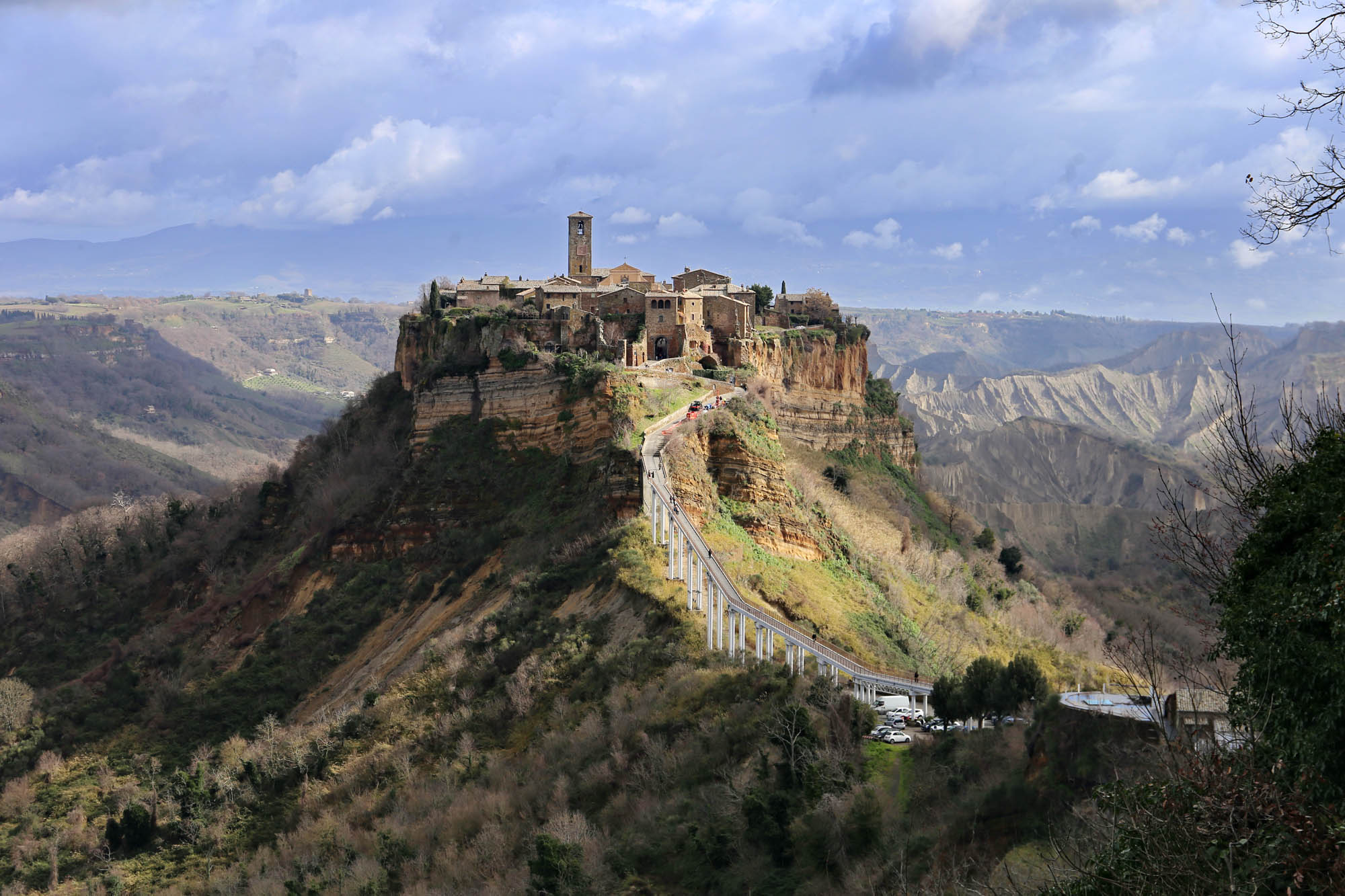
And this is where the great turning point came. The municipality of the “double town” — Civita and the new Bagnoregio — asked a simple question: if these 120 people want to stay, what do they need most? The answer was clear: a road to replace the ones that had collapsed, so they could come and go and move between the old and the new town. And the municipality made the effort. In 1965 it built the reinforced concrete bridge, supported by pillars, that remains to this day the only accessible route into the town. Not for a thriving city — but for just 120 people.
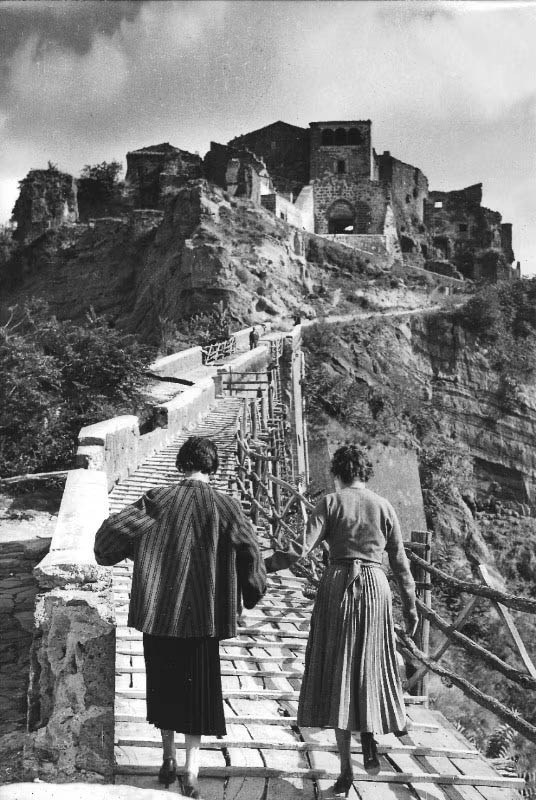
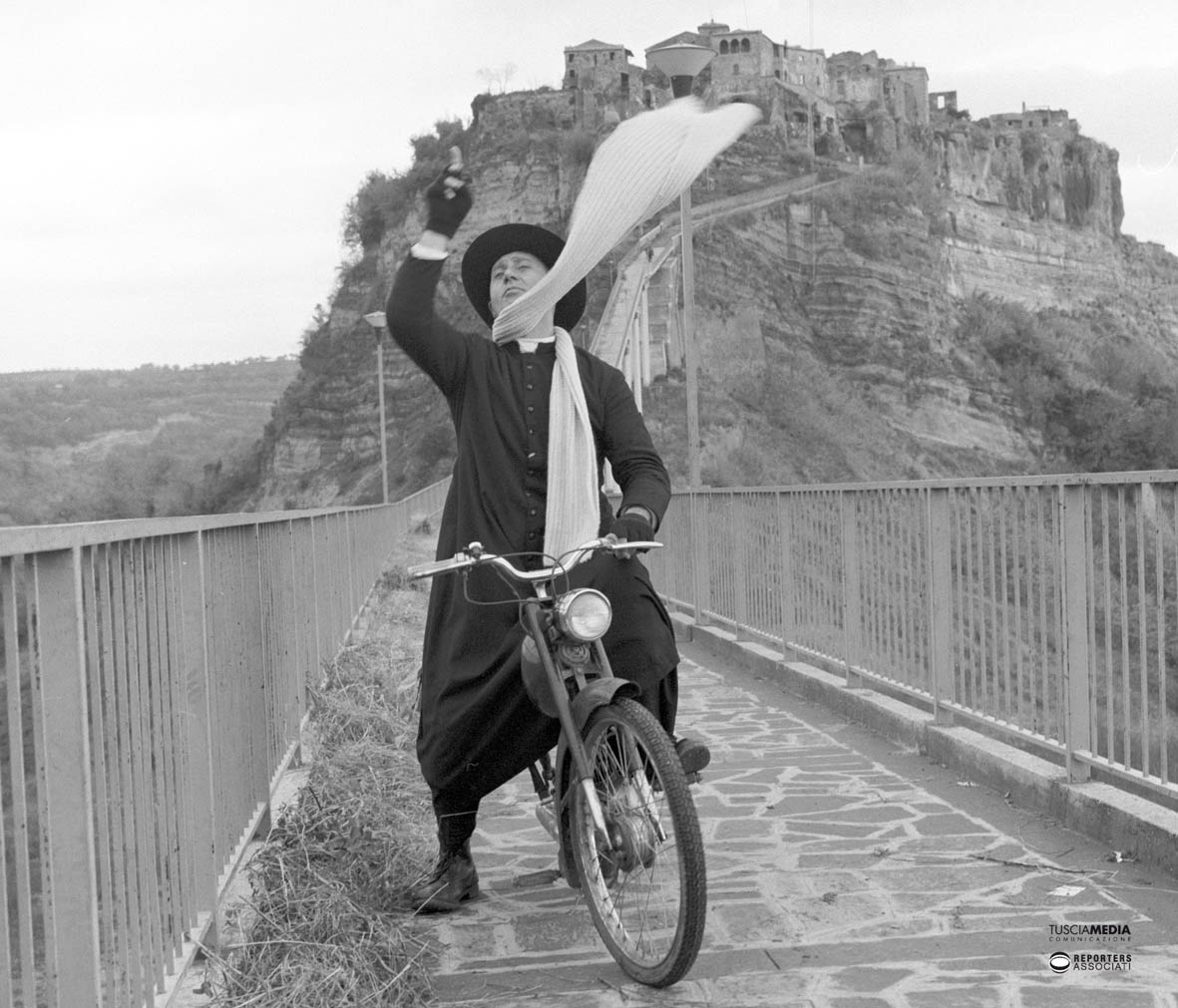
But soon others began using that road as well. Beyond the handful of tourists at the time, filmmakers discovered the historic little town suspended in the sky and began using it as a ready-made set. I due colonnelli (Steno, 1962), Contestazione generale (Luigi Zampa, 1970), In the Name of the Father (Jim Sheridan, 1993), Terra nostra (Brazilian telenovela, 2002), Pinocchio (Roberto Benigni, 2009), Questione di karma (Edoardo Falcone, 2017), Puoi baciare lo sposo (Alessandro Genovesi, 2018), Lazzaro felice (Alice Rohrwacher, 2018) — just some of the most popular, iconic, award-winning productions that significantly boosted the town’s fame and appeal. And that is without mentioning the many documentaries devoted entirely to the town itself.
Yet the greatest surge in popularity came from a film whose director never even visited the town. Hayao Miyazaki had only seen photographs of Civita di Bagnoregio, but according to his own statements it inspired his animated film Laputa – Castle in the Sky (1986). At the heart of the story stands a floating city in the sky, which resembles Civita only in outline — yet Japanese and Chinese audiences embraced the connection, and ever since, more and more visitors have come each year in search of the real-life “city in the sky.”
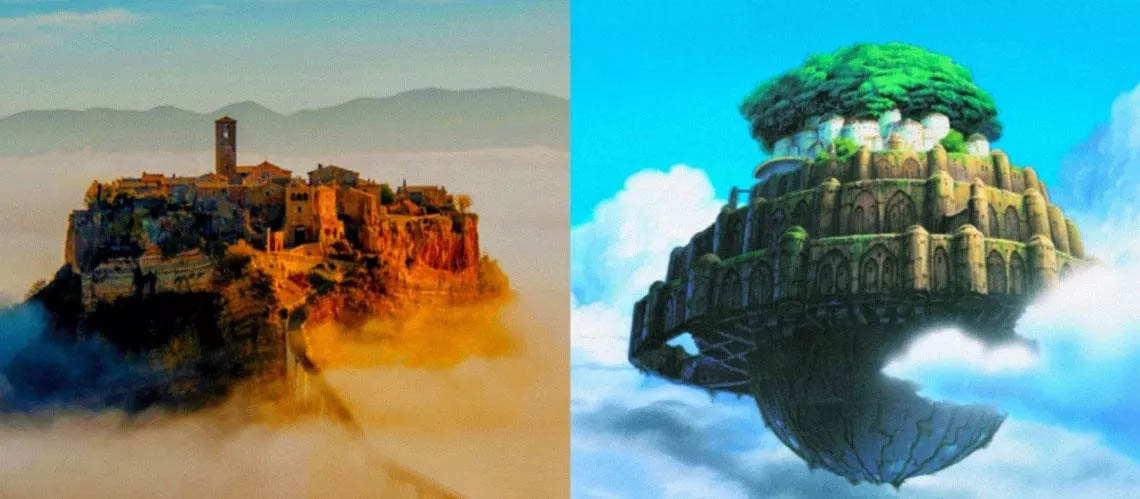
The film exploded in popularity in China in the 2010s, and 天空之城 tiānkōng zhī chéng, “The City in the Sky” has since become one of the top Italian destinations for Chinese tourists. In the 1990s — I can attest from personal experience — Chinese visitors to Italy generally knew only Venice and “the Temple of Ten Thousand Gods,” the Pantheon. But now that China’s middle class can travel — 7% of its 1.5 billion people hold passports, more than twice the entire population of Italy — Chinese tour operators offering 8–10 day Italian itineraries from Rome to Venice now include not only Florence, but also Civita di Bagnoregio and Orvieto in their programs.
In recent years, around 850,000 Chinese tourists a year have visited the town, which now has only ten officially registered residents. Not everyone is delighted about this, of course — yet it is undeniably what keeps Civita alive. Thanks to this attention, the town has become a focal point of international research, and in response to overtourism, thoughtful architectural and sociological studies have been published about it, such as Giovanni Attili’s Civita (2021).
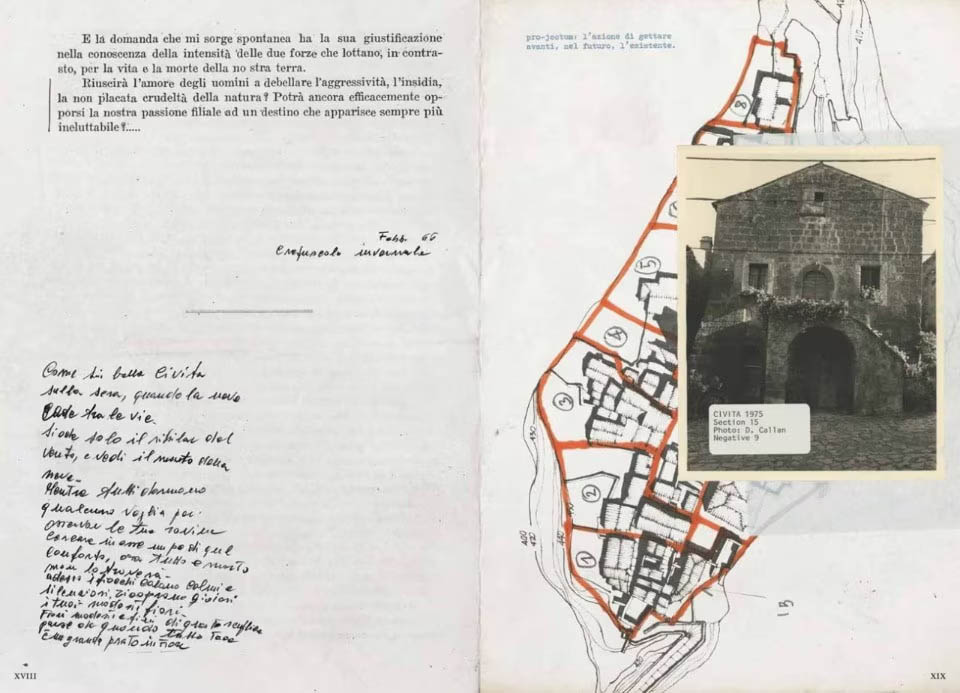
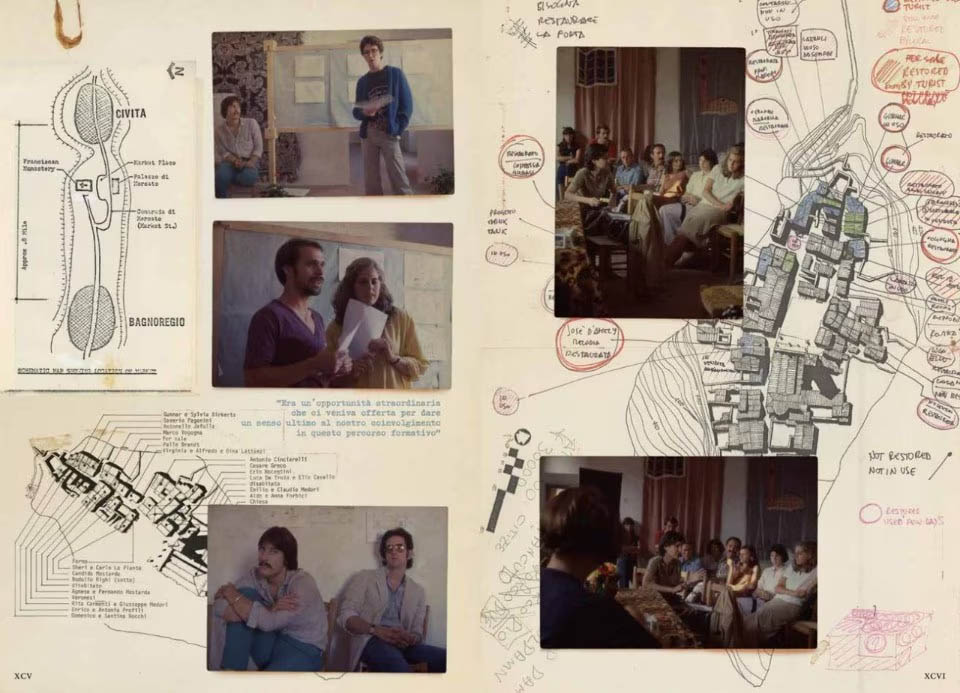
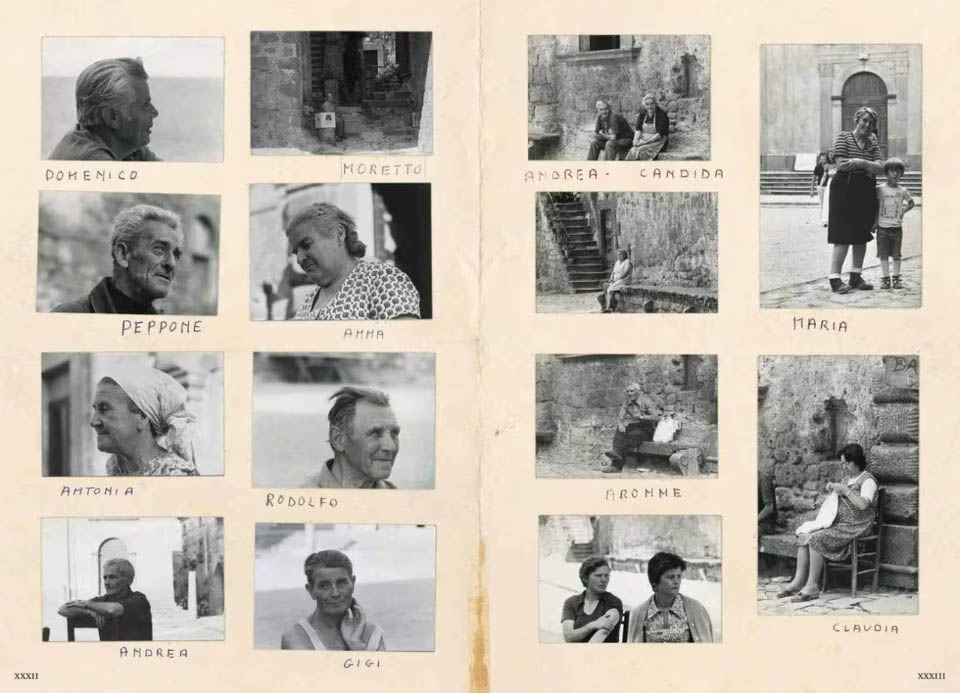
So what happened? The locals — even if only in small numbers — wanted to remain in the town, and the municipality created the minimum condition for that: the bridge. The rest was done by life itself. Erosion did not stop, but the town absorbed the danger into its own identity and turned it into a brand. Civita di Bagnoregio, the dying city, already closer to the sky than to the earth. And that brand evolved into a mass-tourism phenomenon. The town flourished. And this spectacular revival also prompted local and national authorities to invest in ongoing research into how erosion might be halted or at least slowed down.
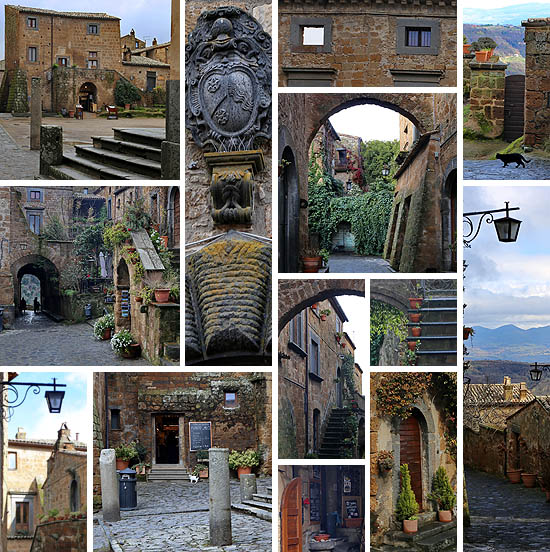 After the gate, we arrive at the church square, around which most of the shops and restaurants are clustered. But beyond this, the town is full of beautifully crafted little squares, courtyards, and hidden corners.
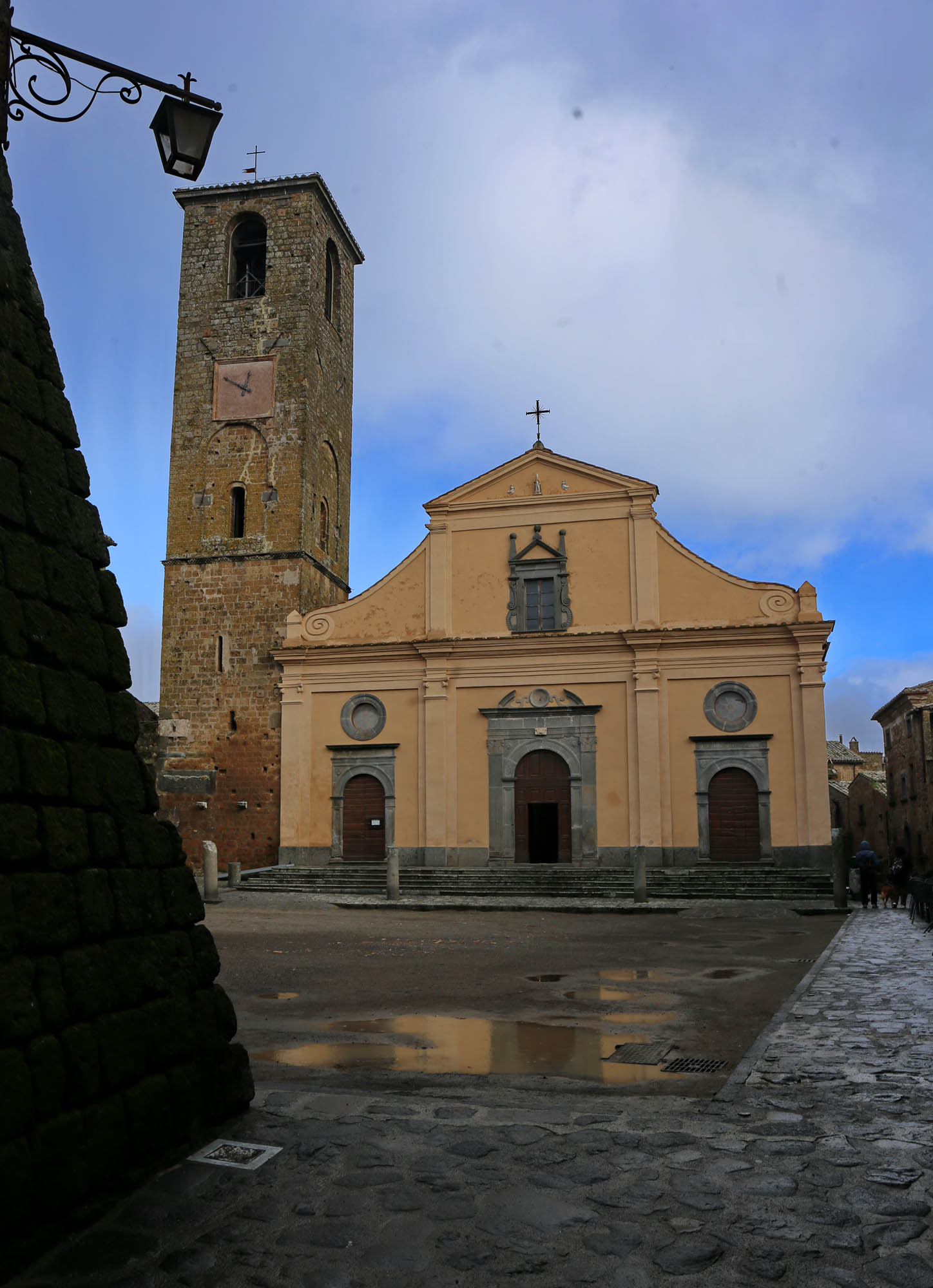
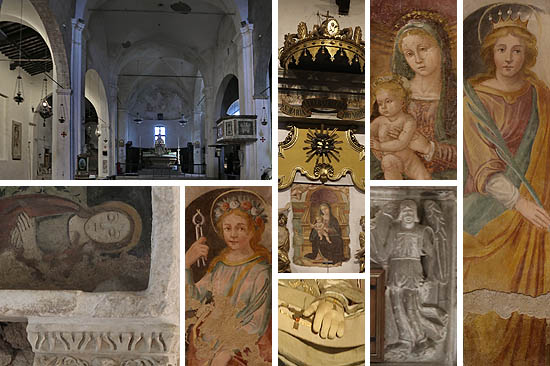 The Church of San Donato is filled with 15th–18th century devotional objects, frescoes, and paintings that testify to an intense popular religiosity.
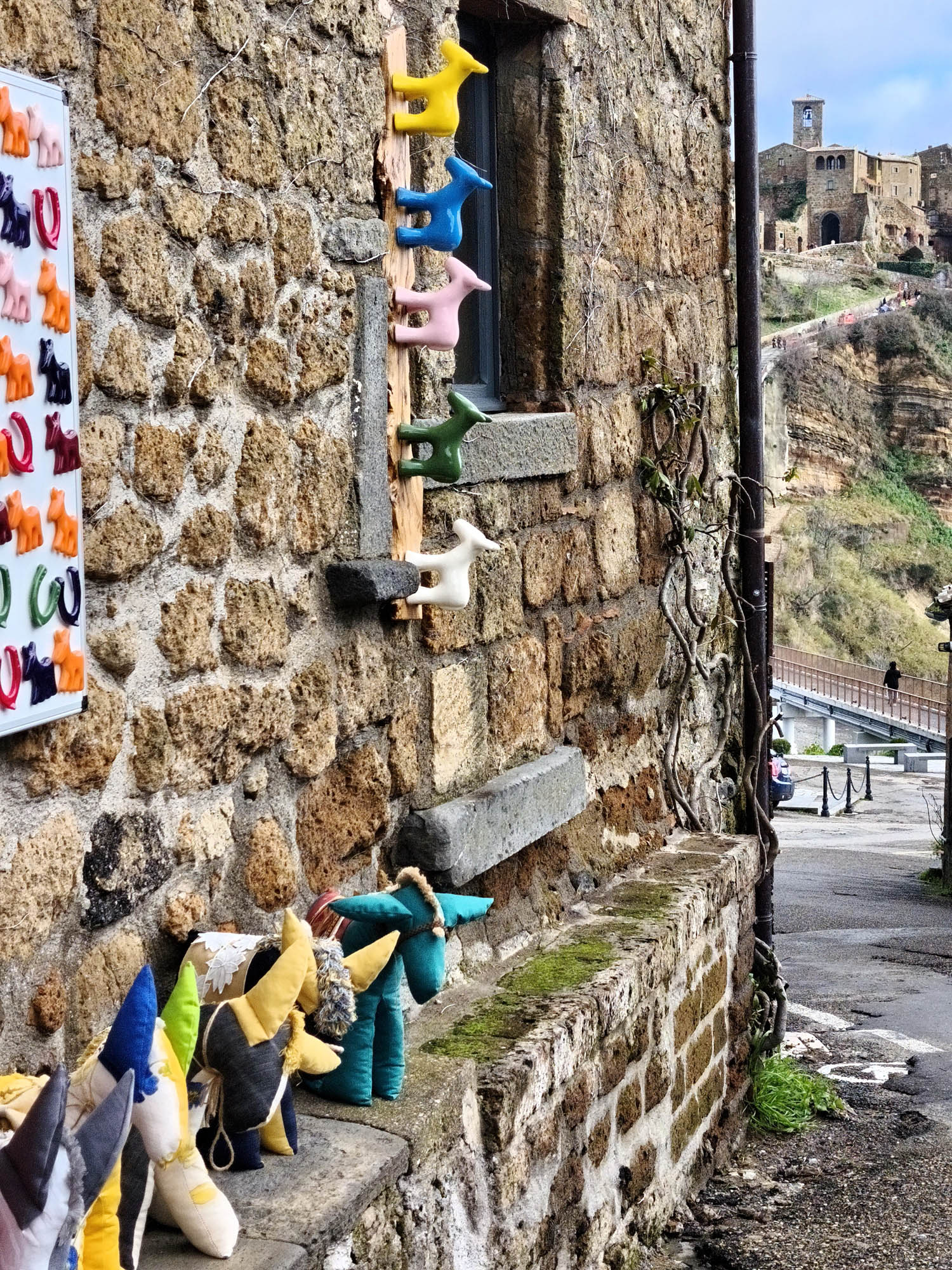
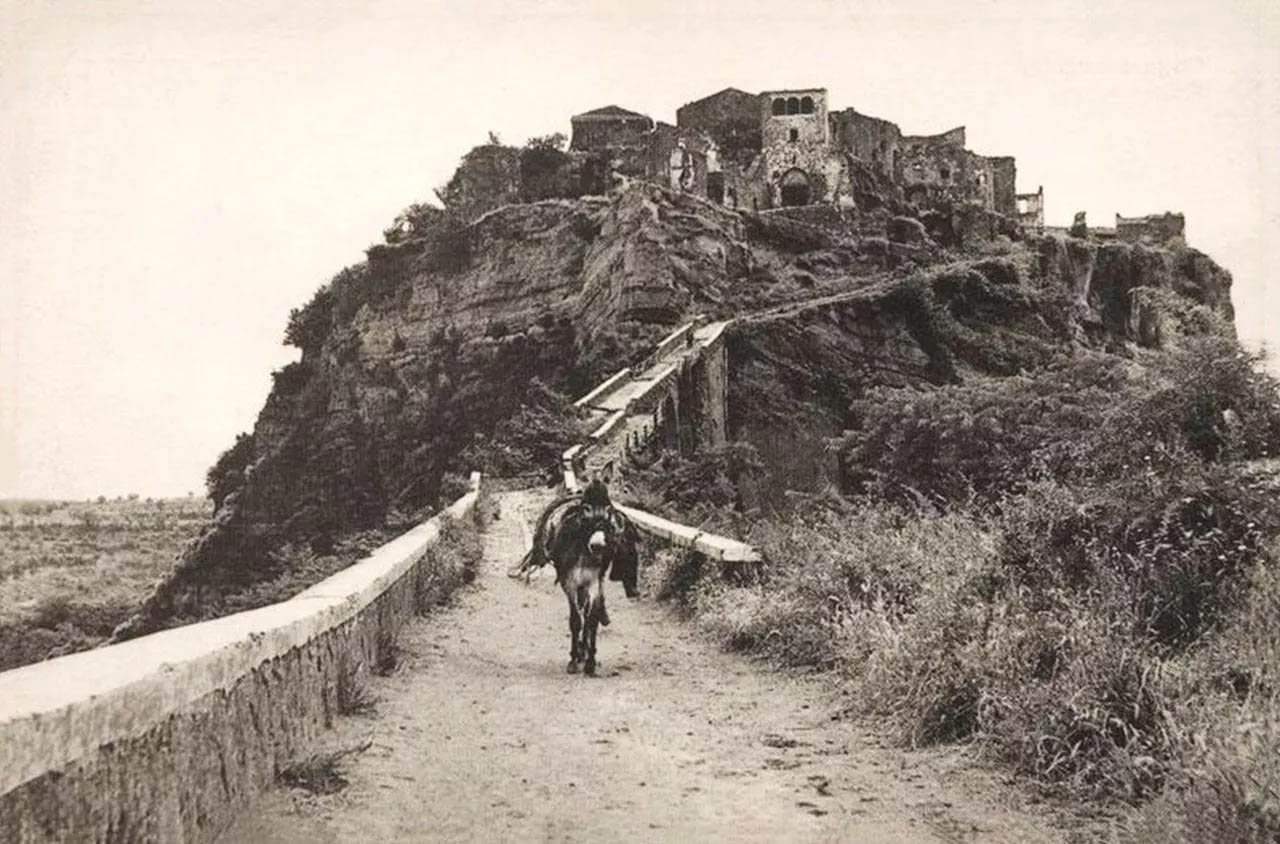 The symbol of Civita di Bagnoregio is the donkey (here in a 1940 photograph), for centuries the primary means of transport and burden-bearing. A donkey palio was also held annually in the square in front of the church.
* * *
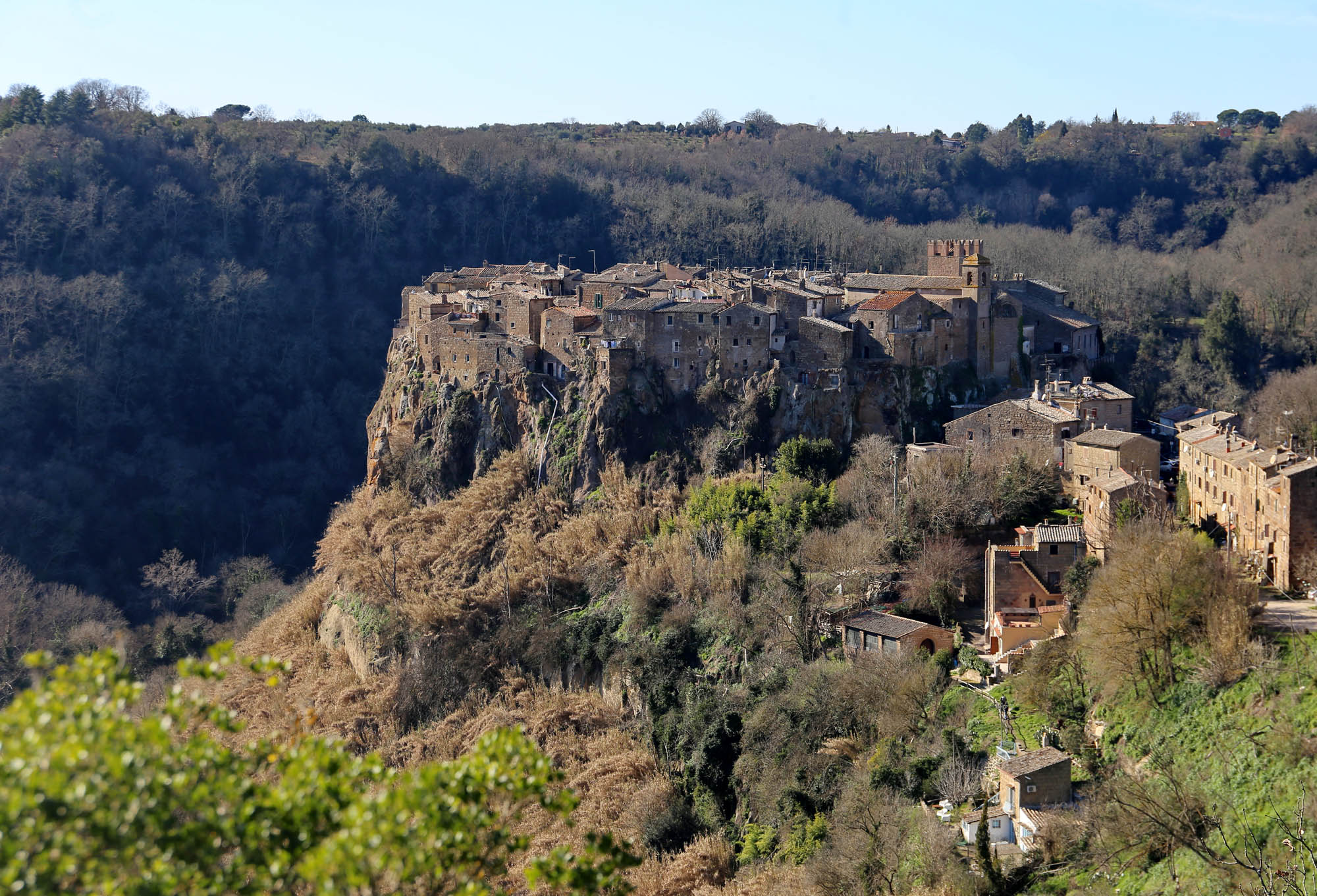
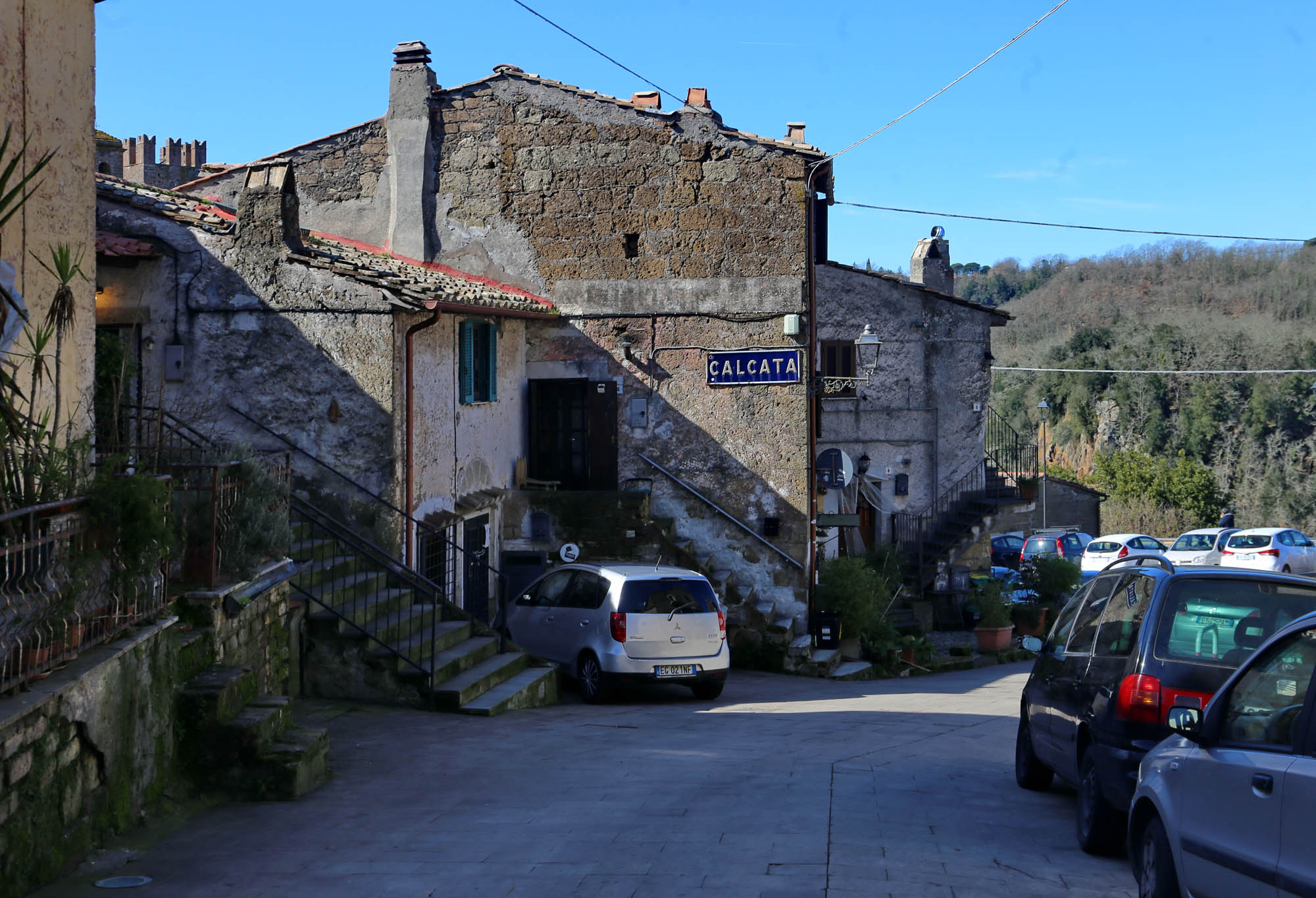
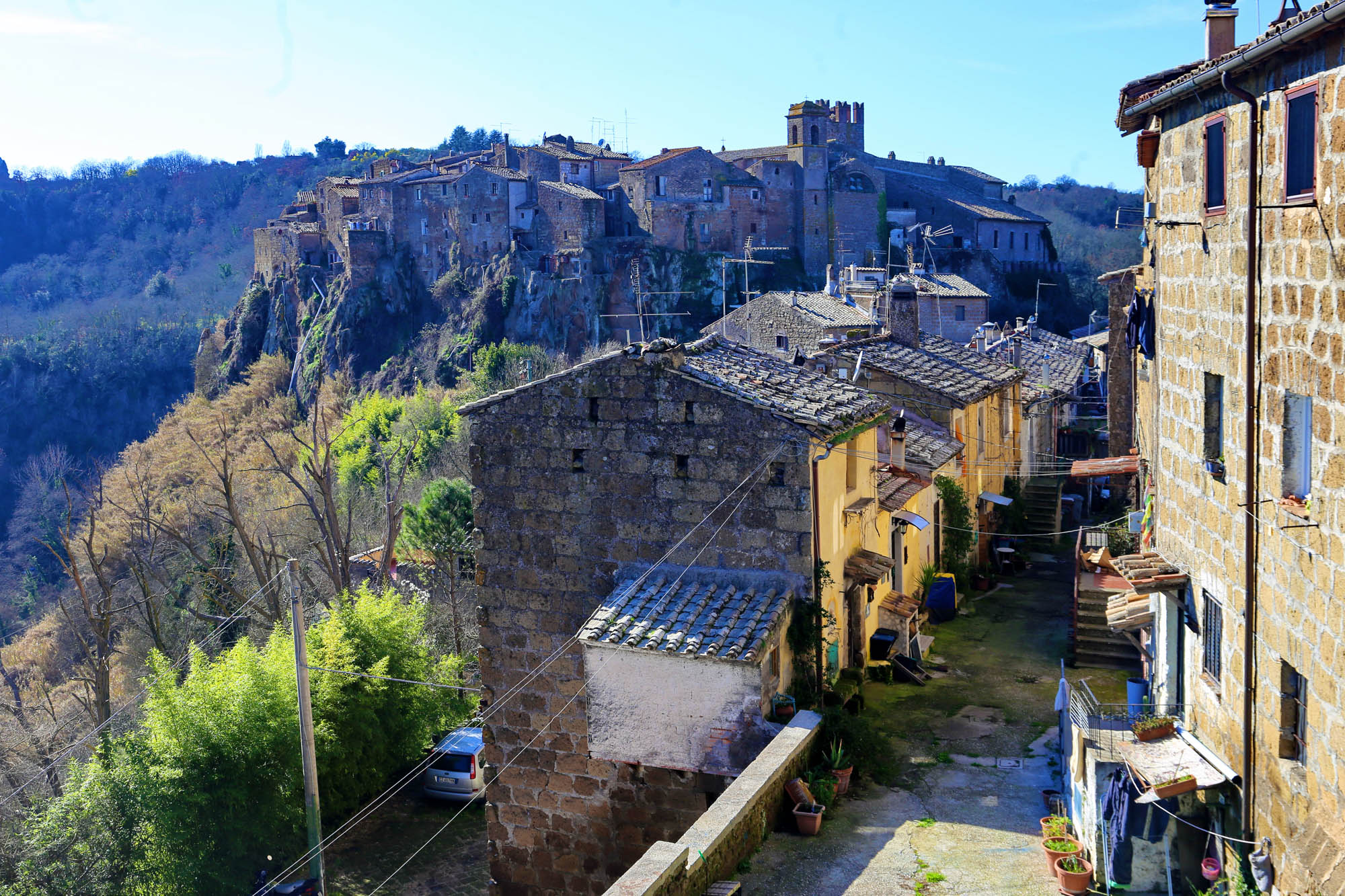
Calcata also began as an Etruscan settlement within Velzna's sphere of influence, later becoming part of Roman Etruria and eventually the Papal States. Due to erosion, the inhabitants of houses slowly crumbling from the cliff edge had already started moving to surrounding areas as early as the 16th century, but the village was officially declared uninhabitable only in the 1930s. The implementation of the evacuation and demolition orders was delayed here as well by the war. By the 1960s, most residents had relocated to neighboring villages. The remaining cliff-edge houses almost seamlessly continue the vertical rock wall, creating a kind of floating effect from a distance, which gave rise to the village’s epic nickname, “il castello nel cielo”.
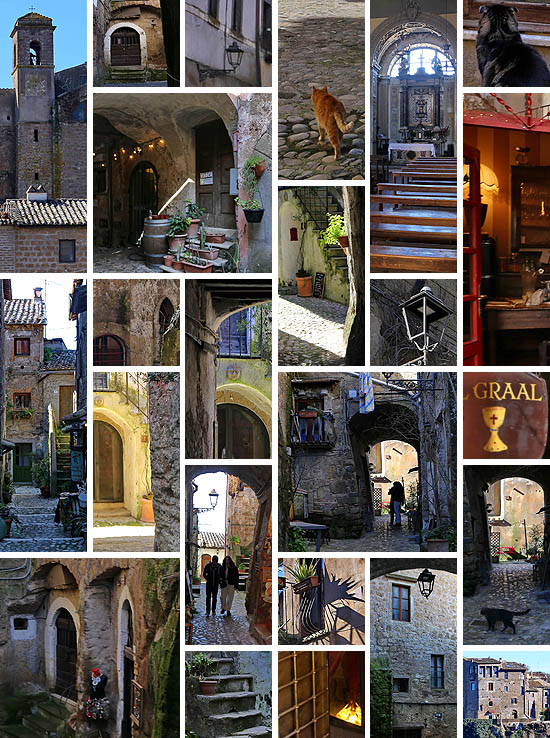
Then an unexpected turn came. At the height of Italy's hippie movement, young artists from Rome and elsewhere began to inhabit the village. At first they moved in illegally, then later bought the houses cheaply from the old residents and restored them. A thriving artist commune emerged, some members of which remain big names in Italy and abroad, as international artists also joined, like puppeteer Marijcke van der Maden. Famous creative groups formed, such as Gruppo Libero or the Piccolo Teatro di Calcata founded by Marco Rosselli. And there were art theorists too, like Paolo Portoghesi or Simona Weller, who gave the village prestige in broader intellectual circles. In 2007, the New York Times described the place as “perhaps Italy’s coolest village, home to about 100 artists, bohemians, aging hippies, and New Age spirits living in a slightly eccentric community.” And the unthinkable happened: seeing this revival, authorities withdrew the eviction and demolition orders, legalizing the settlement and its new society, which still thrives today. During the week, it quietly lives its life, but on weekends many visitors come from Rome, just 40 kilometers away, and then – as we saw on a Saturday – every little restaurant, bar, and craft shop hustles to provide for the influx.
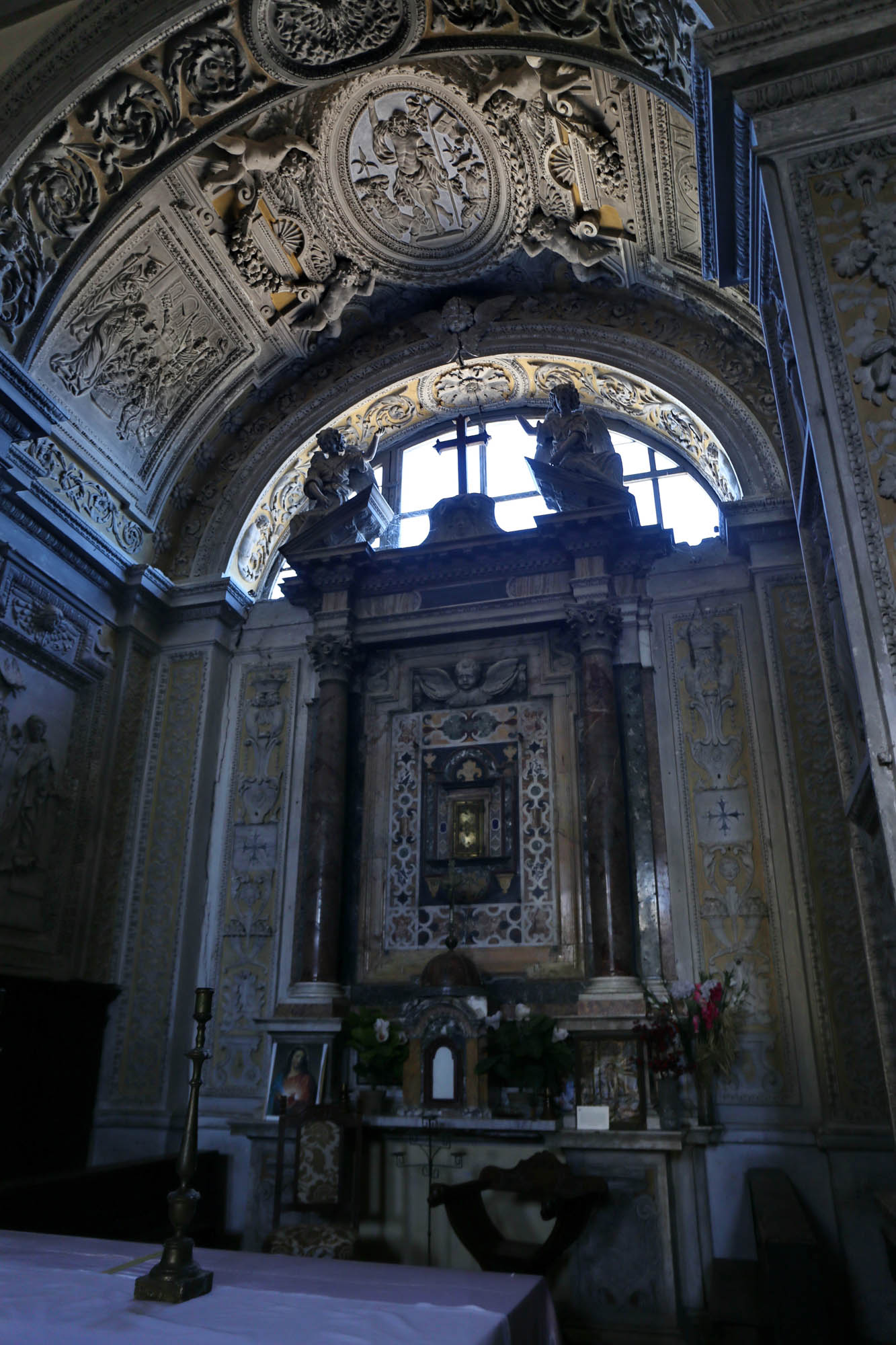
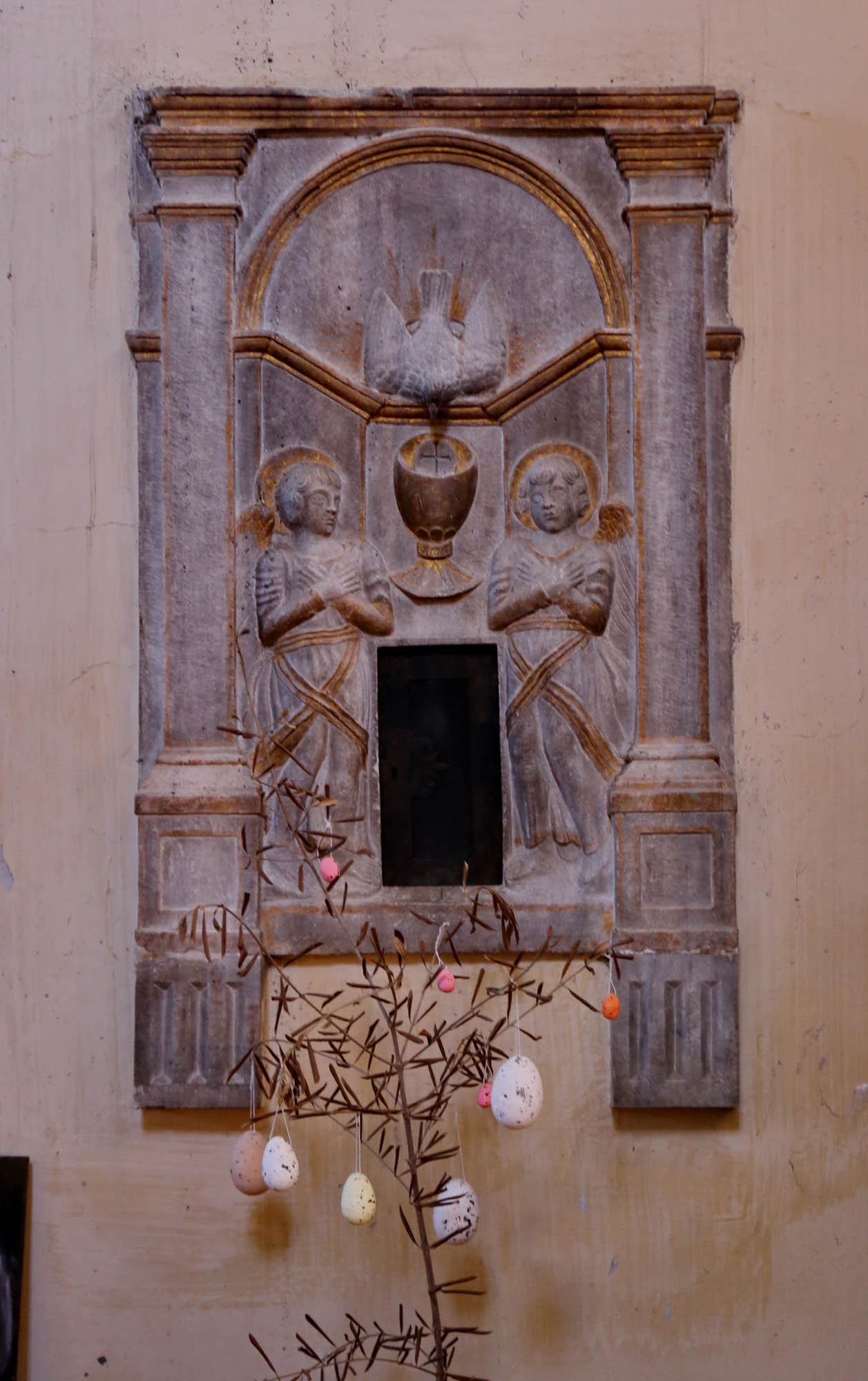
The village also carries a peculiar mystical aura because from 1527 to 1983 it housed a relic considered one of the holiest of its time: the Santissimo Prepuzio, the Holy Foreskin of Jesus, which, according to Jewish custom, was removed on the eighth day after his birth, January 2. Its importance lay in being – aside from the lost Holy Grail with Jesus’ blood – the only piece of Christ’s human body remaining in the world. The relic was looted from the Sancta Sanctorum, the papal relic collection, by a Lutheran German lancer during the Sack of Rome in 1527, but on his way home he was captured here in Calcata, and he hid the small chest in his cell. It was only discovered in 1557 and became Calcata’s treasured possession, turning the village into a “holy town” and a pilgrimage destination. Its small church was dedicated to the Holy Name of Jesus, celebrated on January 2, the day of circumcision, when the relic was carried in procession around the village. Over time, the relic became increasingly awkward for the Vatican, and in 1900 anyone mentioning it faced excommunication. Calcata, however, continued the centuries-old ritual until 1983, when the local priest announced that the next procession would not take place because the relic had been stolen. Who took it remains unknown, but no police report was filed, and the village believes the priest may have confiscated it under higher orders.
So Calcata’s story is that its original population almost entirely abandoned the cliffside town, but another group discovered it and made it their home. They didn’t brand it around decline; instead, they gave the village a lively, bottom-up identity. This identity proved successful, and authorities eventually blessed its survival. I don’t know of any attempt to stop erosion here, but the cliff-edge houses aren’t occupied, and there’s still time for something to happen before erosion reaches the town’s core. At the very least, a few well-lived decades.
* * *
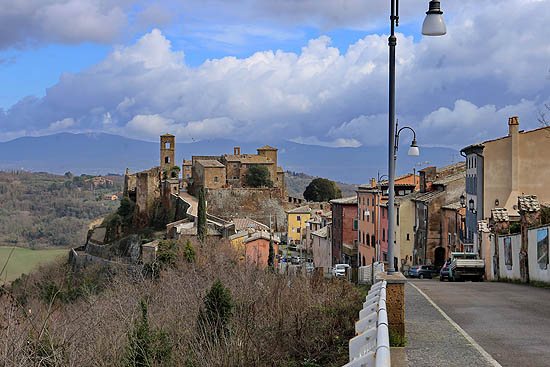
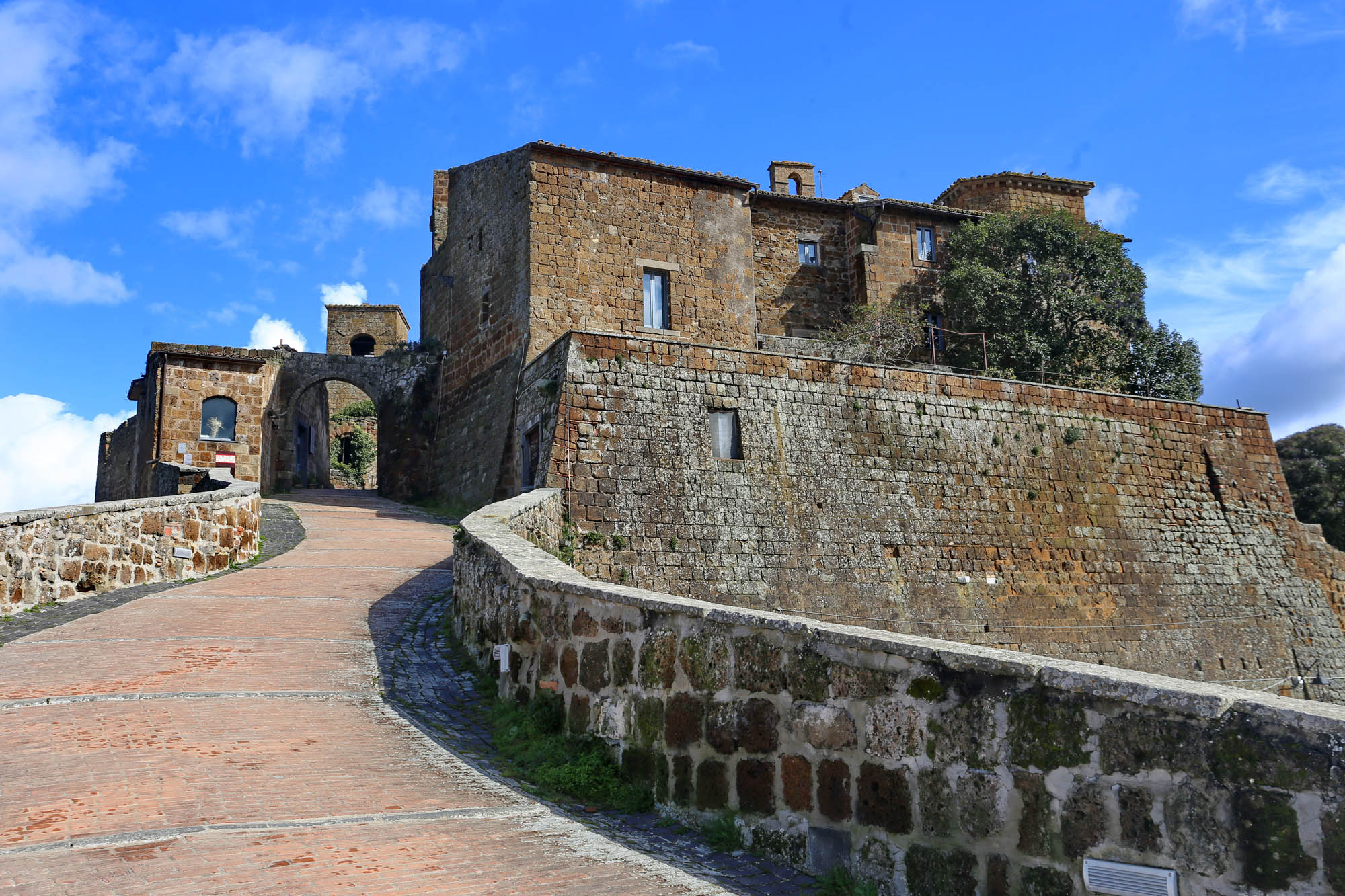
Celleno has been inhabited even longer than the other two towns, since the Bronze Age. It also experienced Etruscan and Roman periods. In the Middle Ages, it was the center of the region, controlled by the Viterbo bishopric and local aristocratic families. Its main square still features the Orsini Castle.
This town also has its own motto: “il borgo fantasma”, the ghost town. As we approach, the road signs display this name everywhere. For now, we do not know what it truly signifies.
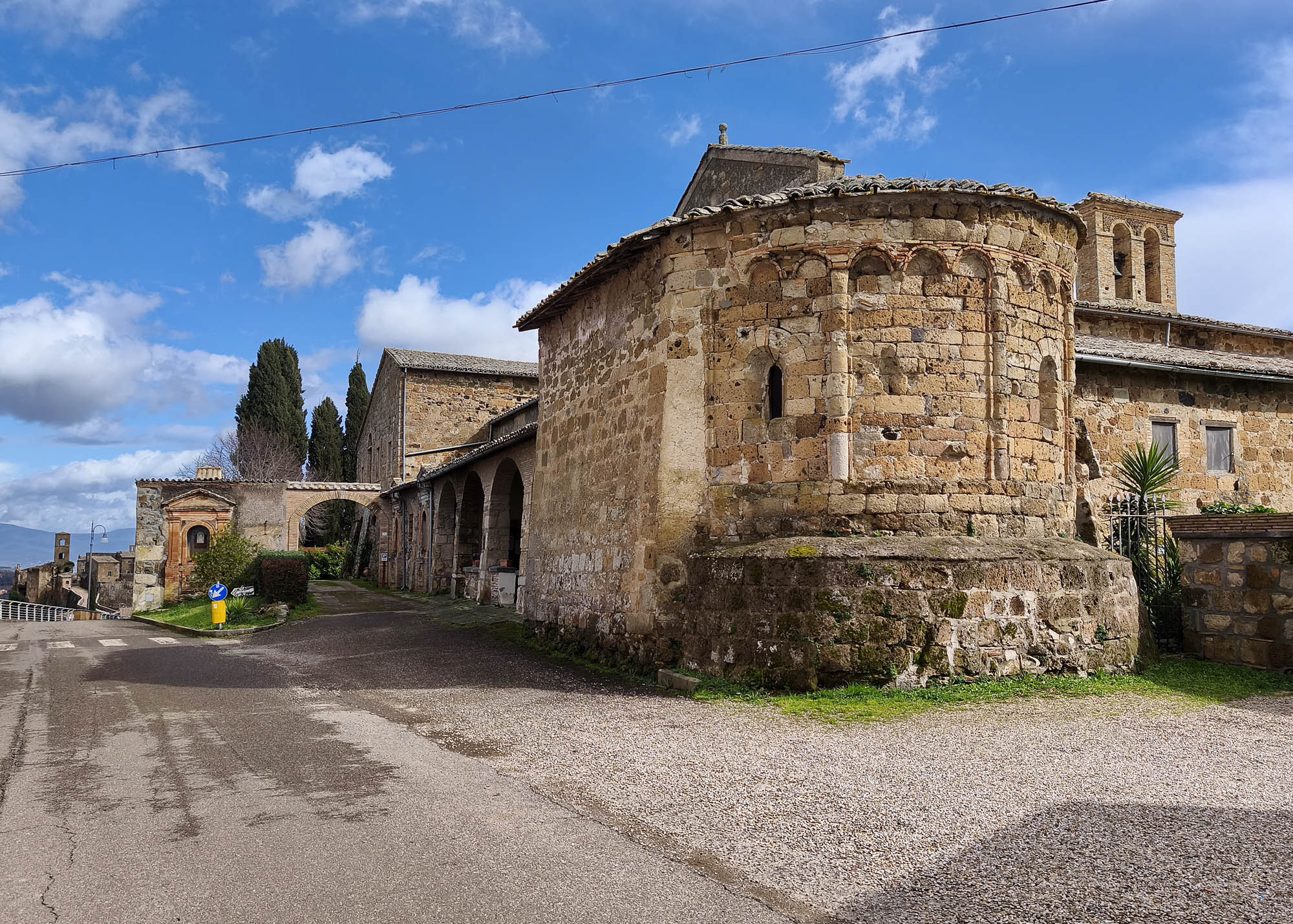
About a kilometer before the town, on a hilltop, stands a former Franciscan monastery, with a Romanesque church apse protruding and a beautiful arched portico at the entrance. We stop in front of it; from here there is a good view of Celleno, perfect for photographs. A sign at the gate indicates that the cloister can be visited daily from 10:00 to 12:30. We ring the bell.
The monastery was founded in 1610 around the 11th-century church to serve the pastoral needs of the area. Its rustic, sturdy cloister was painted in 1716 by one of the monks with portraits of Franciscan saints and scenes from the life of Saint Francis. In the 1750s, the garden wall along the road to the town was built, featuring the stations of the Cross.
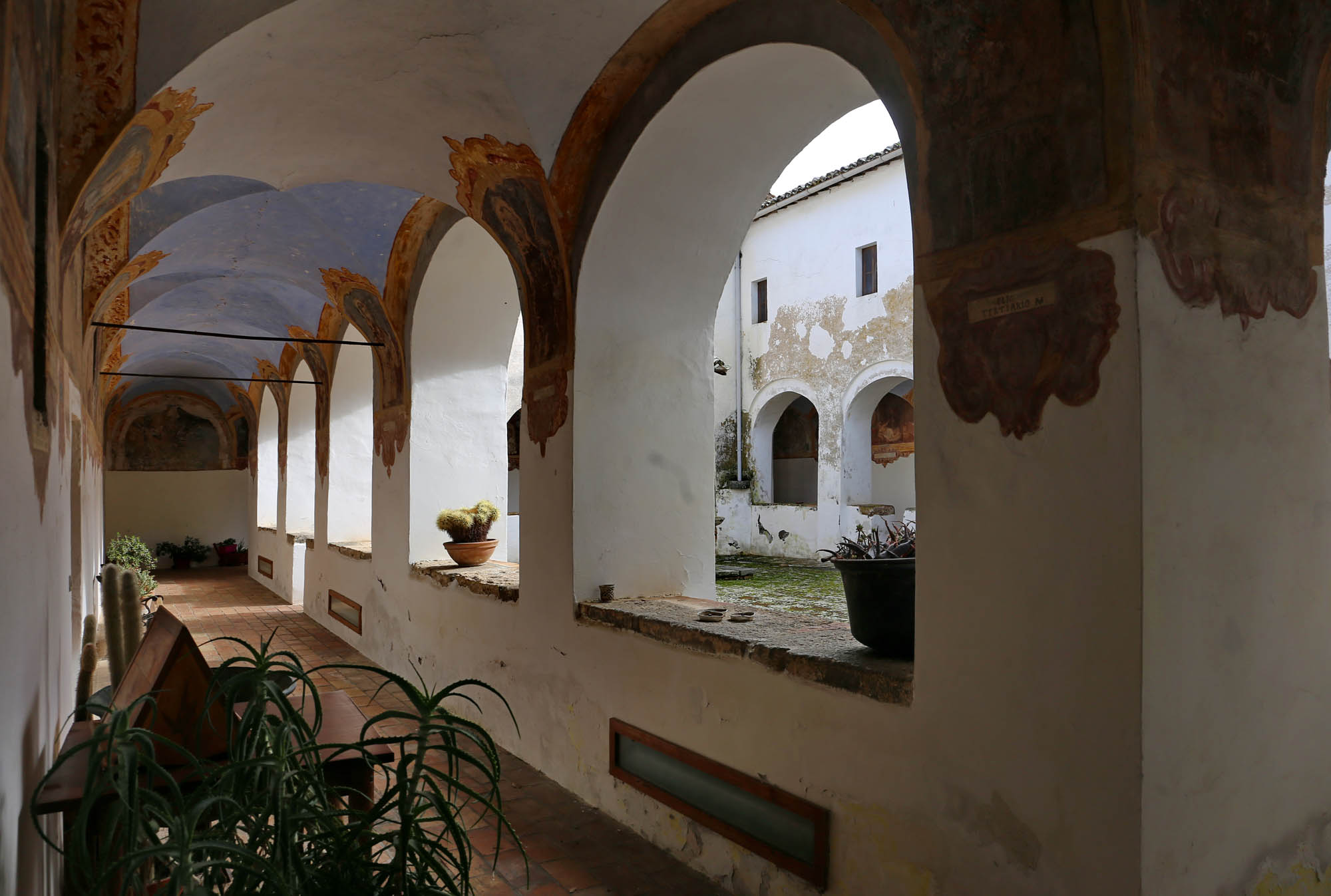
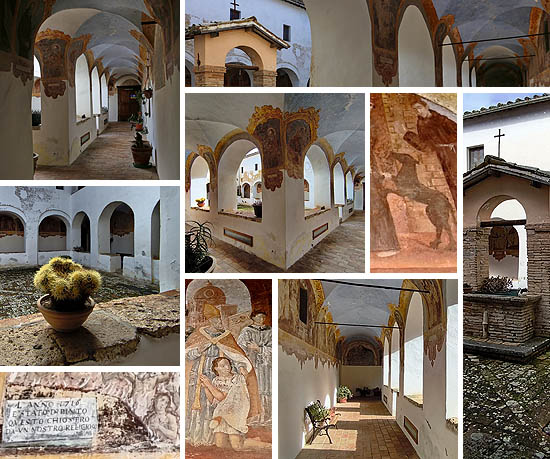
The monastery was heavily affected by the suppression laws of 1875. Their aim was to weaken papal power, reduce the church’s social influence, and seize its economic assets. The damage was enormous. Libraries, artworks, collections, and living traditions were destroyed en masse. This happened to the Celleno monastery as well, which fell into private hands after the Franciscans were expelled. Its library and church furnishings disappeared, and today both of its churches stand empty and are not open to visitors. Parts of the buildings and the ceramic reliefs of the Stations of the Cross were also destroyed.
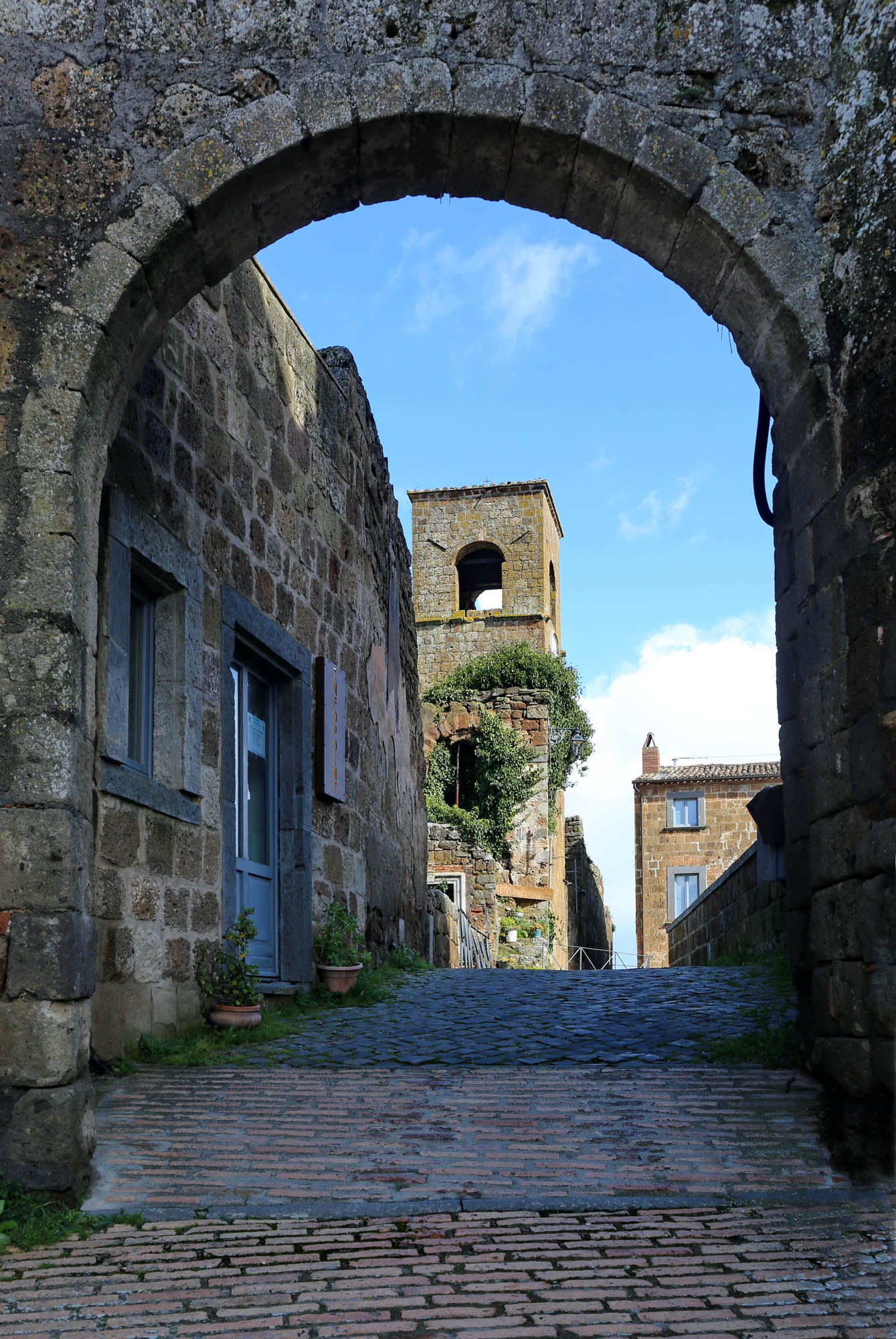
We continue onward, parking at the base of the old town’s cliff. From here, one can only proceed on foot. Looking through the gate, we see ivy-covered ruins. Next to the gate, a sign reads INFOPOINT. I enter, and the man on the phone at the desk looks up and signals he will come out immediately. He is the one who tells us the story.
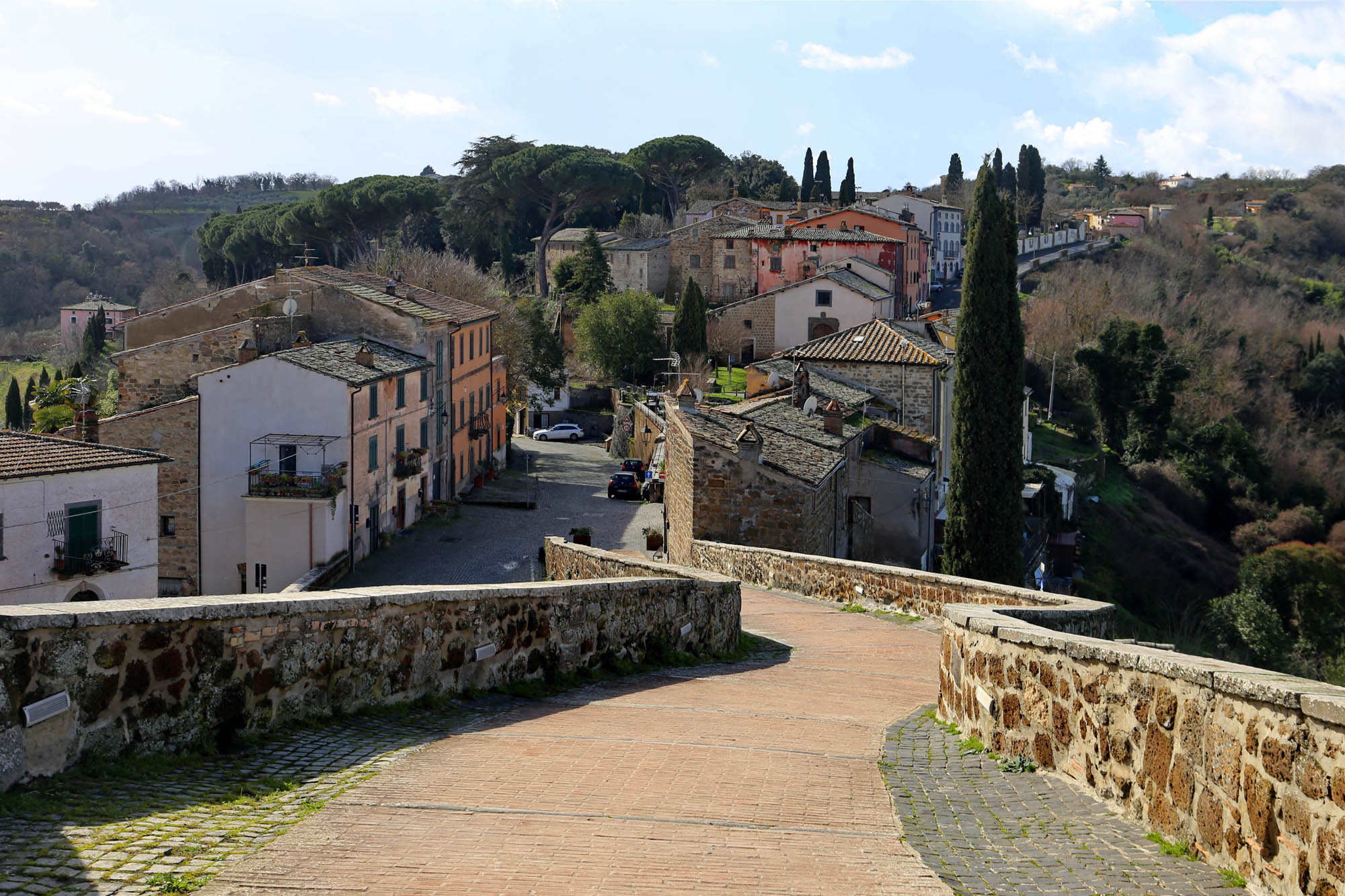
Celleno was also slated for evacuation and demolition in the 1930s. Residents moved to new houses at the base of the cliff, but kept the old ones as stables, returning to them regularly. Drainage was neglected, accelerating erosion. By the 1960s, the municipality decided to carry out the fascist demolition orders to prevent greater danger. All the village houses were blown up, except for those around the main square.
Today, entering through the gate, one can still see the Orsini palace, the church, the former parish, and the bell tower. But moving further from the square, only ruins are visible everywhere.
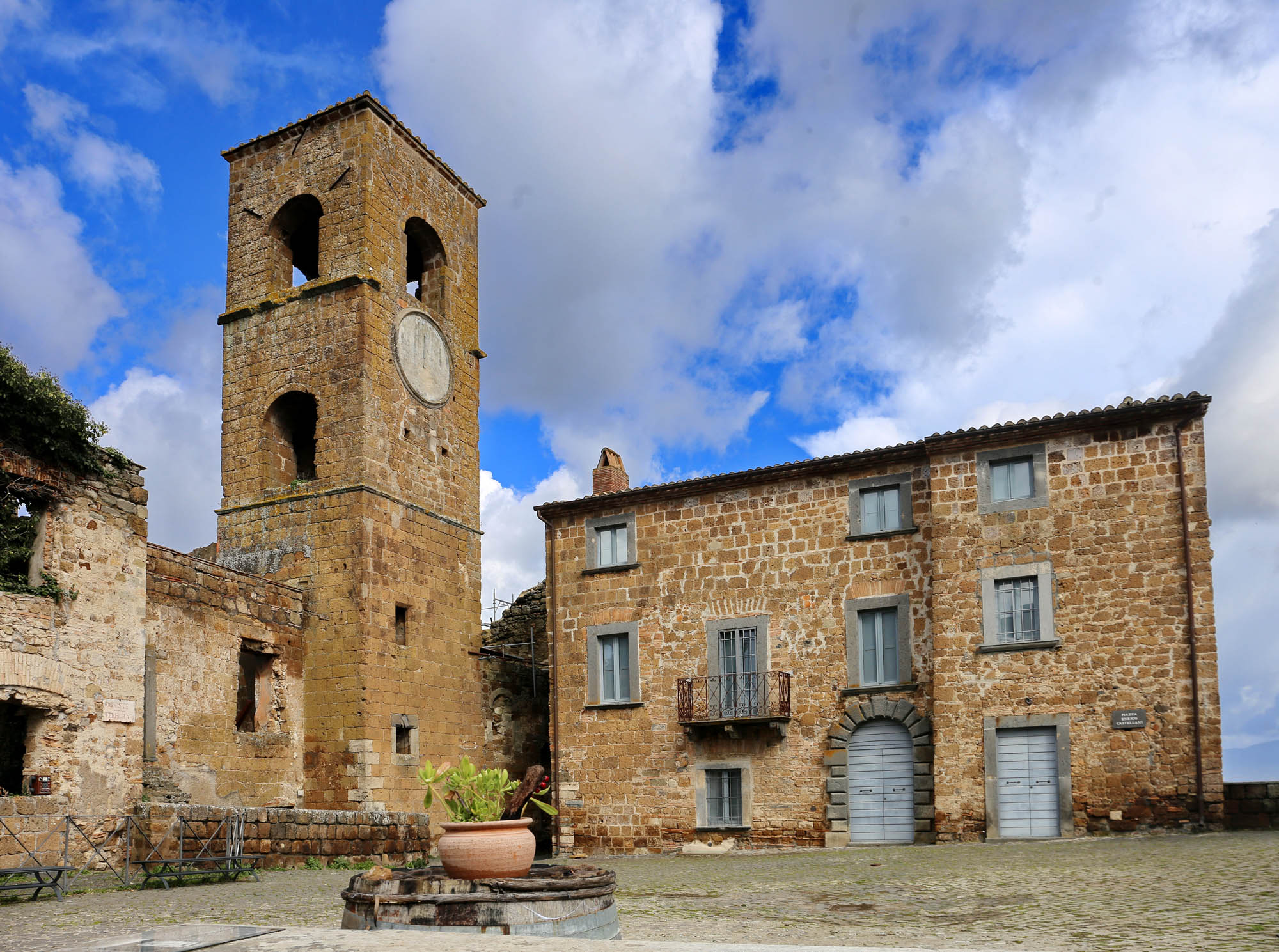
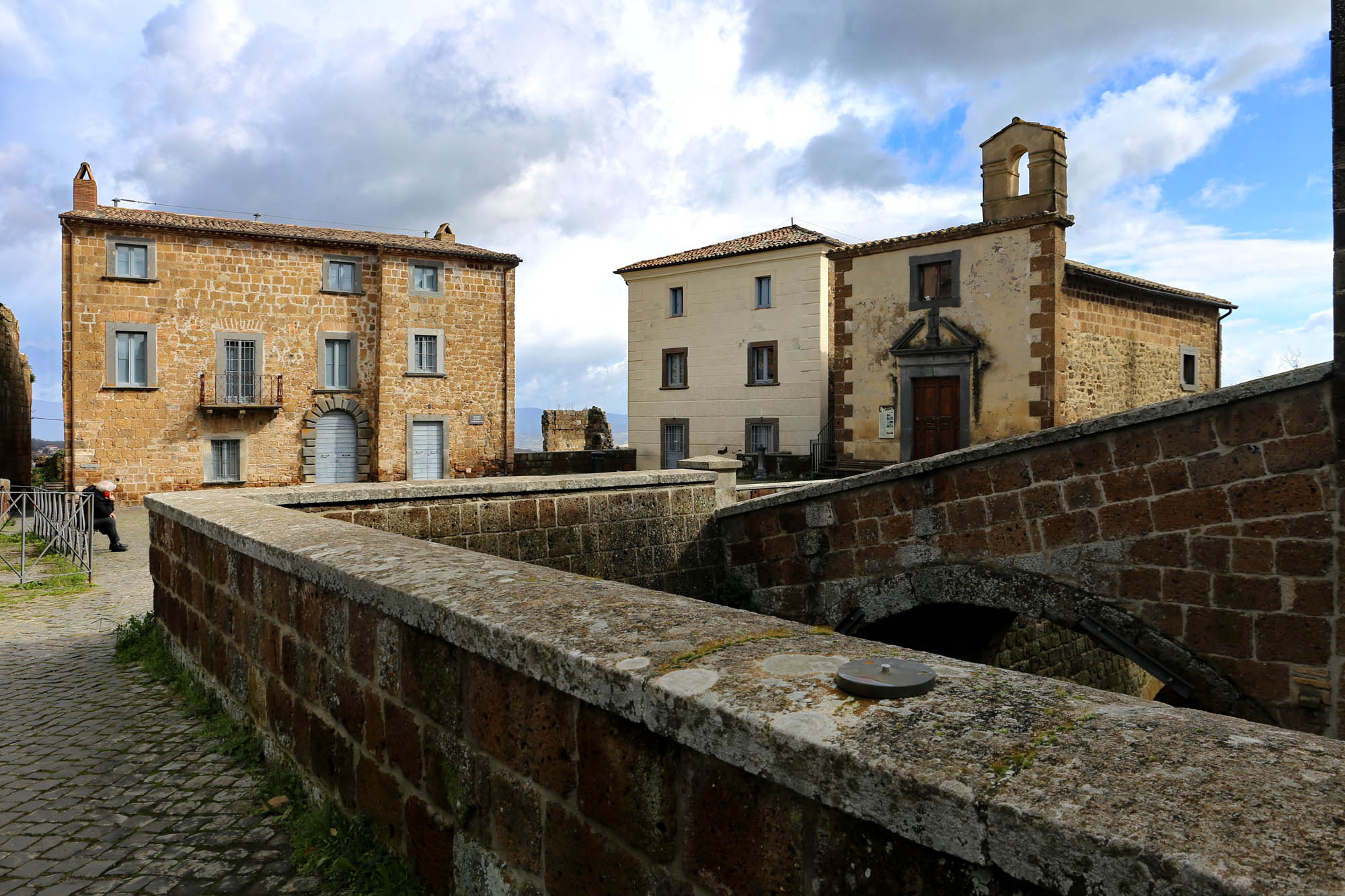
In this town, then, the decisive 1960s saw a different fate than the other two: instead of giving it a new identity or opening a new narrative, the authorities, in the name of rational safety, simply dismantled it.
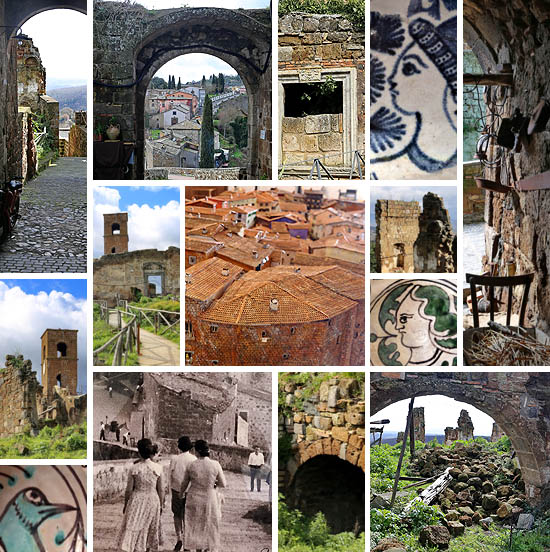
Yet there was a demand for a new narrative. The village’s residents today still care deeply for the little that remains. They founded a cultural association whose volunteers sit at the infopoint and guide visitors. The church now houses a museum, with a large model of the former village at its center, on which they worked for six years. On the wall hangs an enlarged old photograph, showing women in traditional dress surveying the village. In a display case, fragments of pottery found in the medieval trash pits have been restored into complete objects by students from the Viterbo restoration school. A walking path has been laid out among the ruins, and the remains are humanized with charmingly naive installations: rusted bicycles, milk cans, and old tools. The cultural potential for a new identity was also present, as the internationally renowned painter Enrico Castellani moved into the local Orsini palace, commemorated with a plaque on the wall.
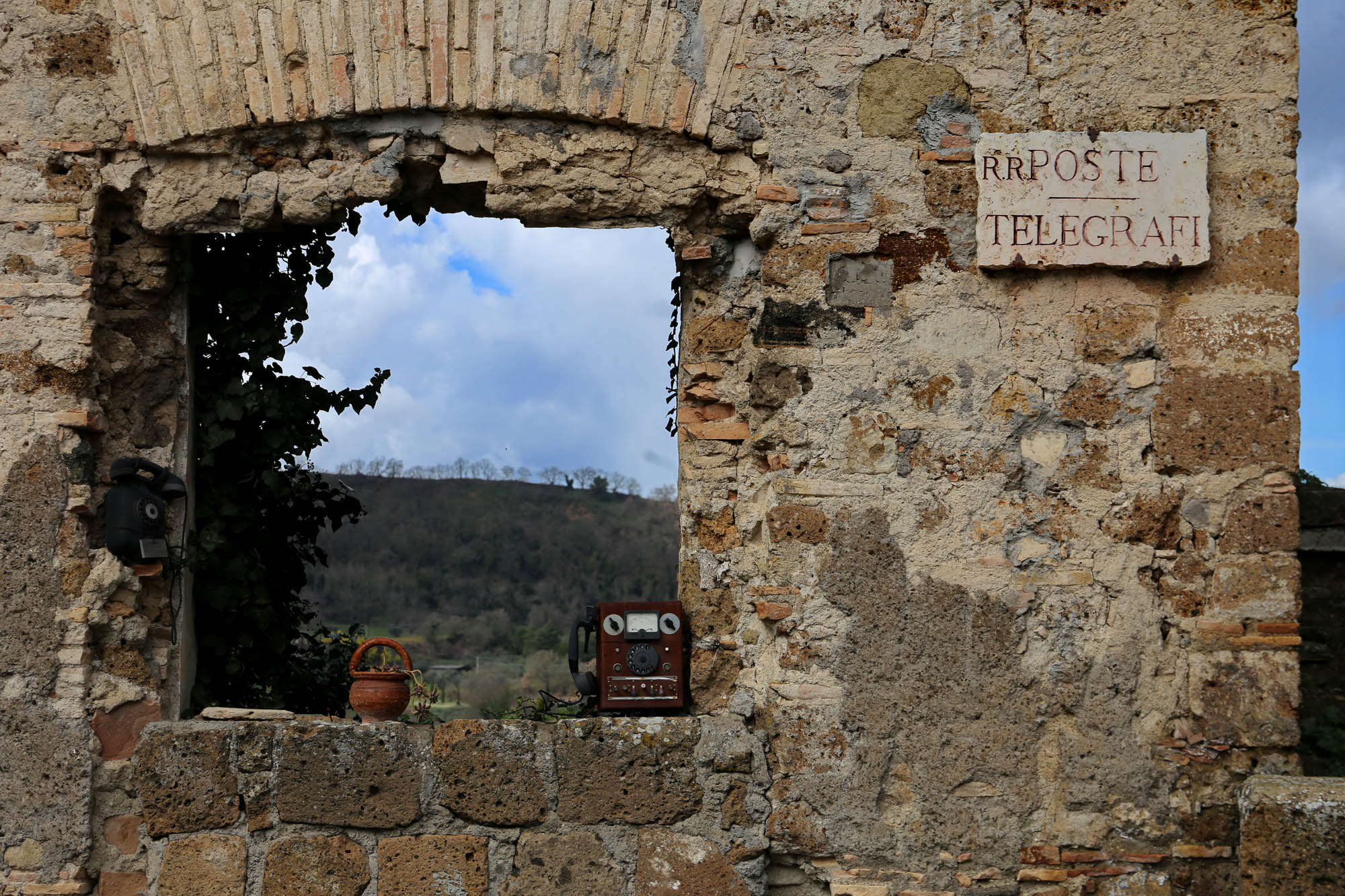
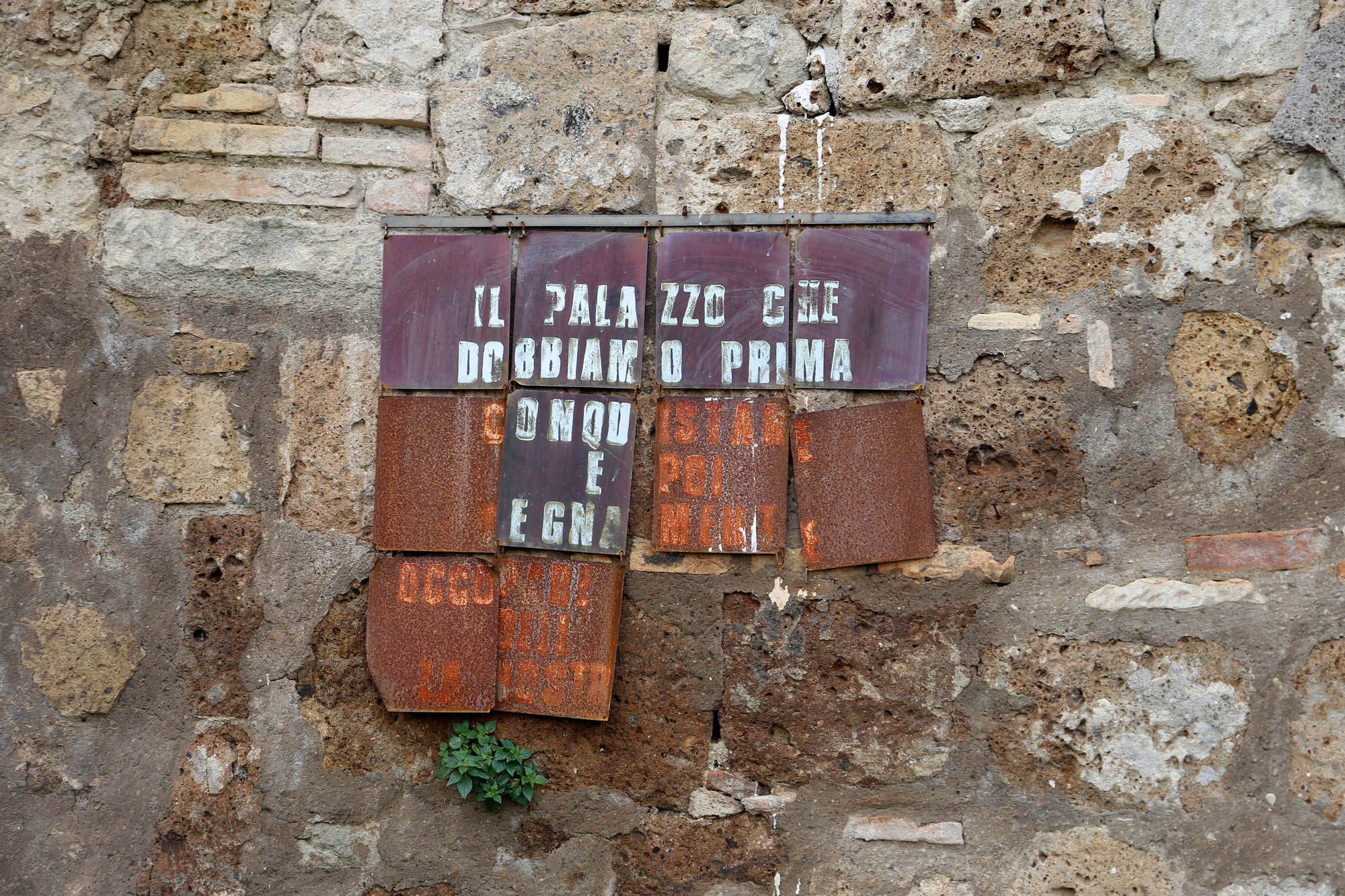 Likely a former socialist/communist inscription on the wall of the old castle: “The castle that must first be conquered, and then properly inhabited…” It didn’t succeed.
The creation of a new identity—a case of too little, too late—amounted to the cultural association trademarking the term “borgo fantasma”, which can now only be used by Celleno. They even have a court document stating they are the ones who consciously destroyed their heritage. In the new village, small ghost figures dressed in white sheets have started appearing over a few shops, symbolizing the “fantasma.”
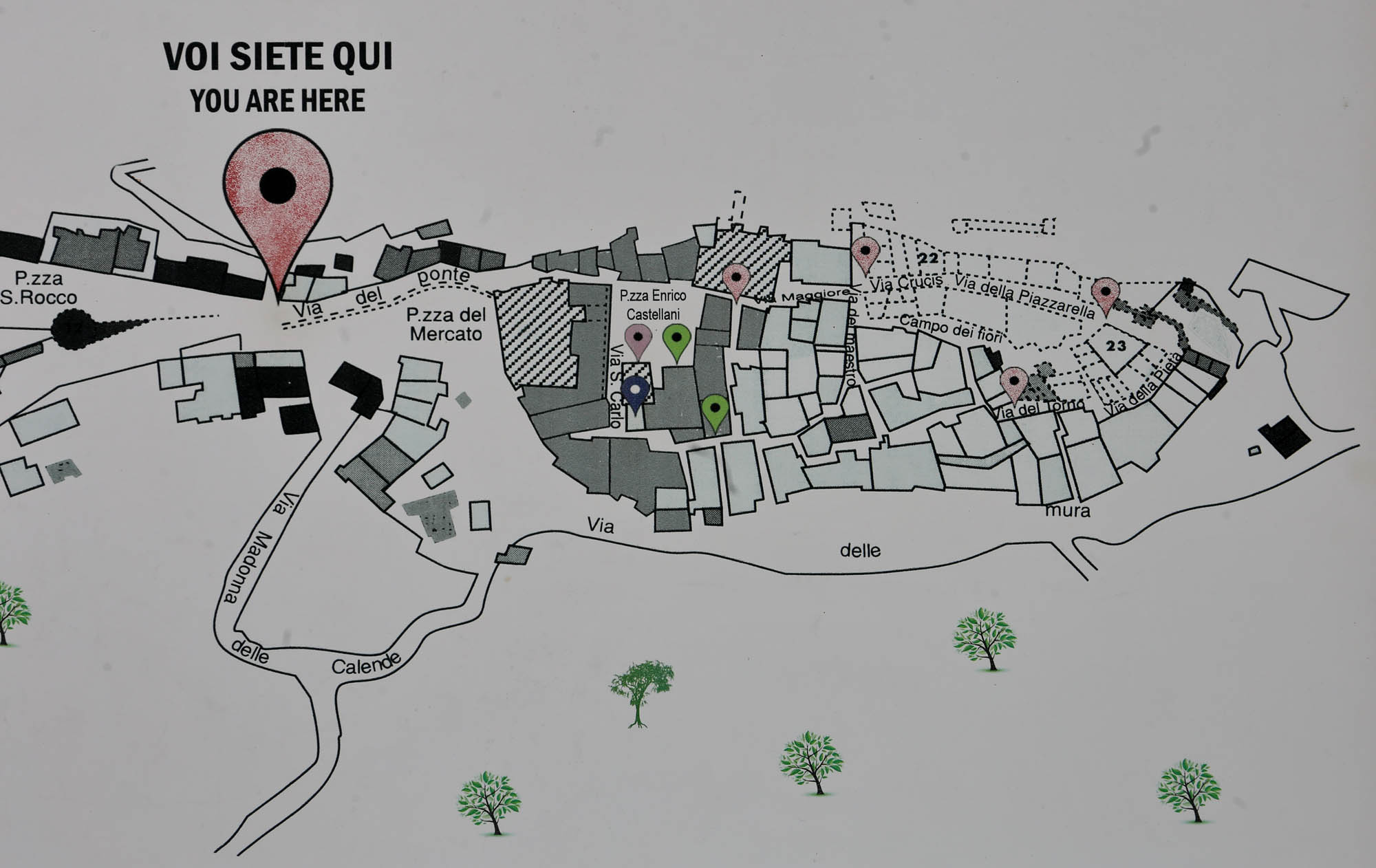 What still stands, what is ruined, and what has vanished entirely
* * *
Three hills, three destinies.
One embraced, and even made a brand of, decay, while doing the little it could for those who wanted to survive. From this little, a remarkable survival emerged.
The second rejected decay and gave the town a new, life-affirming identity. With this reinterpretation, the space of decay became a creative and attractive laboratory.
The third accepted decay. It did not give the town a new identity but carried out the rational decision of the authorities. In hindsight, there is regret, and from the destruction, they try to give a new identity to what remains. The effort is both admirable and poignant.
Cities are made not only of stones but also of narratives. And narratives shape the fate of cities.
Someone diagnosed with a terminal illness can decide whether to do the little that is necessary for a dignified life, spend their remaining days in good company, or, confronting the inevitable, end their life prematurely.
It is as if we are seeing three different illustrations of the last line of Journey by Moonlight: “As long as a person lives, something can still happen.”



Add comment