

 Niko Pirosmani: Arganshchik (organ grinder from Tbilisi), two versions, 1910
We have already met organ-grinders in pre-war Warsaw and Lwów, Bucharest and bombed-out Budapest, and even in America and the Caucasian Georgia, and a comprehensive illustrated post on the history of the barrel organ is already becoming ripe, indeed. This, however, would not be complete without the Russian organ grinder.
 The scene with the organ grinder and the Gypsy girl from an 1910s performance of Stravinsky’s Petrushka
The barrel organ, that is шарманка – whose name is an assimilation of the French charmante with a Russian diminutive suffix – was popular in the towns and even villages of Russia at the turn of the century, together with its master, the шарманщик, whose detailed portrait is drawn in Lev Uspensky’s Записки старого петербуржца 1890-1910 (Records of an old citizen of St-Petersburg), of which we want to specifically write later. It was a special Russian feature that the organ grinder usually went from village to village in the company of a puppeteer, called Petrushka after one of his traditional puppets, who was elevated into high art together with the organ-grinder by Stravinsky in his ballet of 1910.
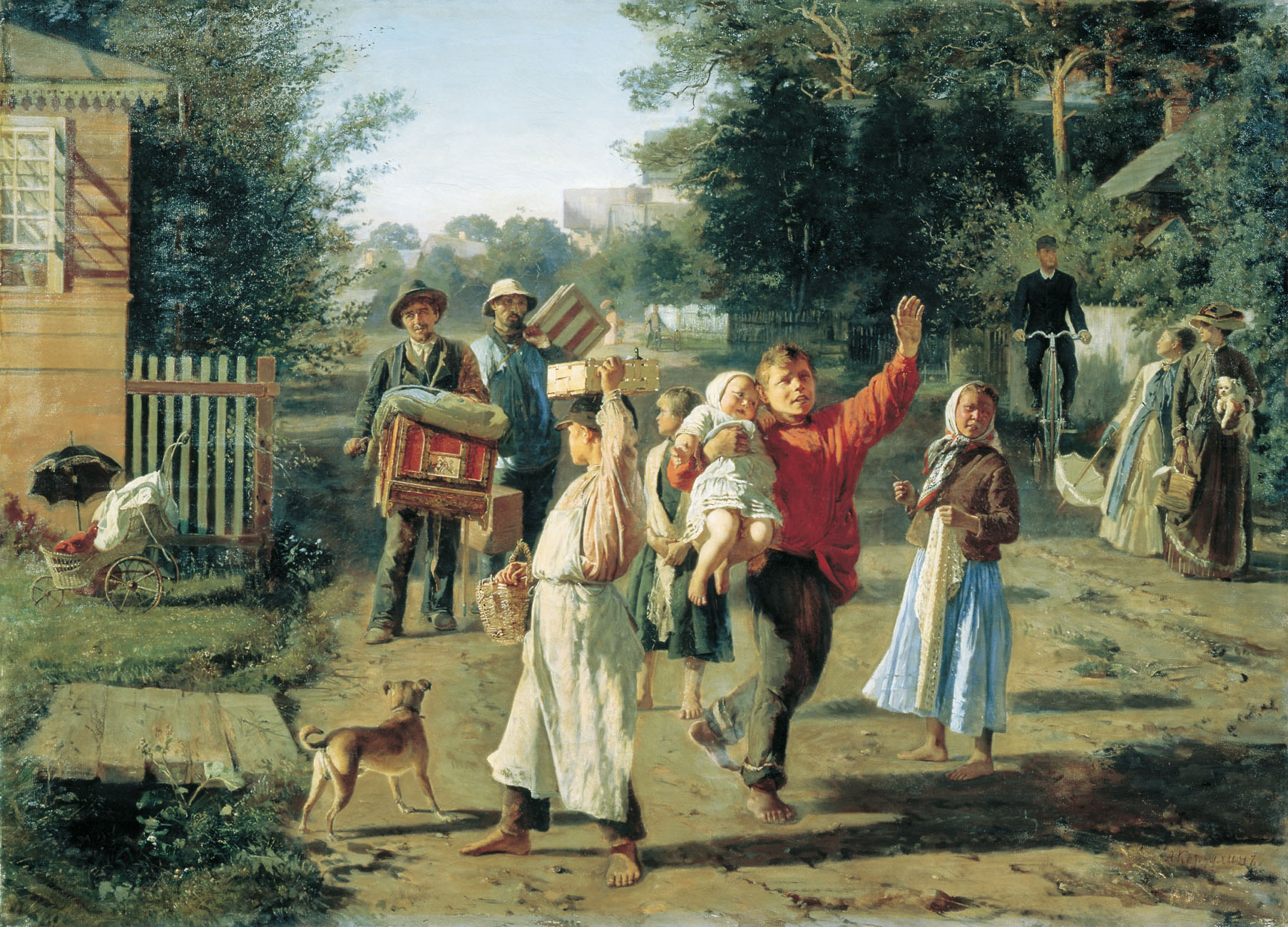 Alexei Ivanovich Korzuhin: “Petrushka has come!” (1888) Russian village idyll. In the background you can discover our old acquaintances, the early heralds of modernization: the paleocyclist to the right, and the children’s stroller to the left.
After the revolution, however, the barrel organ – unlike in other countries – quickly declined in the Soviet Union. On the one hand, it was separated from its Petrushka, monopolized by the young Soviet agitation and propaganda art for the purpose of workers’ performances. On the other hand, as Gilyarovsky’s Moscow shows it sensitively, the Soviet power tried to eliminate both such kinds of mobile elements, and the traditional population which was its audience. One of the last hommages to the sharmanshchik as a living trade is, we think, the book which we would like to present now, and which appeared in Leningrad without date, but sometime around 1925.

Sharmanochka – Little Barrel Organ. Its author is the same Nikolai Yakovlevich Agnivtsev who published the recently presented In defense of the chimney sweep as well as a number of other forgotten pearls of youth literature. You can read the translation of the poems in popup windows.


Песенка старого шарманщика (Song of the old organ grinder). Dedicated to Yevgeny Yevtushenko. Music and song by Bulat Okudzhava
| Шарманка-шарлатанка, как сладко ты поешь! Шарманка-шарлатанка, куда меня зовешь? Шагаю еле-еле, вершок за пять минут. Ну как дойти до цели, когда ботинки жмут? Работа есть работа. Работа есть всегда. Хватило б только пота на все мои года. Расплата за ошибки – она ведь тоже труд. Хватило бы улыбки, когда под ребра бьют. | Barrel organ, charlatan! how sweet you sing! Barrel organ, charlatan! where do you call me? I hardly advance, five minutes an inch: How could I arrive, when the shoes are tight? Work is just work, and work is all the time: so much sweat would have been enough for a life. Pay for the errors as well – it is also work and when it beats under the string – give at least a smile. |
 Ali Baba, the last Russian organ grinder (Pyotr Yakovlevich Lyubaev, Petyka)
Вокруг Света, June 1970
The nostalgia for the barrel organ, as shown by the song of Okudzhava, was not forgotten after the craft went into oblivion. How could it have gone, once in one of the most popular Soviet children’s books – if not the most popular one indeed –, Alexei Tolstoy’s The little golden key (1936), a recast of Pinocchio (which in my humble opinion is better than the Italian original) Daddy Carlo is no carpenter, but an organ grinder! His statue is still standing in front of the Kiev Children’s Theater. Moreover, it seems that the instrument is living a new golden age, which is marked not only by the increasing presence of nostalgia organ grinders on various fairs, but its genial further developments such as the one presented by the Russian television in the following program:
 An organ grinder leading a trained fox and a dog. Ivan Turgenev’s drawing in his sketchbook, 1834


Add comment