

   |
 Michael Chabon realized by reading an old Yiddish phrase book that Yiddish is one of the greatest dead languages in Europe. This language, which a hundred years ago was spoken by just as many people as Hungarian, disappeared without trace from the linguistic map of Eastern Europe. As it was basically a spoken language, it has left behind only a handful of written records: some bilingual prayer books, a couple of 19th-century secular literary works and dailies, the memorial plaques of a few cemeteries and mass graves.
 Shops in the Lwów ghetto in the autumn of 1941
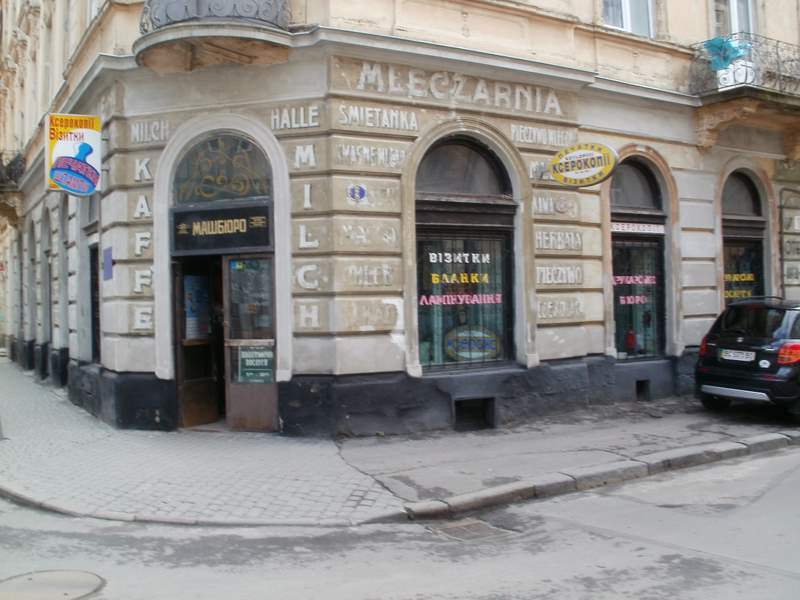
And the shop labels in Lwów. Lwów is perhaps the only city in Europe where you can still see Yiddish inscriptions on the streets. They have not only survived for the seventy years of the city’s sleeping-beauty-dream, but they are also preserved on the quadrates of the decorative plaster nowadays, during the renovation of the shops. As on the facade of the large grocery store presented in the previous entry, at the corner of Chornovola Avenue, behind the opera house, where the former new Jewish quarter met the Old Town.


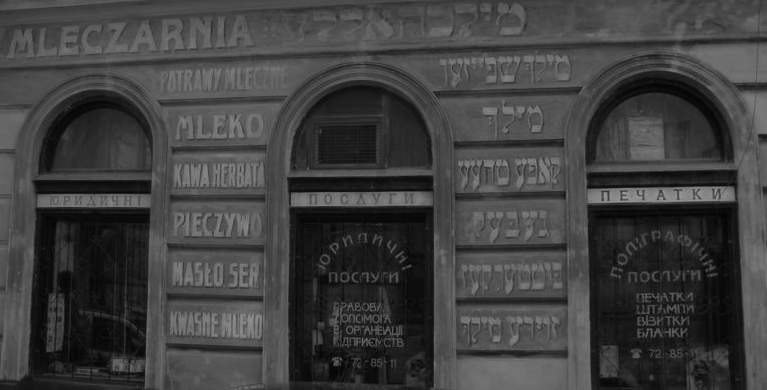
Or as on the wall of the former milk shop whose photo was sent to us by Alfanje from the same neighborhood, and which also announced its assortment in two more languages of old Lwów and Lemberg which disappeared from the city together with Yiddish.
It seems that the owners of the shops are also aware of the unique, brand-like nature of the Yiddish inscriptions in Lwów. This is proved by the fact that they not only preserve and renovate them, but they also copy them to antiquate and make “genuinely Lwówish” the newly opened shop portals. Such as that of this knitwear shop in the former new Jewish quarter, just around the corner from the house of Sholem Aleichem.

However, the recent creation is revealed not only by the modern typography of the inscription. But also by the fact that the equivalent of “knitwear” written in Hebrew characters is not in Yiddish – then it would be שטריקוואַרג shtrikvarg –, but in Hebrew: סריגים srigim. Although this use of the sacred language would have been impossible at the beginning of the last century, nowadays it is obviously more practical if the seller has in mind the Israeli tourists passing by the front of the shop in the direction of the Sholem Alechem memorial plaque. Which is also the most recent and probably the definitively last Yiddish-language inscription in the former Lemberik.


1906 אין דעם הויז האט געוווינט אין
יאר דער קלאסיקער פון דער יידישער ליטעראטור שאלעם-אלייכעם
In dem hoyz hot gevoynt in 1906 yor der klasiker fun der yidisher literatur Sholem-Aleykhem
In this house lived in 1906 the classic of Yiddish literature, Sholem Alechem
יאר דער קלאסיקער פון דער יידישער ליטעראטור שאלעם-אלייכעם
In dem hoyz hot gevoynt in 1906 yor der klasiker fun der yidisher literatur Sholem-Aleykhem
In this house lived in 1906 the classic of Yiddish literature, Sholem Alechem




Add comment