

While the Iranian government is restoring the Armenian churches of northern Iran and nominating them for World Heritage status, just a few hundred meters away, across the border river, every effort has been made to erase even the memory of the people who once lived there.

The Araxes became a border river in 1828, when the expanding Russian Empire took first Northern Azerbaijan and then Armenia from Persia, to which they had belonged for two and a half millennia. The new frontier cut the town of Julfa in two, right at the stone bridge celebrated by Virgil as pontem indignatus Araxes. By then, however, the town had long since lost the memory of its golden age, when it had been one of the key trading hubs between Persia and Europe.
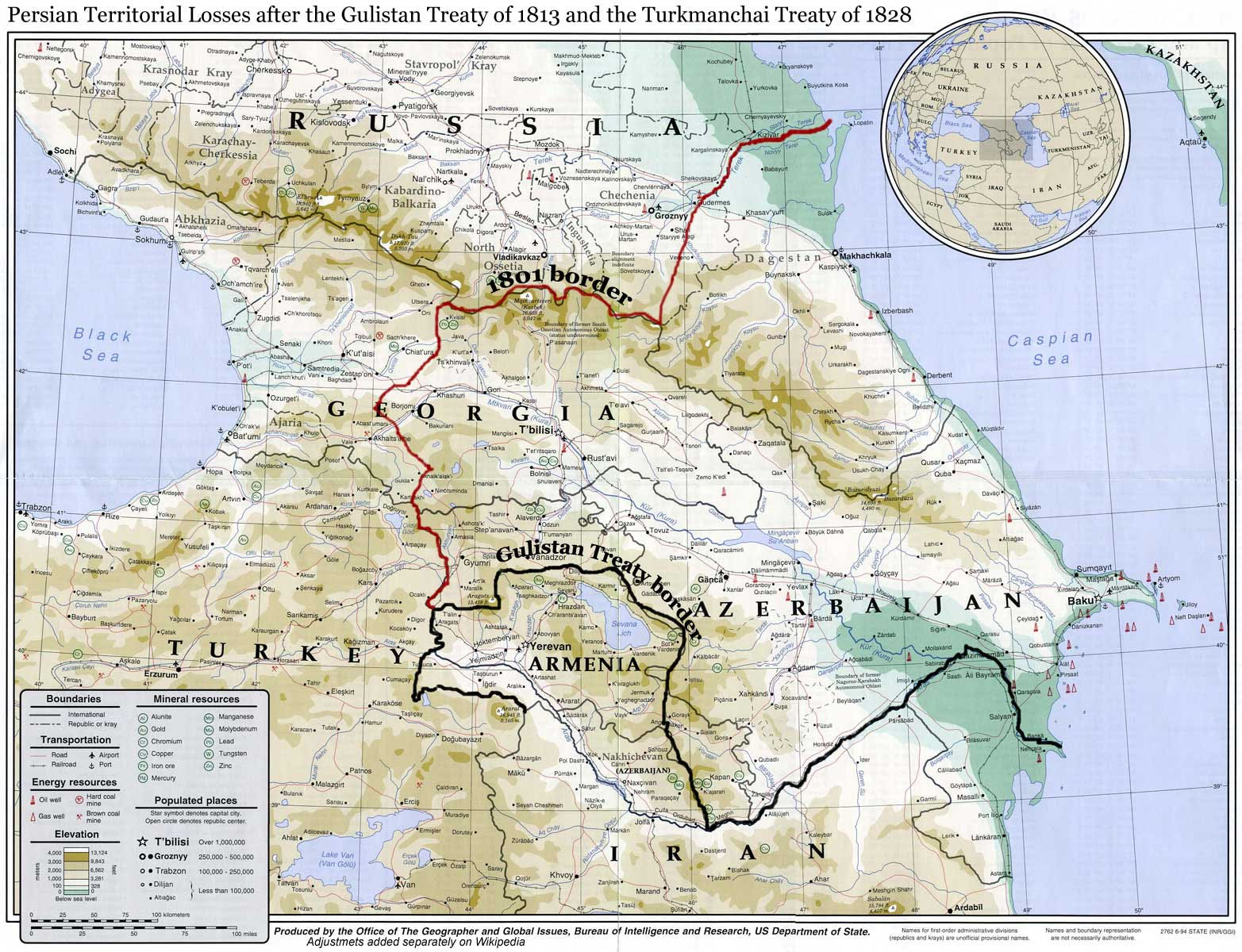 Wikipedia's map marks the 1813 border line in black. The frontier established in 1828 continues it along the Araxes River, which today forms Armenia's southern border.
In the sixteenth century, it was the Armenian merchants of Julfa who bought up Persia's most valuable export, raw silk, and distributed it across Europe. They maintained trading houses from Aleppo to Venice and Amsterdam, and travelers described the town as astonishingly wealthy, with seven churches and three thousand stone houses. Yet the most impressive witness to Julfa's former prosperity was its cemetery, where visitors counted as many as ten thousand beautifully carved, human-sized khachkars, the distinctive Armenian cross-stones.
The golden age came to an abrupt end. During the Ottoman–Persian wars of the late sixteenth century, Shah Abbas the Great realized that he could not defend this wealthy frontier town against the Ottoman Empire. So in 1604 he ordered the entire Armenian population of Nakhichevan to be deported hundreds of kilometers south to Isfahan and its surroundings. The forced march cost an estimated hundred thousand lives. In their new home, the Armenian merchants built up the thriving commercial center of New Julfa, which remains Armenian to this day, while Armenian craftsmen helped turn Isfahan's great square into one of the wonders of the world. Julfa in Nakhichevan never recovered. Its ruins can still be seen west of the modern town that bears its name. Only the cemetery survived intact, stretching along the riverbank at the western edge of the ruined city, with its ten thousand beautifully carved stones.
 The Julfa cemetery in the 1910s, viewed from the west. The town once stood at the foot of the mountain on the left bank of the Araxes. On the right, on the Iranian side, the small Armenian church known as the "Shepherd's Church" (Kelisâ-ye Chupân), built in 1518, still stands on a rocky outcrop above the river. Below is probably the earliest photograph of the cemetery, from B. Chantre's A travers l’Arménie russe (Paris, 1893), reproduced here.

The name Nakhichevan means "the place of descent" in Armenian, because according to tradition this is where Noah and his sons came down from the Ark after it had run aground on nearby Mount Ararat. Until the great deportation of 1604, the region was overwhelmingly Armenian. The deported population was replaced by Turkic pastoral tribes, and the Shah later settled additional Turkic groups there to guard the frontier. The Armenians who remained, or gradually returned, became a minority among the Azerbaijani Turks. In 1920, the Soviet authorities attached the region to Azerbaijan as an autonomous territory. By 1979, Armenians made up only 1.4% of the population in a land where they had represented 40% a century earlier. After the Karabakh war, they too disappeared. Only the cemetery remained.

The first photographic survey of the cemetery—thirty-eight images in all—was made in 1928 by Jurgis Baltrušaitis, the great art historian (The Fantastic Middle Ages), poet, and at the time Soviet Lithuania's ambassador. To this day, it remains the most detailed visual record of the cemetery, hidden away in one of the tightly controlled border zones of the former Soviet Union. The photographs, accompanied by commentary, were published by Dickran Kouymjian in Lisbon in 1986. A PDF version can be downloaded here from the djulfa.com website dedicated to the cemetery.
 Photograph by Baltrušaitis
The last person known to have seen the cemetery intact was the Scottish architect Steven Sim, in August 2005. While visiting Armenian monuments across Nakhichevan, he reported that every medieval Armenian church in the region had been razed to the ground, apparently only a year or two earlier, as the ruins had not yet been reclaimed by vegetation. The Julfa cemetery, however, was still standing when his train passed it along the riverbank. Railway staff forbade him from taking photographs, and shortly afterwards he was arrested and expelled from the country.

While travelling in Iran and visiting the Armenian monuments from the southern side, I remember thinking: next time I'll cross the bridge and photograph the cemetery as well. I was too late. The Julfa cemetery was destroyed on my fortieth birthday. It is a strange thought that while an international group of friends was celebrating with me, surprising me with Italian and Spanish wine tastings, the Azerbaijani army was spending those same days dismantling one of the richest surviving monuments of Armenian culture. For three days, between 15 and 17 December 2005, the khachkars were smashed and carried away from the banks of the Araxes. Armenian residents on the Iranian side of the river filmed the destruction. Using their footage, Sarah Pickman produced the documentary below after becoming the first journalist to report on the events in Archaeology magazine.
On 16 February 2006, the European Parliament condemned the destruction in an official resolution and sought to send a fact-finding delegation to the site, something the Azerbaijani government has prevented ever since. “A lie and a provocation,” declared Azerbaijani president Ilham Aliyev. “We have destroyed no Armenian monuments, because Armenians never lived in Nakhichevan in the first place.”
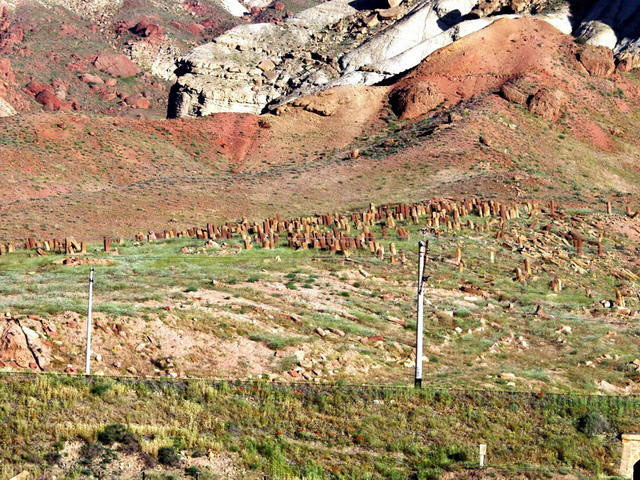
In April 2006, members of the Institute for War and Peace Reporting working in Nakhichevan and Azerbaijan published the first on-the-ground report confirming the cemetery's complete destruction. A military firing range had been established on the site.


The memory of the khachkars lives on in the Djulfa Virtual Memorial Museum.
Hasmik Harutyunyan: Lullaby of Tigranakert (5'53"). From the album Armenian Lullabies (2004).



Add comment