

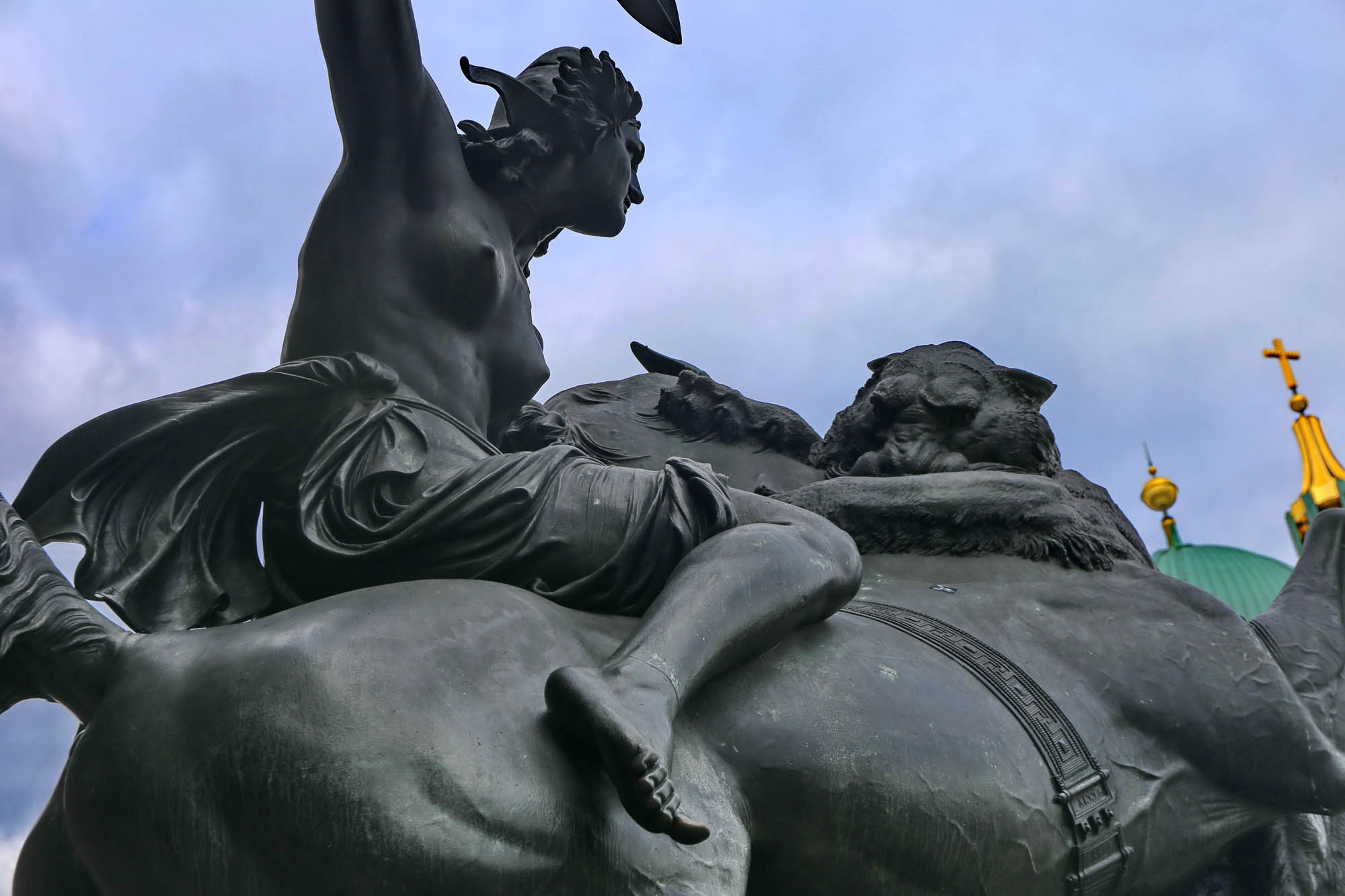
Berlin’s museums have opened again, and one goes to the museum again. The Altes Museum’s collection of antiquities on Museum Island feels like an old, dear friend I’ve missed a lot. On my way out, I sit down on the steps to leaf through the freshly printed catalog of the new Greek portrait sculpture exhibition in the warm spring sunlight — I’ll write about it soon. And as I look up, I suddenly see what I’ve been looking at for a hundred thousand years, as Attila József says: the two bronze statues flanking the museum stairs. On both sides, a rearing horse with its rider — each stabbing a big cat: to the right, a woman slaying a tiger, to the left, a man killing a lion. They’ve been here for a long time — the Amazon since 1843, the man since 1861. Yet it’s only now that it strikes me: what are these action-packed statues doing in front of the House of Fine Arts, the temple of the spirit — these two triumphant, armed riders brutally slaying endangered great cats, symbolic victims of humankind’s dominance?

I’m not the only one asking this question. The Reclam Kunstführer Berlin, which I turn to first for an answer in the museum shop, makes the same observation — it states that “the statues have nothing to do with the museum’s program.”
So how, and why, did they end up here then?
Karl Friedrich Schinkel, the museum’s architect, originally intended to place equestrian statues of the two Prussian kings — Frederick William III and IV — who donated the museum. The building, constructed between 1823 and 1830 and originally called the Königliches Museum, housed the royal family’s private collection and aimed to share its classical heritage with educated citizens. The museum thus fit logically among the buildings surrounding the royal ornamental garden, the Lustgarten: to the south, the royal palace (whose postwar reconstruction, after being lost during the GDR era, is now finally nearing completion) symbolized power; to the east, the Berliner Dom represented the church; to the west, the Zeughaus, later a military museum, symbolized the army; and to the north stood the museum — a monument to the human spirit.
Frederick William IV, however, opposed placing royal portrait statues there. But the idea had taken on a life of its own, and before long, the grand staircase seemed to cry out for equestrian figures.
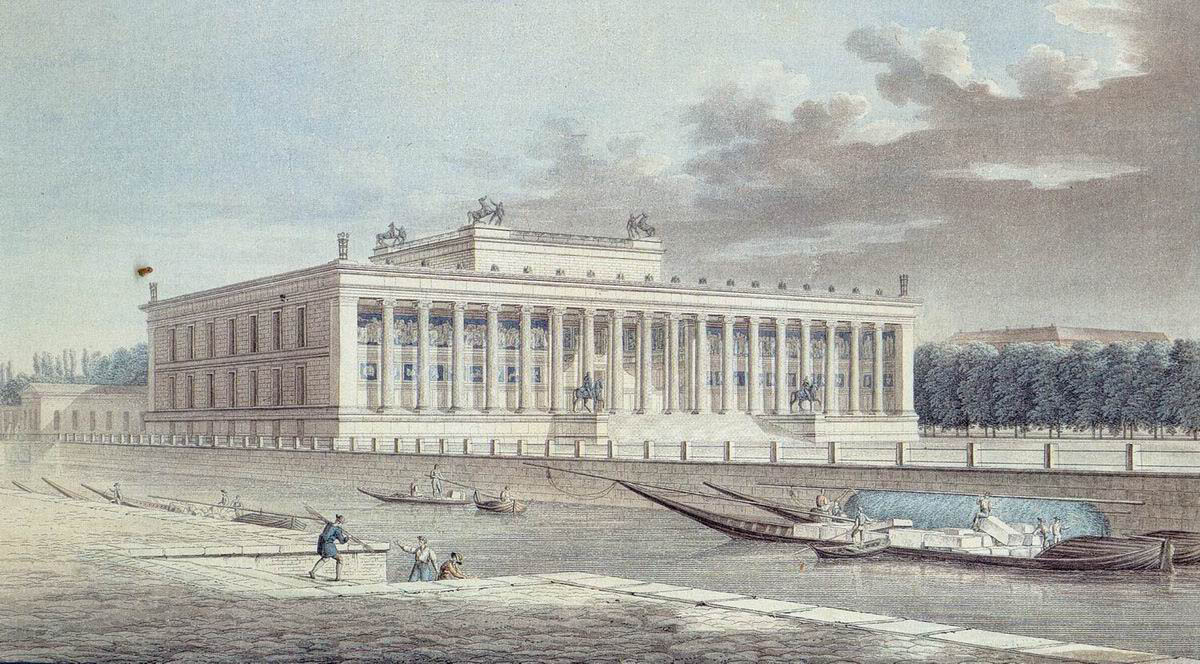 Friedrich Thiele: The Altes Museum, 1830, with two staircase statues that never actually existed.
 The first of the two equestrian statues, created by August Kiss — a sculptor of Silesian origin who studied in Berlin — is the Tiger-Slaying Amazon, or simply the Amazon, placed on the right-hand balustrade of the stairs in 1843. The Illustrirte Zeitung of September 30 gave a detailed account of its installation along with a review. According to the article, signed with the initials L.R., the statue’s greatest merit was that it was cast from public donations. The artist “was bold enough” to model the sculpture life-size in his studio, after which “a large association of enthusiastic friends of art, headed by the King himself” (of which Schinkel was also a member) contributed the funds needed for casting. This, then, is the first — though invisible — link between the museum and the statue: the active participation, the “sacrifice,” of the educated middle class in enriching what was, in the language and spirit of the time, a new temple of civic culture.
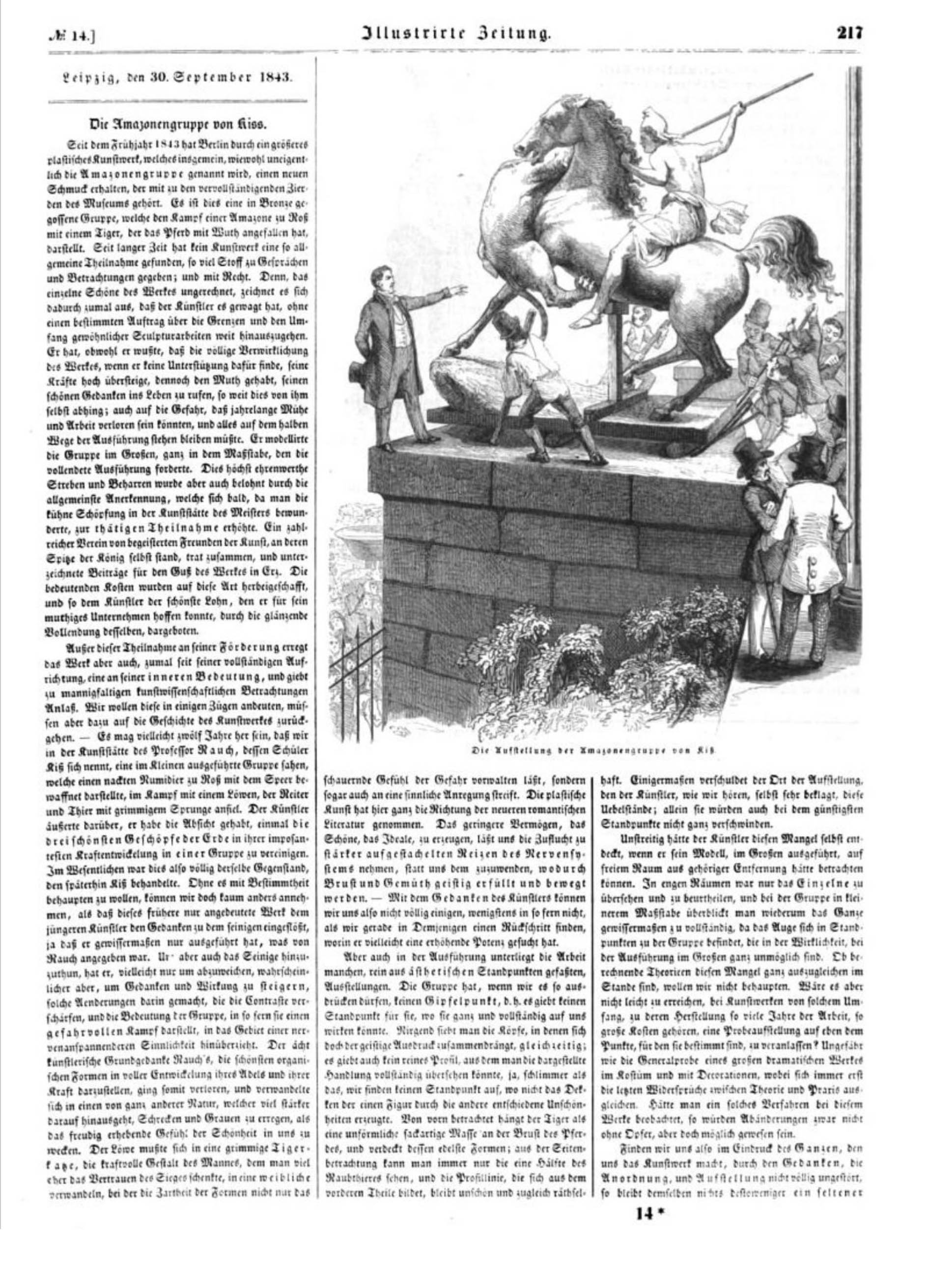 Illustrirte Zeitung, September 30, 1843. In the engraving, the muscular men installing the statue seem to be helping the Amazon fight the tiger with their poles.
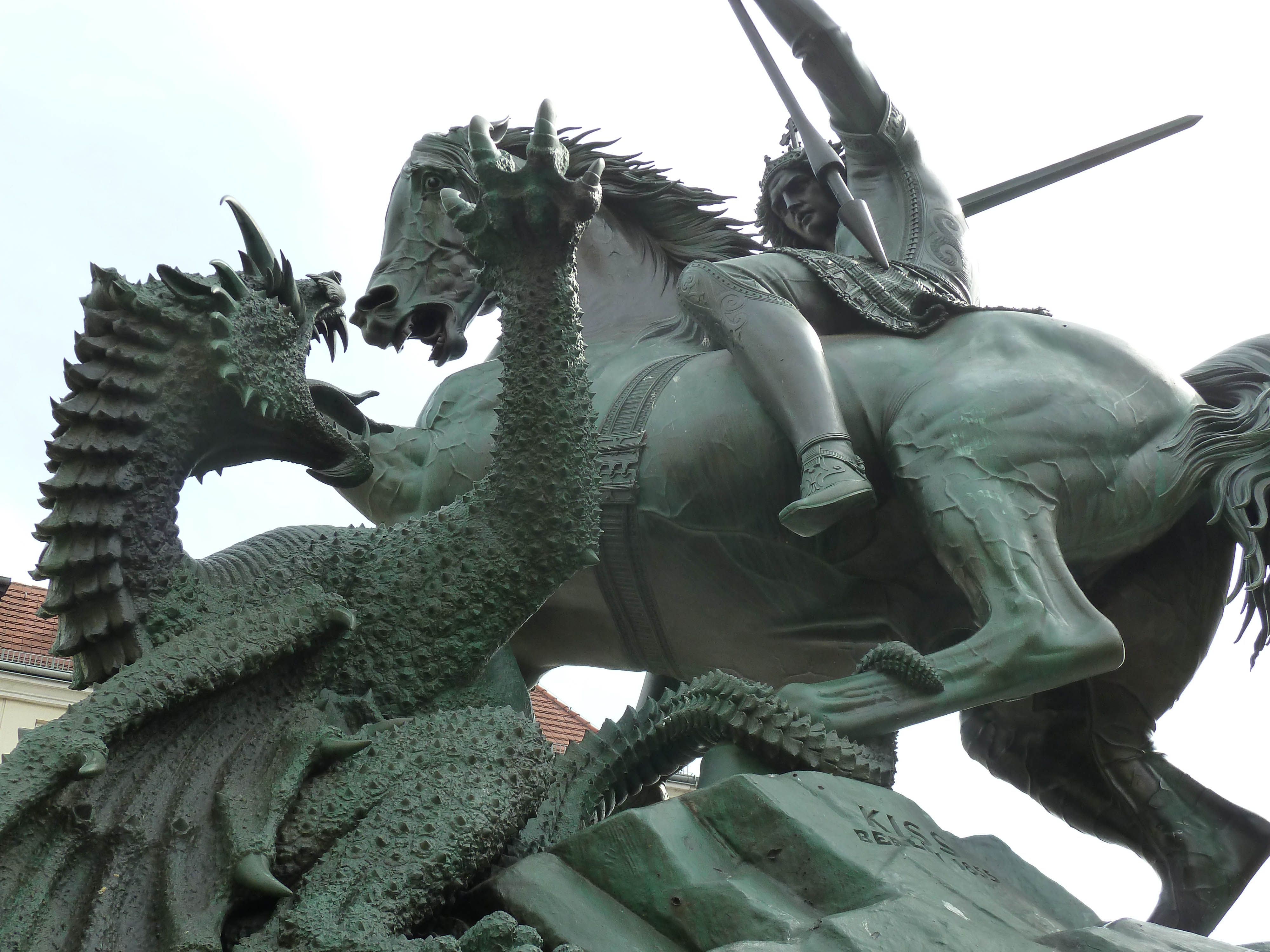
The contemporary mindset also saw in the statue a representation of the spirit’s triumph over animal savagery — precisely the Bildungsziel (civilizing purpose) that the museum itself embodied. It’s no coincidence that August Kiss’s other major work is the statue of Saint George (1855) standing in front of the Nikolaikirche, whose dragon traditionally symbolizes evil — its slaying representing the victory of good.
The prolific critic Karl August Varnhagen praised the statue in much the same way: “The work is grand, bold, expressive, and full of strength... One sees that the horse is lost, yet the human being triumphs. Radiant with spiritual superiority, the beautiful Amazon will be saved and will at least avenge the horse.” This concern for the side character is unusual from a critic, but we know that Varnhagen — who served alternately as an Austrian, Prussian, and Russian captain — had fought through the Napoleonic wars and fully understood what it meant to lose a horse in the heat of battle.
No one yet felt pity for the tiger. The Illustrirte Zeitung reviewer merely complained that while the Amazon and the horse were beautifully detailed, the tiger “hangs on the horse’s neck like a shapeless, sack-like mass”, and there is no angle from which the whole creature can be seen at once. As a photographer, I can confirm this myself.
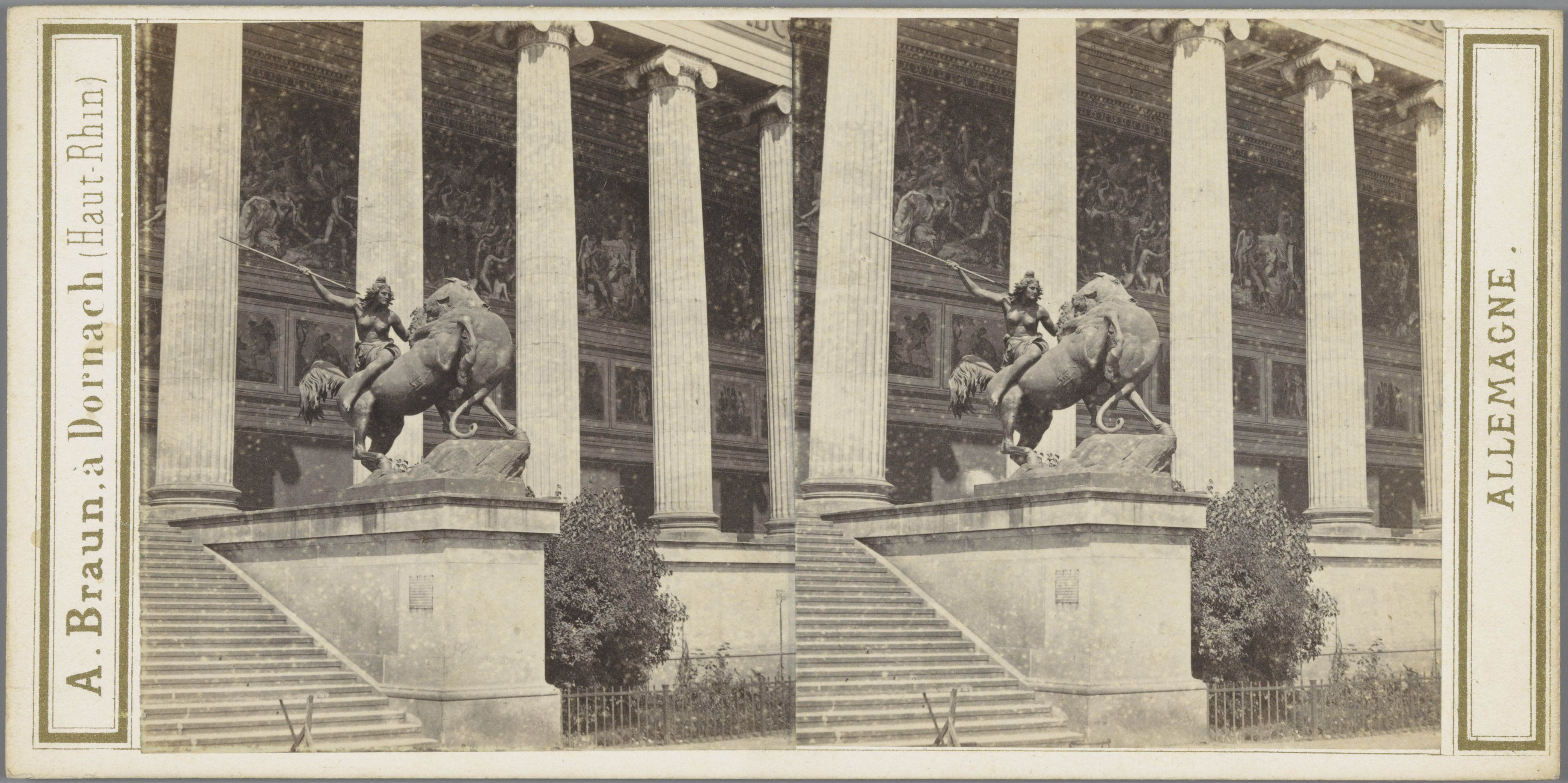 Photograph by Adolphe Braun & Compagnie, 1860–66.
The statue was a great success. Prussia even sent it to the 1851 Great Exhibition in London, where it was displayed in the eastern wing of the Crystal Palace among the exhibits of the German Customs Union (Germany as such did not yet exist!). Michael Leapman writes about it in his 2011 book The World for a Shilling: How the Great Exhibition of 1851 Shaped a Nation:
“A little further on was the German sculptor August Kiss’s depiction of an Amazon on horseback attacked by a tiger, whose combination of energy and delicate modelling made it many people’s favourite work in all of the Crystal Palace. The tiger’s claws were embedded in the horse’s body while the Amazon held her spear aloft, ready to deliver the decisive blow.”
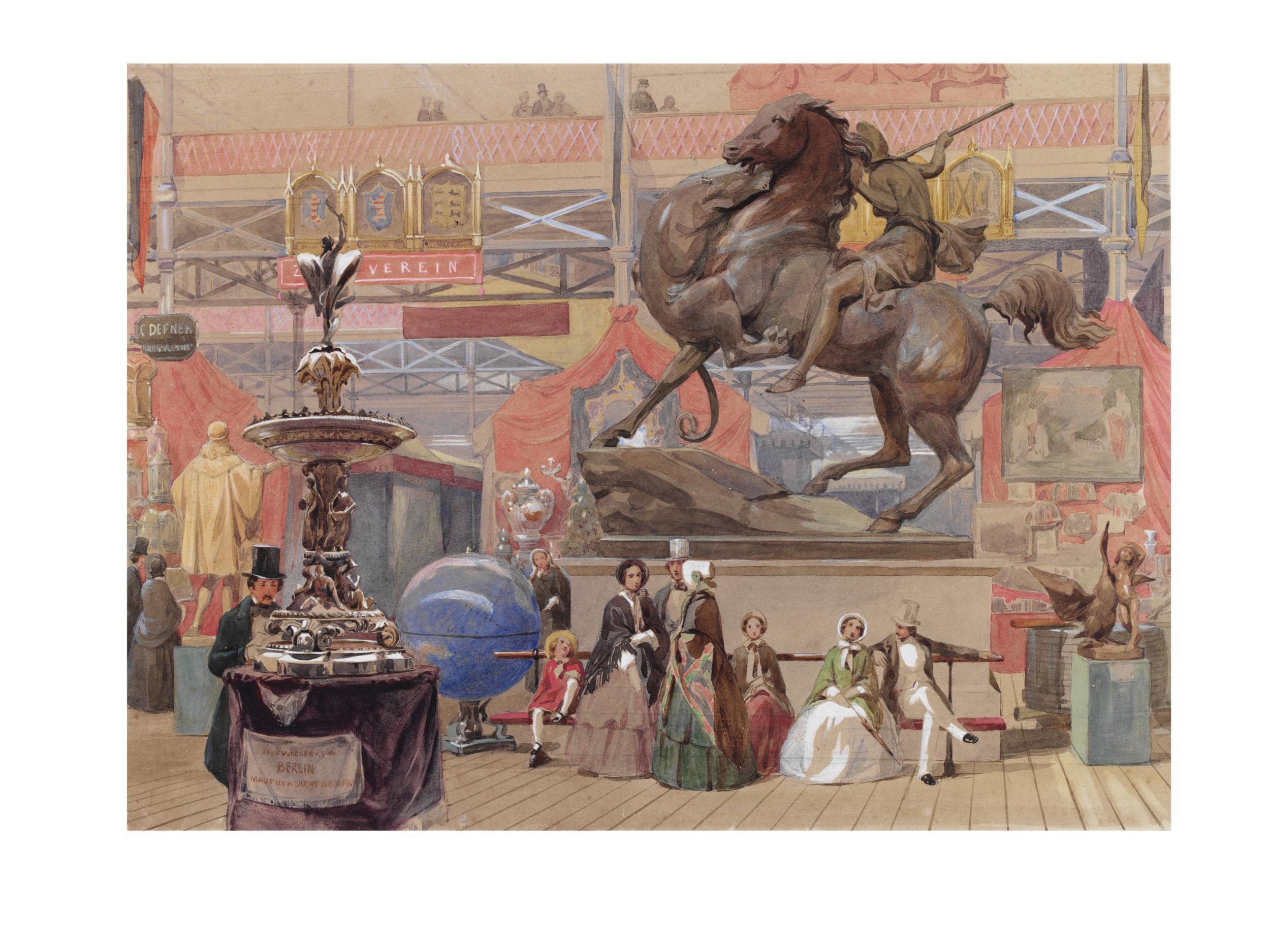 John Absolon: View of the East Wing of the Crystal Palace, 1851.
The sculpture’s popularity in England is also reflected in the fact that George Eliot could use it as a metaphor just four years later in a review. Writing about a story by Charles Kingsley, she praised the work’s romantic vigor and natural truthfulness, contrasting it with the mass of formulaic, classicist writing that merely imitated others, and added: “After a surfeit of Hebes and Psyches, or Madonnas and Magdalens, it is a refreshment to turn to Kiss’ Amazon.” The statue was clearly still very much alive in the minds of educated English readers if Eliot could refer to it so casually. Interestingly, thirteen years earlier the Illustrirte Zeitung had criticized the statue precisely for not following the classical ideal of beauty, claiming that instead of “fully expressing the nobility and power of the most beautiful organic forms,” it sought “the terrible and dreadful,” and instead of “spiritual nourishment and awakening of the heart and emotions,” it aimed at “intense stimulation of the nervous system” — summing up that “sculptural art here has gone entirely in the direction of modern romantic literature.”
Even John Ruskin could still refer to the exhibition years later: in a 1859 Berlin correspondence for the Scotsman, he remarked, “Kiss’ Amazon makes a good grotesque for the side of the Museum steps; it was seen to disadvantage in London.”
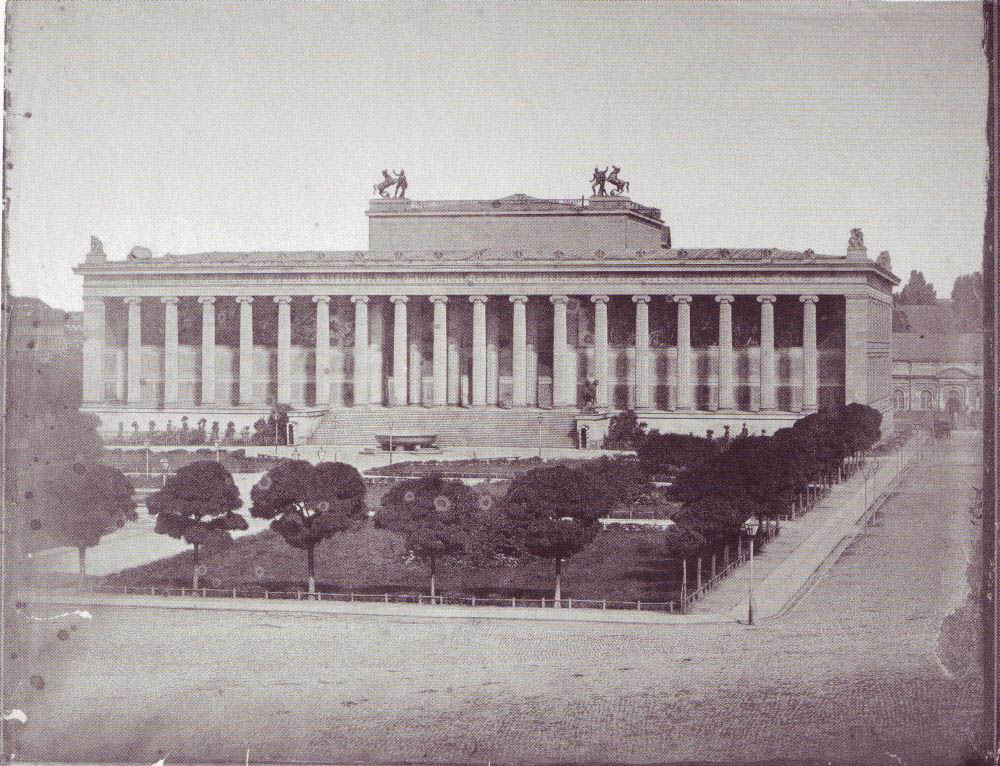
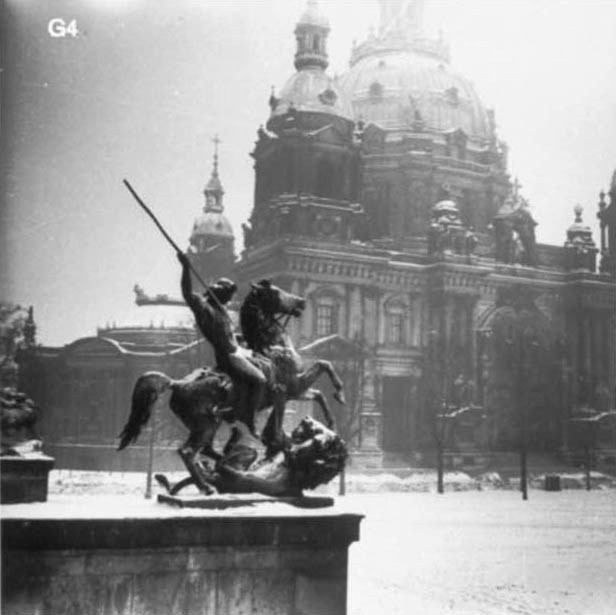
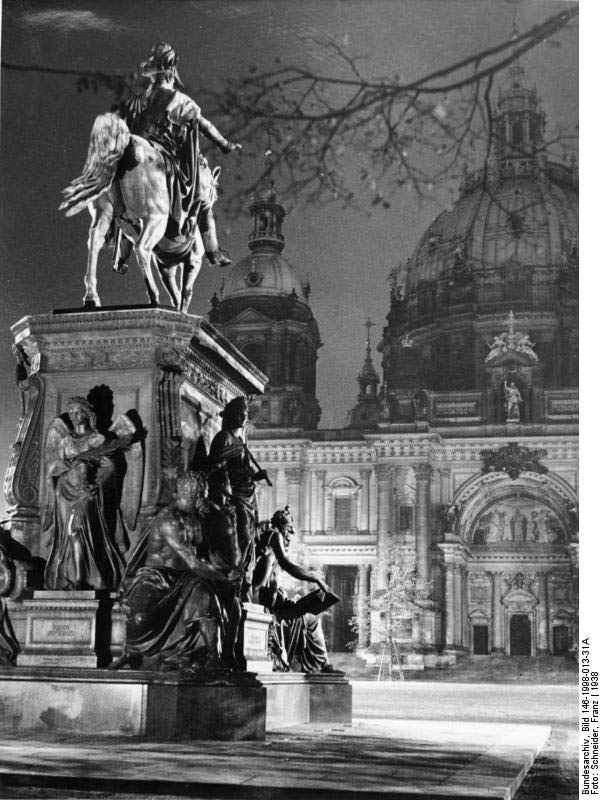
In the 1854 photograph above, the Amazon still stands alone on the museum’s staircase. But her counterpart was already in the making — the Lion-Slayer, or “der Löwenkämpfer,” created by Albert Wolff, a sculptor from Mecklenburg, between 1847 and 1856. Wolff had been a pupil of Christian Daniel Rauch, founder of the Berlin school of sculpture and one of the leading sculptors of the 19th century — as had Kiss himself. The Illustrirte Zeitung had already mentioned in 1843 a small statue the author had seen around 1831 in Rauch’s workshop, depicting a naked Numidian horseman spearing a charging lion. According to the writer, that piece inspired Kiss’s statue (with the modifications described) and was, in turn, directly followed — likely with little change — by Wolff’s own version of the lion-slayer.
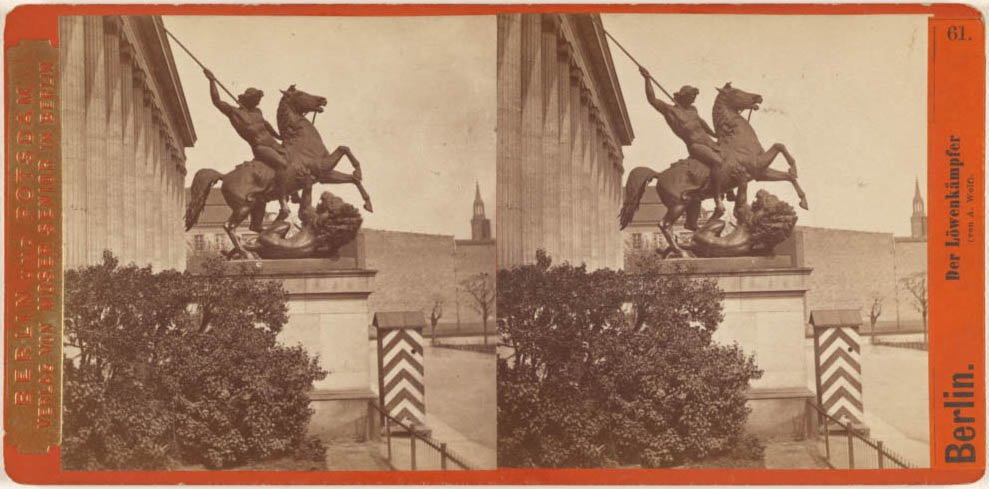 The Löwenkämpfer. Above in a photo by Julius Moser Sr. from the 1860s, below in a photo by Heinz Stockfleth around 1940.
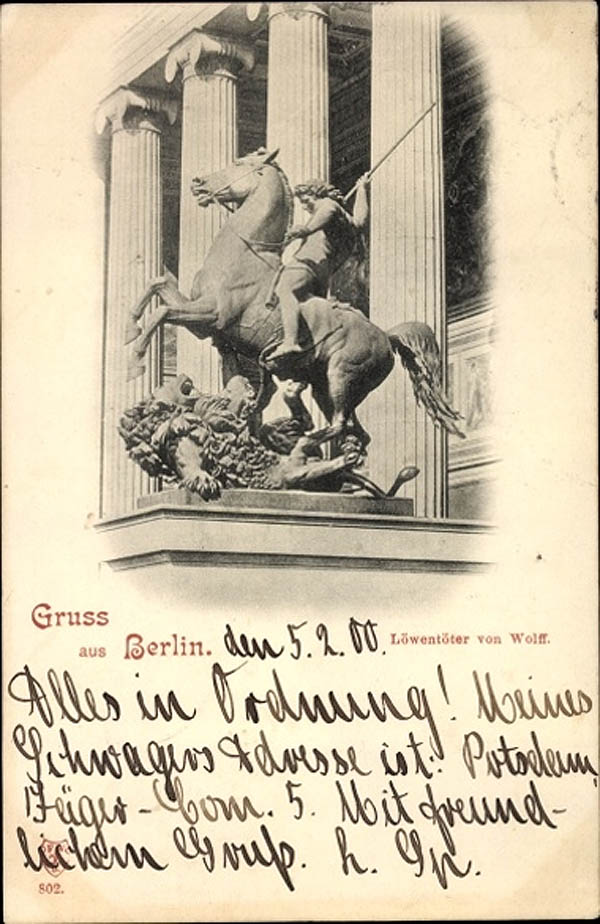
According to the literature, Rauch had originally intended the lion-slayer statue for the museum stairs, and this intention was known and shared by Schinkel before his death in 1841. That idea likely supported the earlier installation of the Amazon, and it may also explain why August Kiss dared to model his statue full-size without sufficient financial backing — perhaps sensing that Rauch’s model had already prepared the public for a monumental equestrian group of this type. By 1861, however, that mood had largely faded. The critic Franz Kugler, who had praised the Amazon’s installation in 1843 — saying that it harmonized beautifully with Schinkel’s (since-destroyed) frescoes in the museum’s portico — now wrote about the Lion-Slayer in words that sound very much like what we, a century later, might also think in a completely changed atmosphere of reception: “In vain do we seek any connection between the temple of peaceful art and such a barbaric, raw depiction of wild nature.” And yet the statue is far more classical and balanced than its earlier 1843 counterpart.
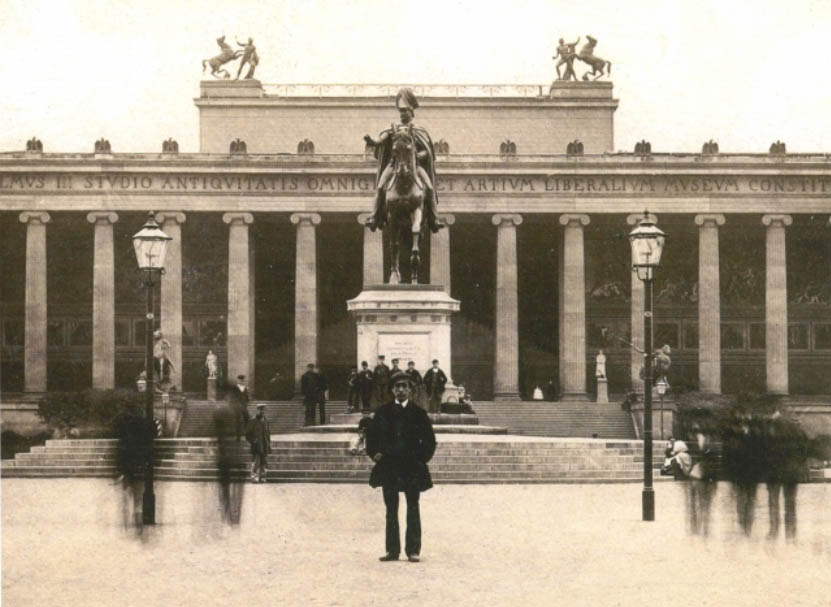 Incidentally, Albert Wolff managed to place another equestrian statue in front of the Altes Museum — that of King Frederick William III, installed in 1871. The statue was melted down for wartime use in 1944.
With such neoclassical genre sculptures, it was common for artists to reimagine some ancient statue or, at least, an ancient description of one. So what might have been the classical inspiration for these two big-cat slayers?
We don’t know of any ancient statues depicting tiger- or lion-killers — but plenty of reliefs or two-dimensional representations exist. One is actually right here in the museum: a mosaic from Hadrian’s Villa in Tivoli, dating to around 130 AD, showing centaurs — half-human, half-horse — fighting three big cats: a tiger, a lion, and a leopard. The tiger bites into the fallen centaur’s side in much the same way that the Amazon’s tiger bites into her horse. The museum purchased the mosaic around 1840, so both sculptors could well have seen it.

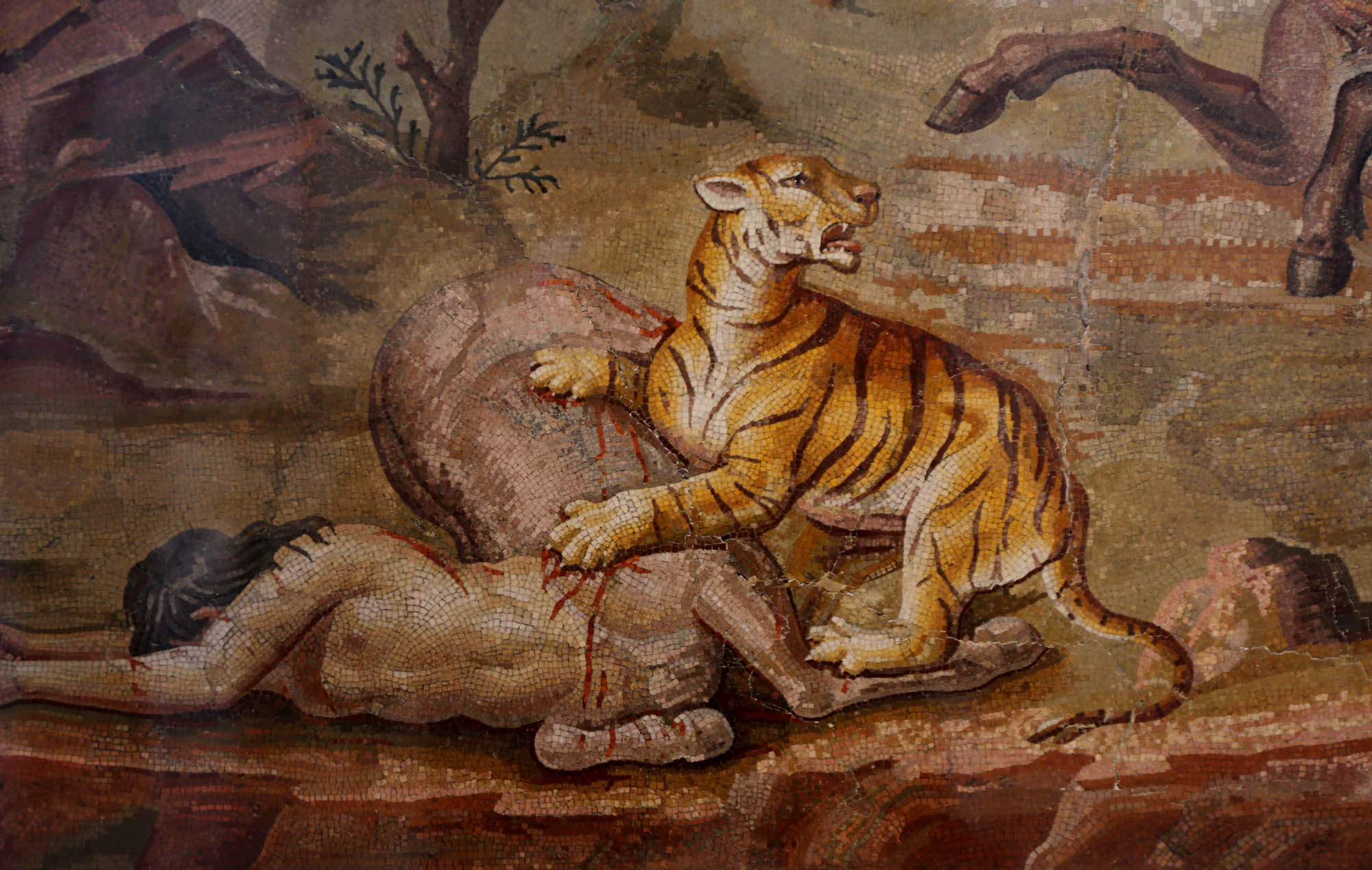
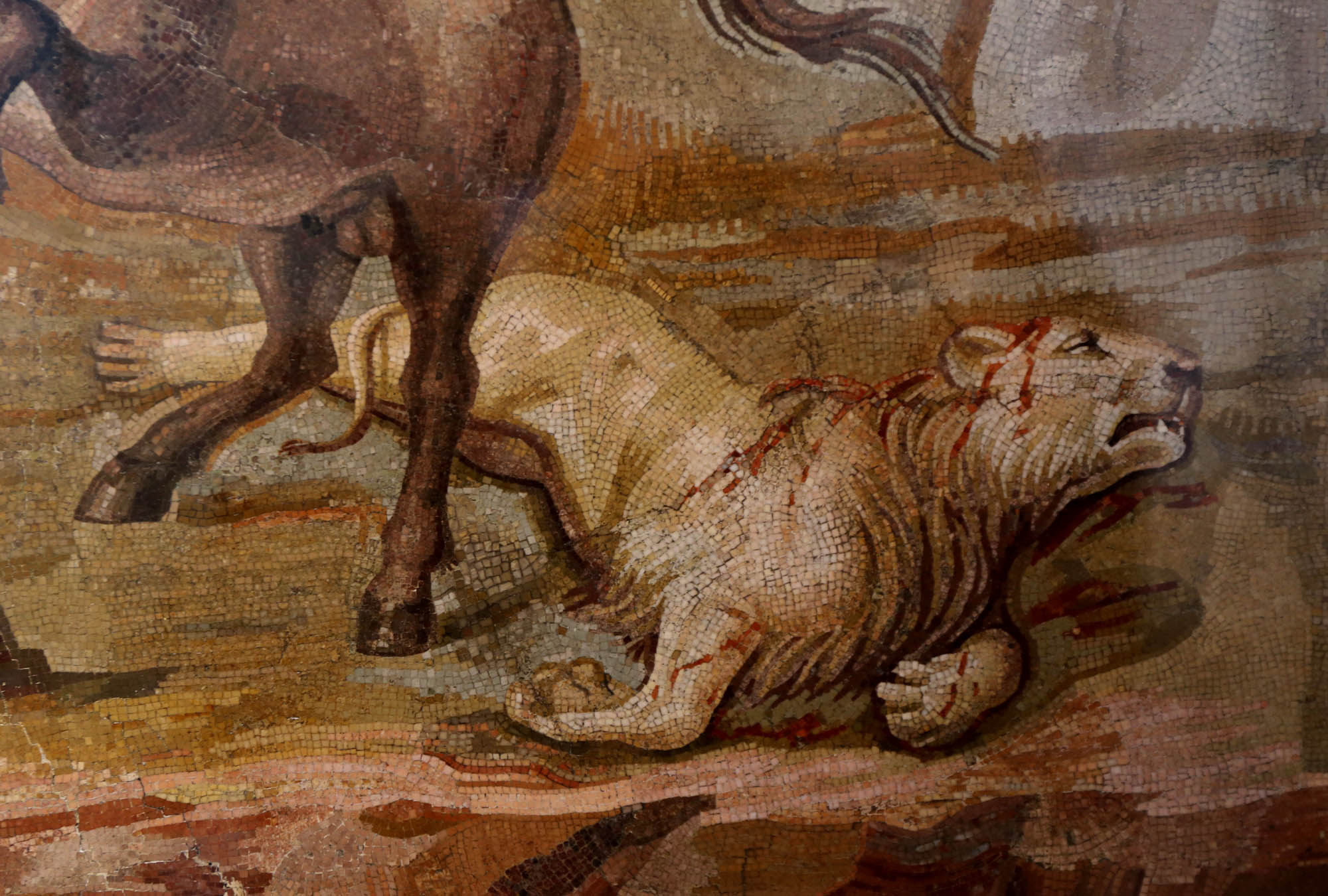
To today’s viewer, the mosaic feels like an over-the-top fantasy — a bit too much of a good thing. Three predatory big cats at once? And centaurs, too? Still, that was probably the intended effect from the start. The mosaic was meant to radiate concentrated exoticism — its key elements being those hybrid human-animal creatures said to live at the edges of the known world, and above all, the tiger. For the Romans, the tiger was the ultimate emblem of the exotic. In the 4th-century Sicilian Villa Romana del Casale — one of the largest surviving Roman mosaic ensembles — the floor of the great cross-shaped hall is decorated with the scene of the “Great Hunt.” On the left, hunting and animal capture take place in Africa; on the right, in Asia. The African scenes are fairly realistic, since the Romans knew that continent well, and the villa’s owner likely played an active role in capturing and supplying wild animals for the Roman circus. But on the Asian side — known to them only by hearsay — things go wild. Alles geht, from rhinoceroses to griffins. Among these exotic creatures, the tiger plays a symbolic role, marking clearly that we’ve entered the realm of the mythical.
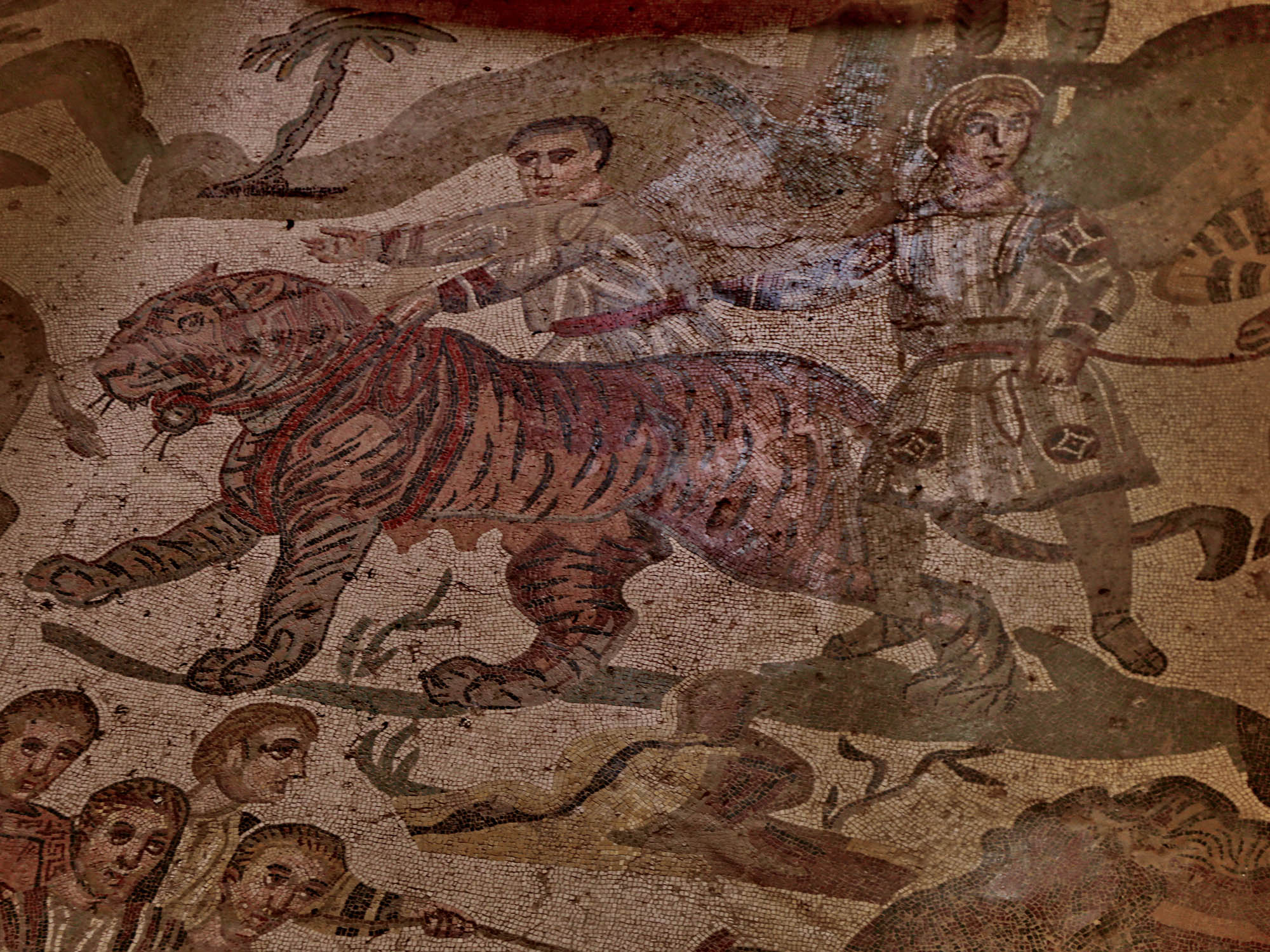
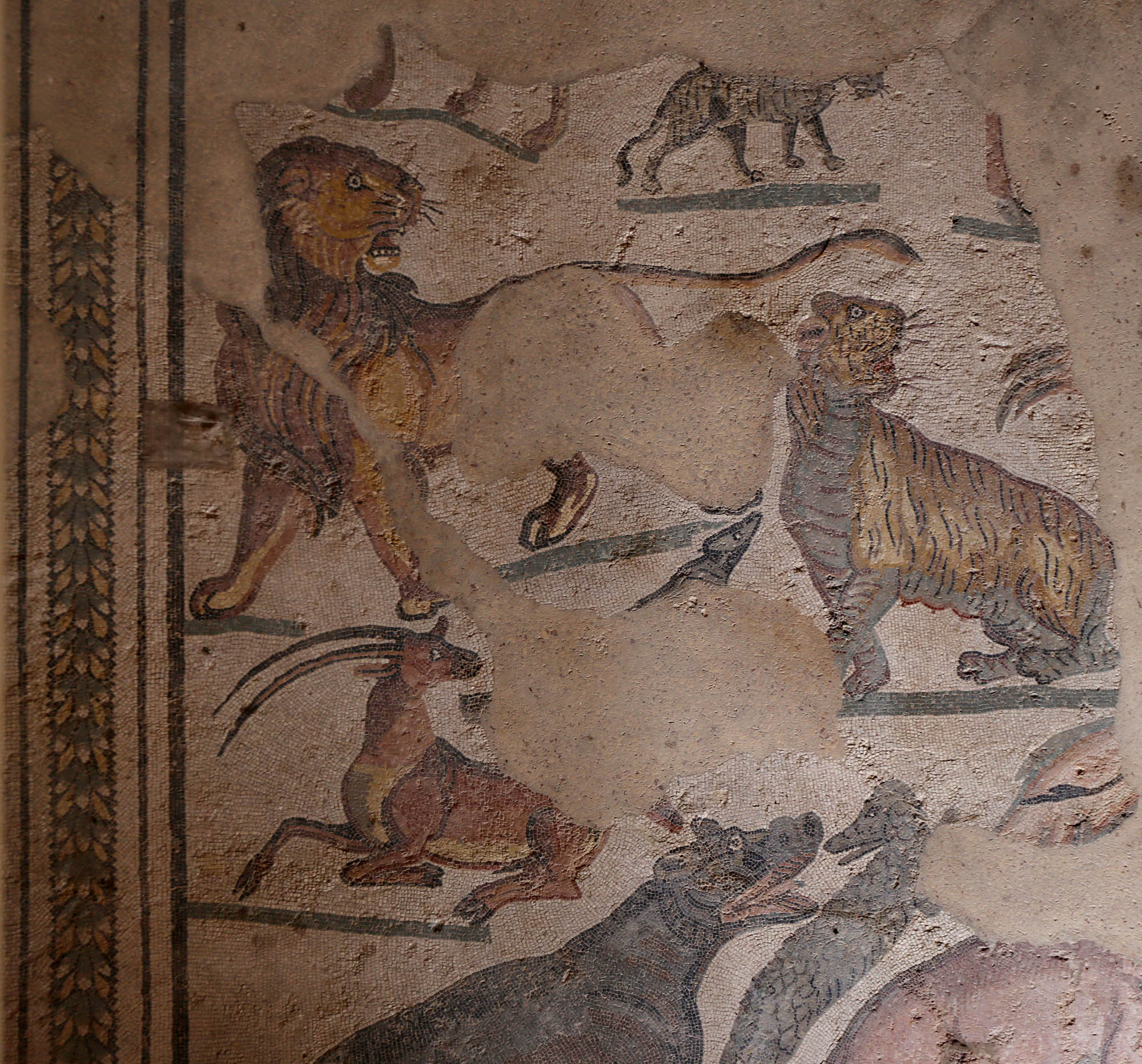
The Romans first saw a tiger in 20 BC, when an Indian delegation brought one as a gift to the emperor on the island of Samos. According to Pliny’s Natural History (8.25), it wasn’t until AD 13, at the inauguration of the Theatre of Marcellus, that Augustus managed to present a tiger publicly for the first time. True, in Gladiator, Commodus unrealistically unleashes twelve tigers in the Colosseum just to dispatch poor Maximus — but that’s hardly the film’s only exaggeration.
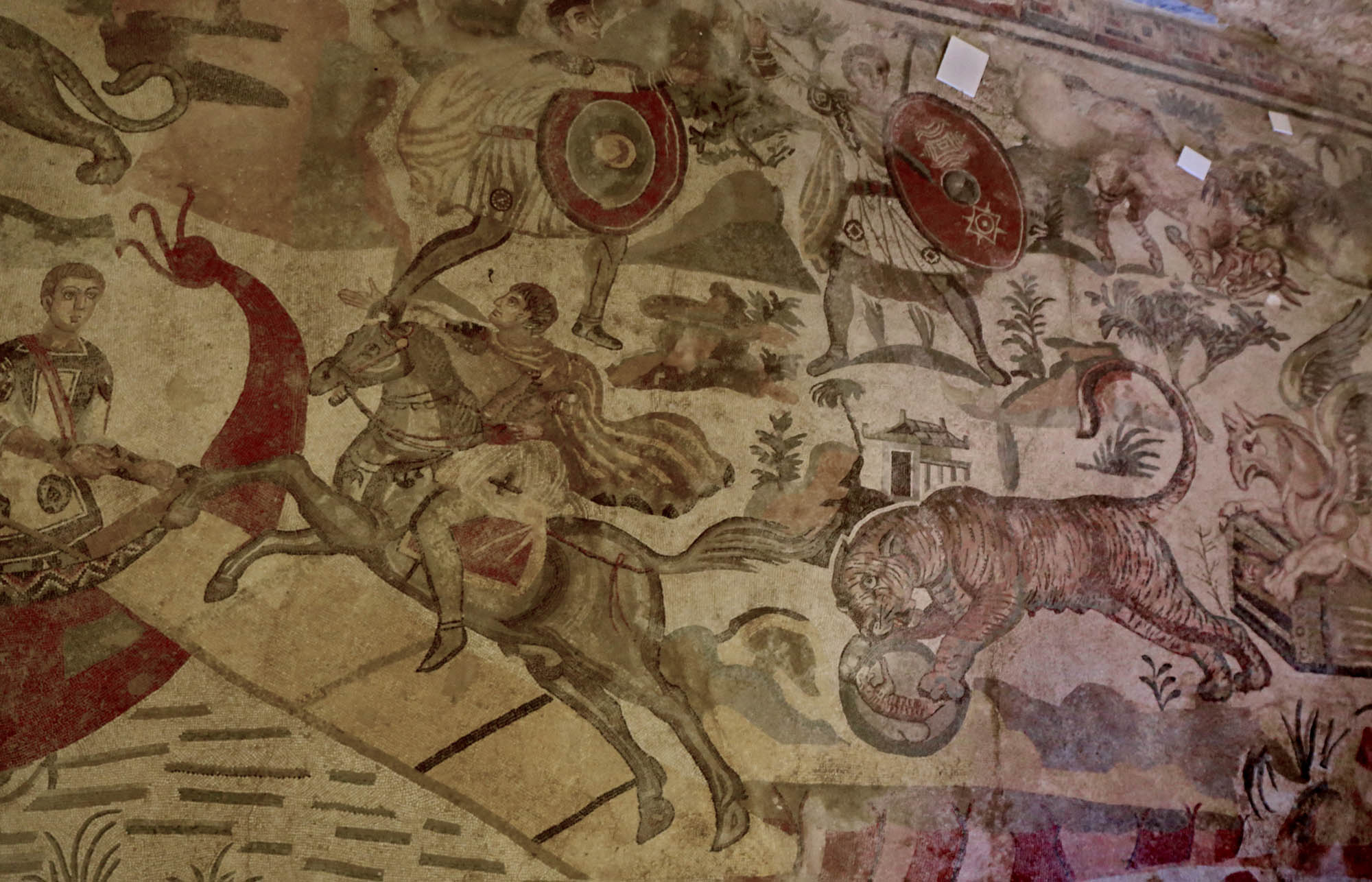
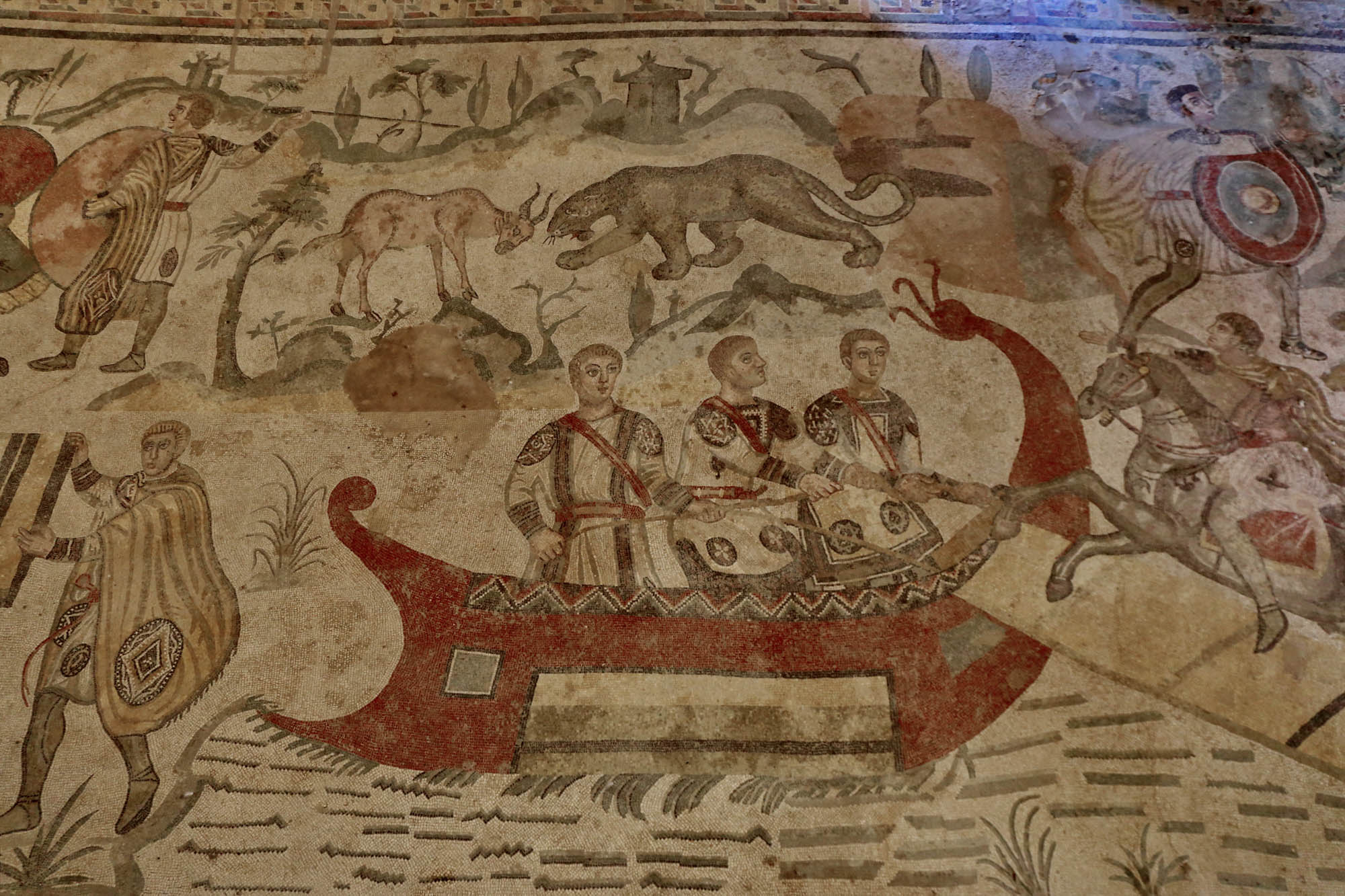
Among the Asian scenes in the Villa Romana, there’s also one inspired by a story from the same Pliny passage (Natural History 8.25) — the very one that Centurion Fungus Maximus Tertius wished to see on the mosaic floor of his house in Zeugma. The tale says that if a hunter steals a tiger’s cubs, the mother gives chase; but the hunter throws a polished metal sphere or convex mirror behind him. Seeing her reflection, the tiger mistakes it for her cubs and is distracted for long enough that the hunter can escape. In the mosaic we see the fleeing hunter with the worm-like cubs draped across his chest, the tiger behind him, and ahead the ship waiting to take him off. The very fact that this far-fetched hunting trick appears on the floor of what was essentially the mansion of a serious large-scale African animal trader shows just how exotic the tiger seemed to the Roman imagination.

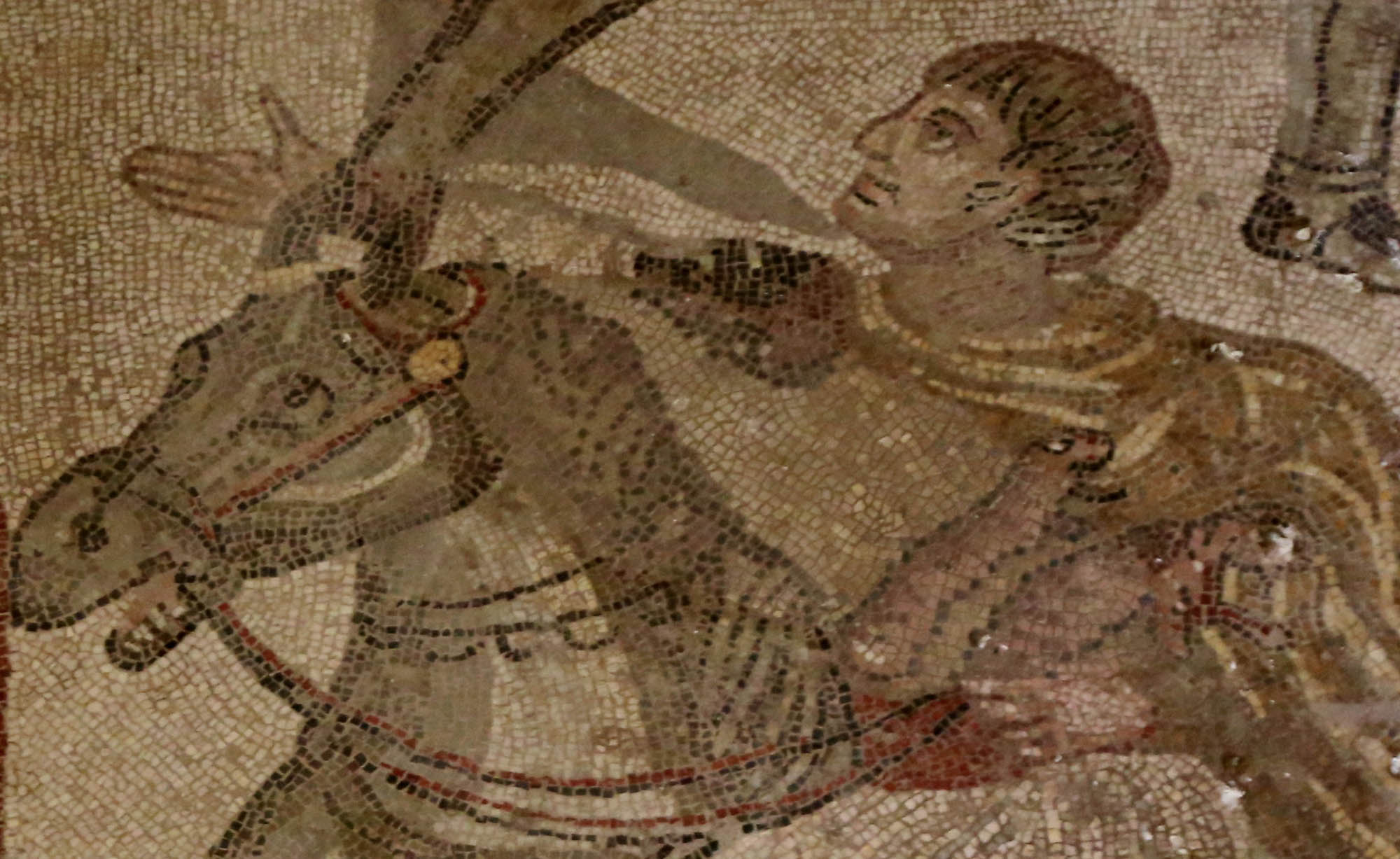
The tiger’s exotic appeal even shows up in the villa’s marine scenes. Based on a horse/hippopotamus dichotomy, the artist imagined a few similar maritime creatures inhabiting the mysterious depths alongside sea gods and naiads — including a sea‑tiger.
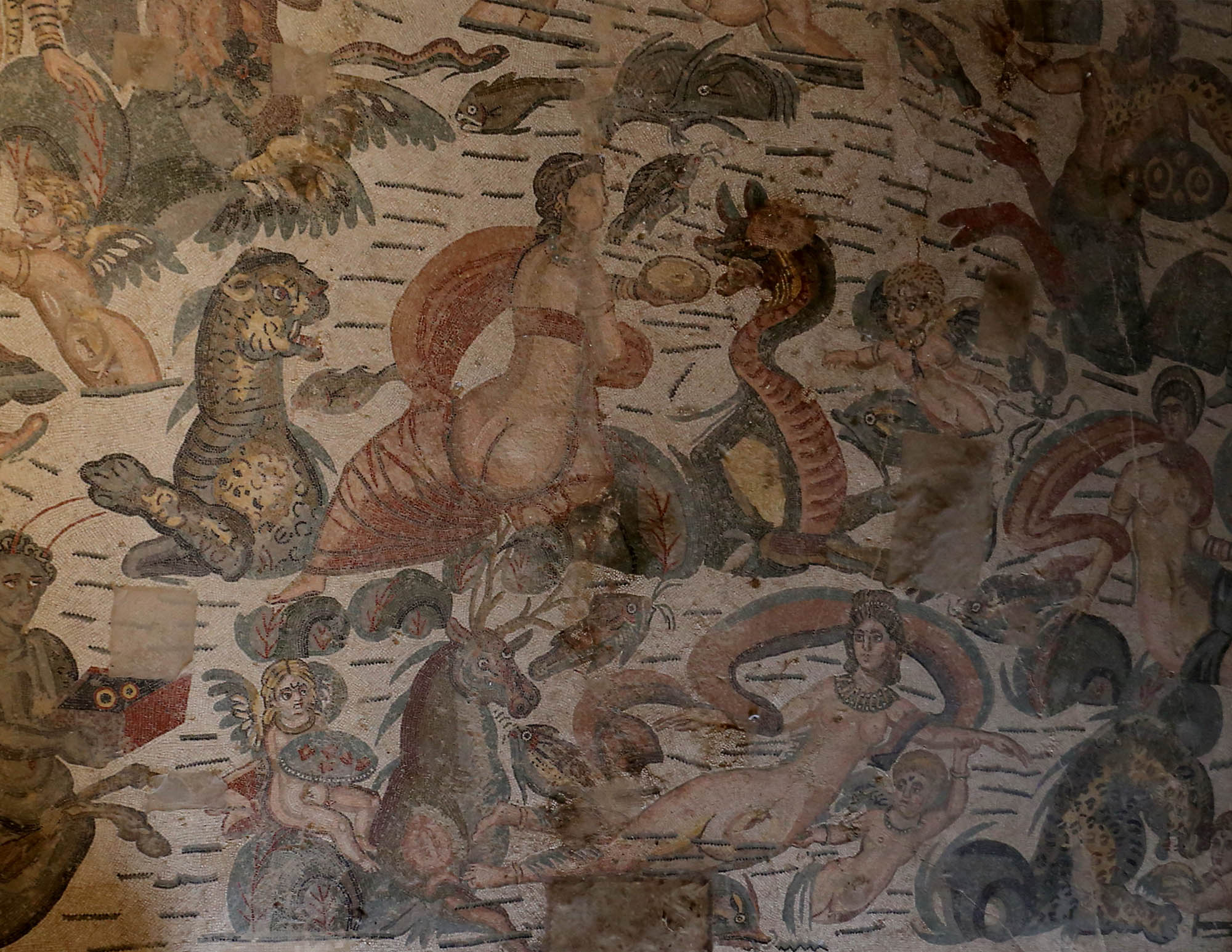
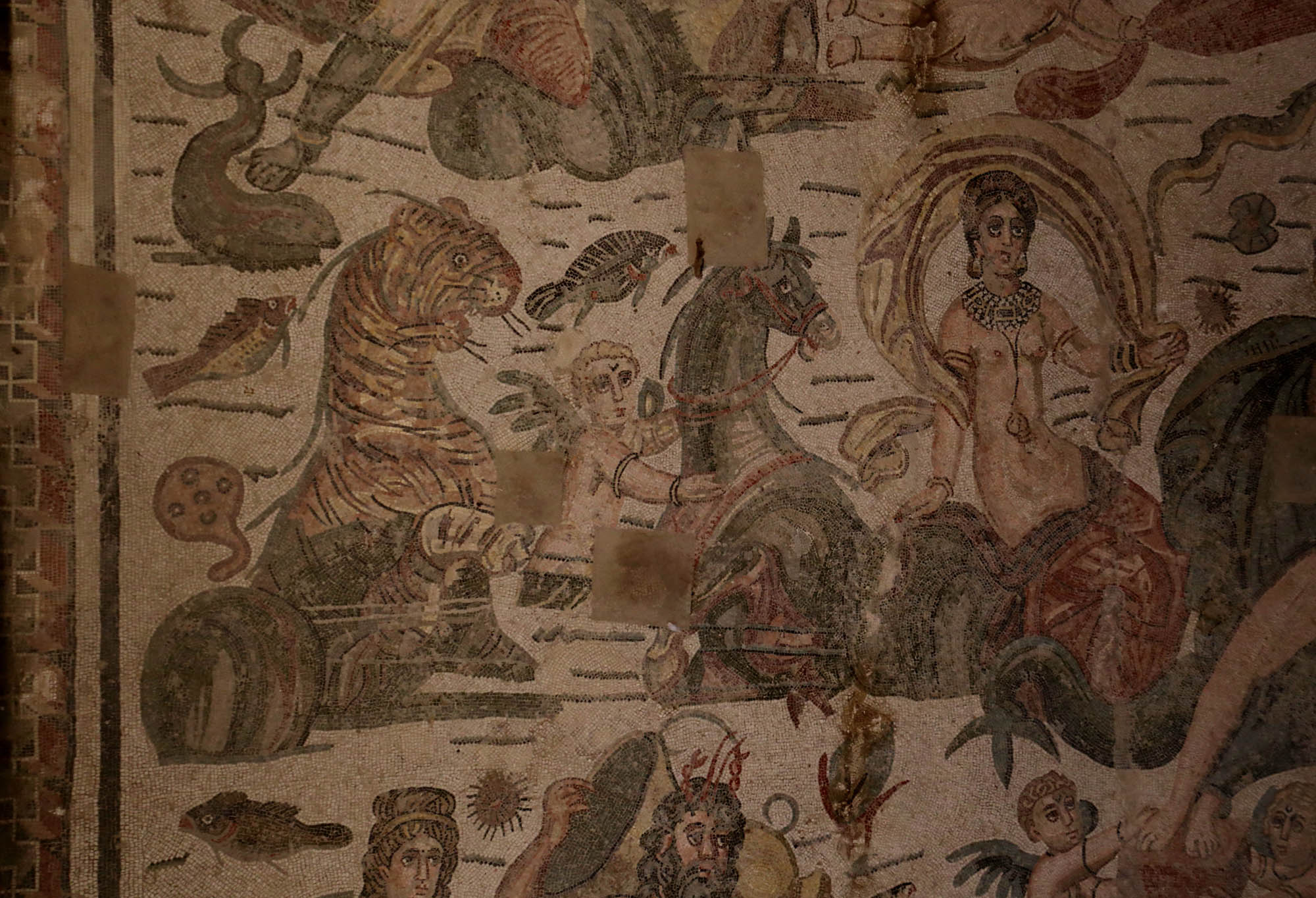
It was probably this aura of the exotic tiger that drew the Amazon to the story as a fitting companion figure — much as the griffin accompanies her on the villa mosaic. After all, an exotic animal calls for an exotic hunter, just like on the floor of Hadrian’s villa. And besides, every self‑respecting Bildungsbürger knew from Virgil’s Aeneid (11.576–577) that the Amazon wears a tiger skin:
Pro crinali auro, pro longae tegmine pallae
Tigridis exuviae per dorsum a vertice pendent.
(In place of golden ornaments for her hair and the long robe of modesty, a tiger’s pelt hangs down her back.)
And someone, of course, had to slay that tiger. So the little Bildungsbürger of long‑ago class trips to the Altes Museum could see at the entrance the perfect illustration of that Virgilian line — back when there were still such Bildungsbürger.
The world has turned since then. It was here, in Berlin itself, that humanity learned it had not transcended its own animal ferocity. And in the tiger and other beasts we’ve come to see the living spirit of nature, endangered not by its own wildness but by ours. Just like here beside me, on the firewall of the Birkholz nursing home in Charlottenburg.
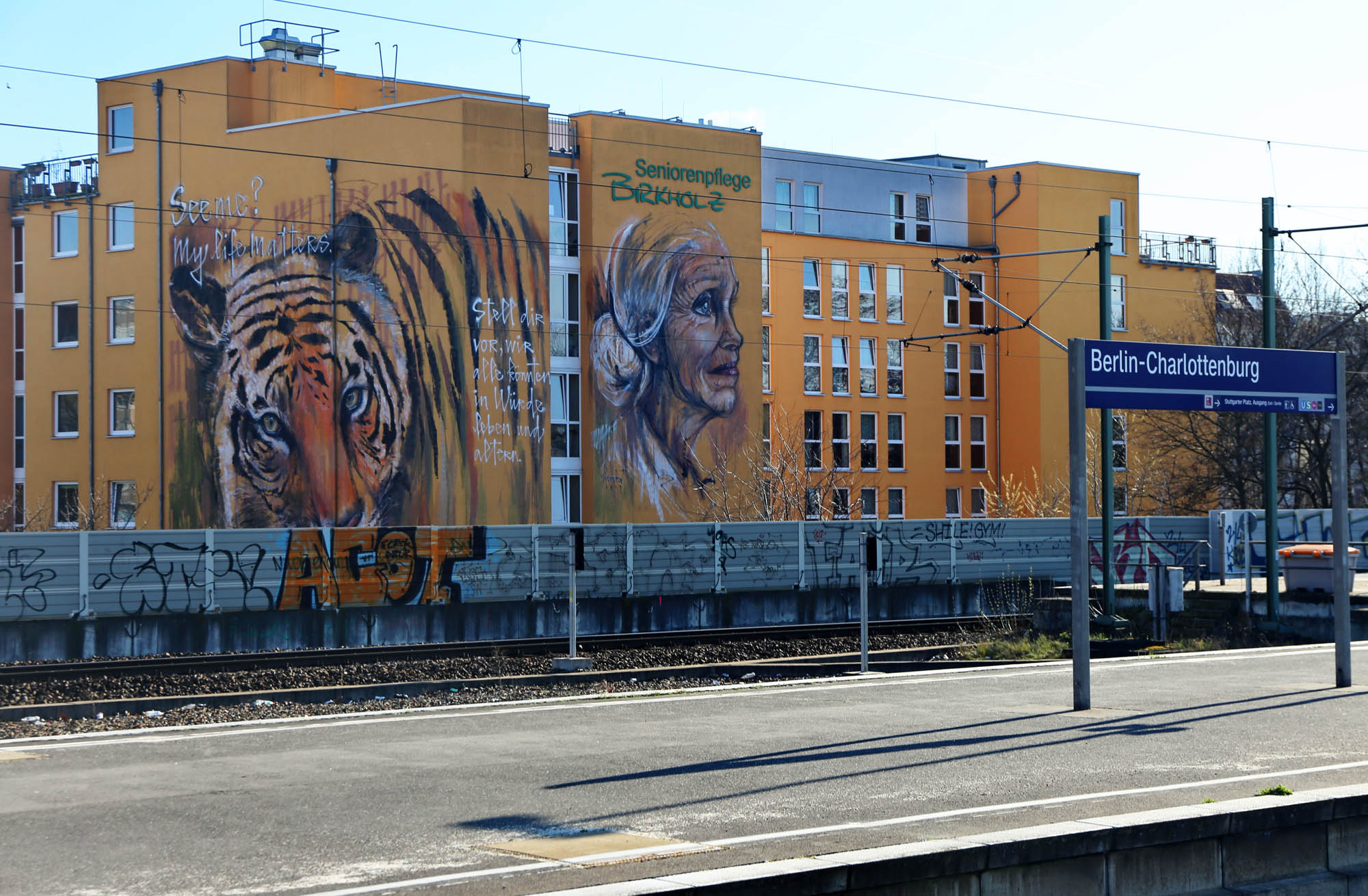
 “Do you see me? My life matters too.” “Imagine a world where everyone is protected.”
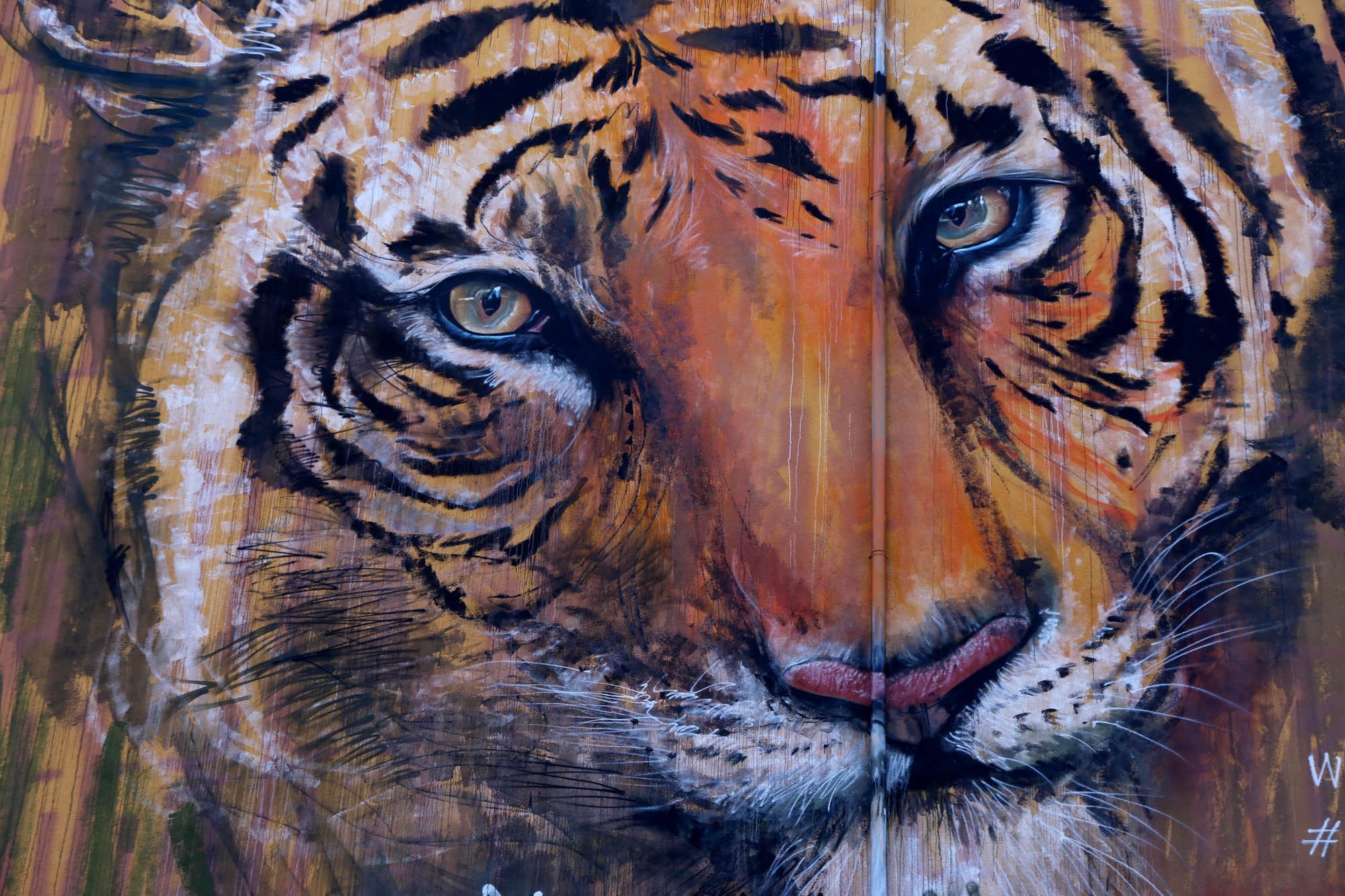
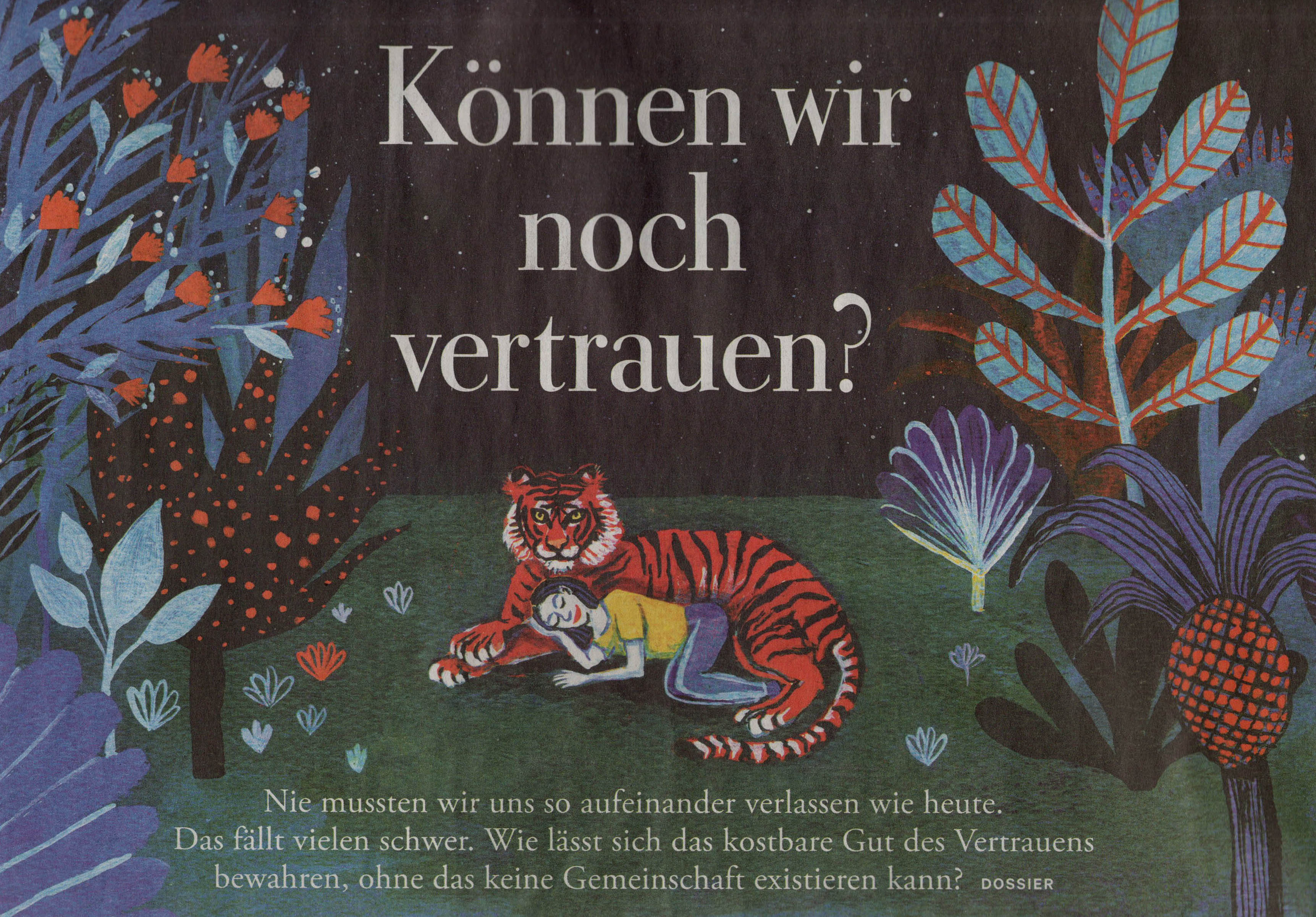
This humanization of the tiger also appears on today’s cover of Die Zeit: under the slogan “Can we still trust?”, the tiger is shown both as a fearsome animal (one we may not trust) and as a fellow creature — endangered, vulnerable, yearning for trust. A reflection of that biblical image where the lion lies down with the lamb — and the tiger, perhaps, with the amazon.



Add comment