

Mardin is large and cosmopolitan enough to have two of everything. Sunni and Shia Muslims, Apostolic and Catholic Armenians, Jacobite and Chaldean Syriac communities all coexist here.
The very name “Chaldean” sounds as if it had slipped out of a Dan Brown novel. Its origins are just as tangled. The Chaldeans were originally an Aramaic people who settled in southern Mesopotamia in the 10th century BC and played an important role in the history of the Assyrian and Babylonian empires. By Roman times, this long-vanished group was used in two ways: by authors like Cicero to mean “magicians” or “astrologers,” and by figures such as Saint Jerome as a general term for Aramaic-speaking peoples.
The name took on a new meaning in 1552, when Yohannan Sulaqa, abbot of a Nestorian Syriac monastery in the village of Alqosh in present-day northern Iraq—also revered as the resting place of the prophet Nahum—grew tired of the patriarchate being passed down within the same Eliya family, from uncle to nephew. He travelled to Rome, accepted the authority of the pope, and was granted the title of patriarch. This new branch of the Syriac Church in communion with Rome was given an old name with a new meaning: “Chaldean.” Sulaqa’s consecration was recognized only by the clergy of the northern provinces, so he had to move to Amida—modern Diyarbakır. From there, his successors fled persecution by the Nestorians to the mountainous Hakkari region near the Persian border, settling in Qudshanis (Konak), and later escaped to Persia during the massacres of 1915.
The Qudshanis line returned to the Nestorian confession in 1672, but their bishop in Amida, Joseph, continued the union with Rome. Despite internal disputes, tensions with other Syriac Christians and the papacy, and persecution by Muslim authorities, this line has survived to the present day. Today, many Syriac Christians in Iran and northern Iraq belong to it, including Mosul’s Ragheed Ganni and his fellow priests, murdered by Islamists in 2007.
The Chaldeans settled in Mardin early on, helped by the presence—just as in Diyarbakır—of Franciscan (Capuchin) missions supporting the new denomination with Vatican backing; notably, this was the only Catholic order tolerated by the Ottomans in the region. Returning from Rome, Sulaqa consecrated five bishops in 1553, one of whom was Hnanisho, the first Chaldean bishop of Mardin. According to Leonard Abel, a papal legate who travelled the region in the 1580s, he was “the most learned man of the entire Nestorian nation.”
The community grew slowly. In 1842, there were 60 families; by 1913, 1,670 faithful with six priests, one church and two chapels, three schools, and several small communities in surrounding villages. The 1915 Sayfo genocide devastated them as well. After the death of their last bishop in 1918, the see remained vacant, and in 1941 it was formally suppressed and placed under the already diminished Chaldean diocese of Diyarbakır. Today, only a single Chaldean family remains in Mardin, working closely with the local Syriac Jacobite majority church.
Unlike the Armenians and Syriac Jacobites, who had their own distinct quarters in Mardin, the Chaldeans formed a more network-like pattern (similar to the city’s other religious minority, the Shia). Their single church, Mor Hirmiz, stood on the main street, alongside a monastery that also served as the bishop’s residence. Across the street, descending toward the bazaar, stood a smaller chapel, and another further west in the Christian quarter. In nearby villages, small mission stations operated; the only Chaldean-majority village was Issadeir, a few kilometers north of the city.
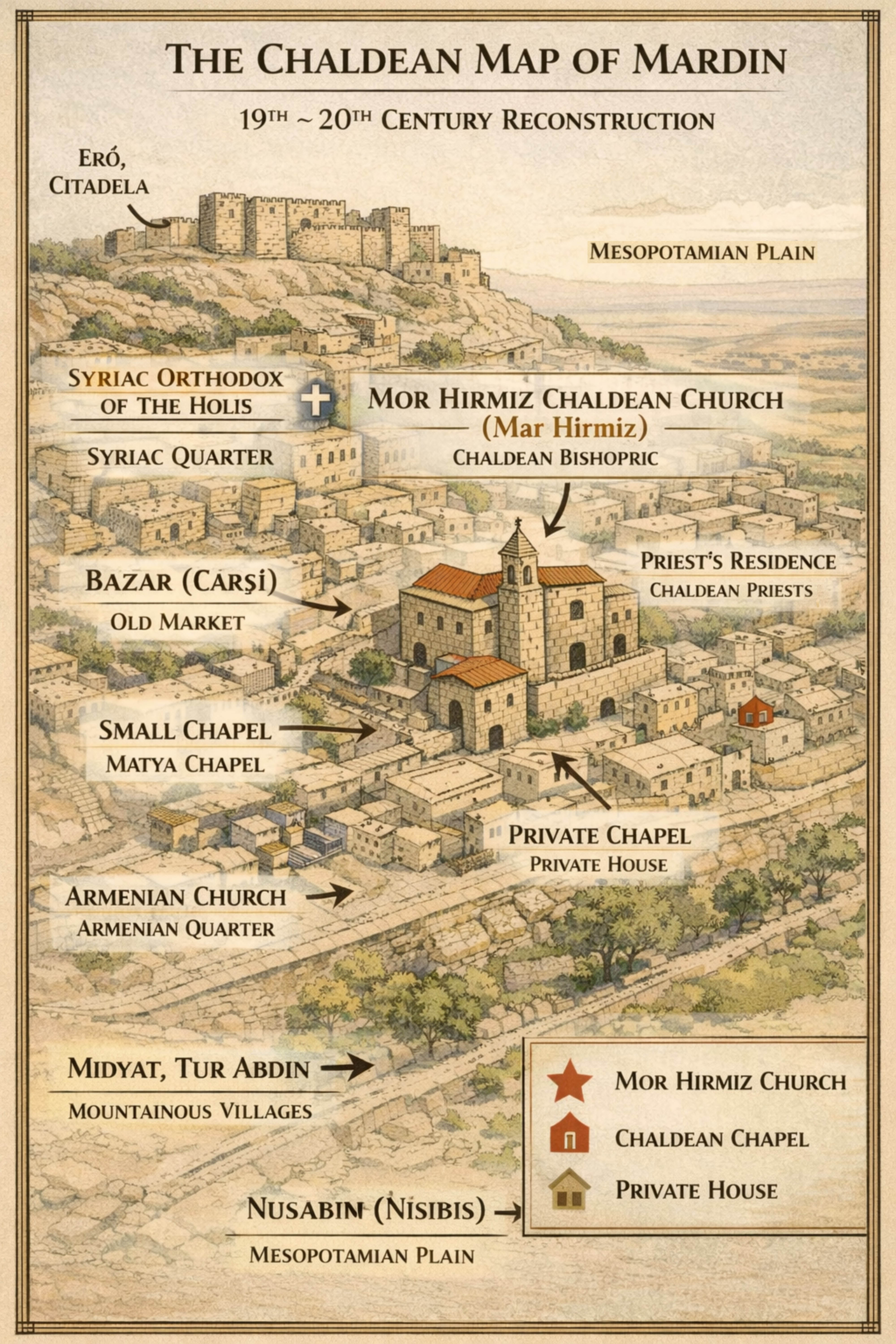 An AI-generated map of the Chaldean topography in Mardin. Nothing on it is precise, especially the shape of the Chaldean church, but it gives an approximate idea of the city and the location of the Chaldean network.
Of all this, only the church survives today. After decades of closure, it reopened in 2005. No liturgy is held there—it is kept open purely as a historical site.
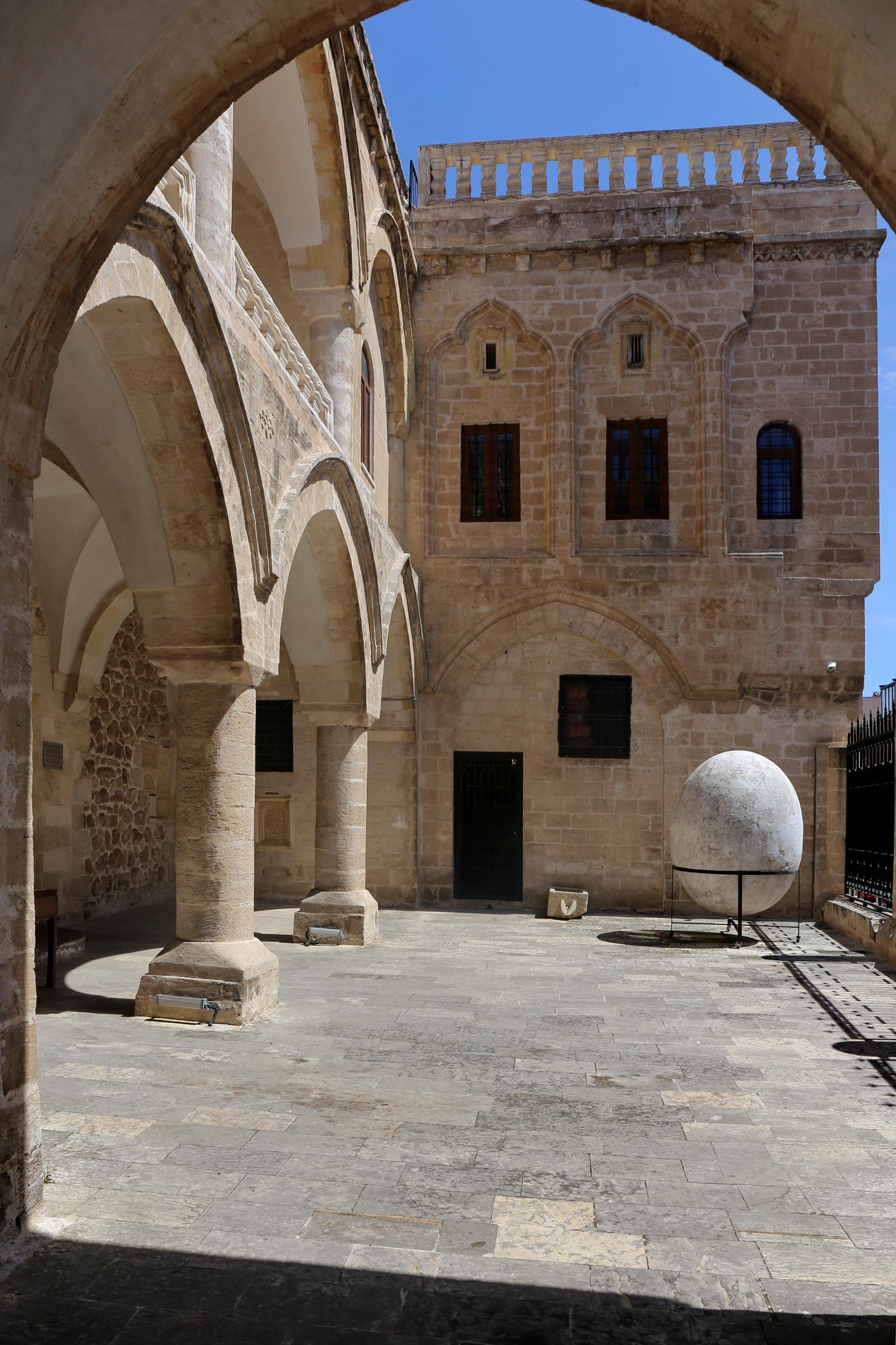
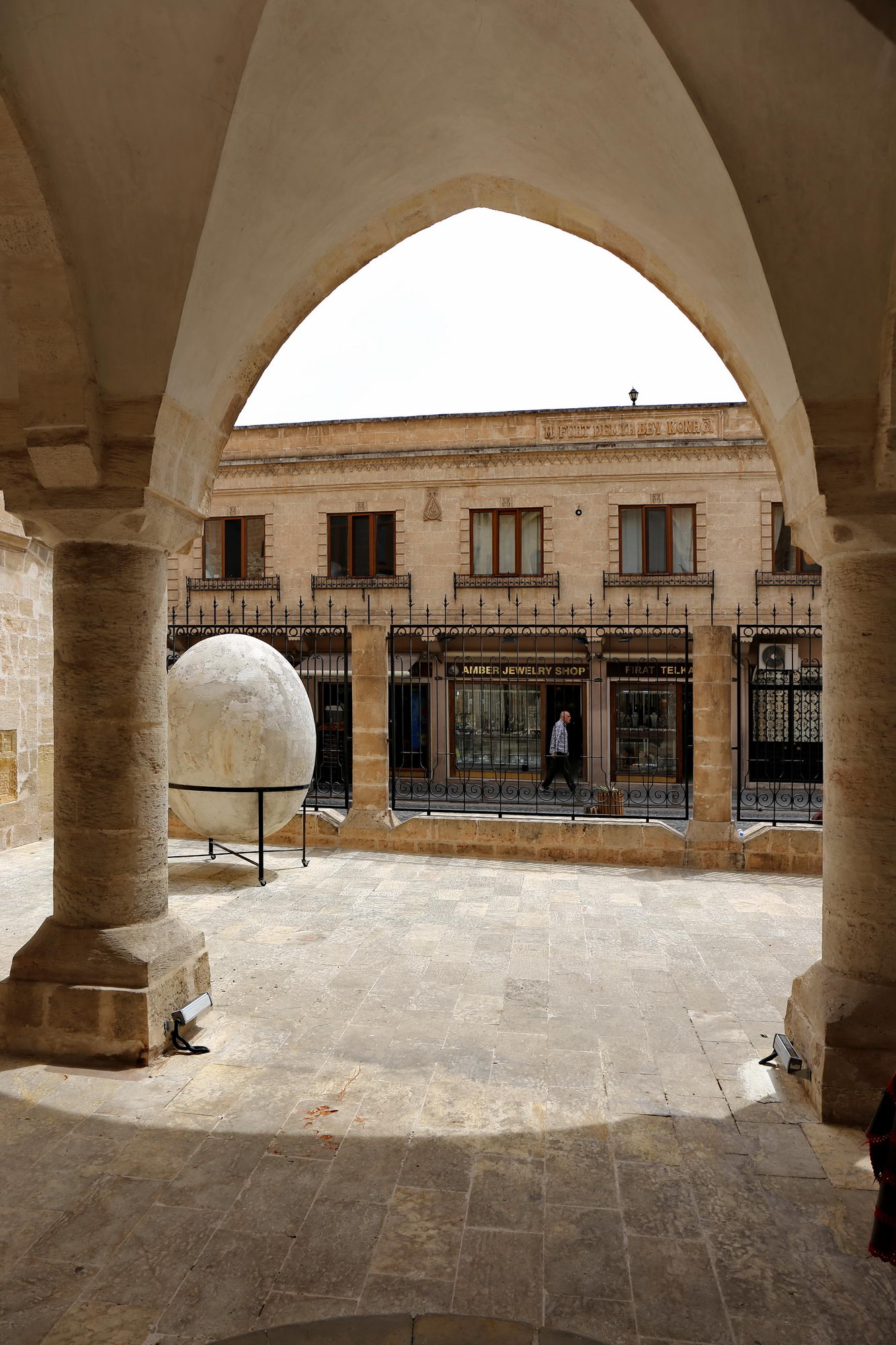
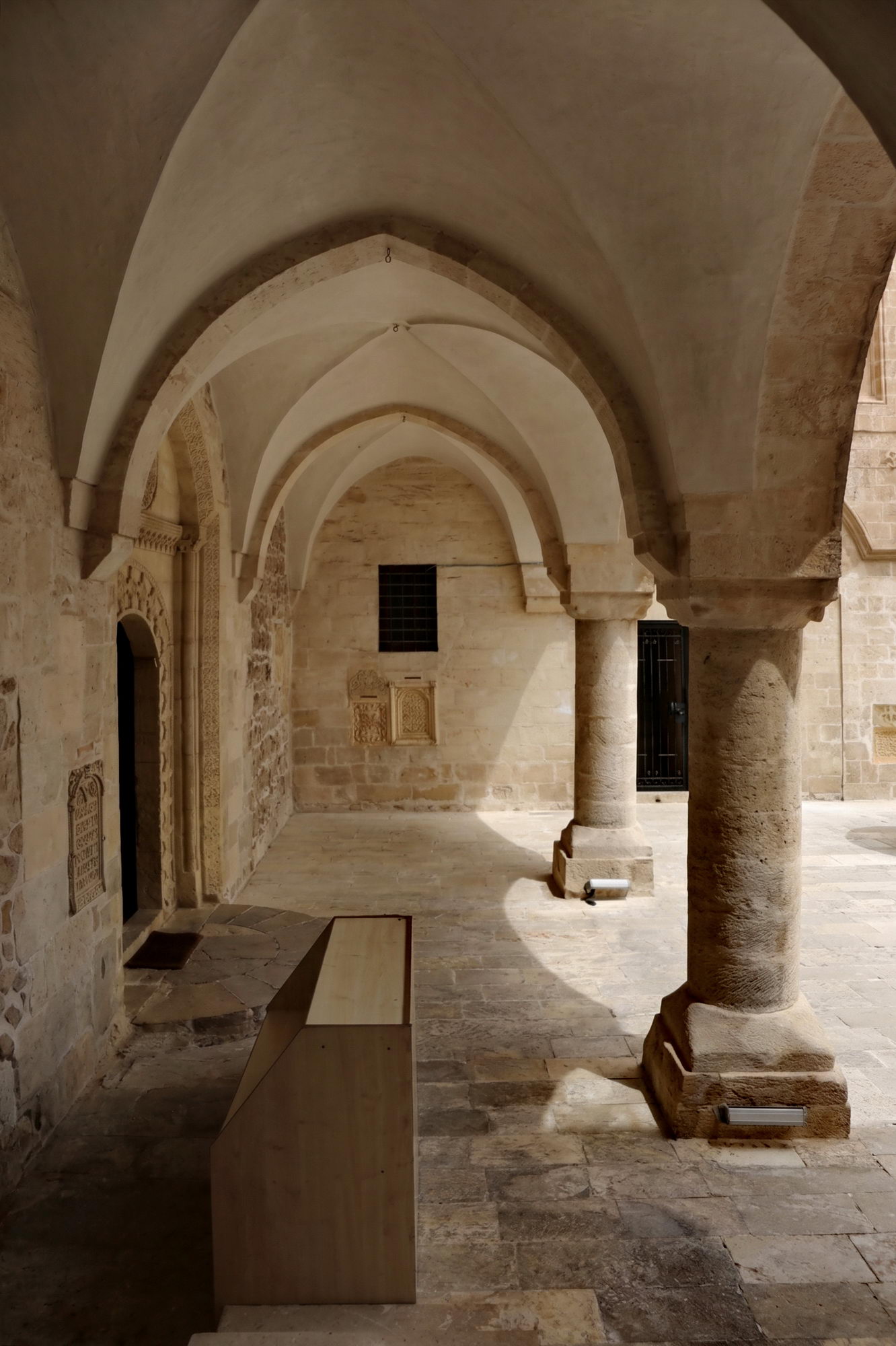
The former episcopal complex encloses a rectangular courtyard on three sides, while the fourth side opens onto the street, separated only by an iron fence. On the opposite side of the courtyard, beneath arcades, lies the entrance to the church.
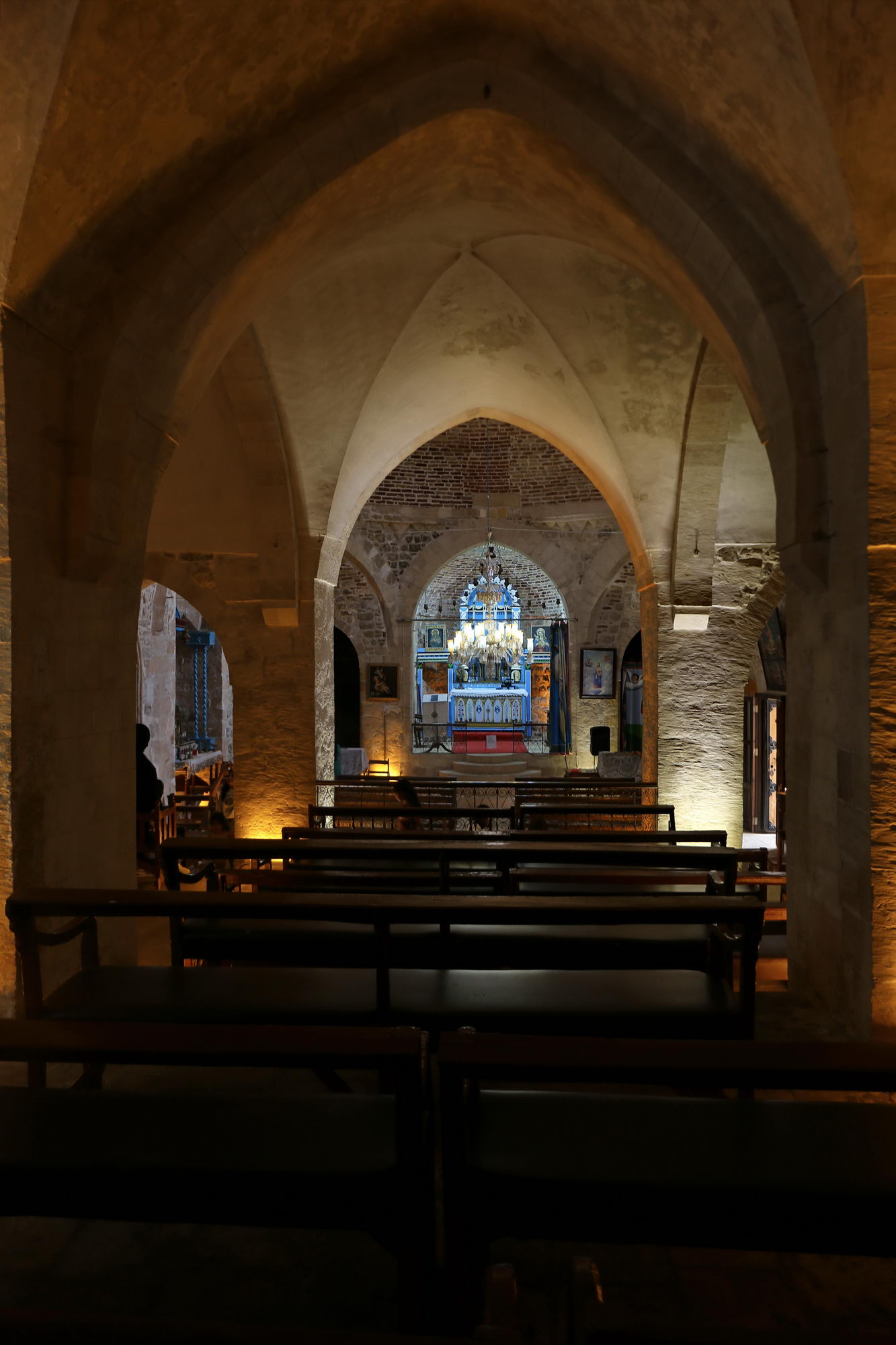
The main hall of the church is unusual: instead of a longitudinal basilica, it has a circular plan covered by a single large dome—more reminiscent of a hammam or a cistern. The reason for this architectural choice is unclear, but it is telling that the Syriac Jacobite church in Diyarbakır has a similar layout. There, it is clearly a later addition attached to an older apse that still contains 5th-century elements. From its history we know that a major rebuilding took place after an earthquake in the 16th century. This coincides with the founding of the Chaldean community in Mardin in 1553, suggesting that the model—and perhaps even the craftsmen—may have come from Diyarbakır. Local tradition dates the Mor Hirmiz church to the 4th century, but this is most likely a pious legend. It is unlikely that the Jacobites would have handed over an earlier church to a new denomination only for it to be rebuilt. More plausibly, the entire church and the surrounding palace-monastery complex were constructed anew in the 16th century.
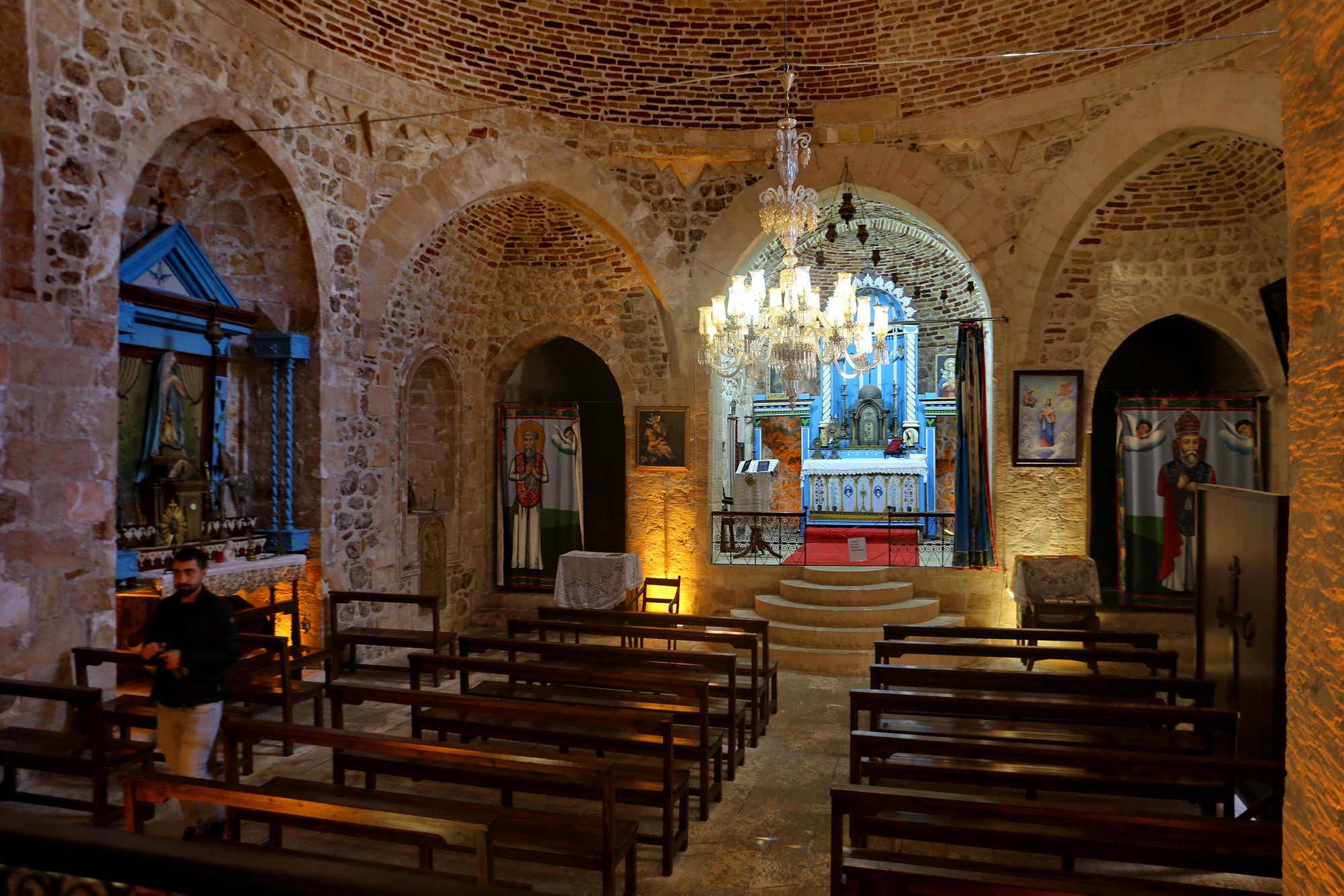
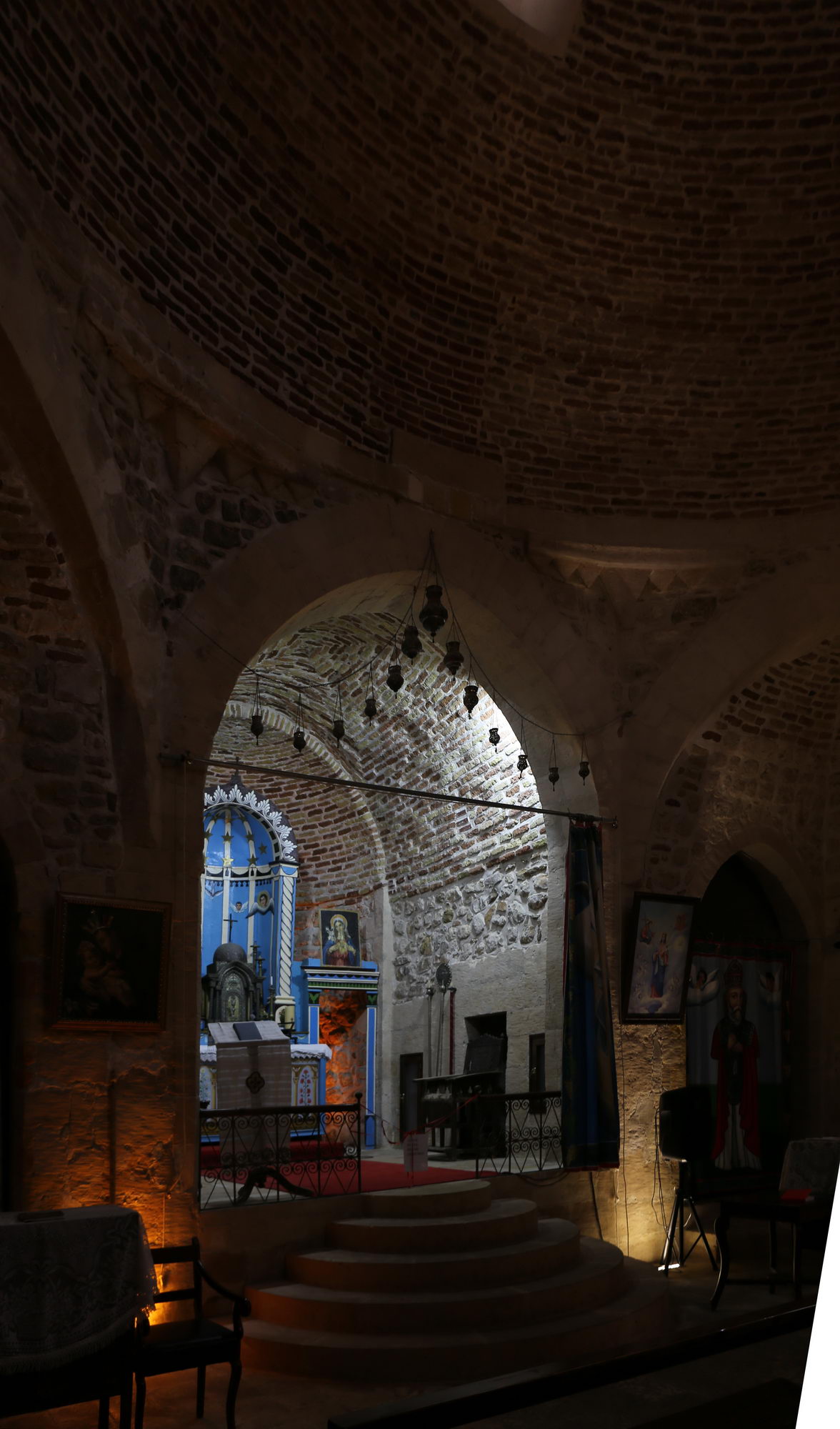
The church is dedicated to Mor—Saint—Hirmiz (Hormizd), a revered hermit-teacher of Nestorian Christianity at the turn of the 6th–7th centuries. The community that formed around him established the Rabban Hormizd cave monastery near Alqosh in northern Iraq, which later became one of the most important spiritual centers of both Nestorian and, after 1500, Chaldean Christianity, as well as the burial place of the Chaldean patriarchs.
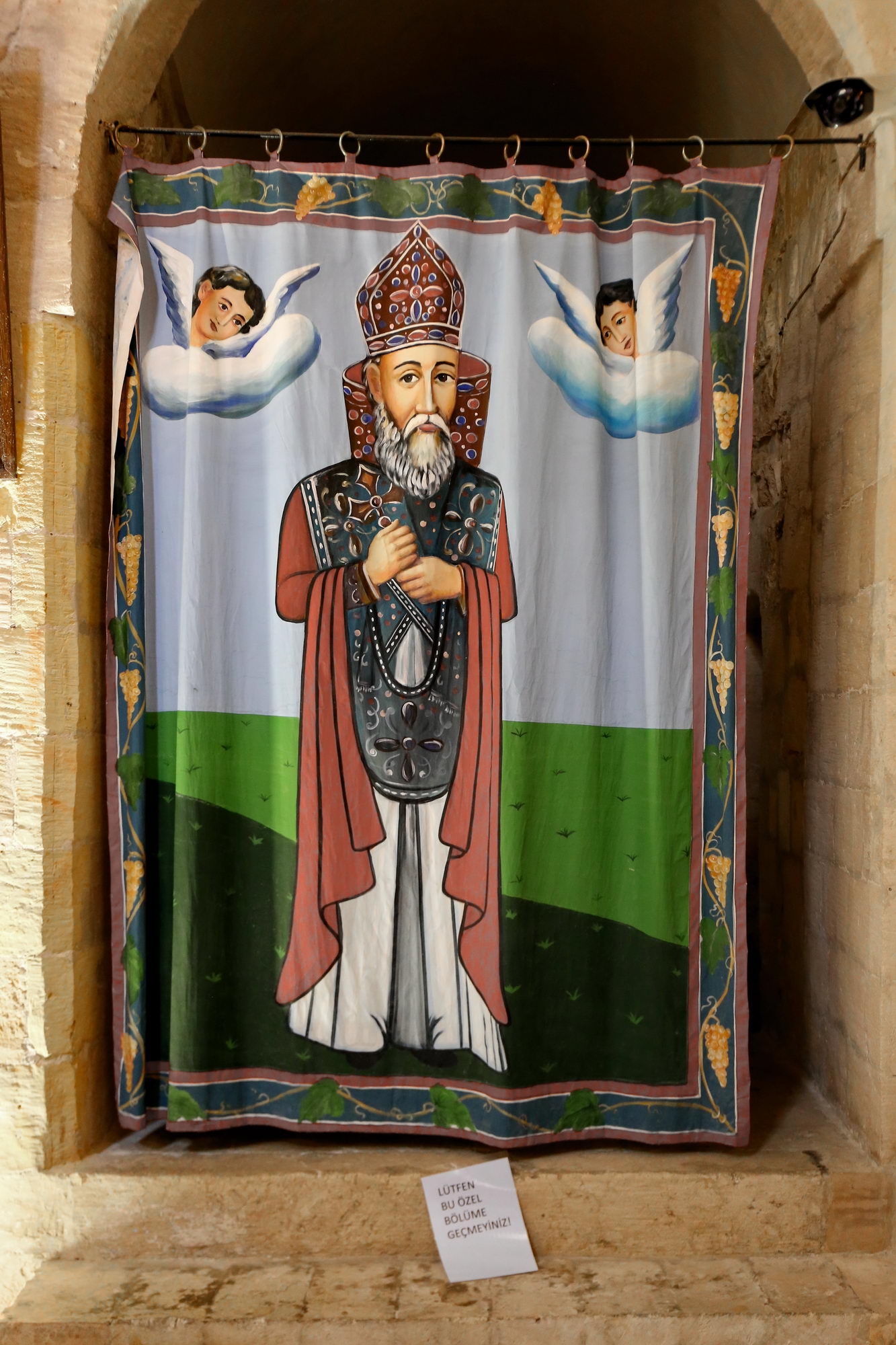
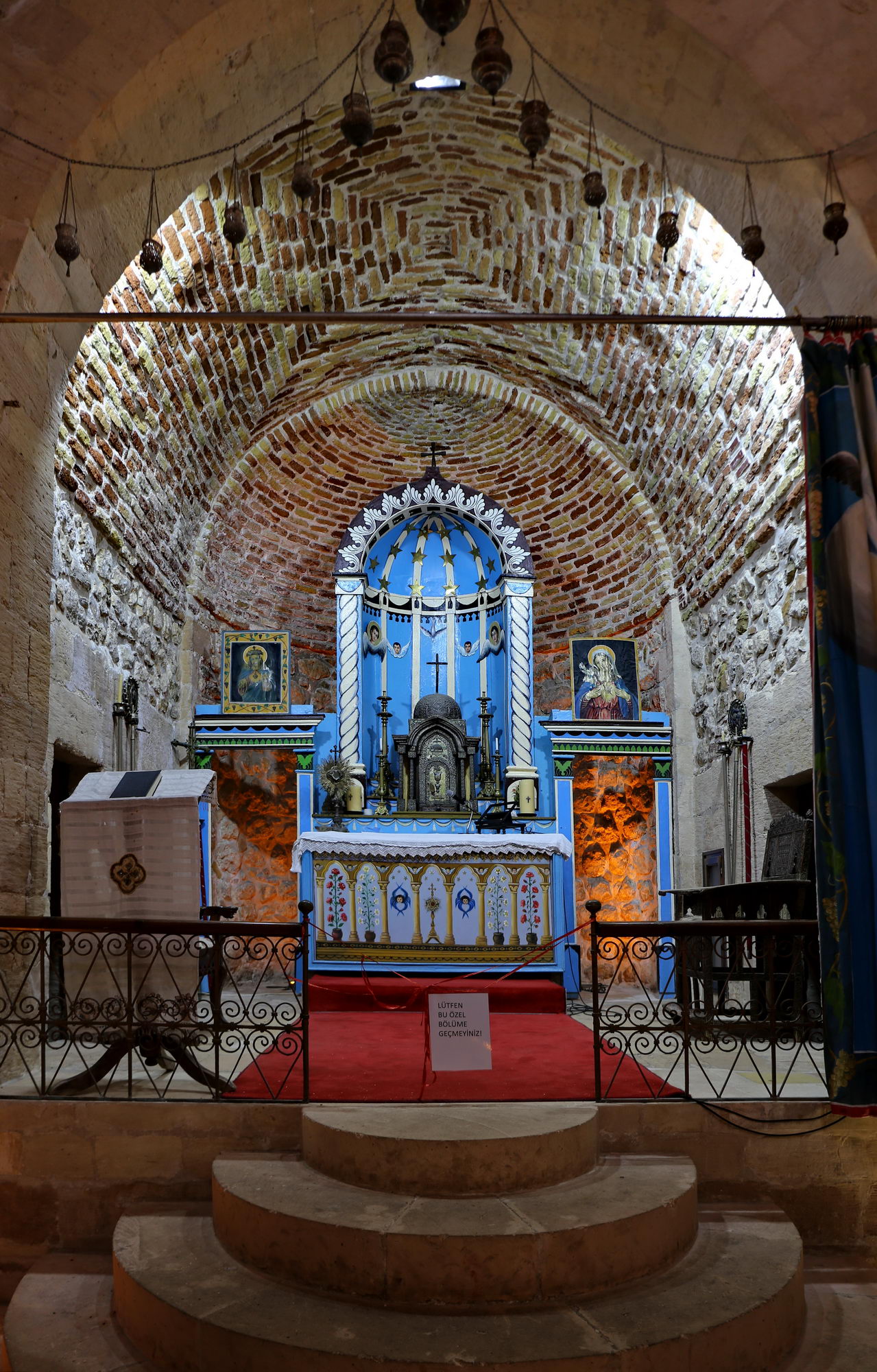
From the circular main nave of the church, three small apses open to the east, each containing wooden altars that, in a distinctive Syriac manner, look like cabinets placed in the sanctuary. The apses can be hidden behind curtains, which are drawn during the transfiguration in the liturgy.
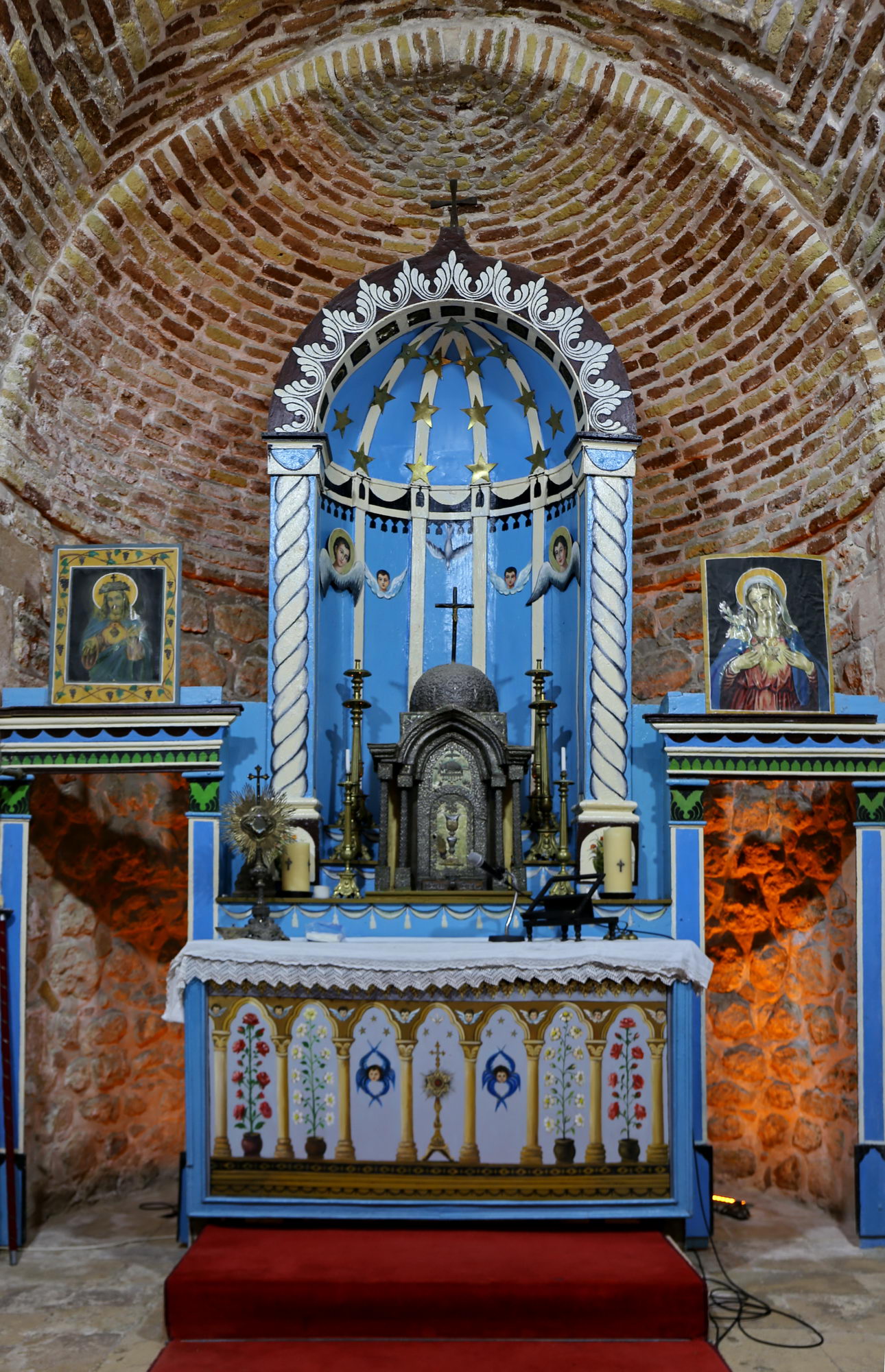
On the side walls of the nave stand two Marian side altars, each featuring a liturgical statue of Christ at its base: the larger one depicts the dead Christ in the Holy Sepulchre, while the smaller one shows the newborn Jesus lying in the manger. Near the sanctuary side of both walls lie the tombs of two prominent 19th-century Chaldean bishops.
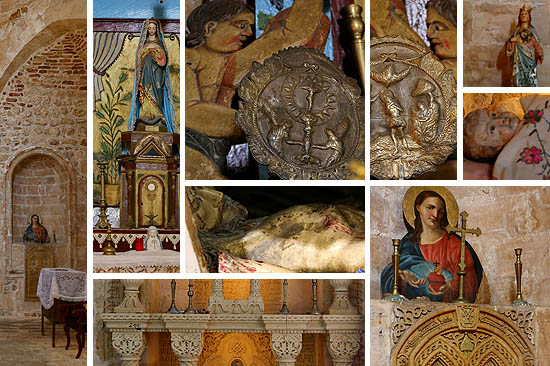
Around the turn of the 18th–19th centuries, when the congregation had outgrown the old church, the circular main nave was extended westward with a three-aisled basilica. Along its side walls, additional small side altars and large panel paintings were added.
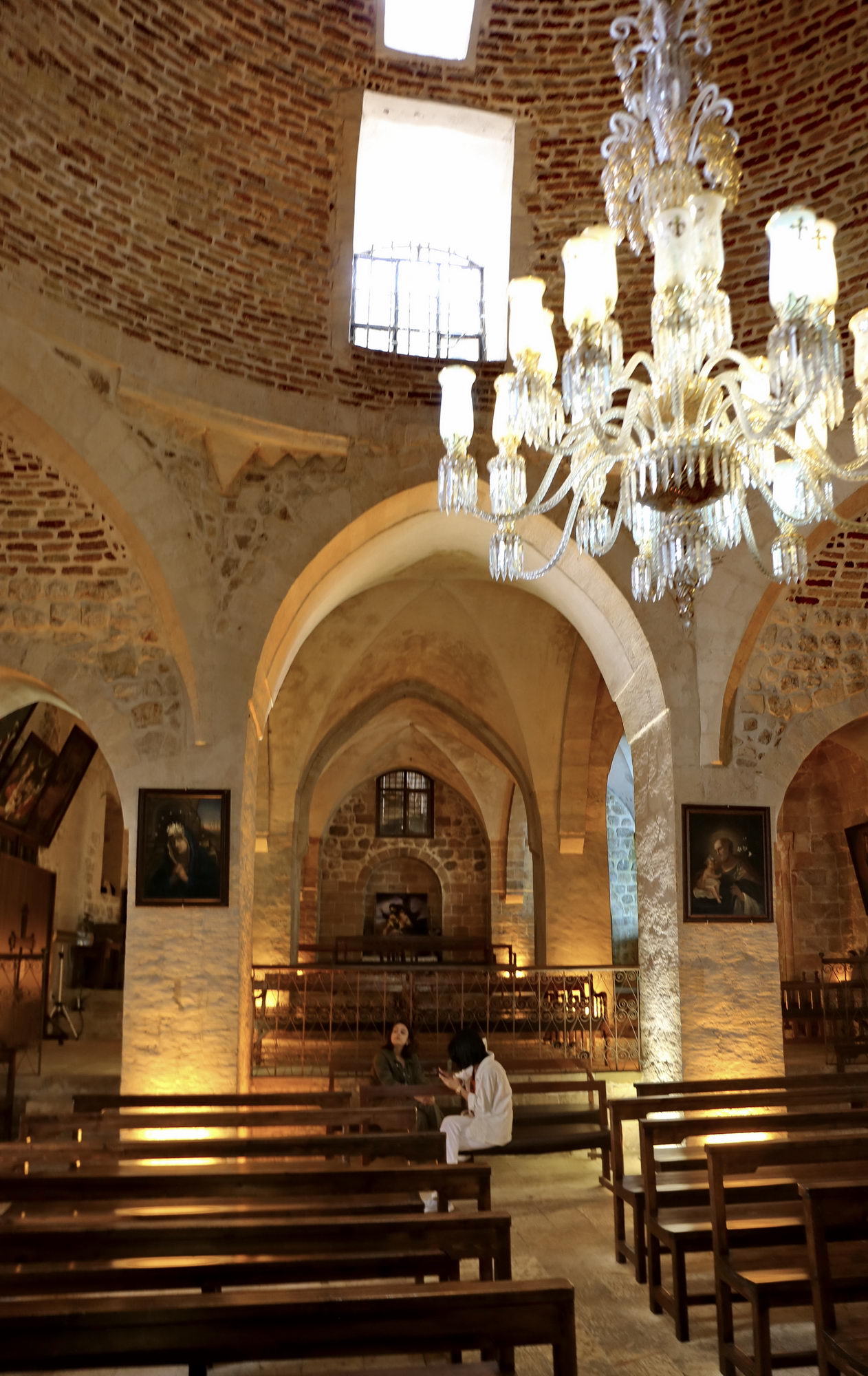
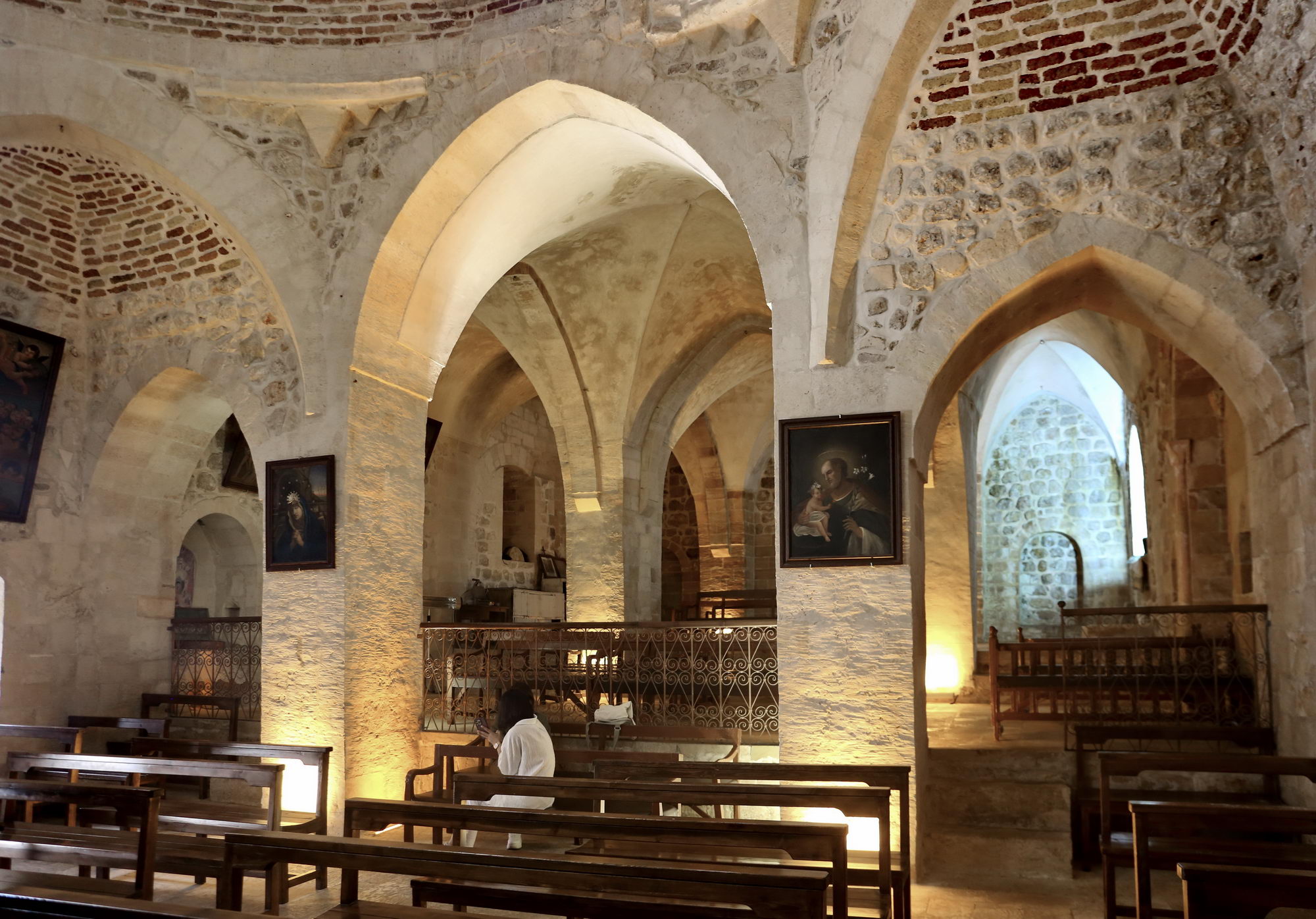
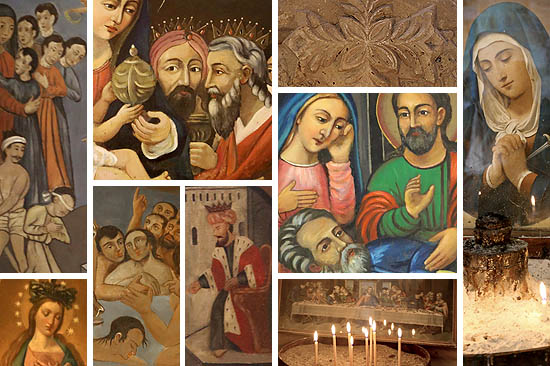
Syriacs and Armenians originally had no icons. On one hand, they split from the Orthodox Church before icons became widespread; on the other, their theology emphasizes Christ's divine nature over his human one, so depicting the visible human side would misrepresent the essential. Their early images therefore mainly show the cross, from which vegetal tendrils grow to symbolize the salvific work of the divine nature, as seen in Armenian khachkars or Syriac vine crosses.
With the arrival of Catholicism in the Middle East – through the Crusades and Catholic missions – Armenians and Syriacs could no longer resist the attraction of colorful Catholic holy images. Their church imagery thus adapted 16th–17th-century Renaissance and Baroque Catholic artworks, evoking the impression of naïve European folk-Baroque holy pictures.
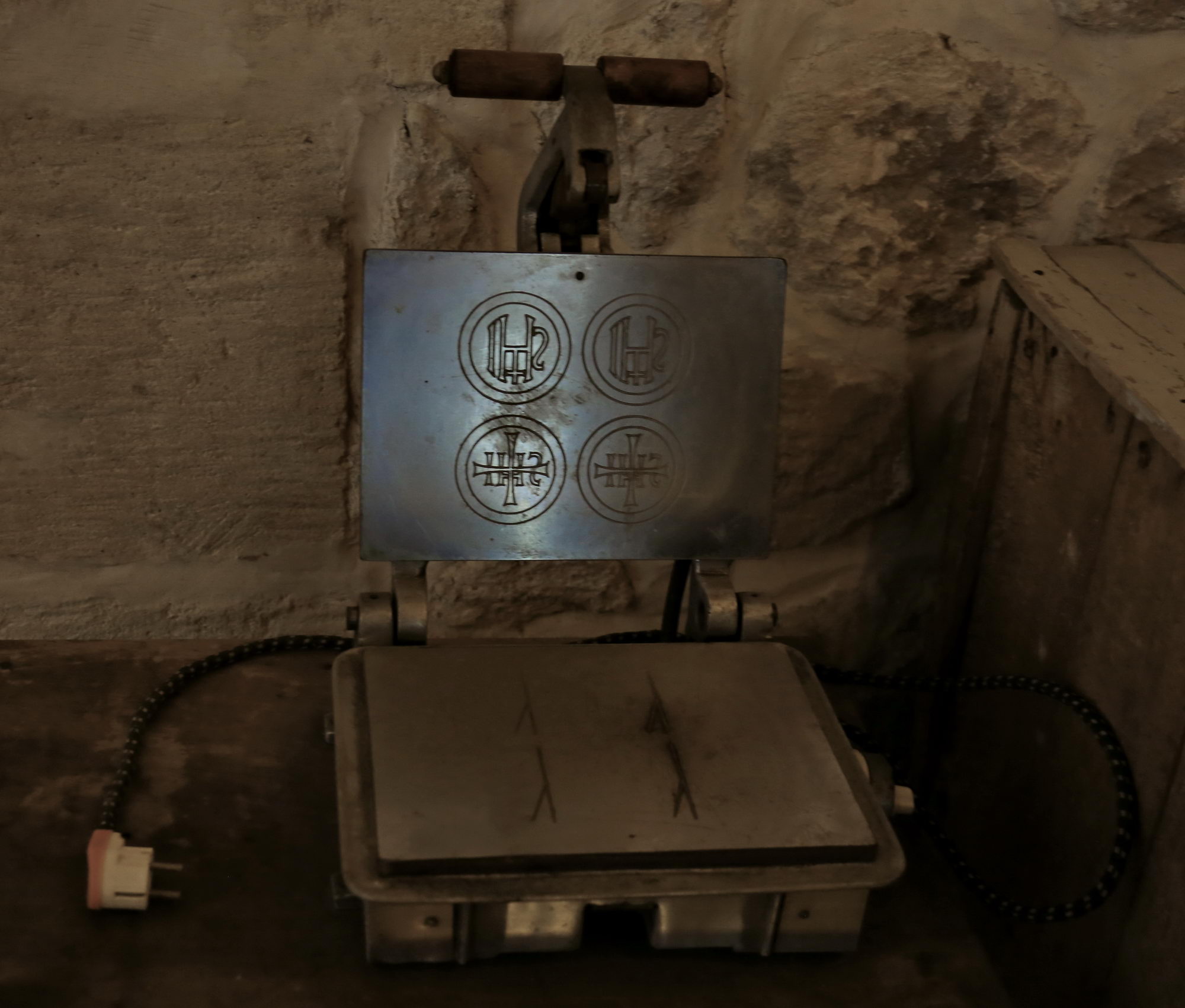
At the back of the church stands a unique device: an electric host maker. Almost certainly a Catholic import, as evidenced by the characteristic patterns on the large hosts, and because Eastern churches traditionally use leavened bread in the liturgy.
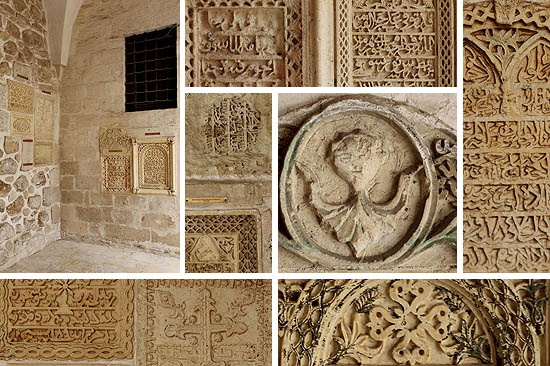
Exiting the church through the doorway under the arcades, visitors can see epitaphs of former bishops in Syriac and Arabic, accompanied by small modern plaques in Latin letters.
At the table next to the entrance, the church caretaker welcomes visitors and provides tickets. The caretaker is now my friend, the Syriac Jacobite Christian Edip, who also knows the local and surrounding Syriac network well and is an excellent guide, speaking Aramaic, Turkish, Italian, German, English, and some Spanish. I warmly recommend him for both individual and group tours; his phone number is +90 546 786 97 71.
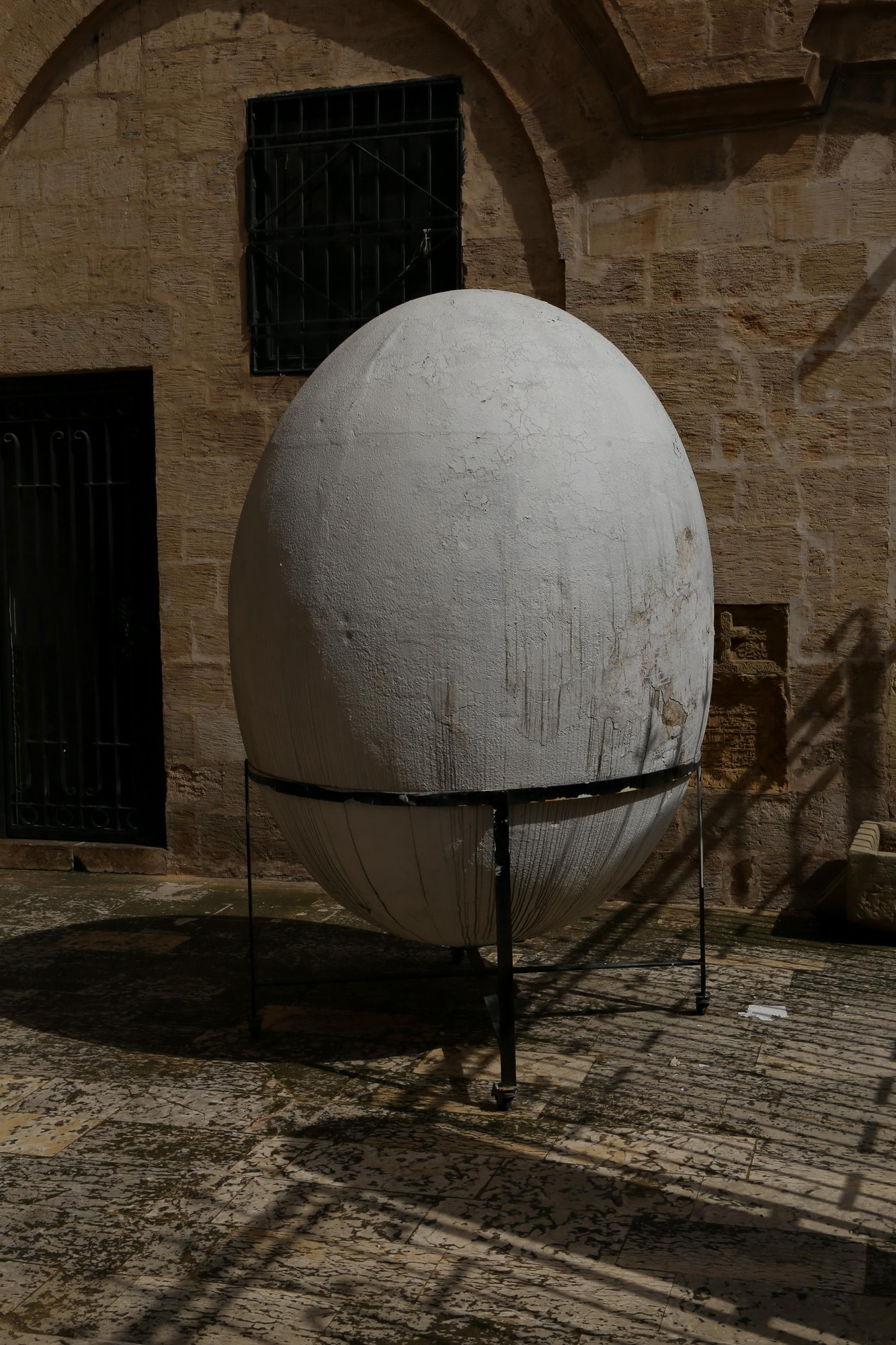
And in the courtyard stands something at first glance out of place: a monumental white egg. A contemporary sculpture donated to the church by an Ankara-based sculptor as a symbol of Mardin – the egg of Shahmaran.



Add comment