

When people think of Byzantine monastic landscapes, three places usually come to mind: Mount Athos, the Meteora monasteries, and Cappadocia. And in Cappadocia above all, the painted churches of the Göreme Valley.
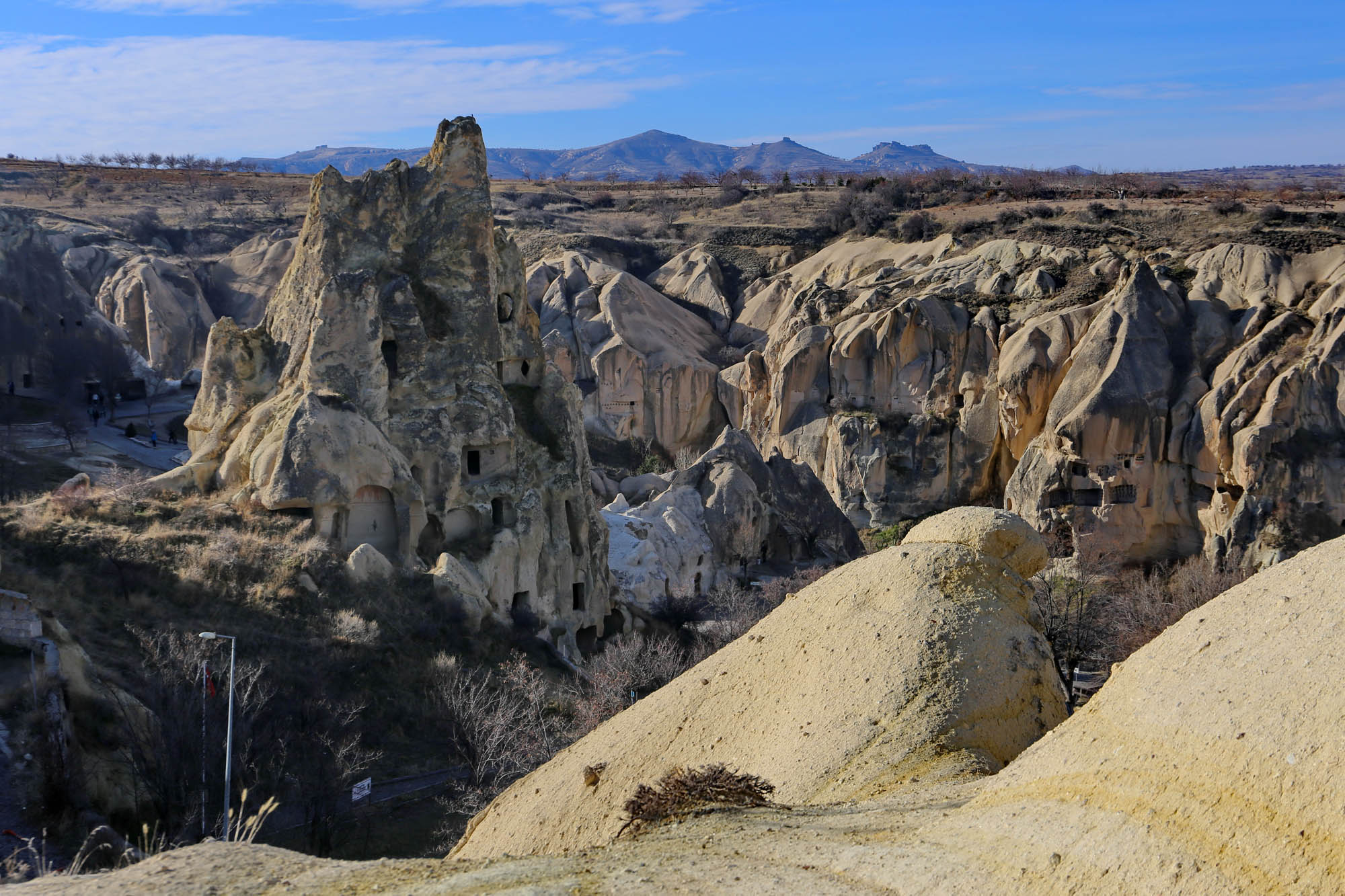
The Monks’ Valley of Göreme is the most important center of Cappadocia’s historical monuments. Dozens of cave churches and monasteries were created here between the 4th and the 12th centuries, from the beginnings of Eastern monasticism until the Turkish conquest. Most of the region’s surviving medieval frescoes are also found here, in ten churches clustered in the heart of the valley, today collectively known as the “Göreme Open-Air Museum”.
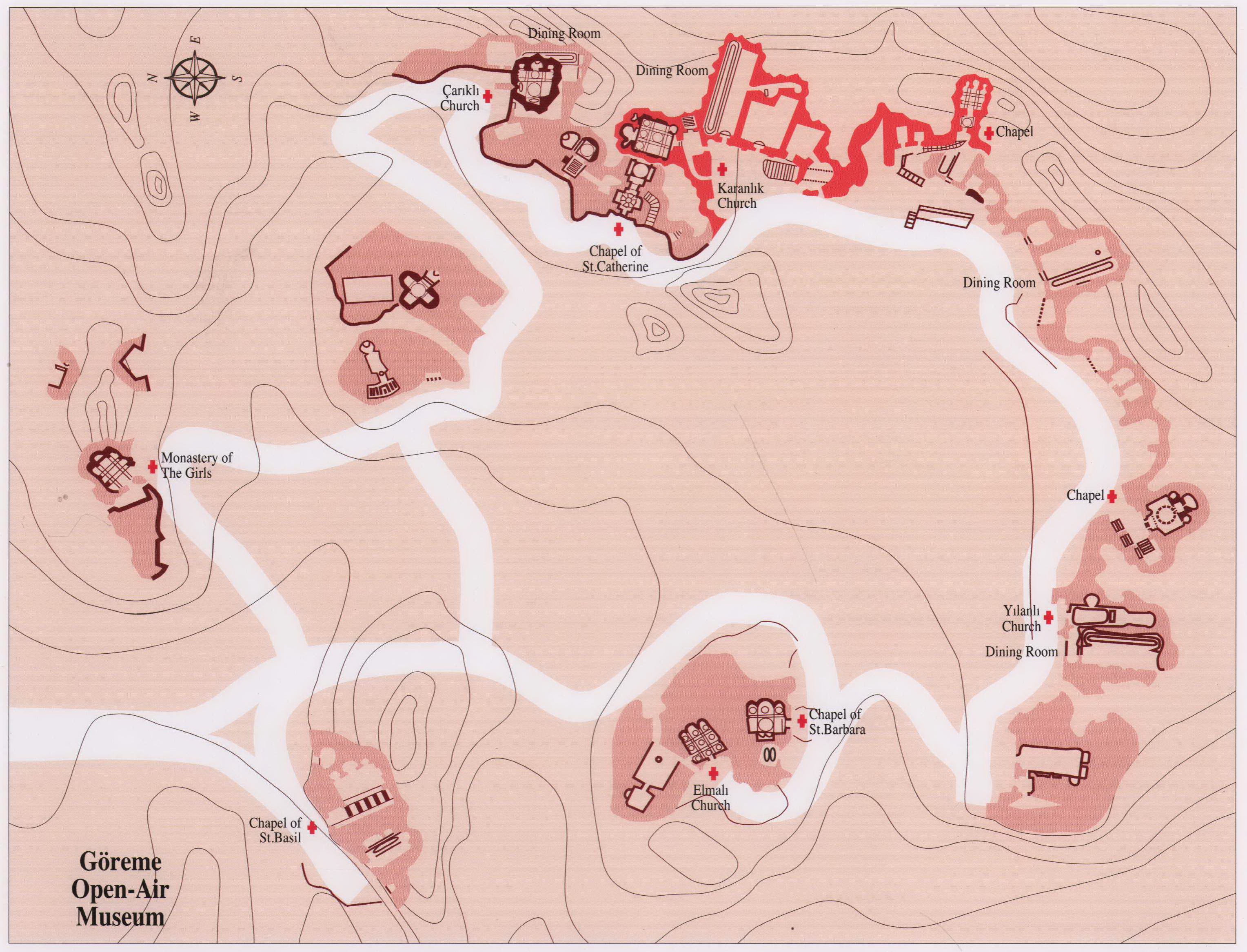
The ten churches were mainly painted between the 9th and 13th centuries, during a flourishing period when the great Byzantine soldier-emperors – Nikephoros Phokas and Ioannes Tzimiskes – pushed the Arab conquerors of the 7th century back from the borders of Cappadocia, allowing the province to fill once again with monasteries. At the same time, the military aristocracy received estates here, whose revenues enabled them to sponsor monastic foundations and invite masters from Constantinople. These artists brought the refined style of the imperial capital to a frontier region that had never before seen art of such quality. The Göreme monastic complex of ten churches also functioned as a pilgrimage center and a theological school, which further explains the particularly impressive and encyclopedic fresco cycles that survive here.
About the churches themselves – and about the communities that created and used them – we know almost nothing. Hardly any written sources survive from Cappadocia before the Turkish conquest; most communities disappeared with that conquest, and whatever folk traditions may have lingered were lost during the population exchange of 1923. The Muslims resettled here from northern Greece knew nothing of the traditions of the earlier inhabitants, while the Cappadocian Greeks deported there have long since forgotten them. The history of Byzantine Cappadocia must therefore largely be reconstructed from these churches and their frescoes.
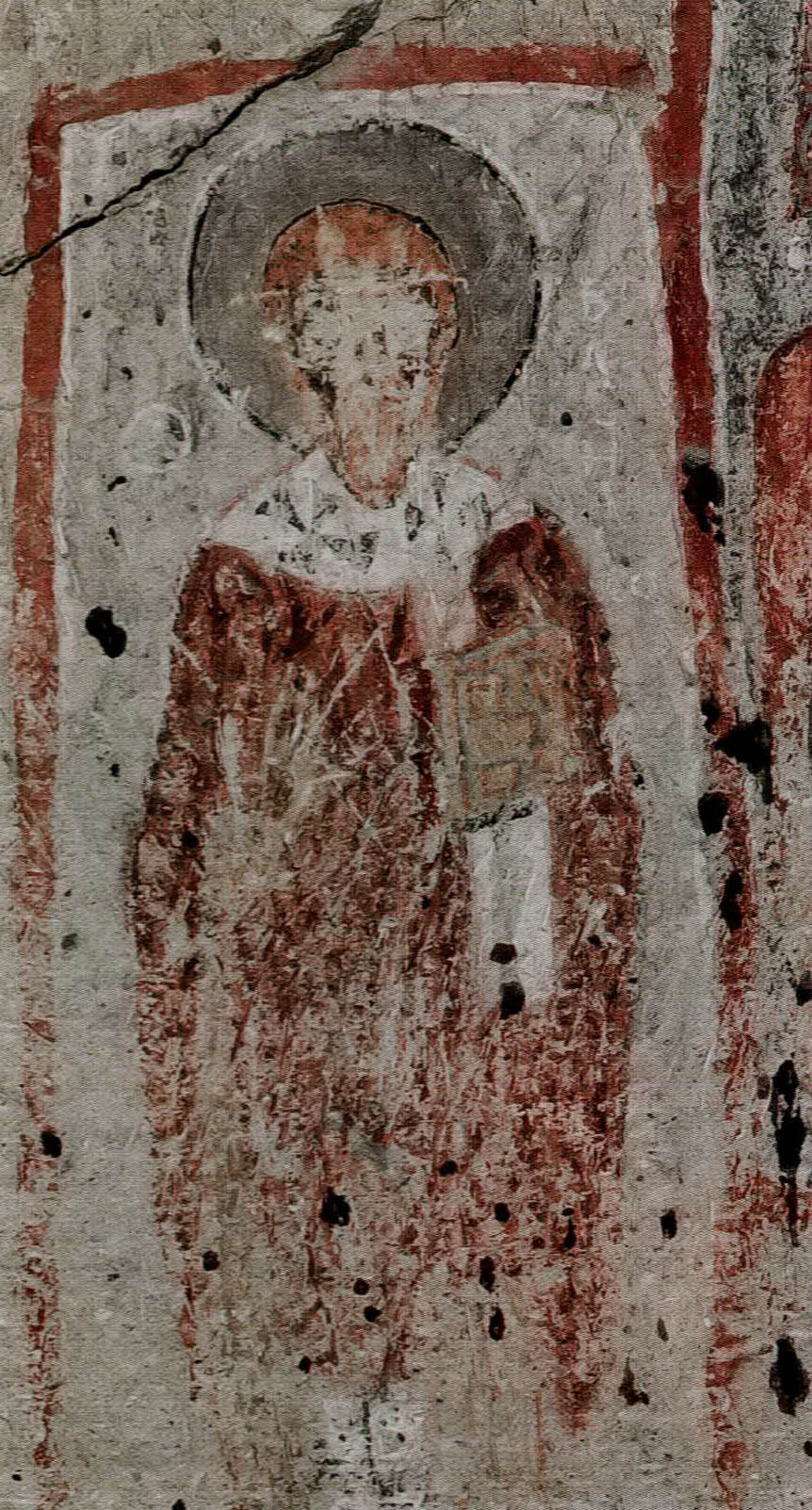
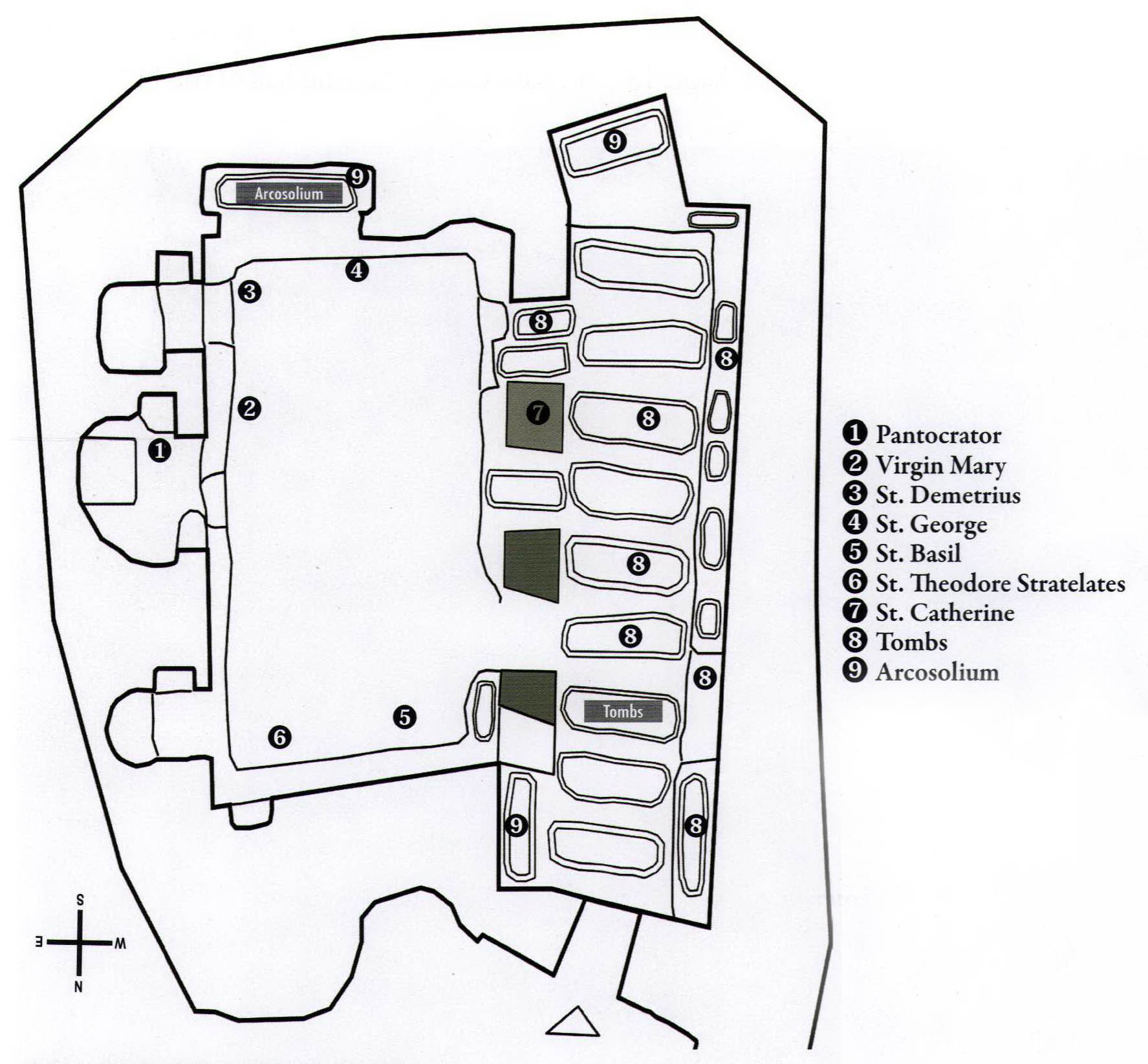
As a result, we do not even know the original names of the churches. Their present-day names are based on their most prominent images. Thus the first church on the museum circuit – officially “Chapel No. 18” – is called the “Church of Saint Basil”, because on the northern entrance wall there is a depiction of Saint Basil (Basileios), bishop of Caesarea, a local Cappadocian Church Father and one of the founders of Orthodox monasticism.
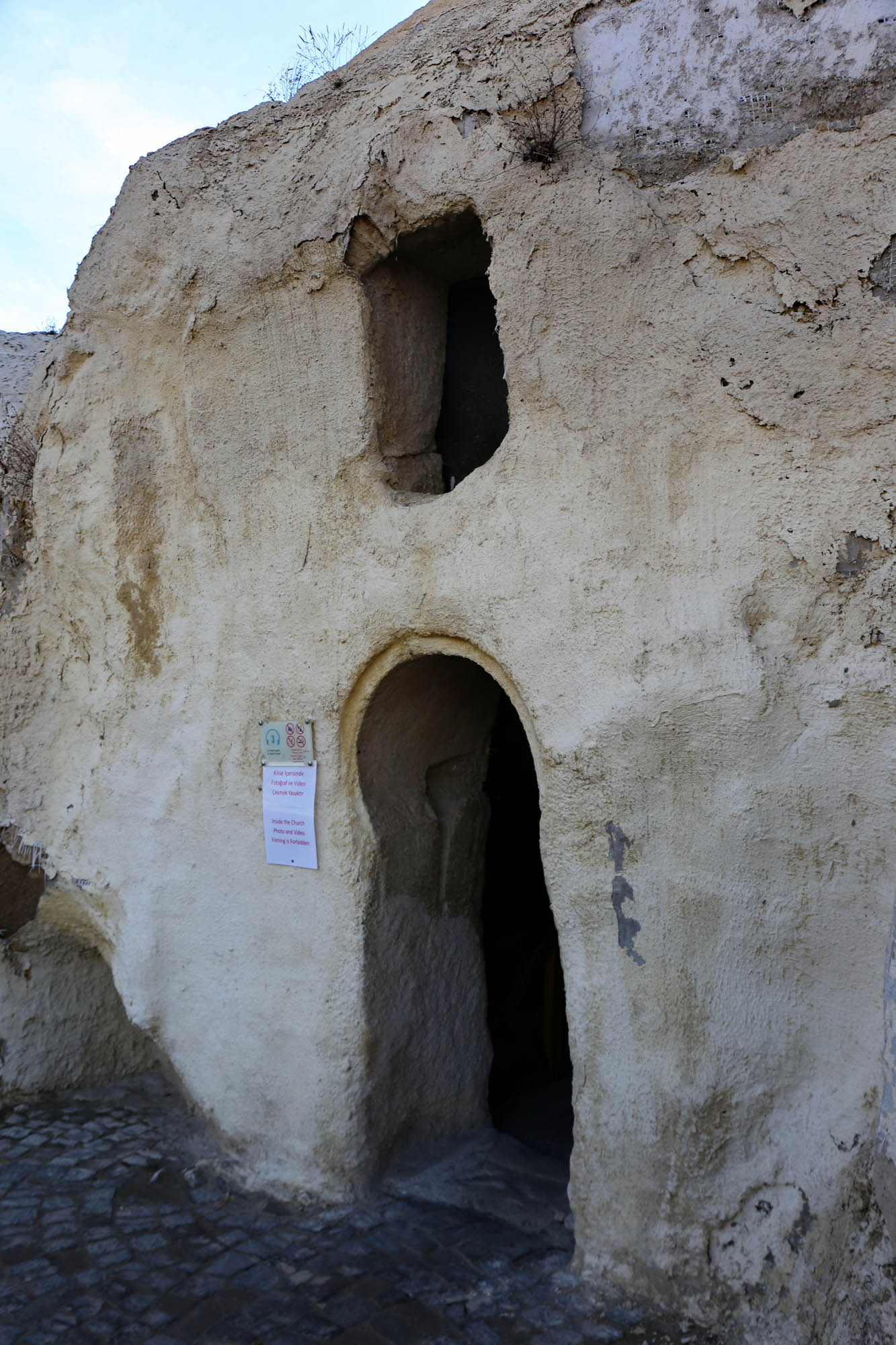
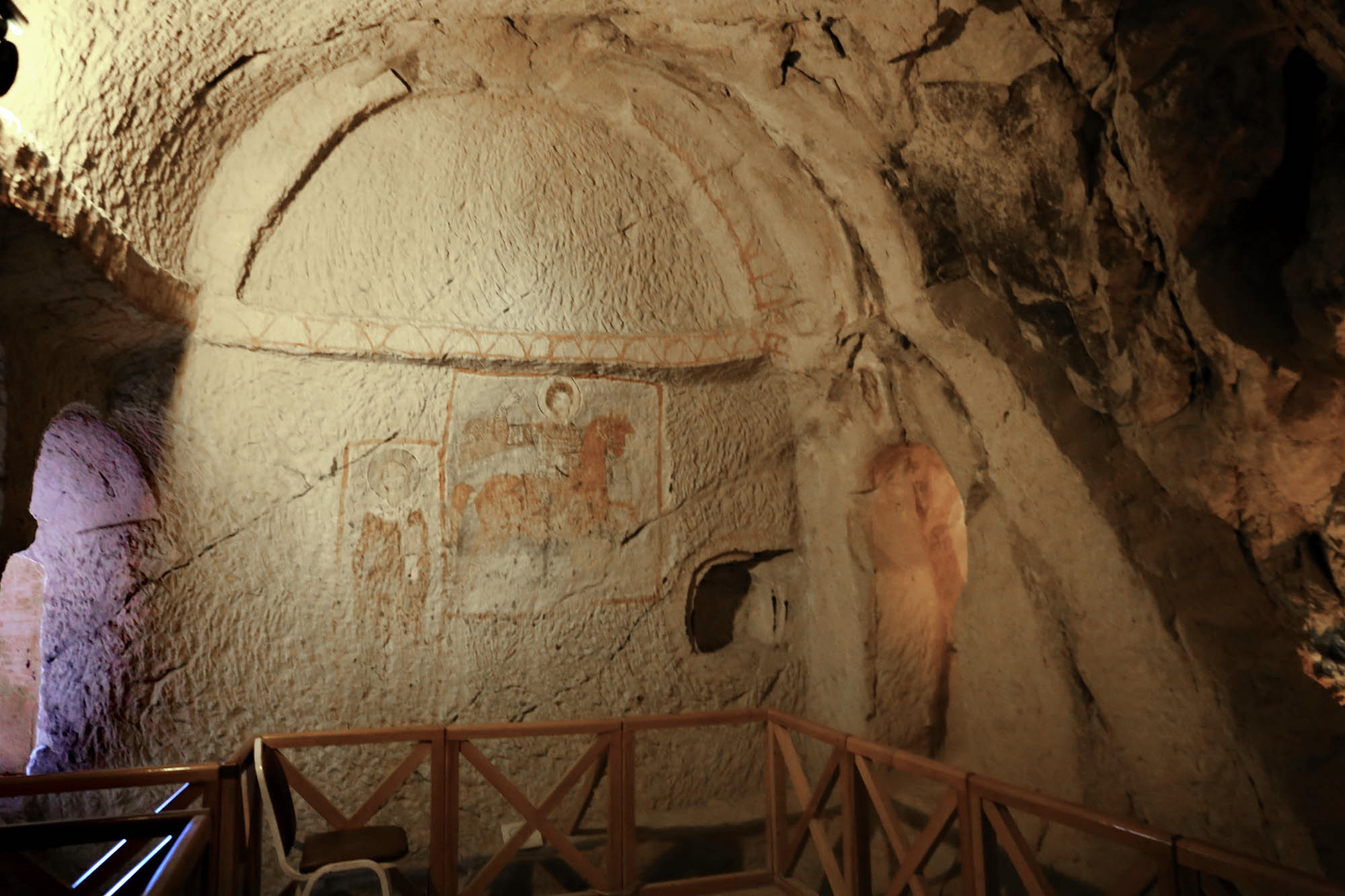
The interesting thing about this church is that its apse and altar open onto one of the long (eastern) sides, so the church is wider than it is deep. This was a typical feature of early monastic churches; most Syrian monastic churches in southern Turkey follow the same layout. It allowed the monks to line up in a row, side by side, rather than one behind the other, at the altar during ceremonies.
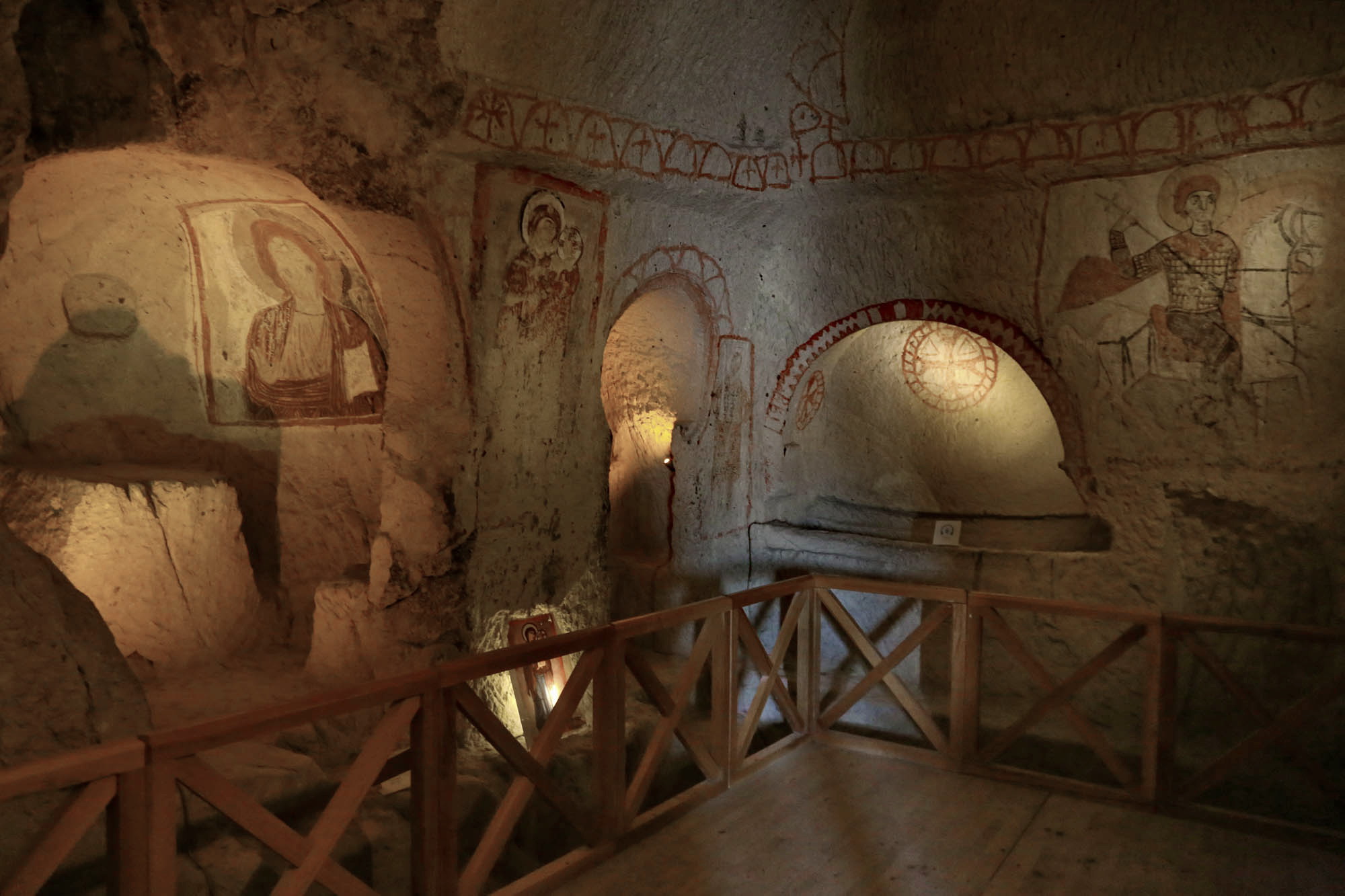
The frescoes in the church date from the second half of the 11th century, the last great flowering of Cappadocian monasticism. They don’t yet form a unified cycle as in later Orthodox churches. Instead, a few prominent images are scattered across the walls like a patchwork, each with its own meaning and historical tradition.
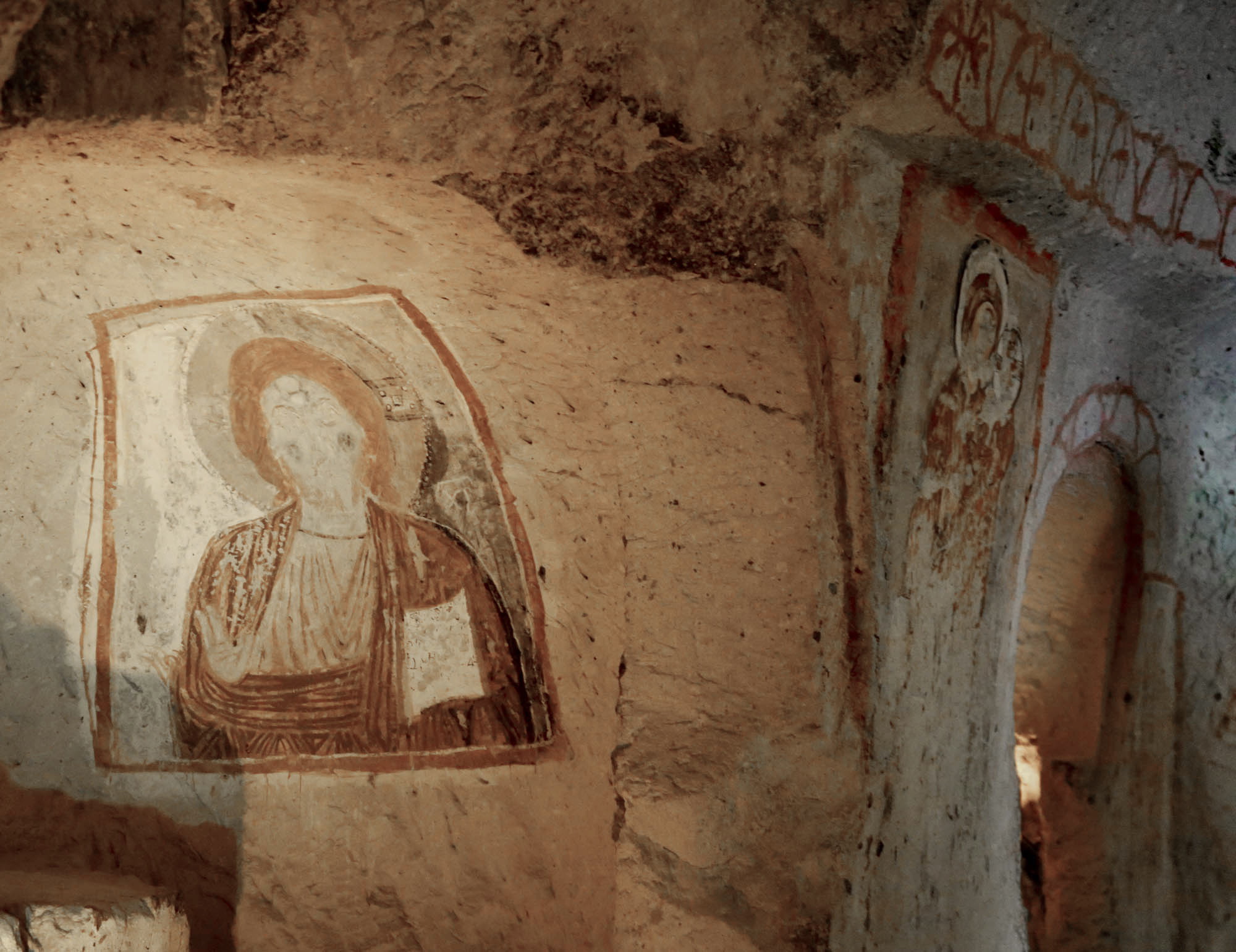
Above the altar on the wall is the image of Christ Pantokrator, raising one hand in blessing and holding a book in the other, signifying that He is the Word made flesh. This depiction of Christ, sustaining the world by His power, was becoming widespread at the time and soon became an indispensable motif in Orthodox churches.
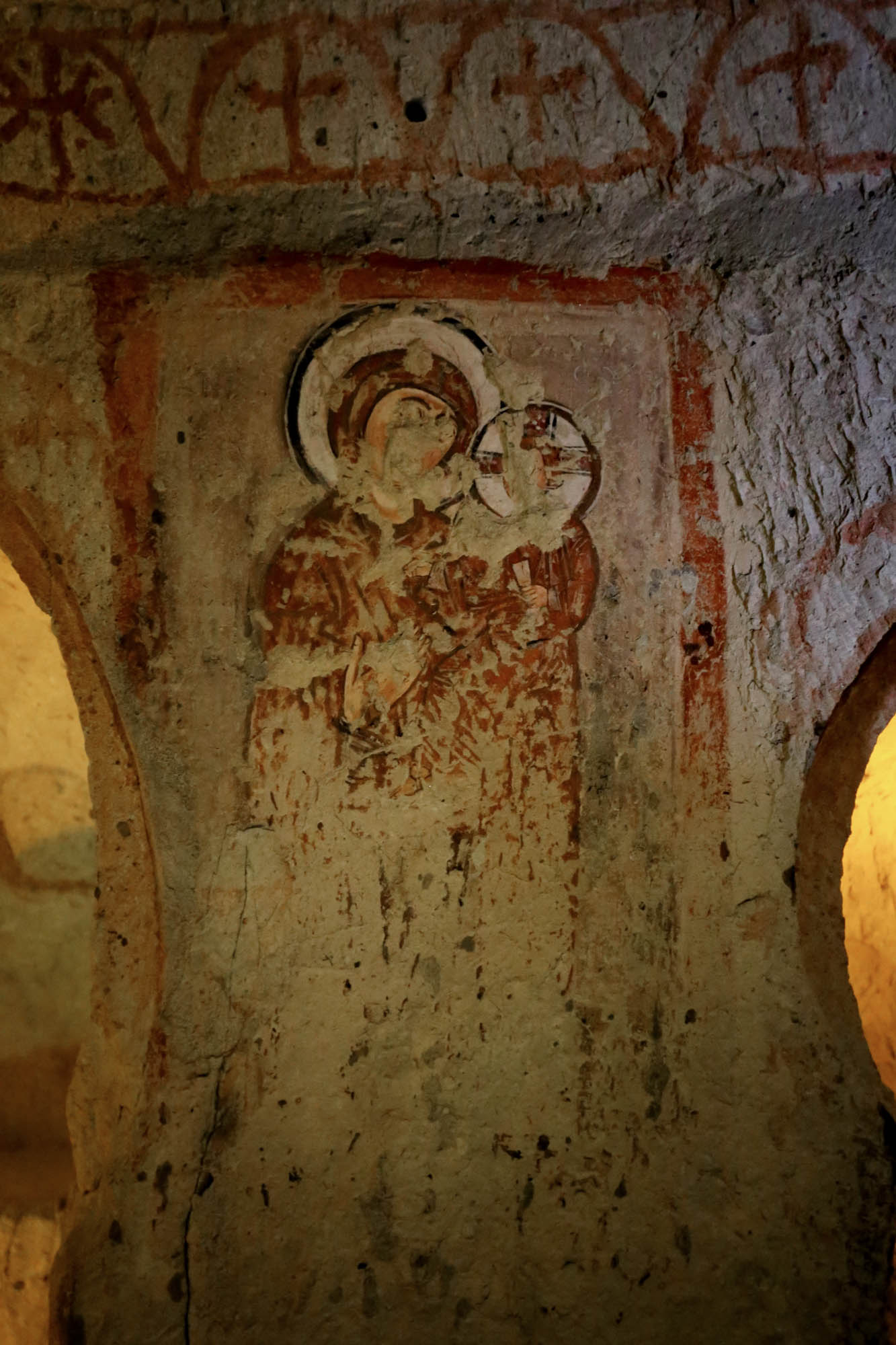
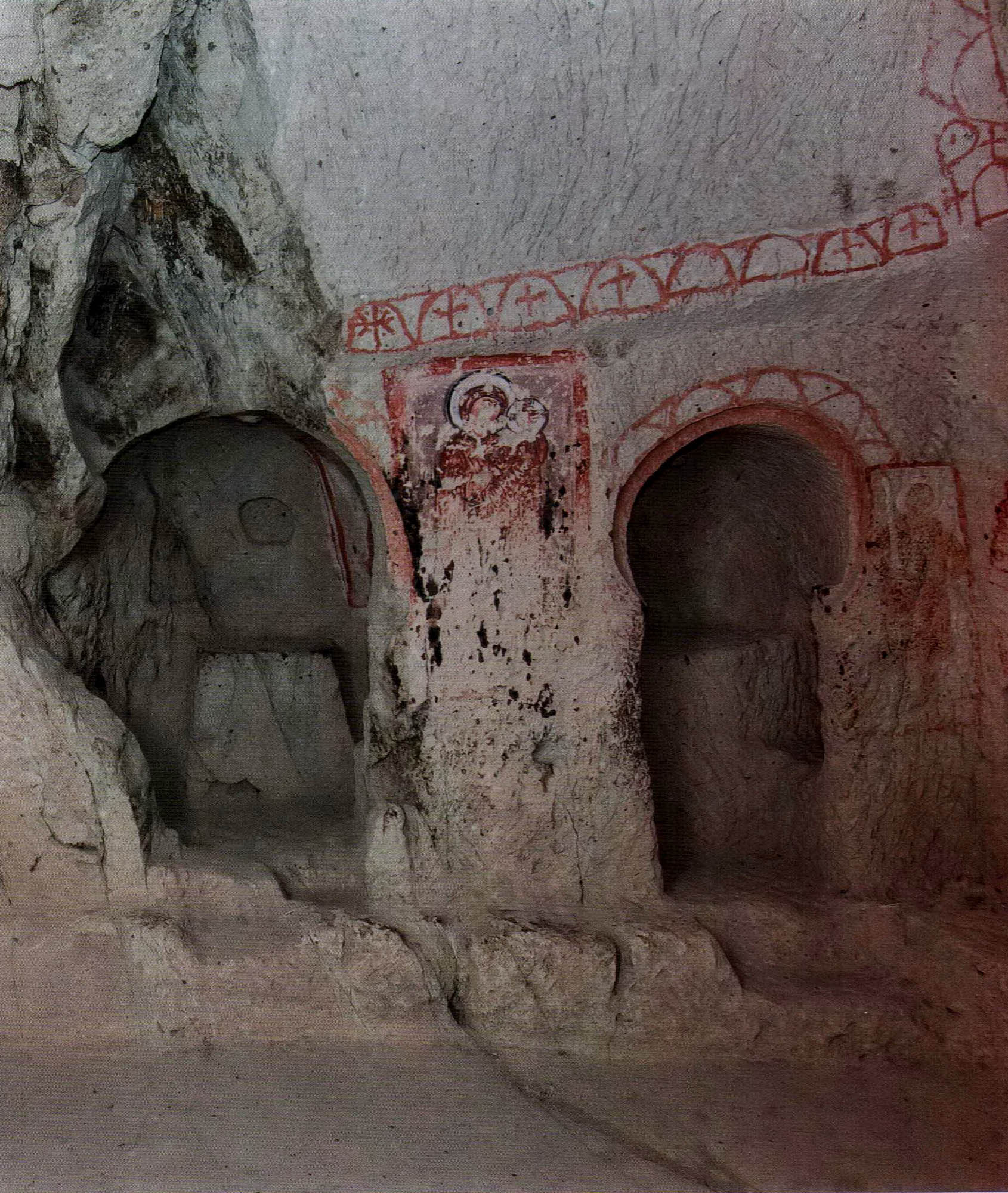
To the right of the altar, on the wall, there’s a full-length image of Mary holding her child. This follows the most revered Marian icon of the time, the full-length Hodegetria preserved in Constantinople. At the beginning of the century, a tiny monk could also be seen at Mary’s feet, with a Greek inscription above: “Lord, help your servant, monk Ignatios.”
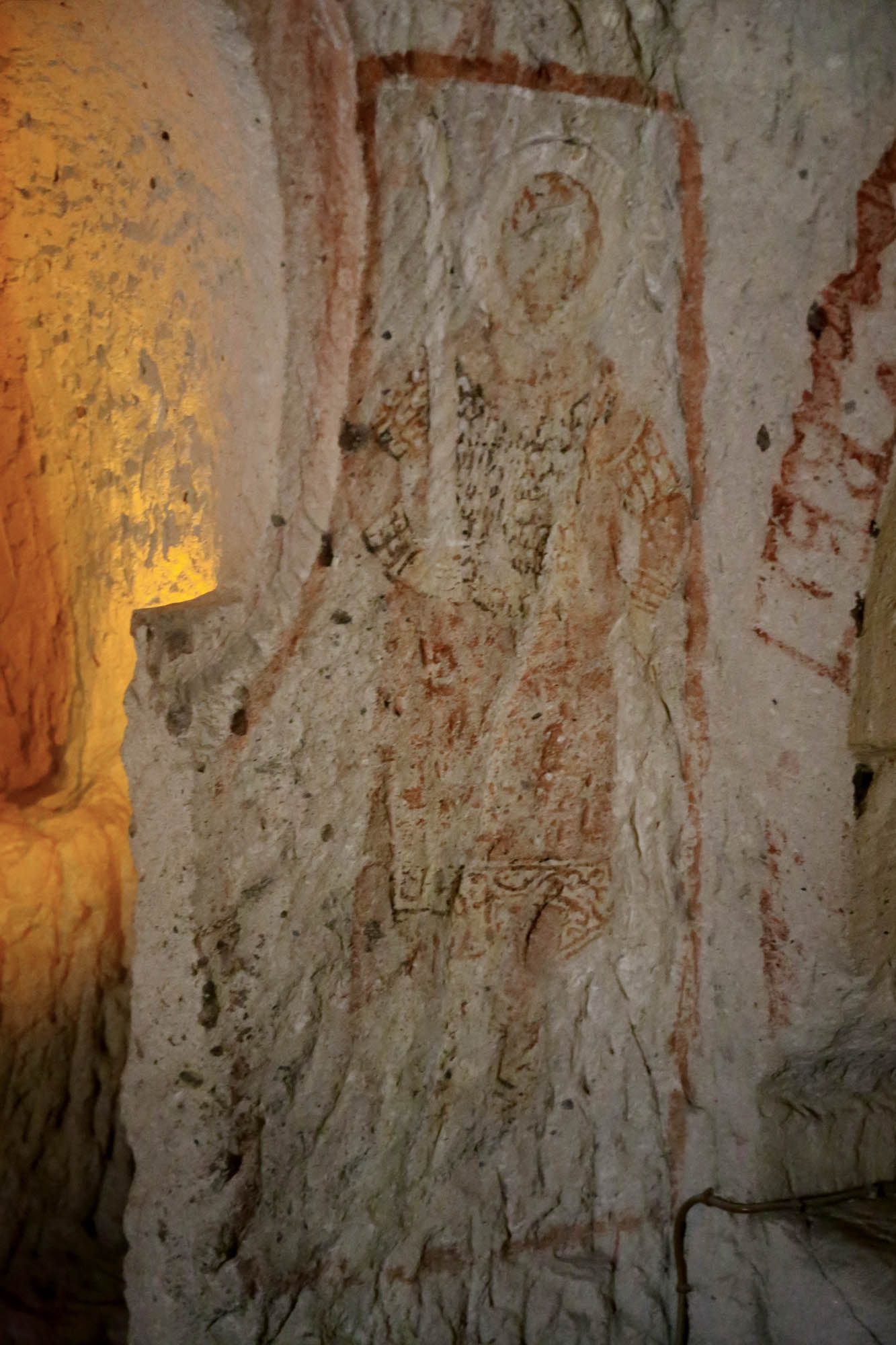
On the two short walls, you see a mounted warrior saint, each accompanied by a standing saint. On the southern wall, Saint George on a white horse pierces an enemy — either a man or a dragon — and in the corner behind him stands the warrior saint Saint Demetrios. On the entrance’s northern wall, Saint Theodore on a brown horse likely pierces a dragon, with Saint Basil standing behind him.
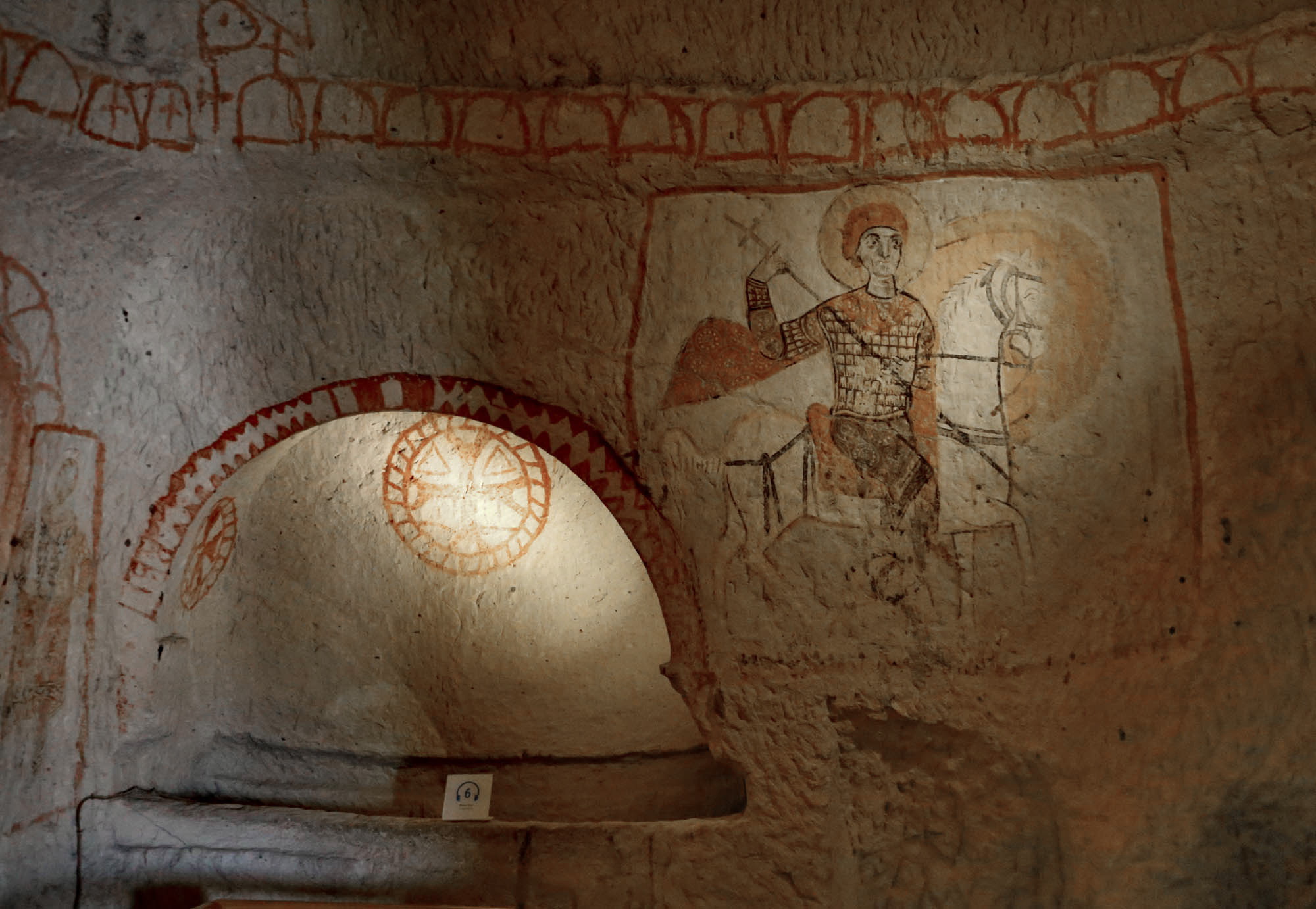
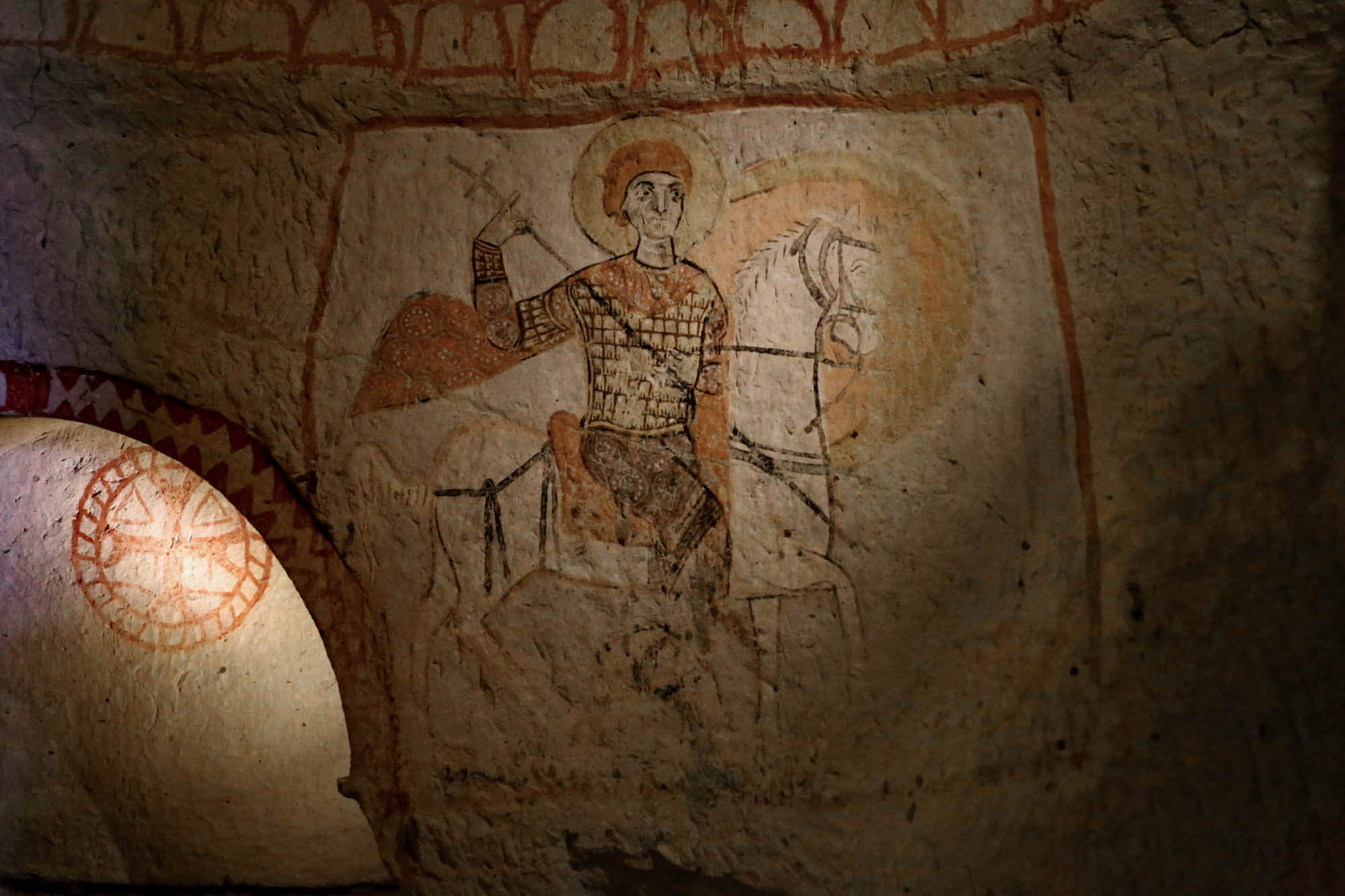
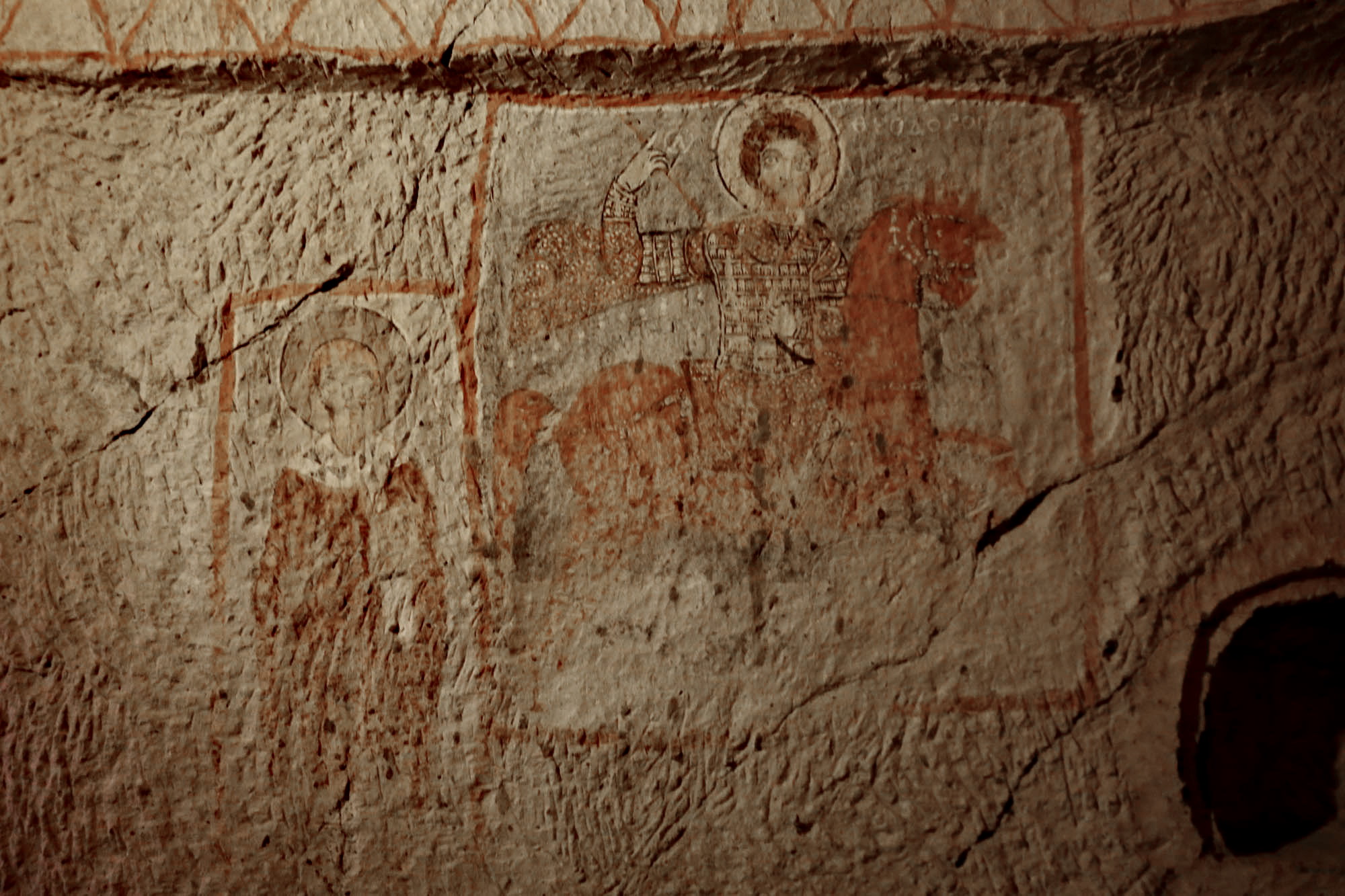
Warrior saints, especially the mounted Saint Theodore and Saint George, were prominent figures in Cappadocian art. Cappadocia was a frontier region, with many Byzantine soldiers stationed here and a locally militarized population, explaining the importance of warrior saints. Saint Theodore and Saint George often appear together, facing each other, as seen in several other Göreme churches. I’ve written before about Saint George, whose cult grew strong in 10th-century Georgia; here, he mounts a horse and begins slaying dragons, previously attributes of Saint Theodore. The two mounted saints were often depicted together in Georgia. Georgia and Cappadocia were closely linked in the Middle Ages: Christianity spread from Cappadocia to Georgia from the 4th century, and Georgian kings founded or sponsored several churches in Cappadocia — thus the dragon-slaying Saint George returned to Cappadocia, where he became almost a national saint.
Interestingly, the Arab opponents also got to know Saint George in Cappadocia, creating a Muslim counterpart, Al-Hidret, celebrated on the Christian Saint George’s Day as Hidirellez or Ederlezi (see Goran Bregović’s famous song).
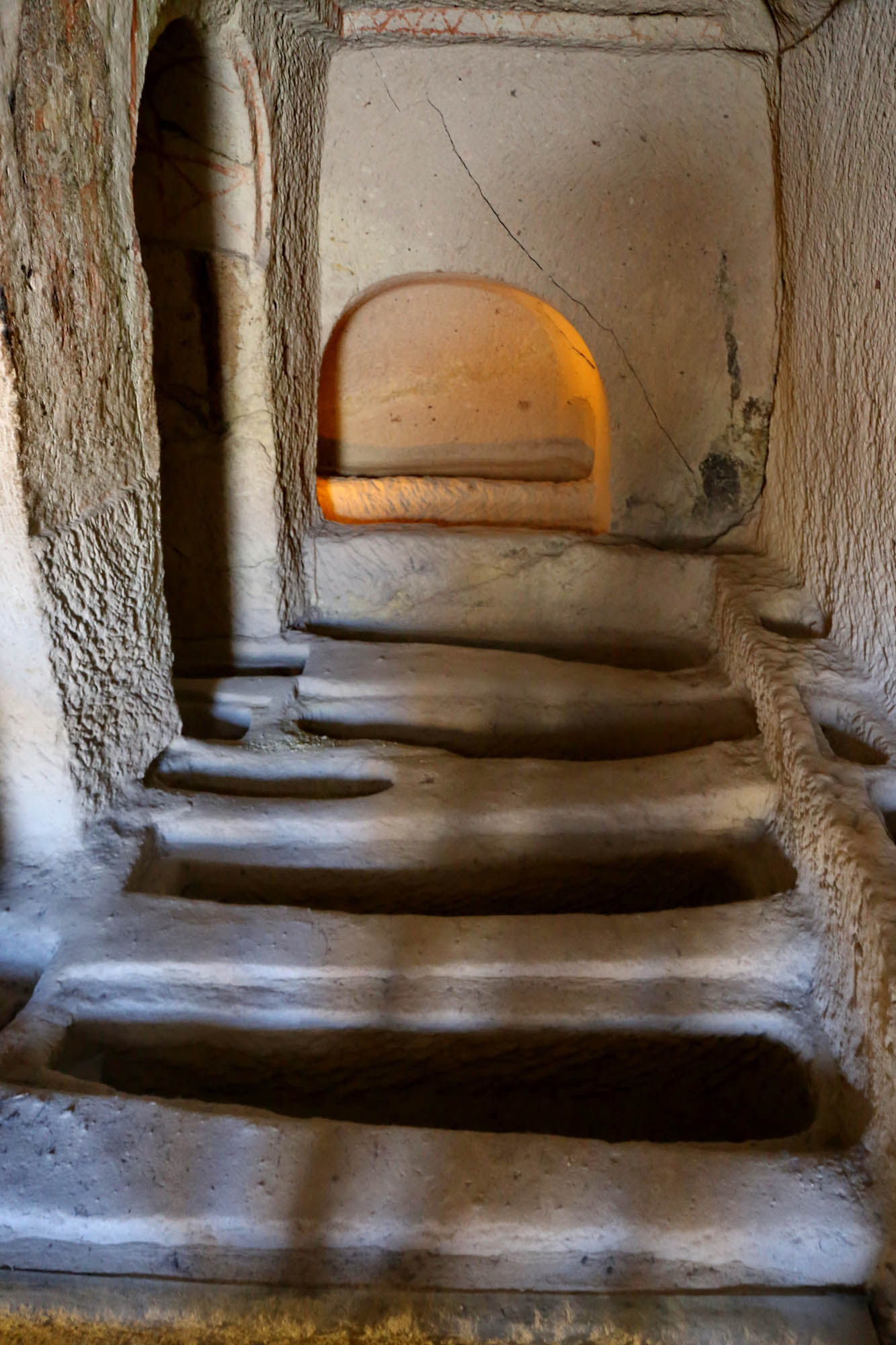
The Saint Basil Church has two naves: the outer nave contains graves, probably of monks. This dual-nave design, unknown in the West, was common in early Orthodox architecture, where the outer aisle was mainly used for funerary rites and lay ceremonies, similar to churches in Svaneti, Georgia today.
To be continued with the other churches
|
|



Add comment