

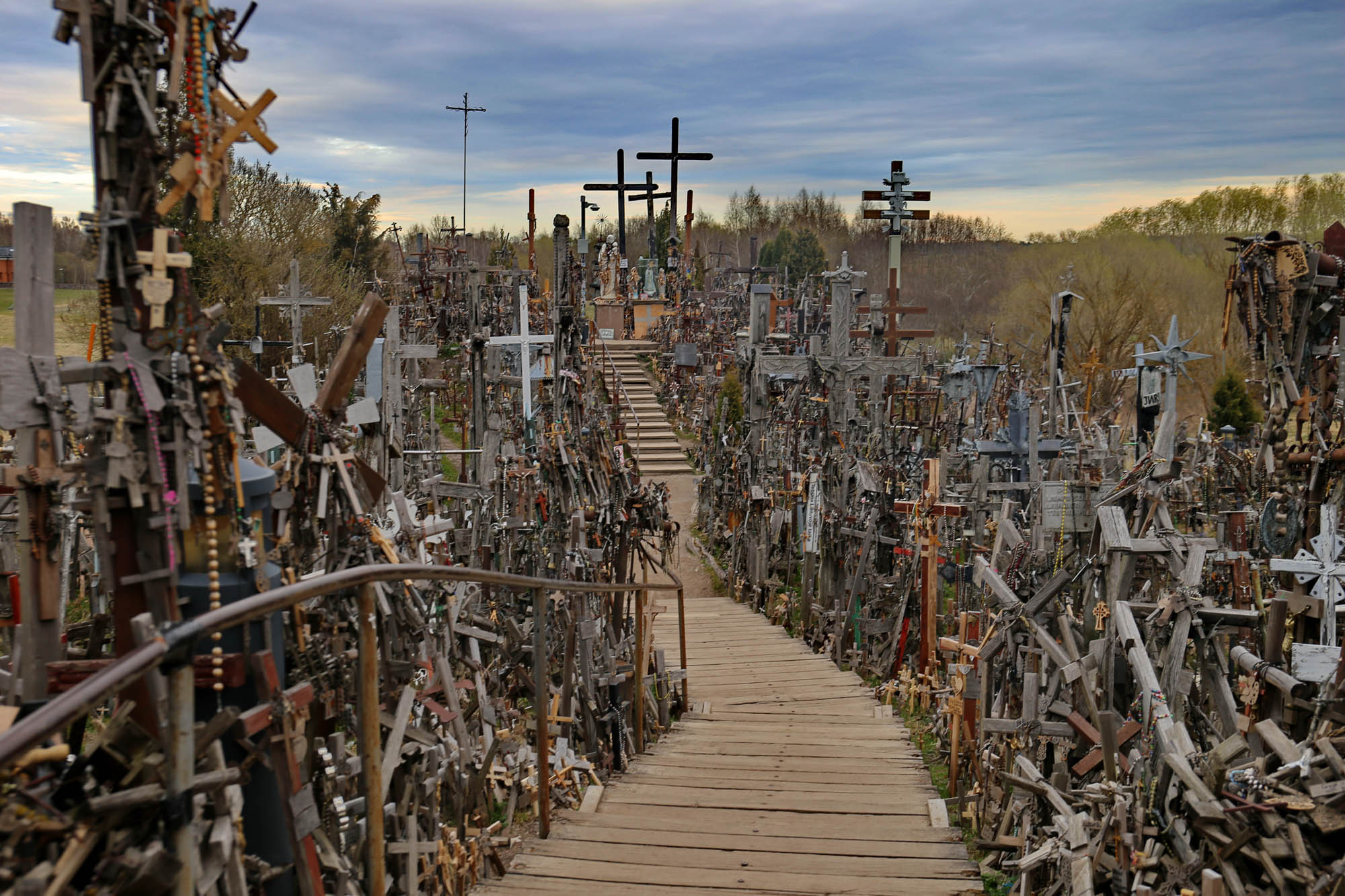
The Hill of Crosses in Lithuania is one of the most unusual and moving pilgrimage sites in Europe. Three low mounds rising from the plain – the remains of the medieval hillfort of Jurgaičiai (or Domantai) – where, after the failed anti-Russian uprisings of 1831 and 1863, families began to erect crosses for relatives whose bodies they were never allowed to recover or bury.
The practice of setting up crosses fits into an old Baltic, more specifically Lithuanian tradition known as kryždirbystė, the custom of domestic cross-making. After a death, recovery from illness, or the fulfillment of a vow, a cross would be erected near the home. If it commemorated the dead or those lost in war – or if a tree was planted in their memory – people would bring flowers, bread, and candles there on certain days. The tree, or the equivalent cross, became a living memorial, sustaining the memory of the departed.
In the Baltic region, certain places – hills, trees, crossroads, riverbanks, forest edges – are not only sites of remembrance but also layered archives, where the past exists as a spatial accumulation.
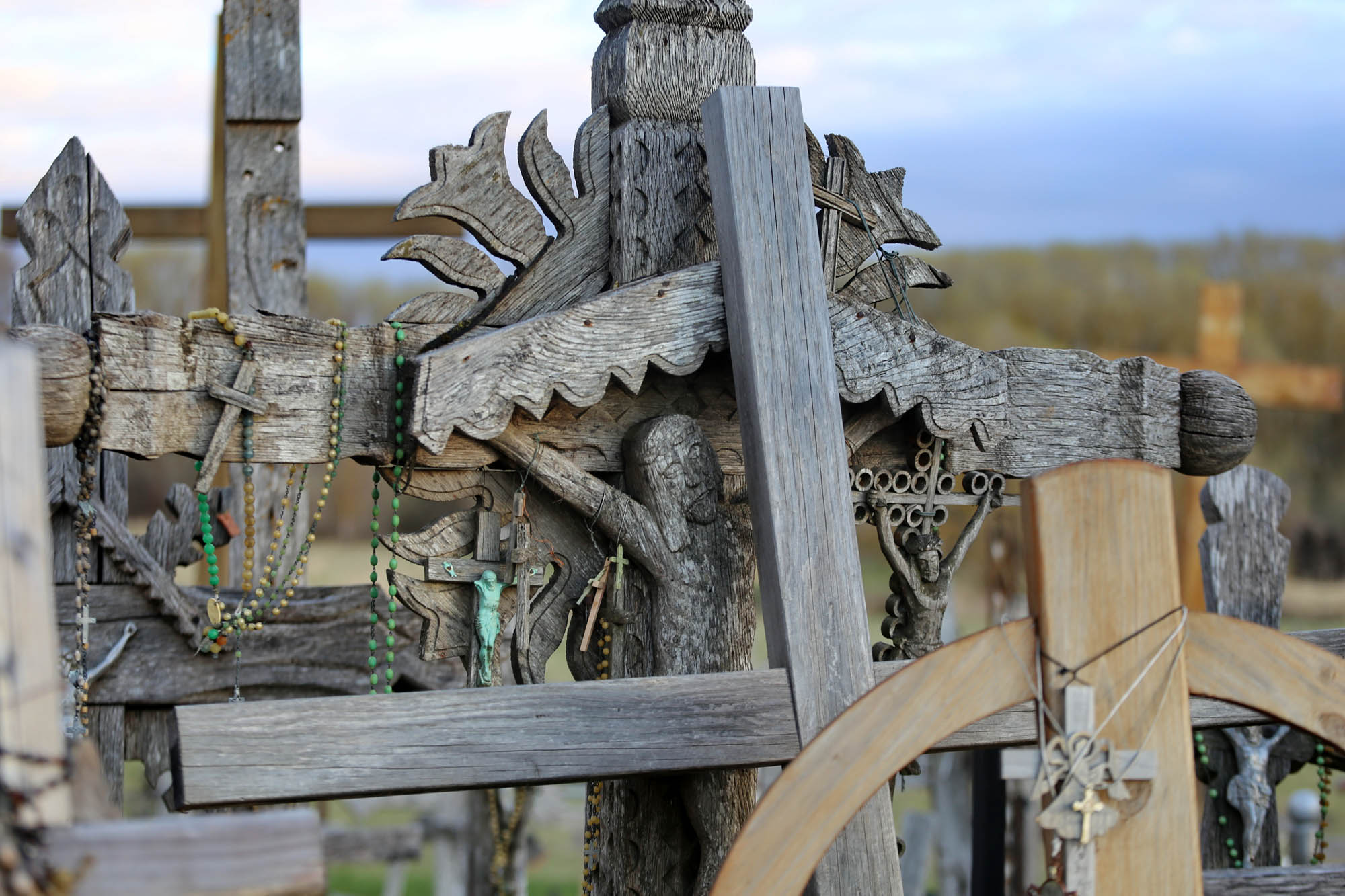
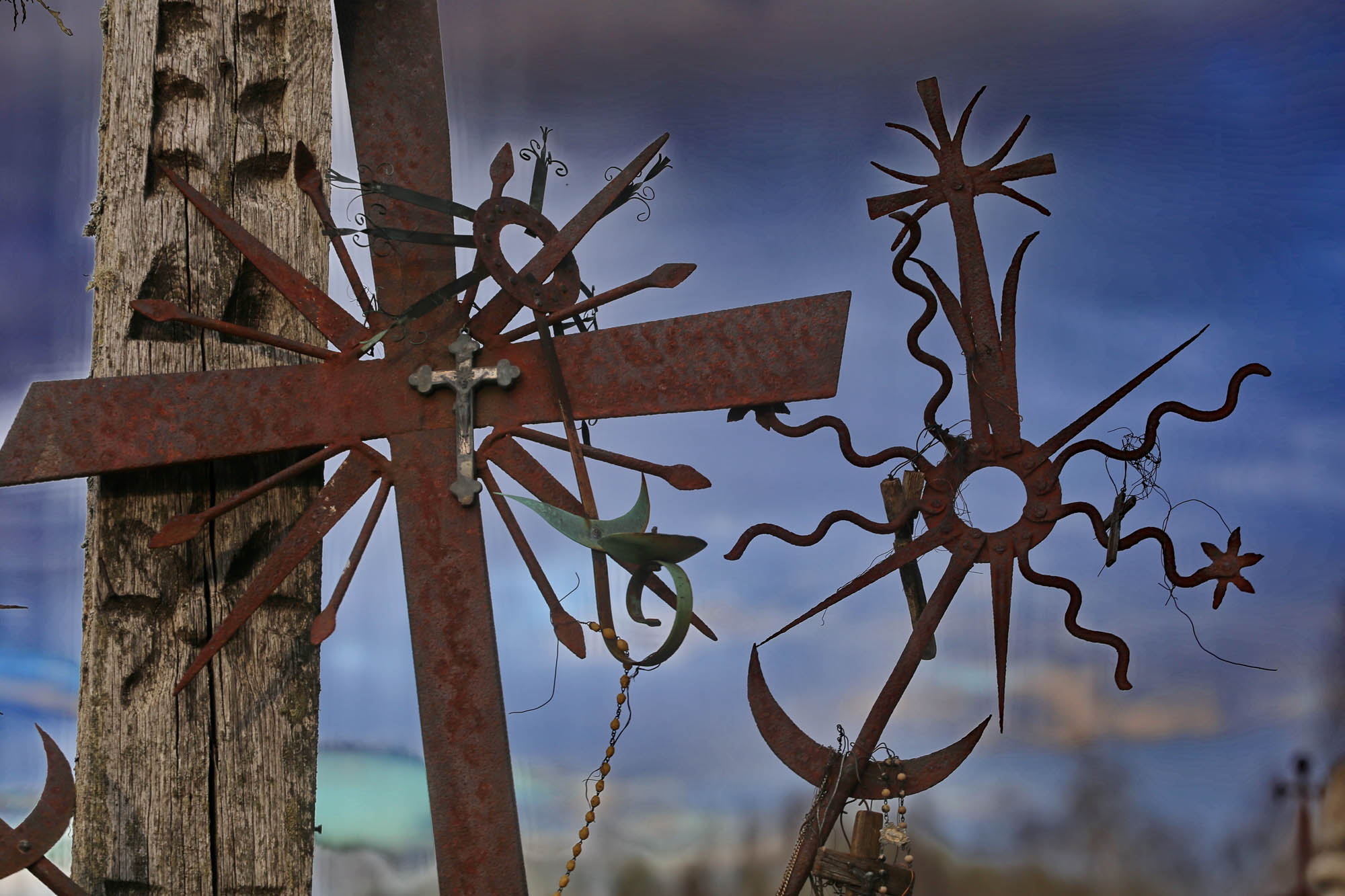
During the Soviet occupation, such crosses were also erected in memory of those who had been deported. When the authorities removed them – fully aware of their meaning – families or villagers would put them back, often in altered form, so that memory became not repetition but layering.
A frequent form of forbidden remembrance was also “speaking to the wind,” when those left behind would recount their memories aloud in open fields or forests. This practice is key to understanding the Hill of Crosses as well, where locals often refer to the wind moving among the crosses and “recalling names.”
Lithuanian rural historical memory does not build fixed monuments but performs acts of remembrance, continuously replaying the past.
In Soviet times, this past – marked by anti-Soviet symbols recalling crimes committed by the regime – was considered inconvenient and therefore forbidden. The Hill of Crosses was bulldozed three times, and there were even rumors of plans to flood the site. Yet each time, locals returned – defying the authorities and risking imprisonment – to bring back their crosses, creating new constellations, until the place became a symbol of quiet national resistance and religious freedom, and after 1990, of renewal.
In this sense, the hill resembles the spontaneous memorial on Szabadság Square in Budapest, which likewise sets the personal memory and loss of individuals and families against an officially imposed narrative – just as chaotic and just as indestructible, because it can be rebuilt after every attempt to erase it.
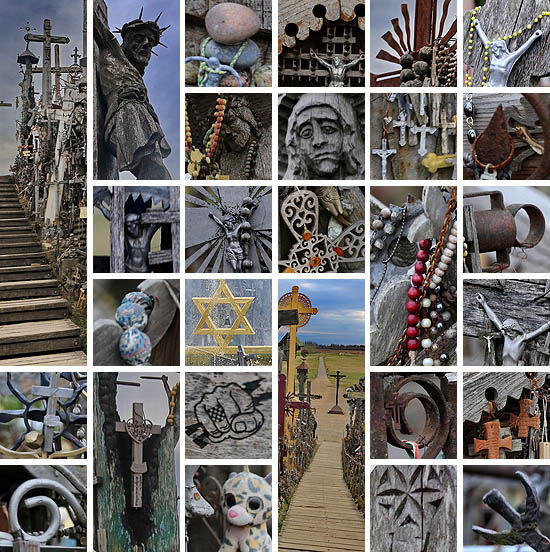
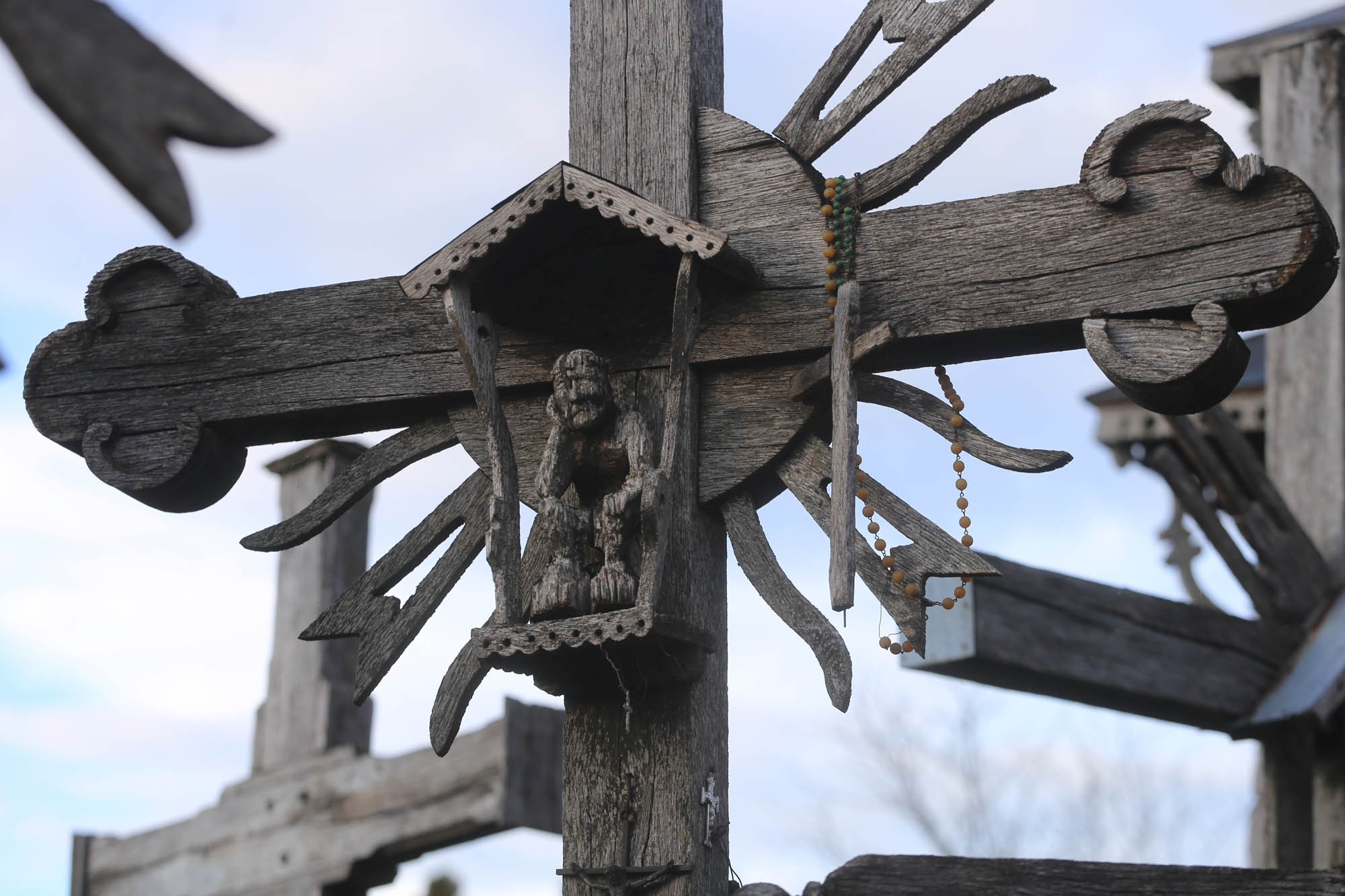
The tradition of kryždirbystė goes back to pagan times, when Lithuanians did not erect Christian crosses, but “trees of life” in front of their homes. Motifs of these ancient forms still survive on folk crosses today: the solar disk, stylised vegetal shapes, and the life-tree form of the cross itself—its axis rooted in the earth and crowned in the sky, joining the lower and upper worlds. Soul-birds settling in the tree, wave and spiral patterns marking the cycles of time, the flow of water and life, the movement of fate—all of these are still present. Today, this tradition is included in UNESCO’s list of Intangible Cultural Heritage as a centuries-old, uninterrupted practice of folk art, religion, and social life.
“The Hill of Crosses is not a place of death, but a place of stubborn memory. It is not a cemetery, nor merely a collection of religious symbols. Rather, it is a space where memory refuses to obey history.
The twentieth-century history of Lithuania taught that memory cannot remain a purely internal matter. What is destroyed often returns in objects. The cross here is not only a sign of faith, but also a statement that something did not disappear, even when it was forbidden.
During the Soviet period, the hill was demolished several times. Yet after each destruction, new crosses appeared. This was not merely stubbornness, but a different logic of history: memory is not linear, but returning.
Power always seeks order in space. The Hill of Crosses is the opposite: a disordered order. A structure that cannot be centralized, because each cross is a separate story, and none replaces another.
Therefore, this place is not an “monument” in the usual sense. It is rather a process: a space where individual memory accumulates but never becomes a single shared narrative.
The silence that reigns there is not emptiness. Silence itself is a form of speech. It does not deny history, but transcends it.
And perhaps most importantly: the Hill of Crosses is not the closure of the past, but proof that the past cannot be definitively closed. Each new cross is a new sentence in the same unfinished text.”
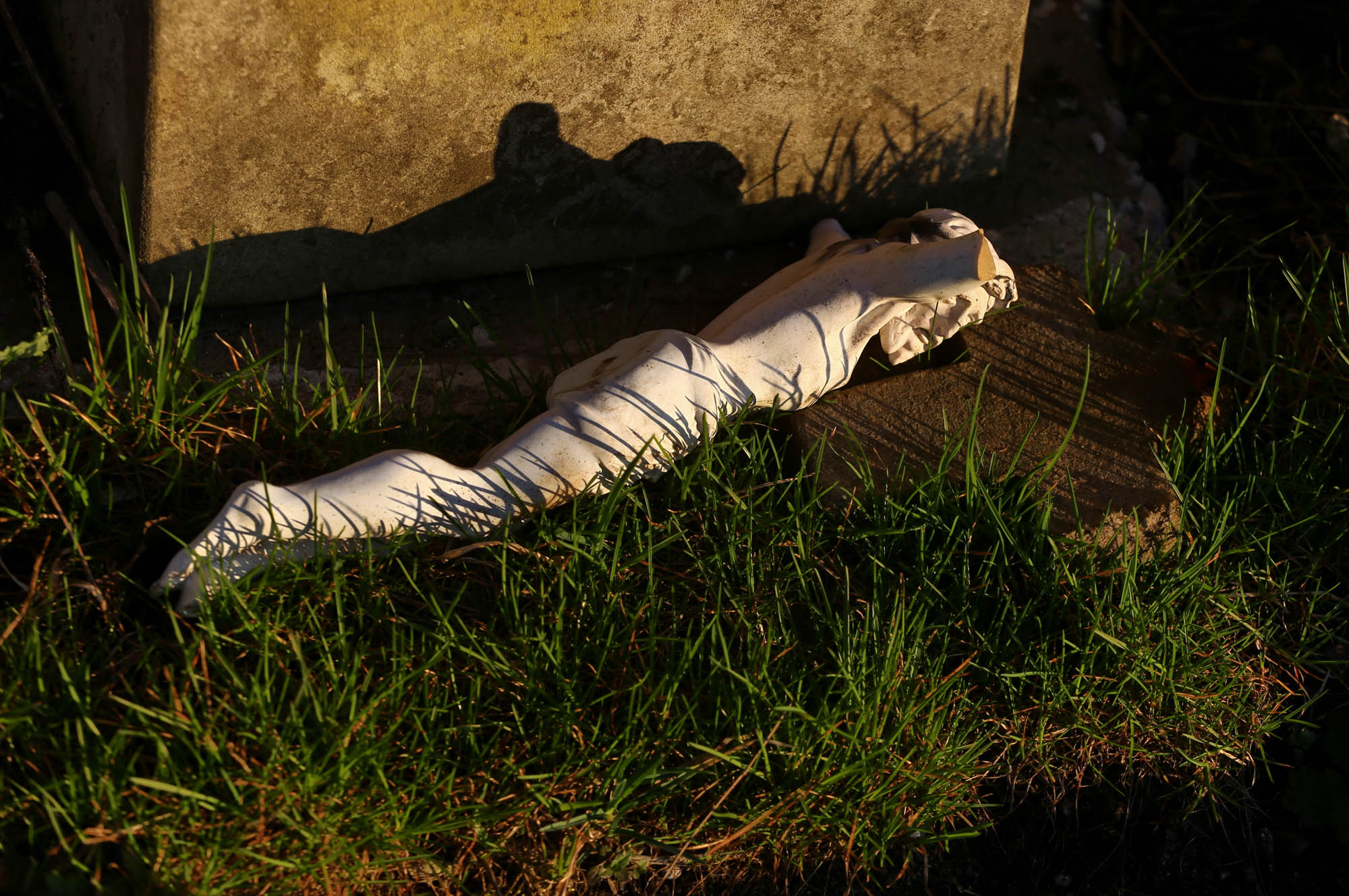
Many Western descriptions of the hill begin like this: “a mystical place”, “a pilgrimage wonder of Eastern Europe”, “a unique religious curiosity”.
This is a misreading. Where the real content is a combination of political memory, resistance, and popular religiosity, the Western gaze sees “exotic spirituality”. It treats a monument of historical trauma, identity assertion, and civic resistance as a “peculiar religious attraction”.
Another common approach presents it as a visual shock, a forest of death, an aesthetic horror. Political resistance becomes atmospheric decoration, personal memory a dark spectacle.
Western museum logic, meanwhile, tends to treat the site as an exhibition, a static installation, whereas in fact it is a continuously growing, chaotic field of memory without final composition or fixed form.
A more subtle romantic misreading sees “ancient Europe”, “lost spirituality”, “timeless folk tradition” in the place. This, however, erases the trauma of the 19th and 20th centuries and turns what is deeply historical into something timeless.
Or, even more romantically: “As if it were a forest of carved wooden prayers.”
A Lithuanian visitor would simply say: “We brought a cross for my father. Nothing special. It stands among the others.”
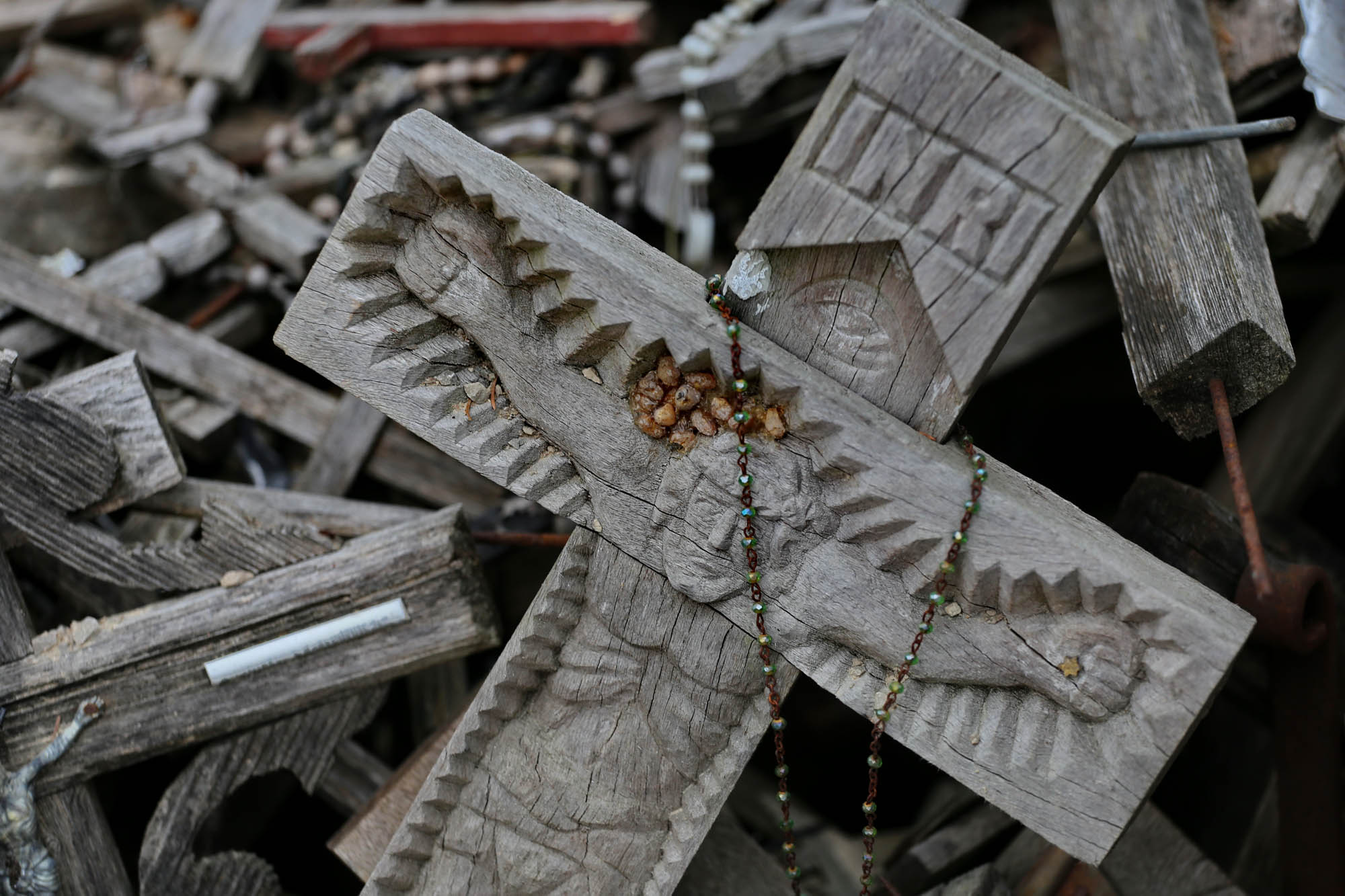
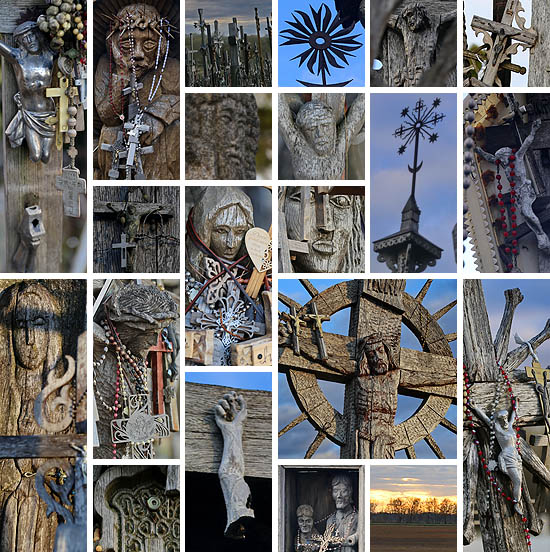
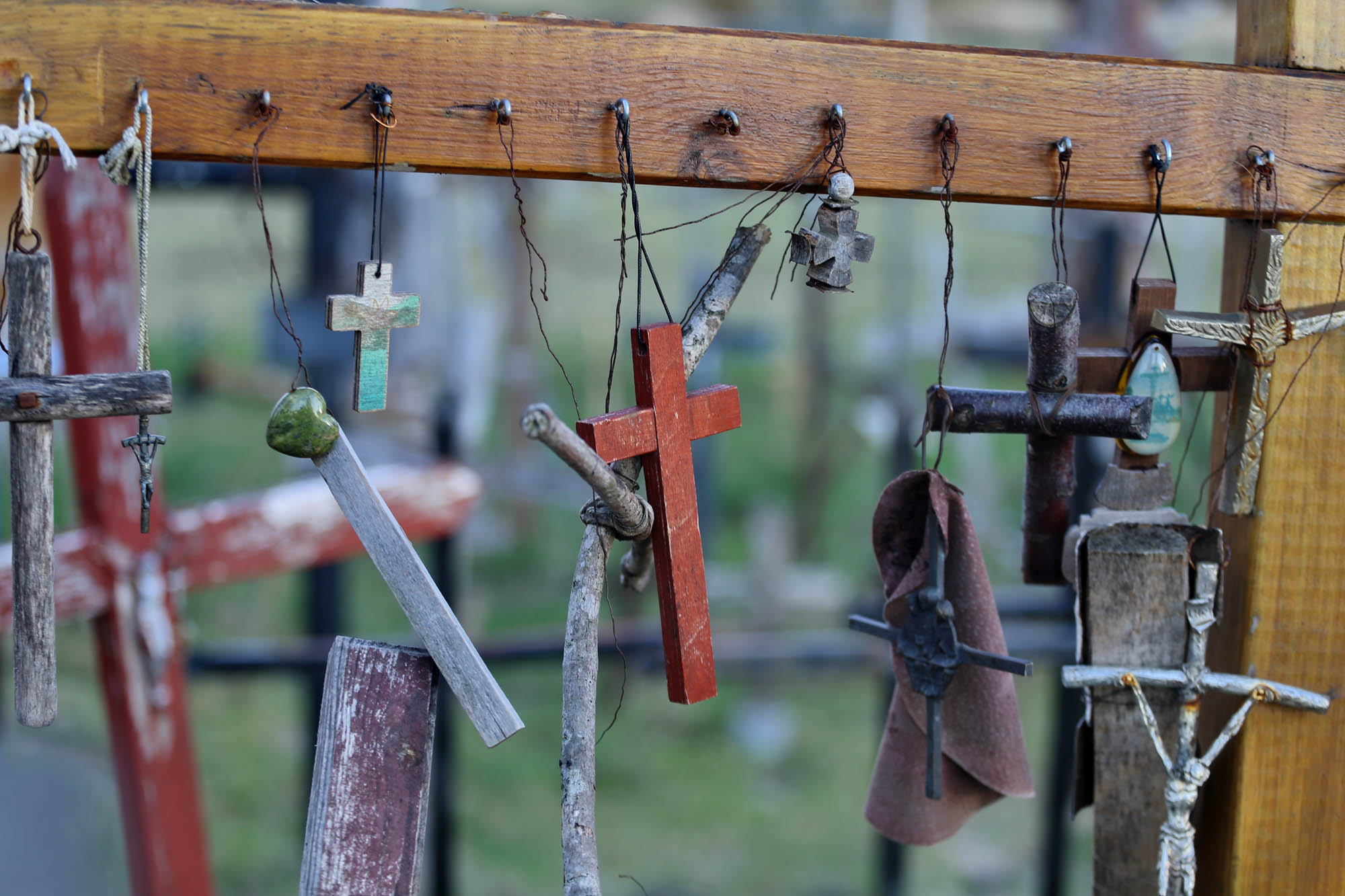
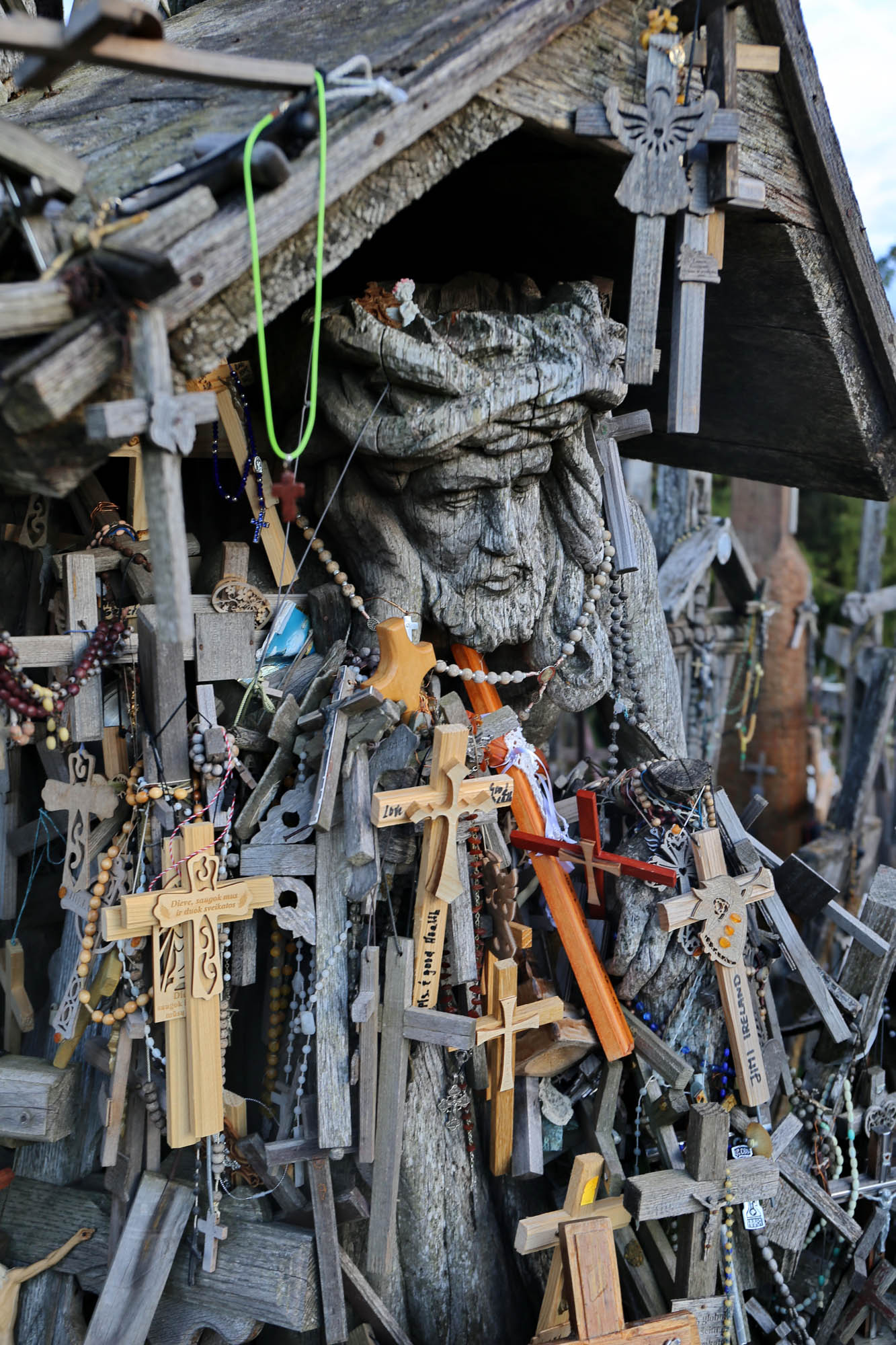
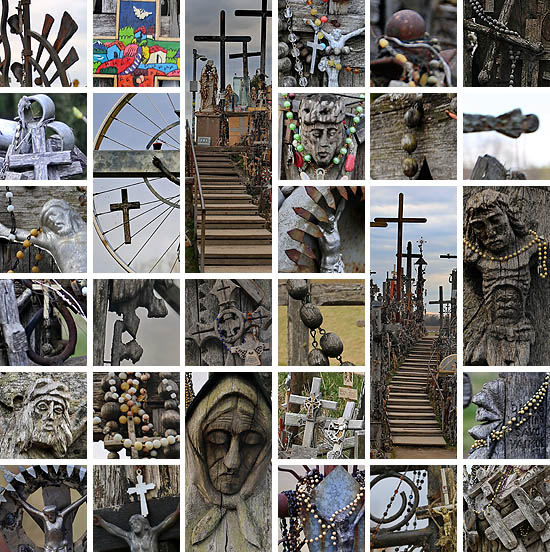
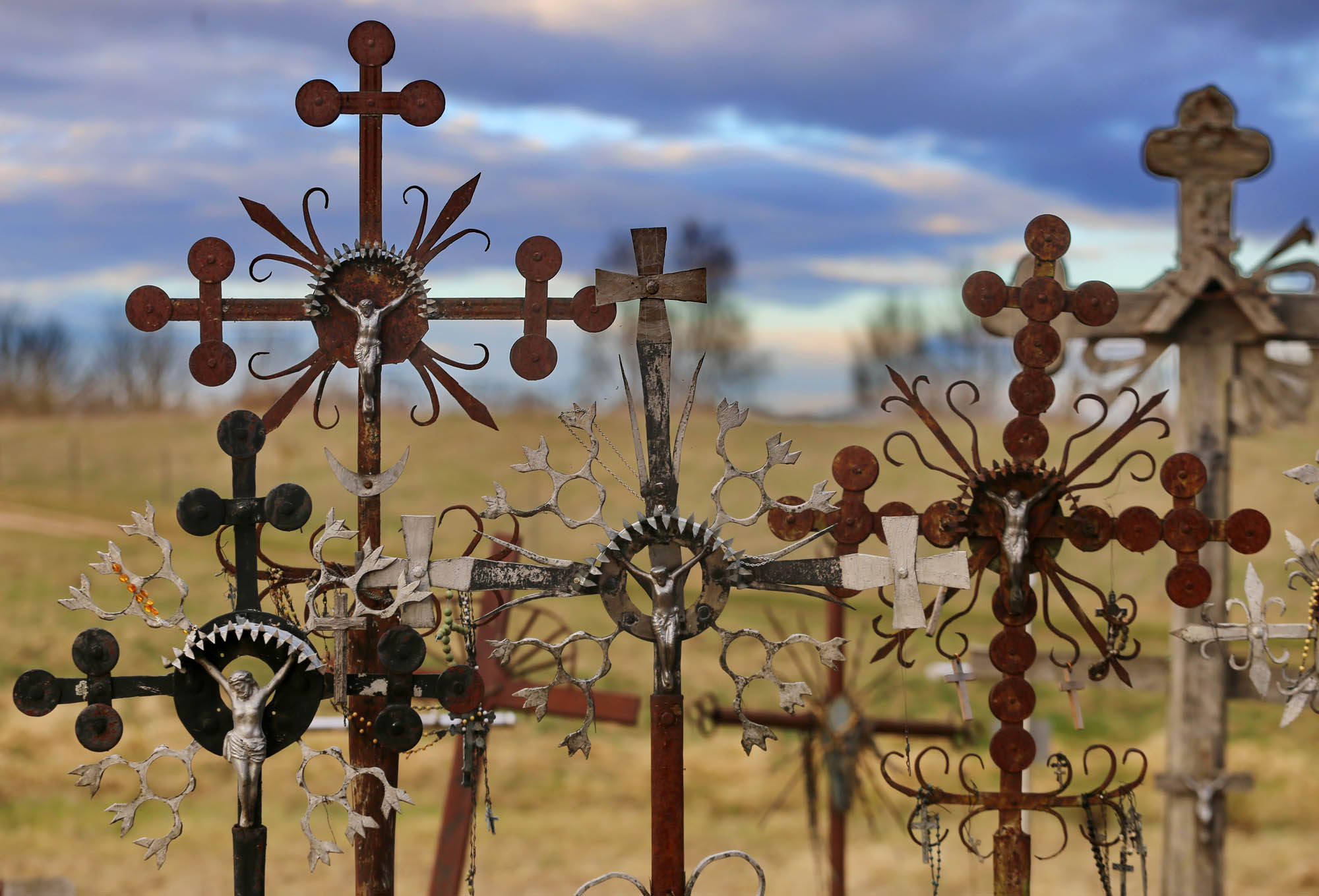
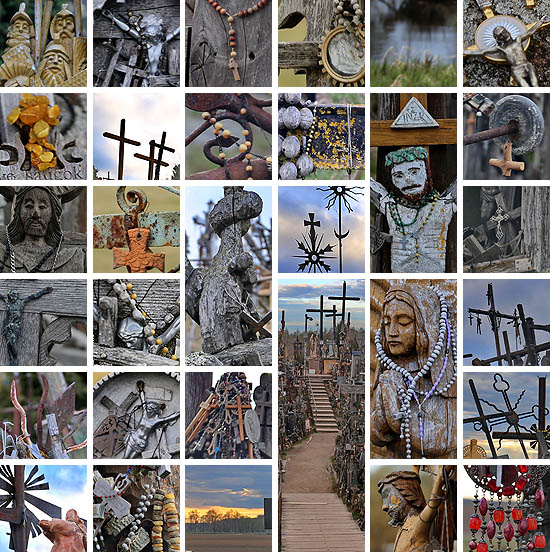
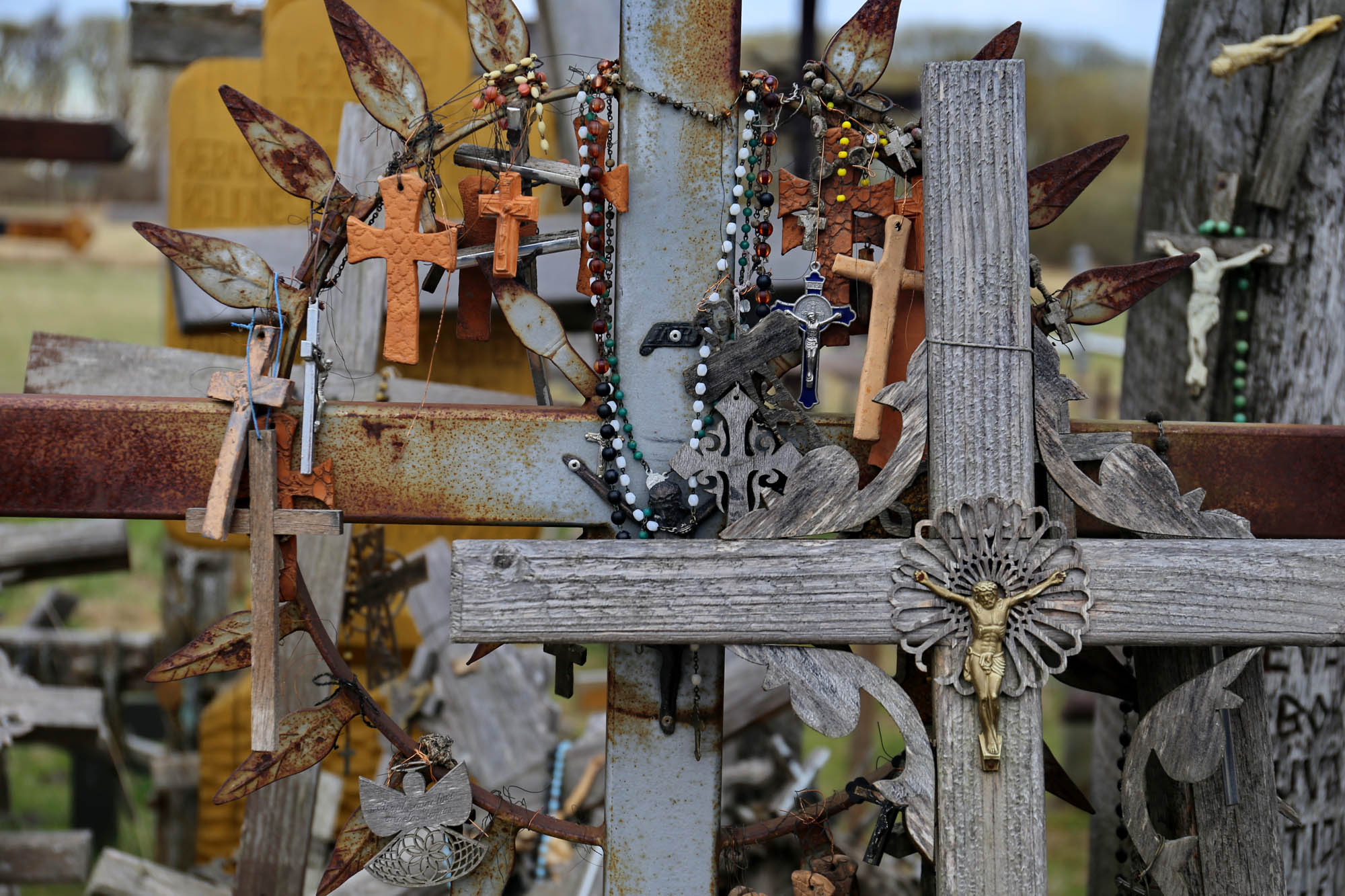
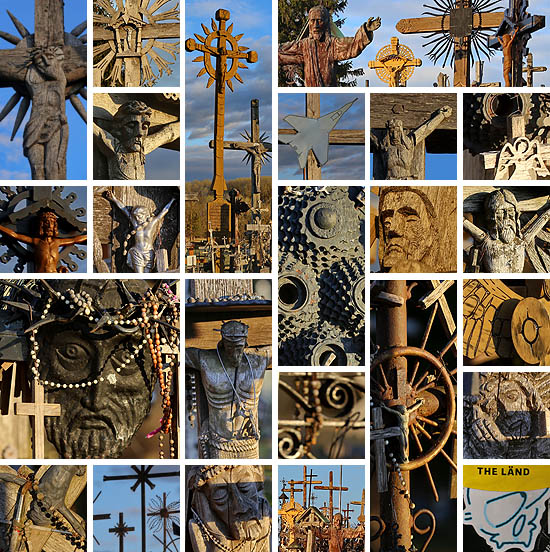
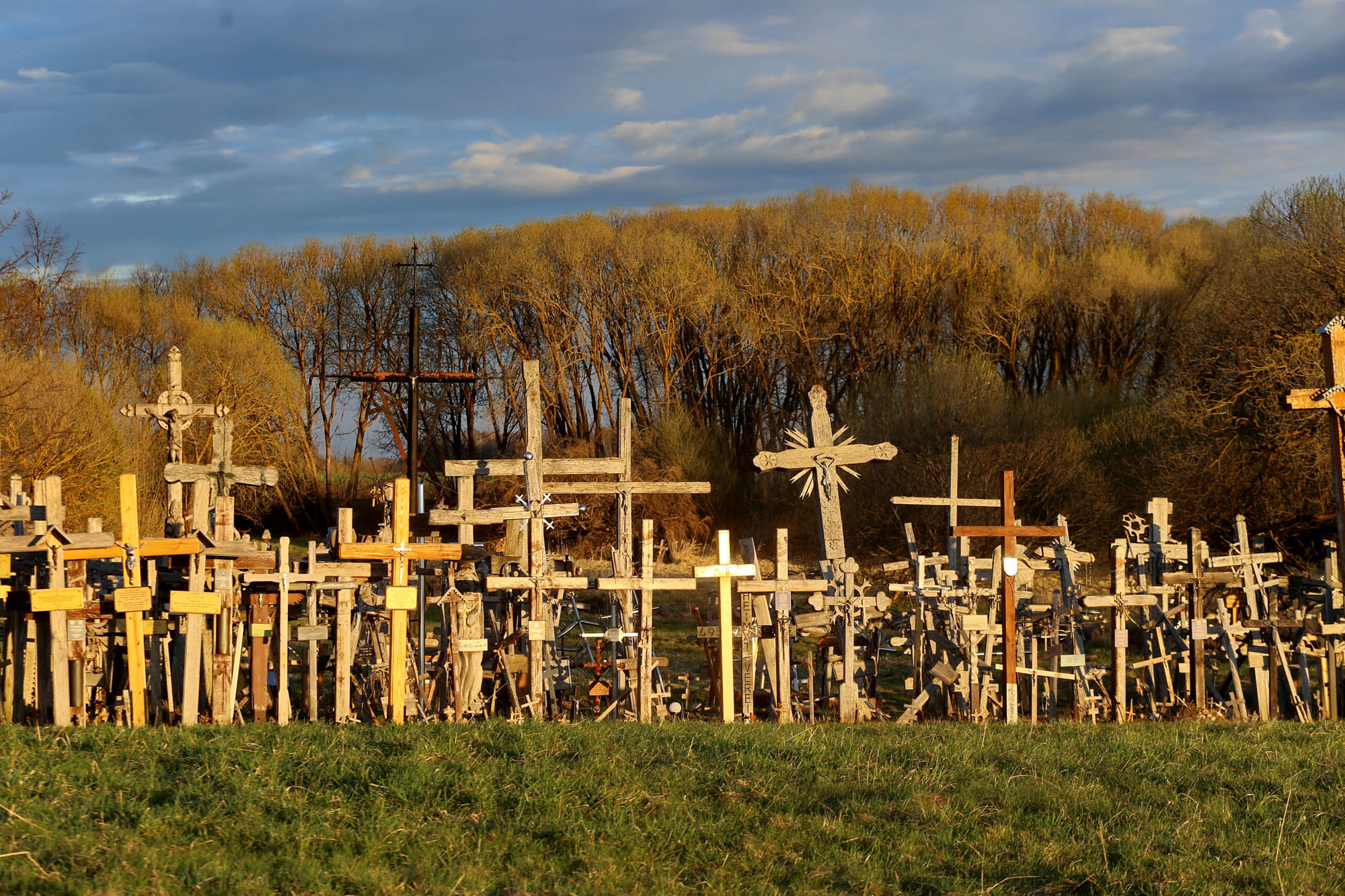
At first glance, the sheer number of crucifixes and corpus figures can feel almost overwhelming. But if you walk around for a while and start paying attention to the details, a rather distinctive aesthetic begins to emerge.
On one hand, there is the aesthetic of surreal juxtapositions of somewhat clumsy, rough-hewn folk objects — an aesthetic praised by Rimbaud as well, and one that generates a generous amount of unintended humor.
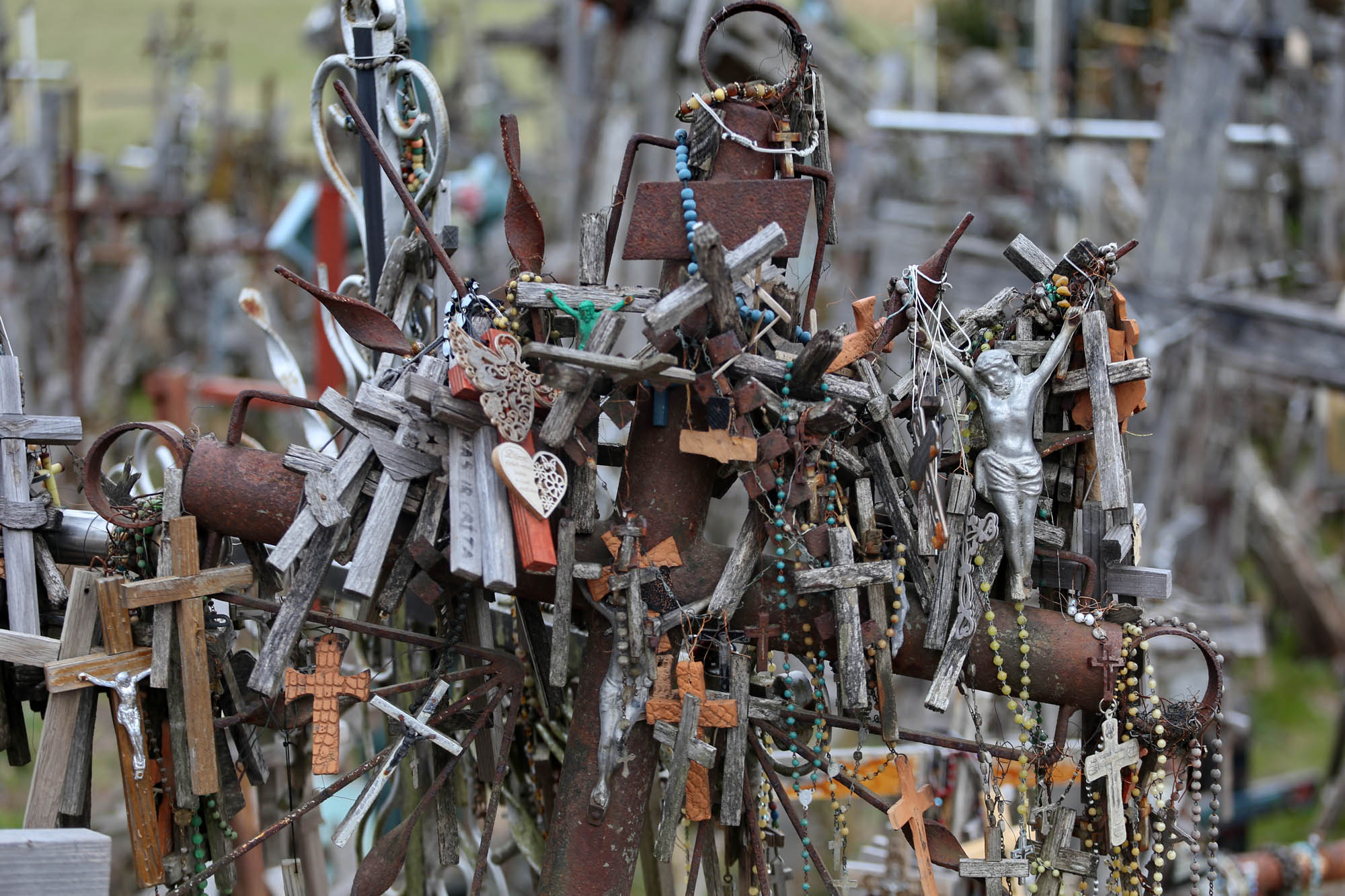
On the other hand, there is the aesthetics of abundance, excess, and endless repetition — or, in Eco’s phrase, “the infinity of lists,” which recalls the infinite accumulation of Wunderkammern; as if tens of thousands of crosses were just as many individual cries of complaint testifying to the infinity of human suffering; or as if, in a Sufi-like manner, tens of thousands of names were being used to circle around the one and unsayable Name of God.
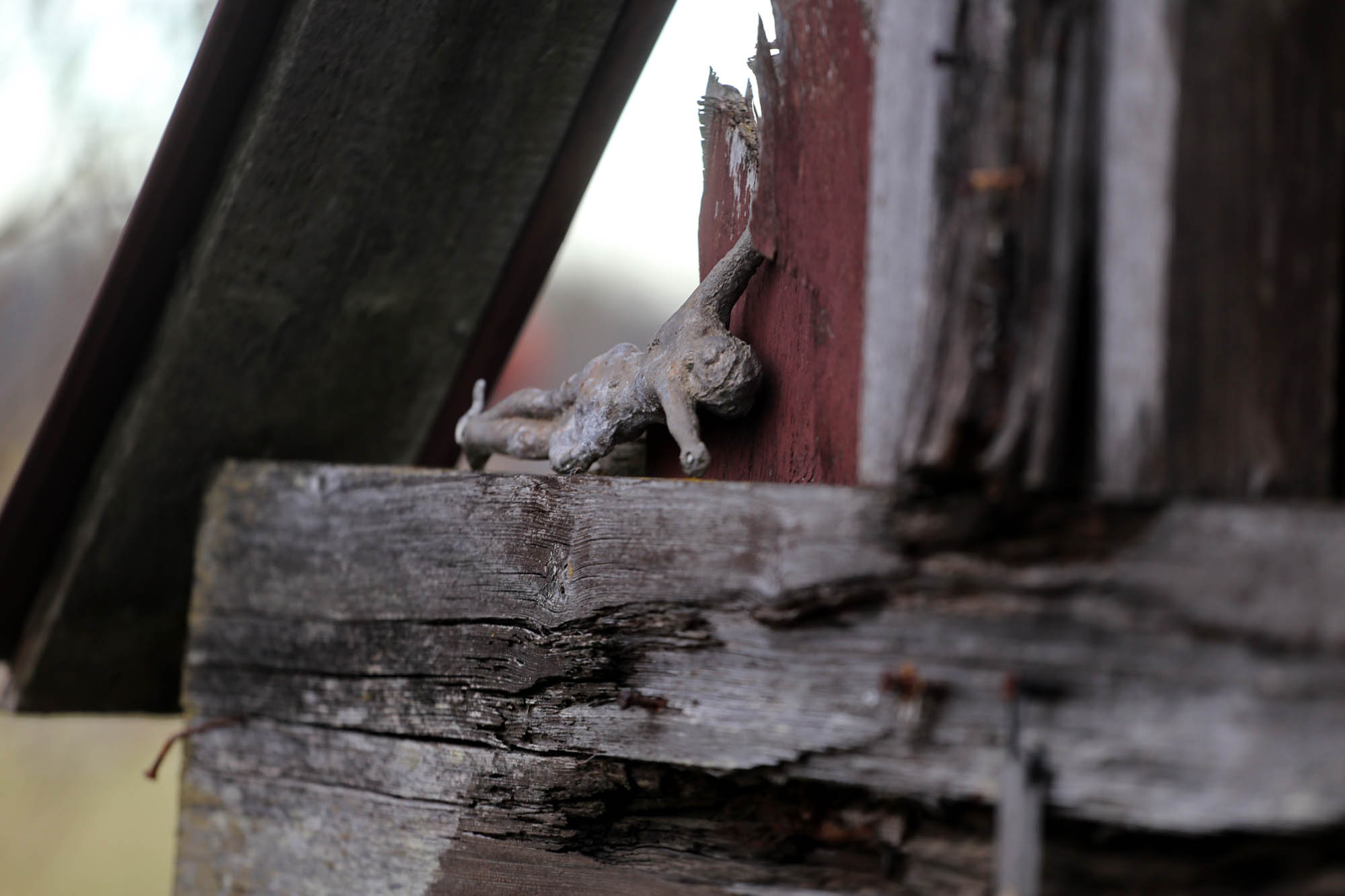
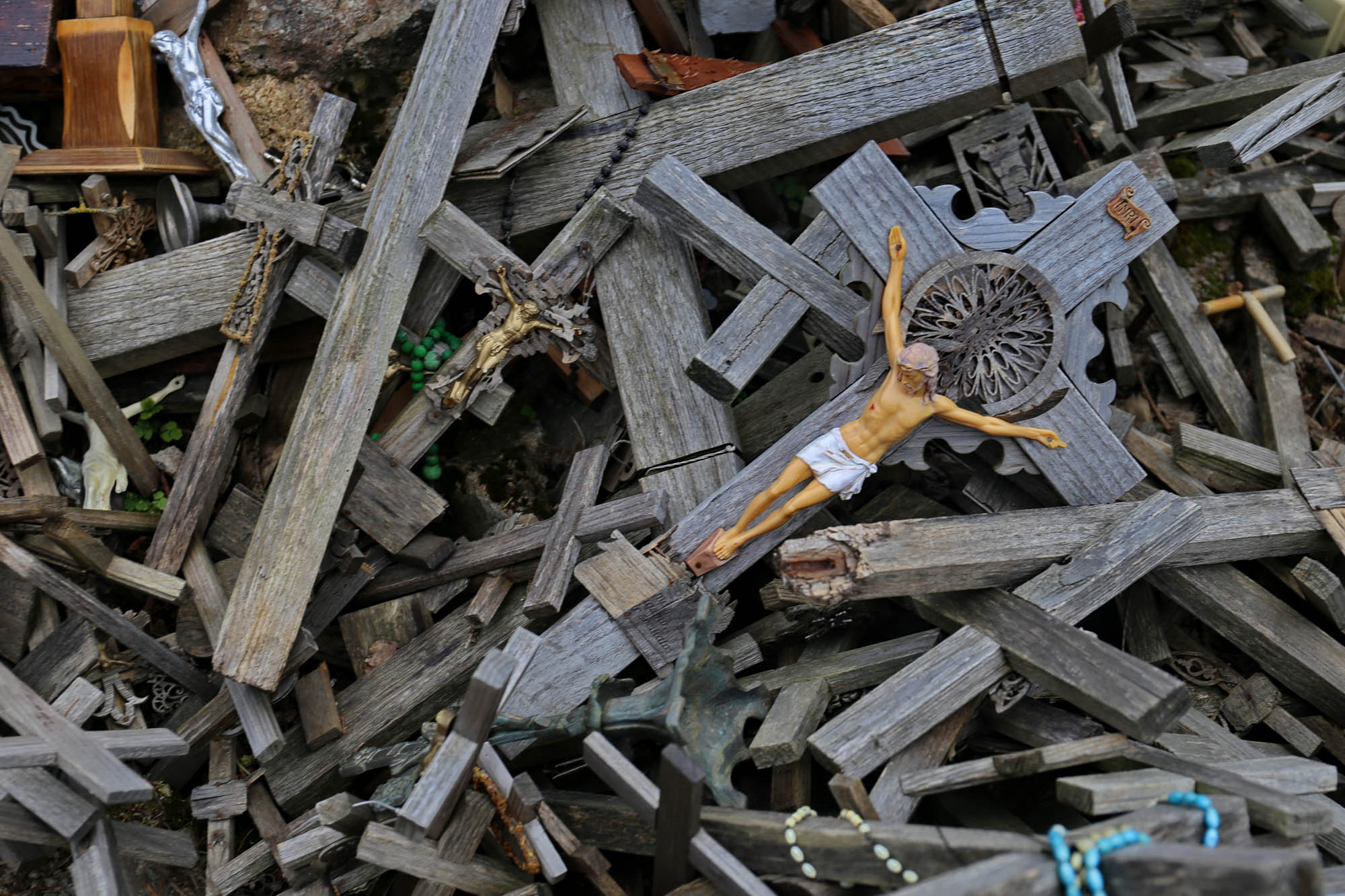
Also important is the interplay between large and small objects: the way tiny crosses are hung on larger crucifixes, becoming smaller and smaller until they dissolve at the base into a single decaying mass of cross-debris — as if we were zooming into a fractal, where no matter how deep you go, every level repeats the same pattern.
|
Oi, kalne, akmens ir vėjo,
Nebuvo čia kryžių, nebuvo ženklų,
Dabar stovi medžiai be šaknų,
Vėjas vaikšto tarp jų kaip dvasia,
Oi, kas sudėjo akmenį ant akmens,
Žemė neprisimena geležies,
Ir aš klausausi — kalnas tyli,
Oi, Kryžių kalne, svetimų ženklų kalne,
Oi, žmogau, tu, kuris statei ženklus,
Tu atėjai su geležimi ir malda,
Ir aš, kalnas, nesipriešinau tavo rankoms,
Kryžiai tavo stovėjo ant mano kūno,
Aš leidau jiems augti tarp savo akmenų,
Oi, žmogau, tavo vardai nesunaikino mano tylos,
Vėjas vis dar vaikšto tarp mūsų šakų,
Aš nebe skiriu seno ir naujo,
Oi, Kryžių kalne, sakau sau, |
Oh mountain, mountain of stone and wind,
There were no crosses here, no signs,
Now trees stand without roots,
The wind moves among them like a soul,
Oh, who placed stone upon stone,
The earth does not remember iron,
I am silent — the mountain is silent,
Oh Mountain of Crosses, mountain of foreign signs,
Oh man, you who set up the signs,
You came with iron and prayer, and the earth
And I, the mountain, did not resist your hand,
Your crosses stand upon my body,
I let them grow among my stones,
Oh man, your names did not destroy my silence,
The wind still walks among the trees,
I do not separate the old from the new,
Oh Mountain of Crosses, I say to myself, |
Oi toli toli mano (Oh, far, far away). Lithuanian folk song, sung by Elzė Griškevičiūtė



Add comment