

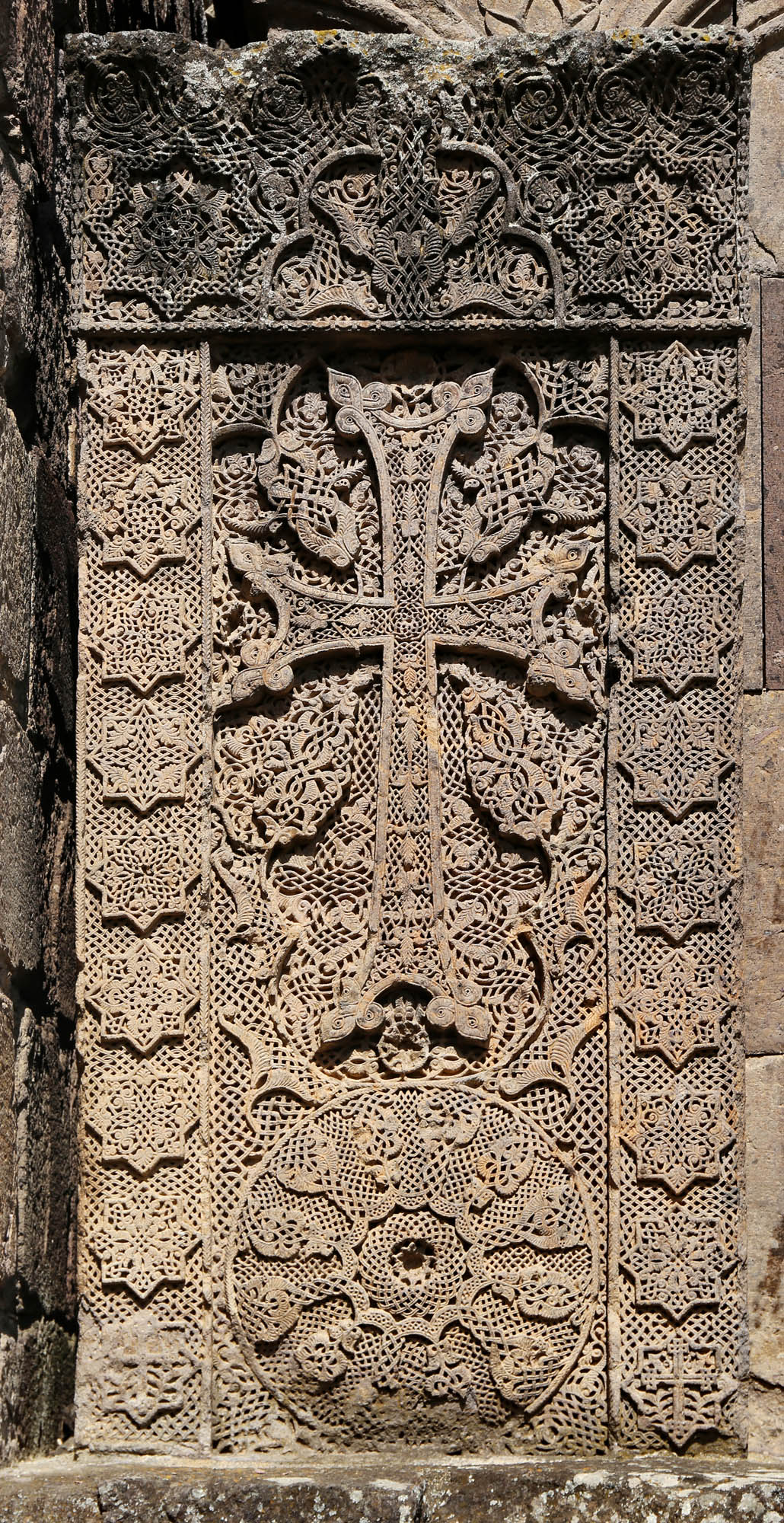
We have already seen how Master Vahram of Haghpat brought almost to perfection in the 1270s the “needle-carved” khachkar style first developed by Mkhitar at Sanahin in the 1180s. Yet his pupil Poghos surpassed even him with the Embroidered (Aseghnagorts) Khachkar erected in the nearby Monastery of Goshavank in 1291, regarded by Armenian art history as the technical pinnacle of khachkar carving.
The entire surface of the khachkar is covered with an endless lace-like pattern built from delicate geometric forms, stars, and polygons. Although the stone appears symmetrical, digital analysis has shown that among the tiny ornamental details there are no two identical motifs. Poghos designed every square centimeter individually.
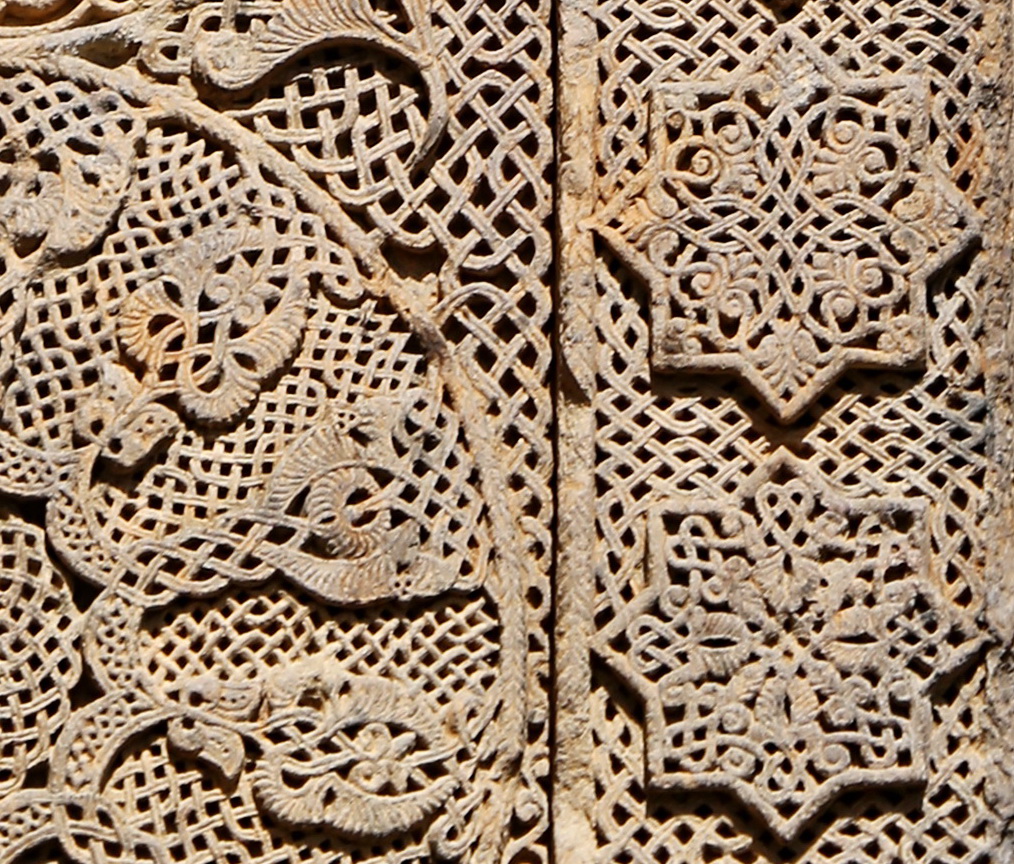
Like Mkhitar and Vahram before him, Poghos constructed the composition in several layers. The uppermost layer is the great cross itself, whose arms terminate in palm leaves. The second layer consists of the delicate chain of vines, grape leaves, and pomegranates running beneath and behind the cross, the rays of the circle of eternity, and the eight-pointed stars along the borders. The third is the microscopic lacework of the background, which appears almost black because of the shadows, making the cross and circle seem to float before the surface of the stone.
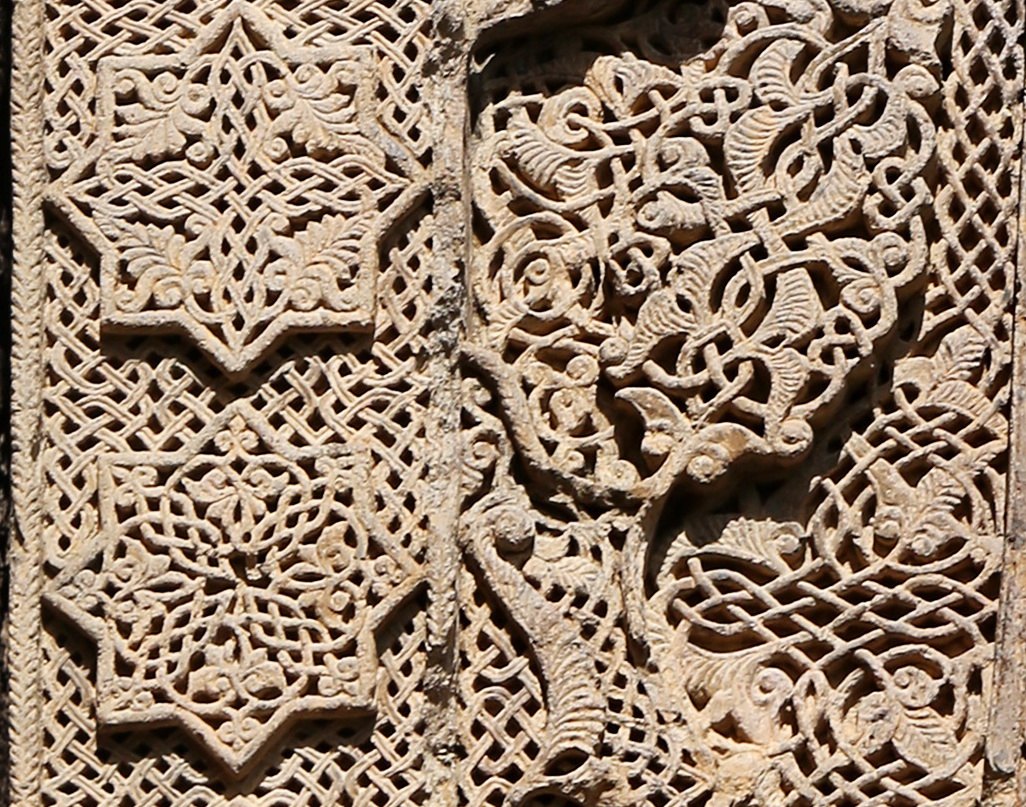
Poghos even undercut the lattice pattern so deeply that, viewed up close, it almost seems as though several layers of carved stone screens had been set in front of the block itself.
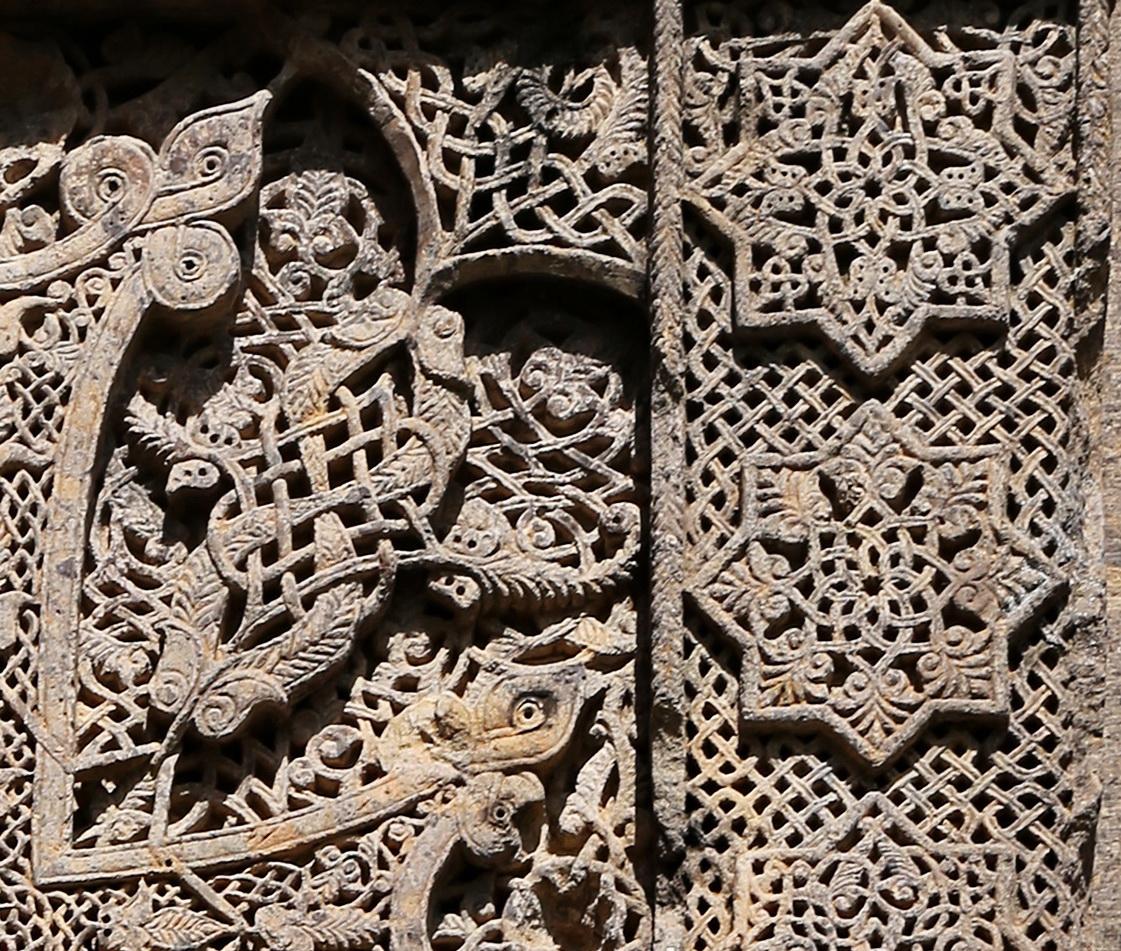
The “needle-carved” khachkars could only have been made from volcanic tuff, available in many different shades — Poghos worked here with a local brownish-green variety. Freshly quarried tuff still contains a large amount of moisture (“quarry dampness”), which makes it remarkably soft and easy to carve in extremely fine detail. After carving, the water slowly evaporates toward the surface, while dissolved silica crystallizes and acts as a natural cement binding together the volcanic ash particles. Calcium-rich compounds within the tuff also react with carbon dioxide and moisture in the air, gradually transforming into limestone. Together these processes create a hard weather-resistant protective crust on the stone’s surface, while the interior remains relatively soft and porous, giving the material flexibility against frost damage.
Once hardened, the protective layer of tuff has only one truly serious enemy — aside from the pickaxes of the Azerbaijani army: acid rain. Acid slowly dissolves both the outer crust and the limestone structure that strengthens the stone from within, causing the surface to crumble away. Sulfuric and nitric acids transform the limestone into gypsum, which traps surrounding dust and sand particles, creating a dirty blackish layer that eventually begins to blister and peel away in shell-like flakes. This process is visible at the very top of the Embroidered Khachkar, whose projecting upper section protects the rest of the monument from rain and is therefore itself the most exposed to weathering.
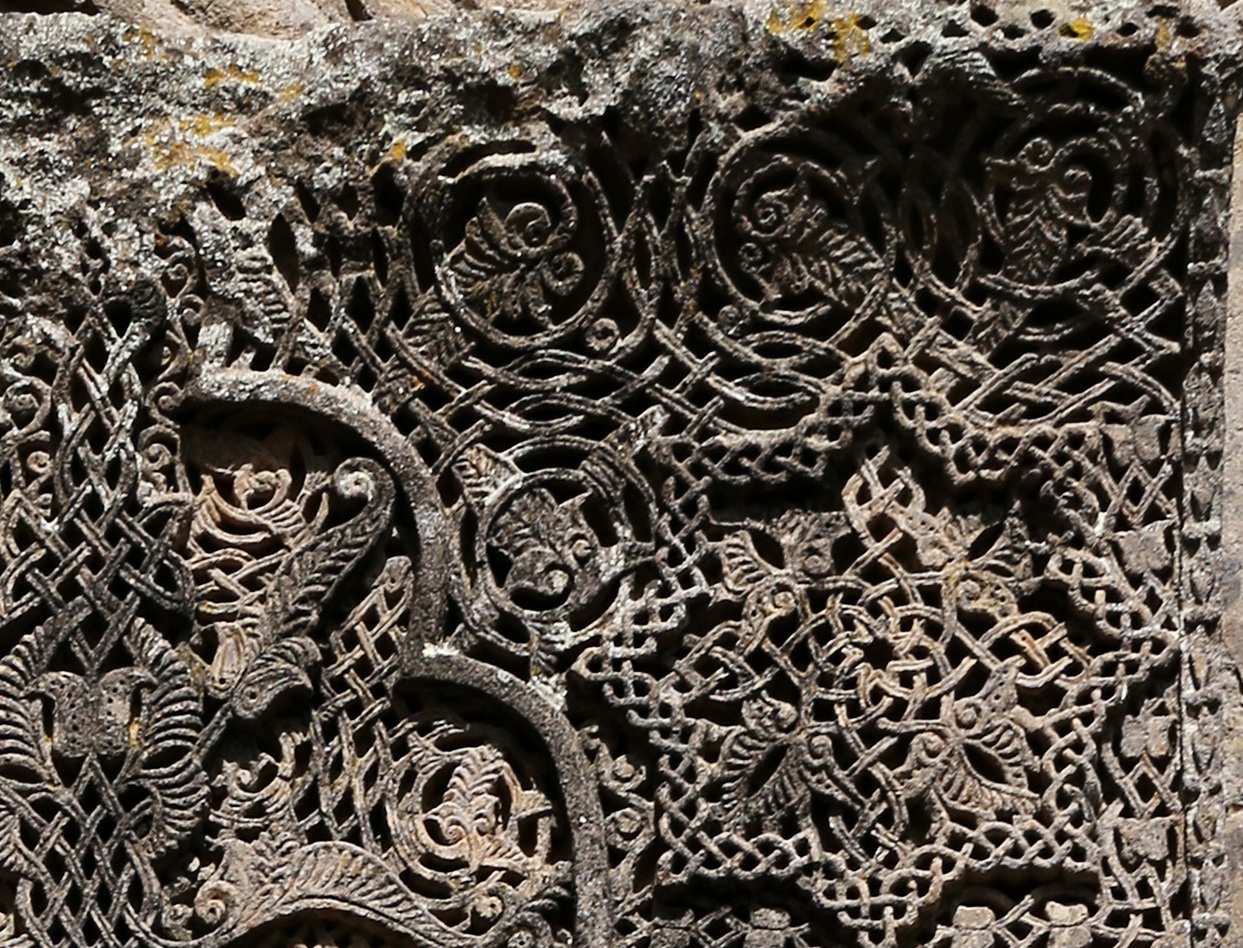
This is also why, although Poghos carved two Embroidered Khachkars, which were originally erected on either side before the main church of St. Gregory the Illuminator at Goshavank Monastery, one of them was already transferred in 1935 to the History Museum of Yerevan, while the other — the one shown in these photographs — was treated with a special silicate-based protective coating that repels water while still allowing the stone to breathe.
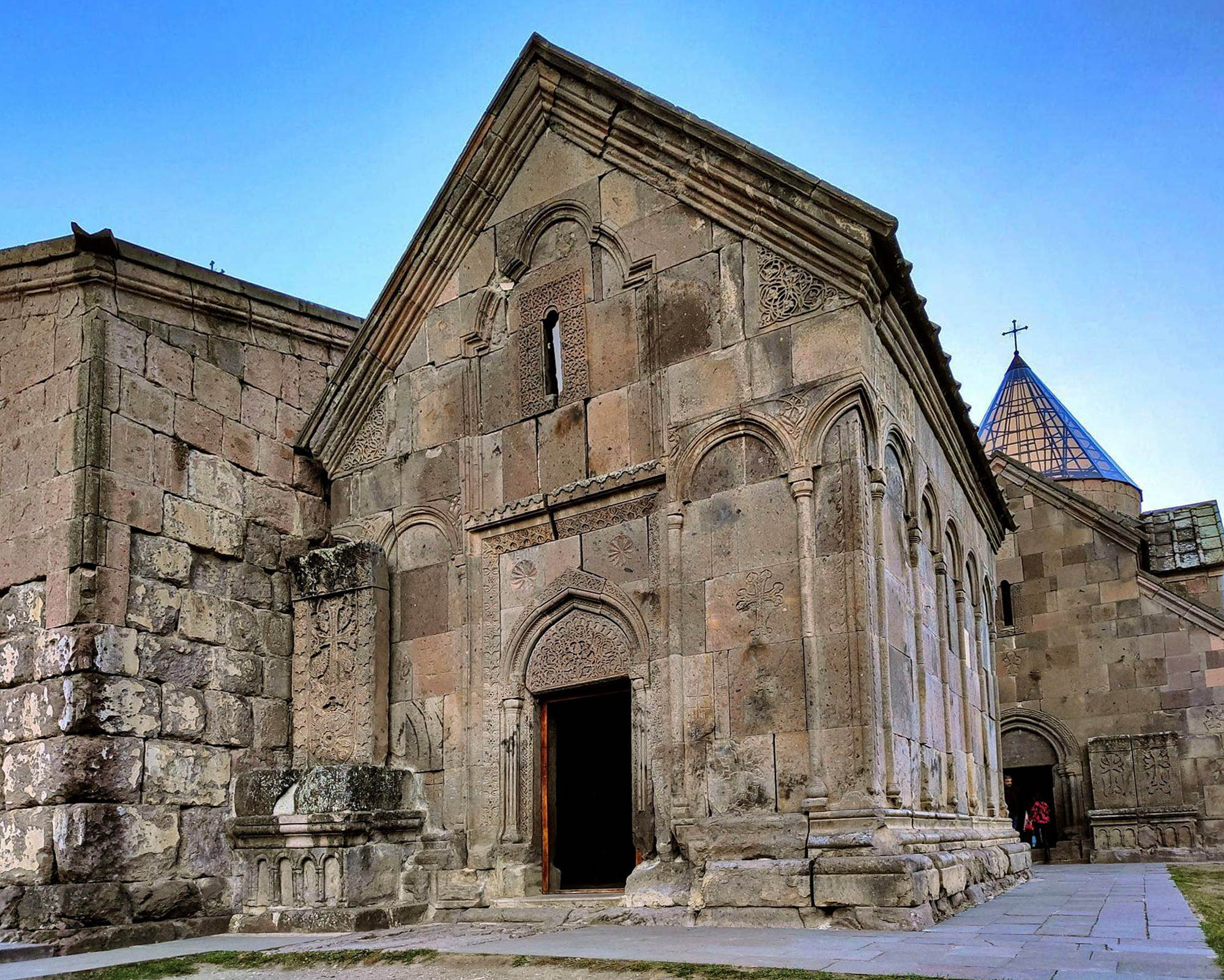
It is hardly surprising that one of Master Vahram’s pupils from Haghpat came to Goshavank to carve a khachkar. After all, the great scholar who founded this monastery in 1188 — Mkhitar Gosh — had himself come from Haghpat.
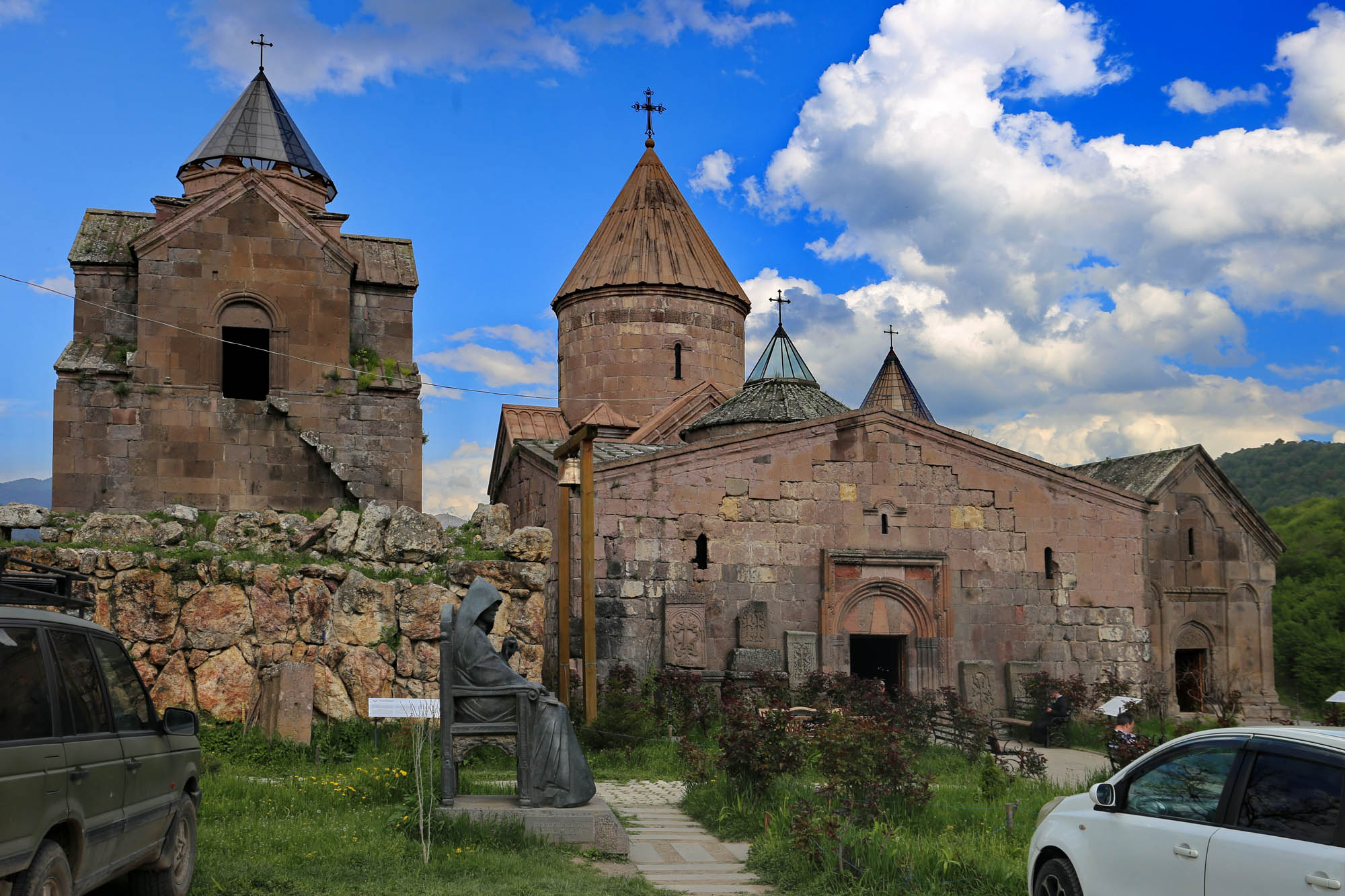 Statue of Mkhitar Gosh before Goshavank Monastery
Mkhitar Gosh (c. 1130–1213) was born in Gandzak, today’s city of Ganja in Azerbaijan. After completing the monastic academy of Haghpat, he received the title of vardapet (doctor of theology / church teacher). He then traveled to Cilician Armenia, to Mount Amanus (Ἄμᾱνος) above Antioch — known in medieval Armenian as Sev lerner, “Black Mountain,” and today in Turkish as Nur Dağları, the “Mountains of Light.” Until the end of the Crusades, this region sustained an intense monastic life comparable to that of Mount Athos today, until the emir of Aleppo exterminated the monks of Amanus, which Muslims referred to simply as Gâvur Dağ, “the Mountain of the Infidels.” Greek, Armenian, Syriac, and Frankish monks lived side by side here, creating an extraordinarily broad intellectual horizon in the local monastic academies — something unimaginable in the more conservative mountain monasteries of northern Armenia.
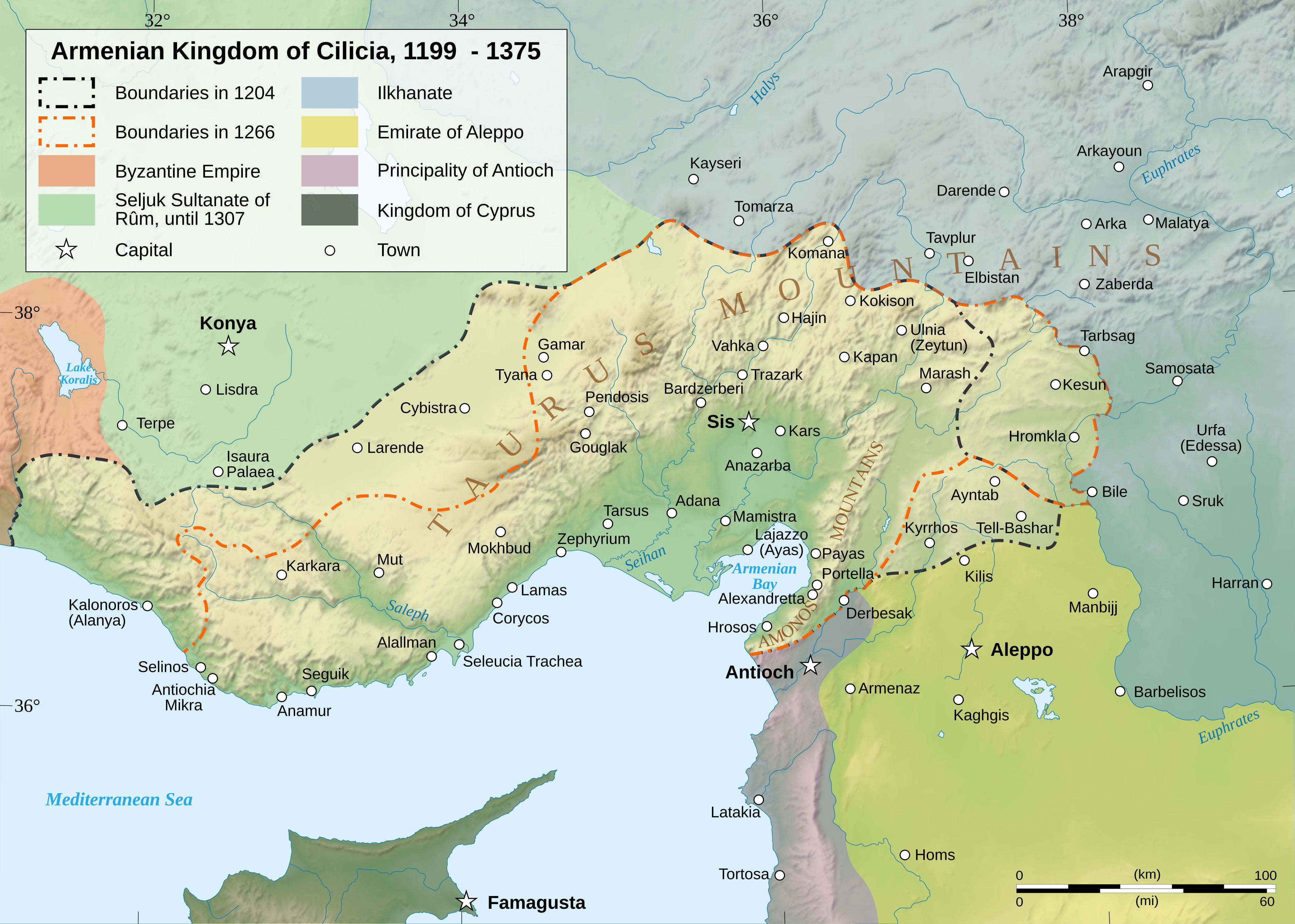
In order to study at the academy there, Mkhitar concealed the doctoral title he had already earned at Haghpat — meaning that after graduating, he effectively became a vardapet twice over. It was here — most likely in the rich library of the Armenian Monastery of Castana and in the Byzantine legal courses taught at the Greek-Syriac Monastery of Barlaam — that he encountered the Byzantine Nomokanon legal collection and Armenian translations of the ancient Greek philosophers.
Returning to Haghpat, he entered the service of the Zakarians, and in 1184, at their commission, compiled the Datastanagirk, the first Armenian secular and ecclesiastical law code.
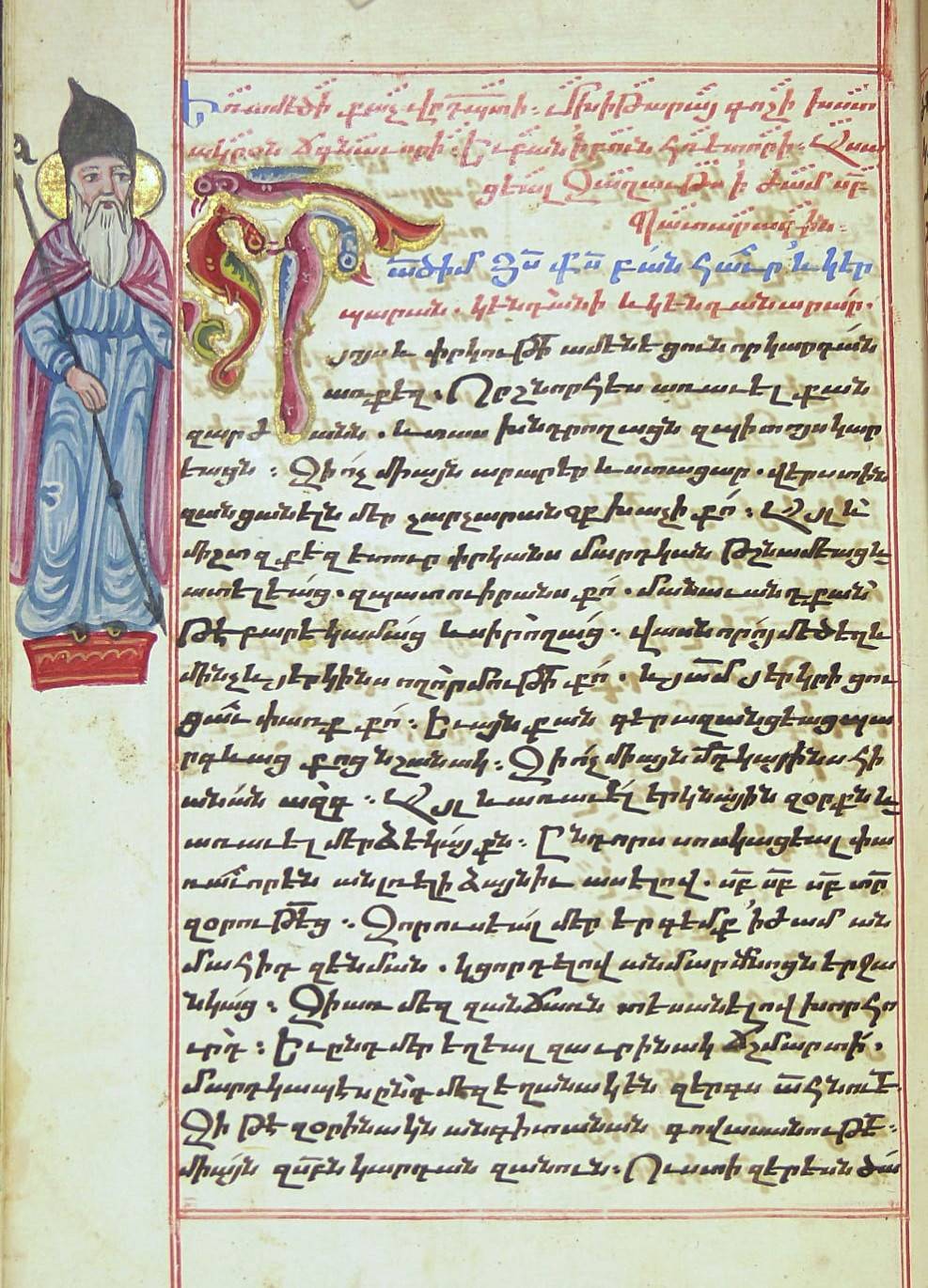 Portrait of Mkhitar Gosh in the earliest surviving complete manuscript of the law code, dated 1295 (Matenadaran, MS 484)
The book spread throughout the Armenian world to such an extent that the kings of Poland officially approved it for the Armenian communities invited into eastern Poland — especially Kamianiec Podolski and Lwów — who continued to live according to its regulations until the partition of Poland in 1772. This is why Mkhitar is most often depicted holding the scales of justice in one hand.
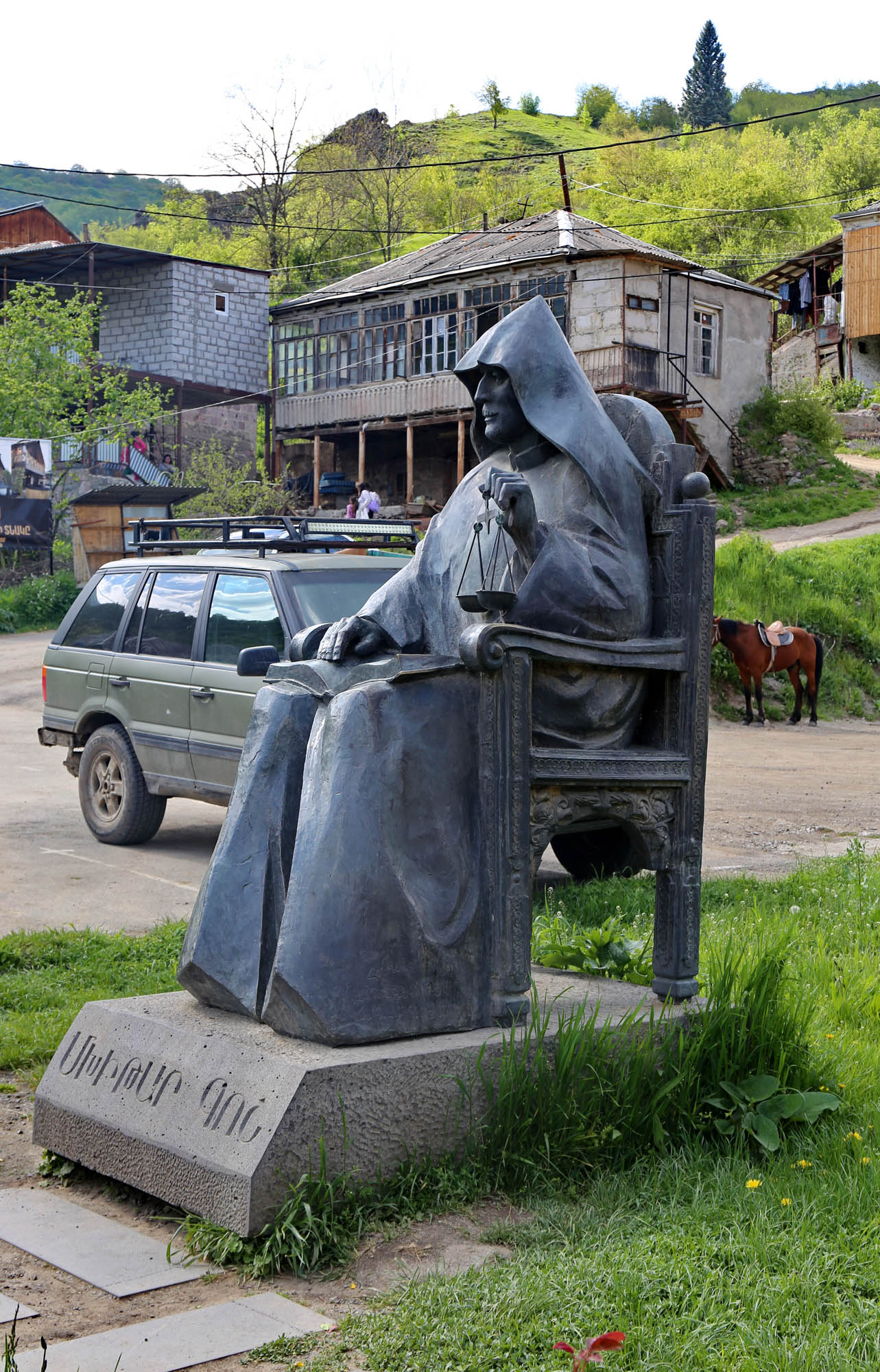
As we can see in the statue standing before the church at Goshavank, Mkhitar did not have a beard — quite unusual for a medieval monk. He did not shave it, which would have been considered improper, but simply could not grow one. From this came the nickname “Gosh,” meaning “bare-chinned.” He made the name so famous that even the original name of the village and monastery, Nor Getik, was eventually replaced by it — Goshavank literally means “the monastery of Gosh.” Even the nearby wine of Ijevan, considered one of the finest in Armenia, was named after him.
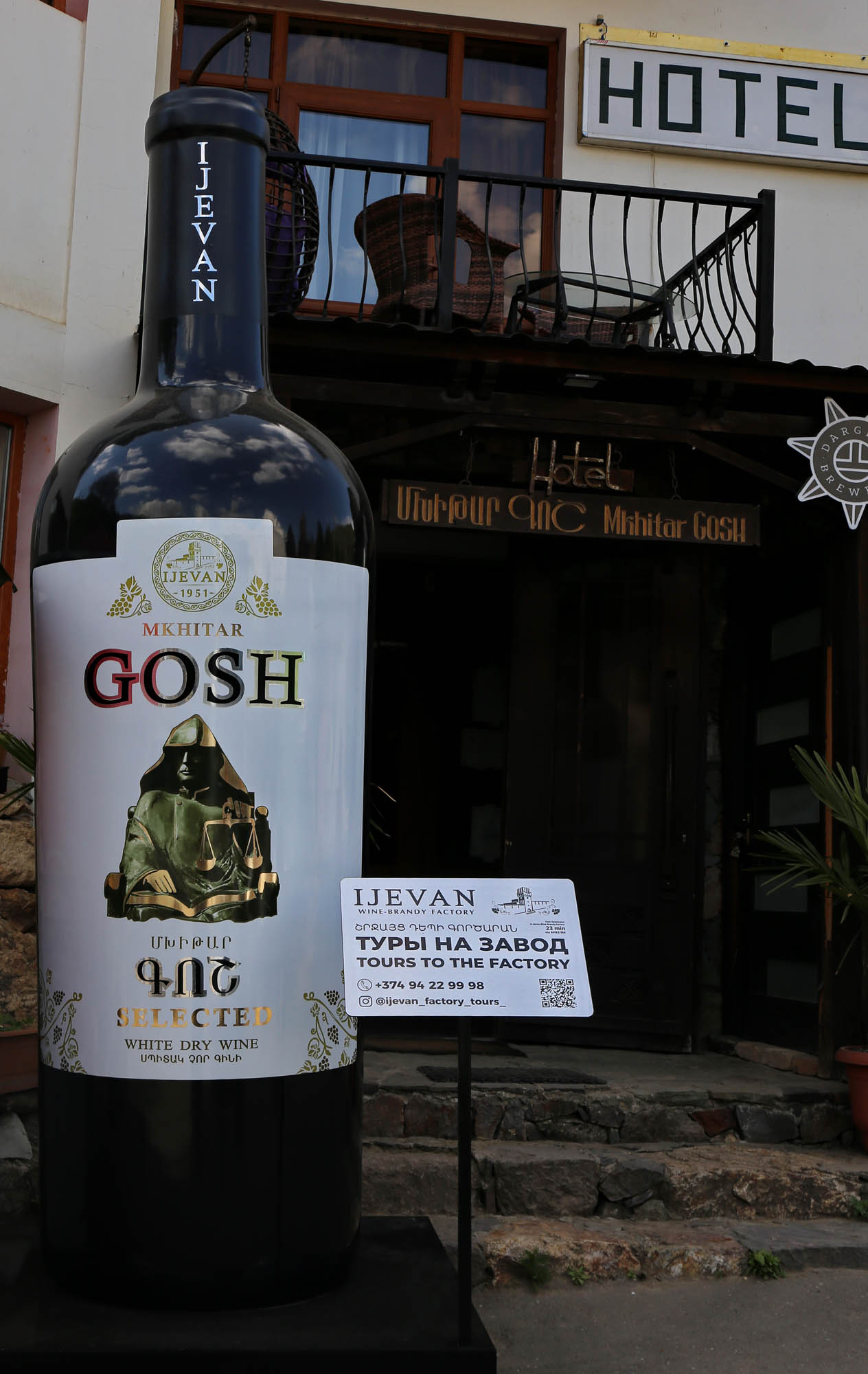 In wine, there is truth
The Datastanagirk contained provisions that were considered remarkably liberal for its age: it prohibited the blood feuds common in the Armenian mountains, rejected corporal mutilation as punishment, and protected serfs from abuses by their lords. It forbade the forced marriage of girls and declared such marriages invalid. It imposed severe penalties for domestic violence and allowed abused women to seek divorce, including legal division of property. It gave particular protection to pregnant women, as well as to female honor and dignity. The code even included regulations concerning animals and nature: harsh punishments were prescribed for overworking or mistreating domestic animals, or neglecting their care. It was also among the first legal texts to forbid hunting during breeding seasons, the killing of useful wild animals, and the cutting down of fruit trees.
But Mkhitar was also an outstanding teacher, and wrote a book intended for a wider audience: the Arakkh (“Fables” or “Parables”), a collection of animal stories. Drawing partly on ancient fables and partly on Armenian and other Eastern traditions, he reworked each tale and added a moral interpretation.
The lion, the bear, and the fox made an alliance and went hunting together in the forest. They managed to bring down a huge buffalo, a wild boar, and a fat hare.
After piling the prey together, the proud lion looked at the bear and commanded: “Divide the spoils among us fairly, according to what each deserves!”
The bear bowed and replied: “My mighty king, the judgment is simple. The great buffalo belongs to you, for you are the strongest among us. The boar shall be mine, since in strength I come after you. And the little hare should go to the fox, for he is the smallest.”
When the lion heard this, he flew into a terrible rage that the bear had dared to divide the spoils as though he were an equal partner. With one mighty blow of his paw he struck the bear dead.
Then the lion turned to the trembling fox and said: “Now you divide the prey.”
The fox bowed deeply and answered: “My lord, let the buffalo be your majestic breakfast, to give you strength for the day. Let the boar be your rich midday meal, to nourish your noble body. And let the little hare be your light evening supper before you rest.”
The lion nodded with satisfaction and asked: “O wise fox! Who taught you to divide things with such perfect justice?”
The fox pointed toward the lifeless body of the bear and whispered: “The bear, my lord.”
Gosh’s interpretation:
“This tale teaches the weak and the humble to learn from the downfall of the reckless and the foolish. The bear grew arrogant and forgot that one cannot demand equal rights before earthly rulers and kings without placing oneself in danger.
The wise man does not wait until he himself feels the wrath of power upon his own skin. Instead, he walks through the world with open eyes, observing the downfall of the proud and rebellious, and draws caution and humility from the misfortunes of others in order to preserve his own life and peace. For wisdom lies not only in speaking the truth, but also in knowing when to speak, and before whom.”
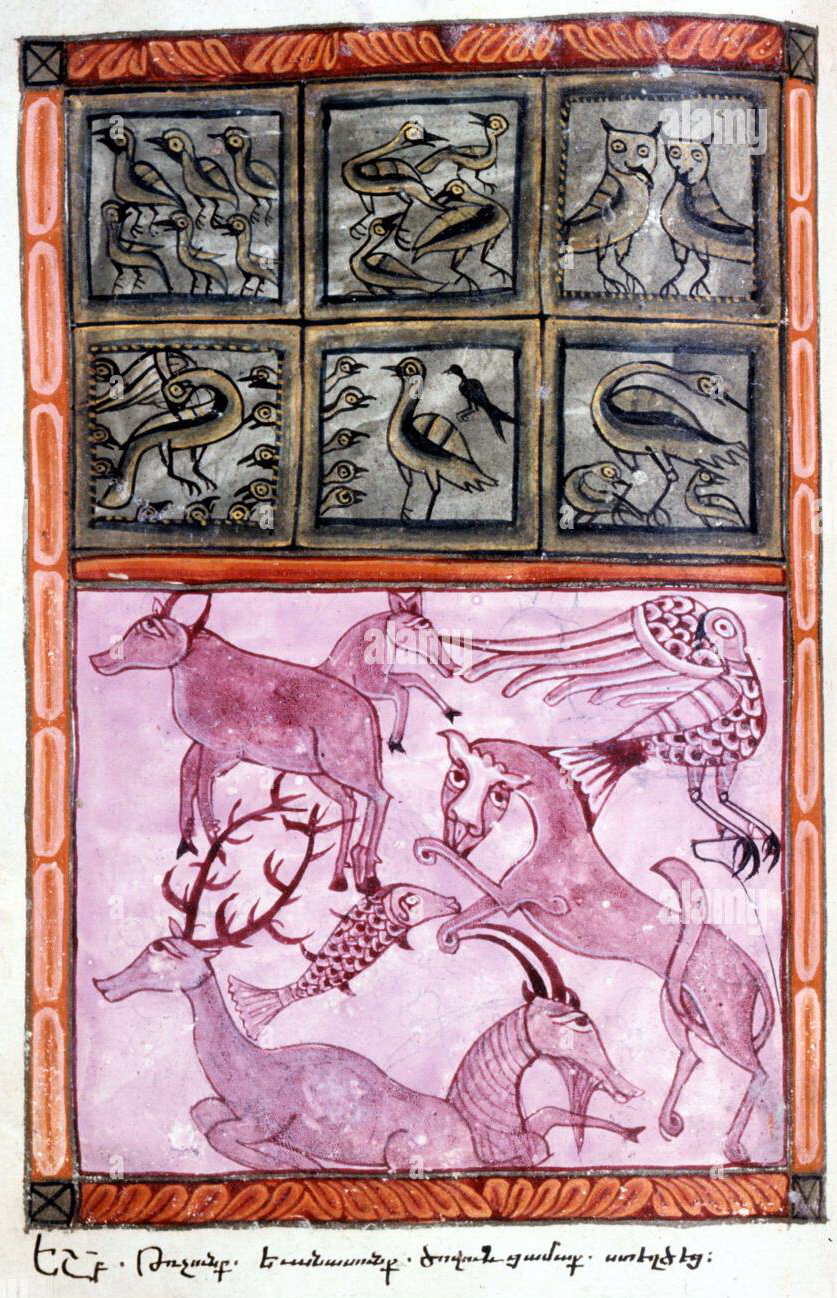 The Creation of the Animals from a 1587 Armenian Gospel manuscript from Vaspurakan. Matenadaran, MS 3083
The book became a basic textbook in medieval Armenian schools. Students learned not only reading and composition from it, but also rhetoric: pupils would take on the roles of the animals and argue their positions — the bear defending the justice of equal division, while the fox arguing that caution was the highest virtue.
Since the future judges, diplomats, and princely advisers of Armenia were educated in the monastic academies, stories of this kind deeply impressed upon them not only what the ideal world should look like — as described in the law code — but also what the real world was actually like, and how a wise person ought to live within it. The fable above, for example, taught future Armenian diplomats how to negotiate intelligently and cautiously with powers far stronger than themselves.
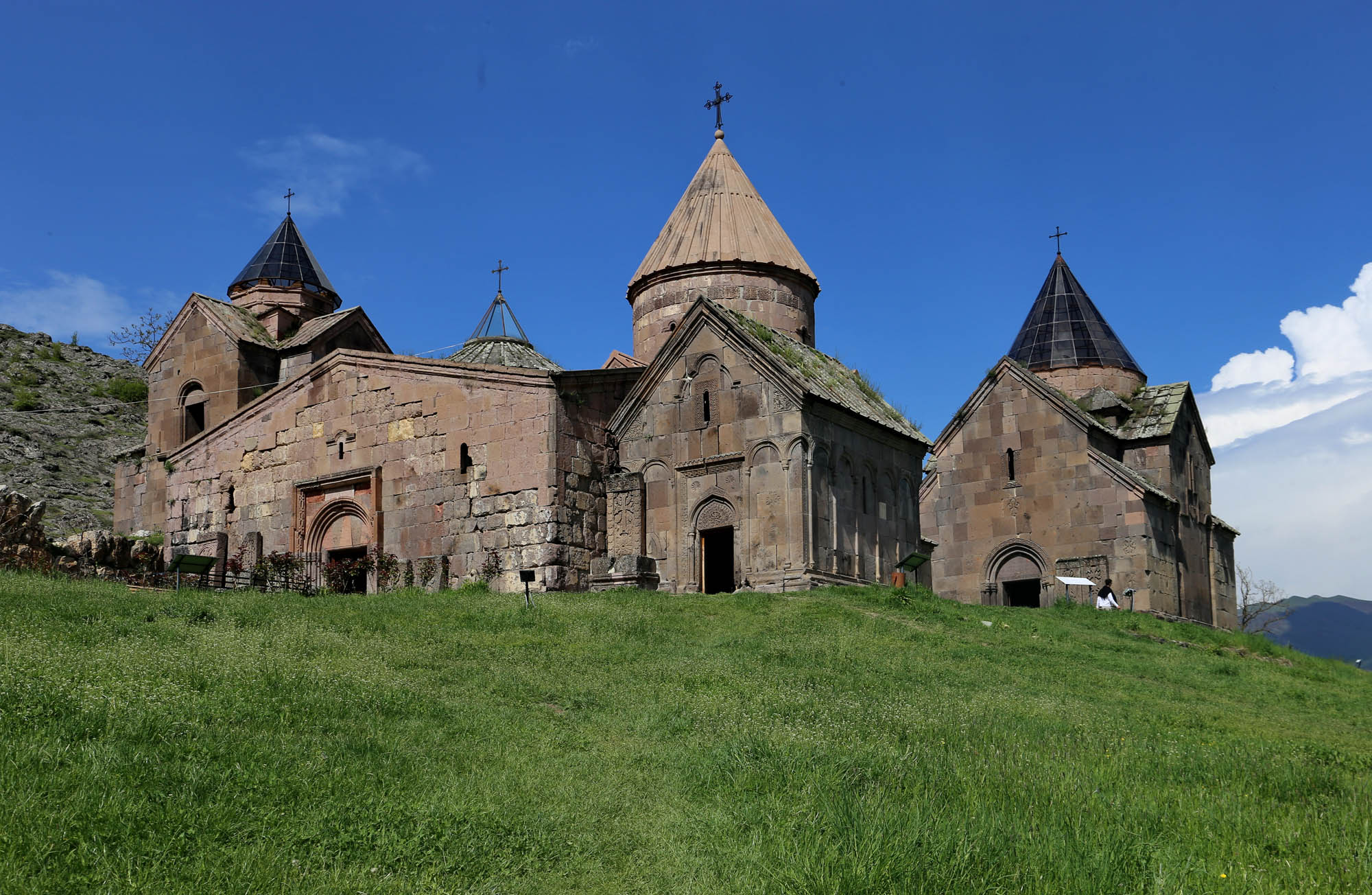
When the monastery of Nor Getik collapsed in an earthquake in 1188, Mkhitar saw the moment as the perfect opportunity to found an independent academy. With the permission and financial support of the Zakarians, he rebuilt the monastery — which soon became the most important center of learning in 12th–13th century Armenia.
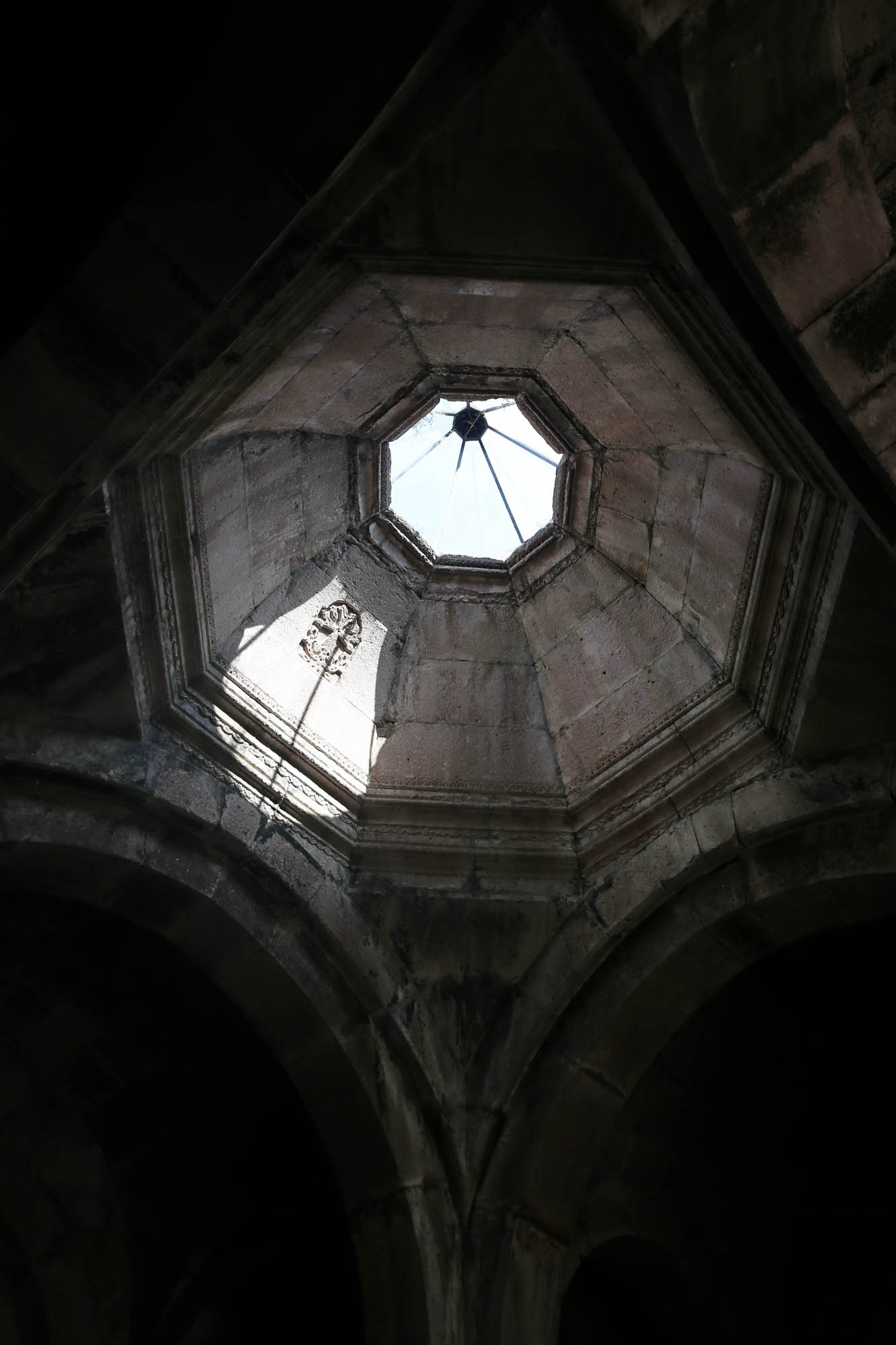
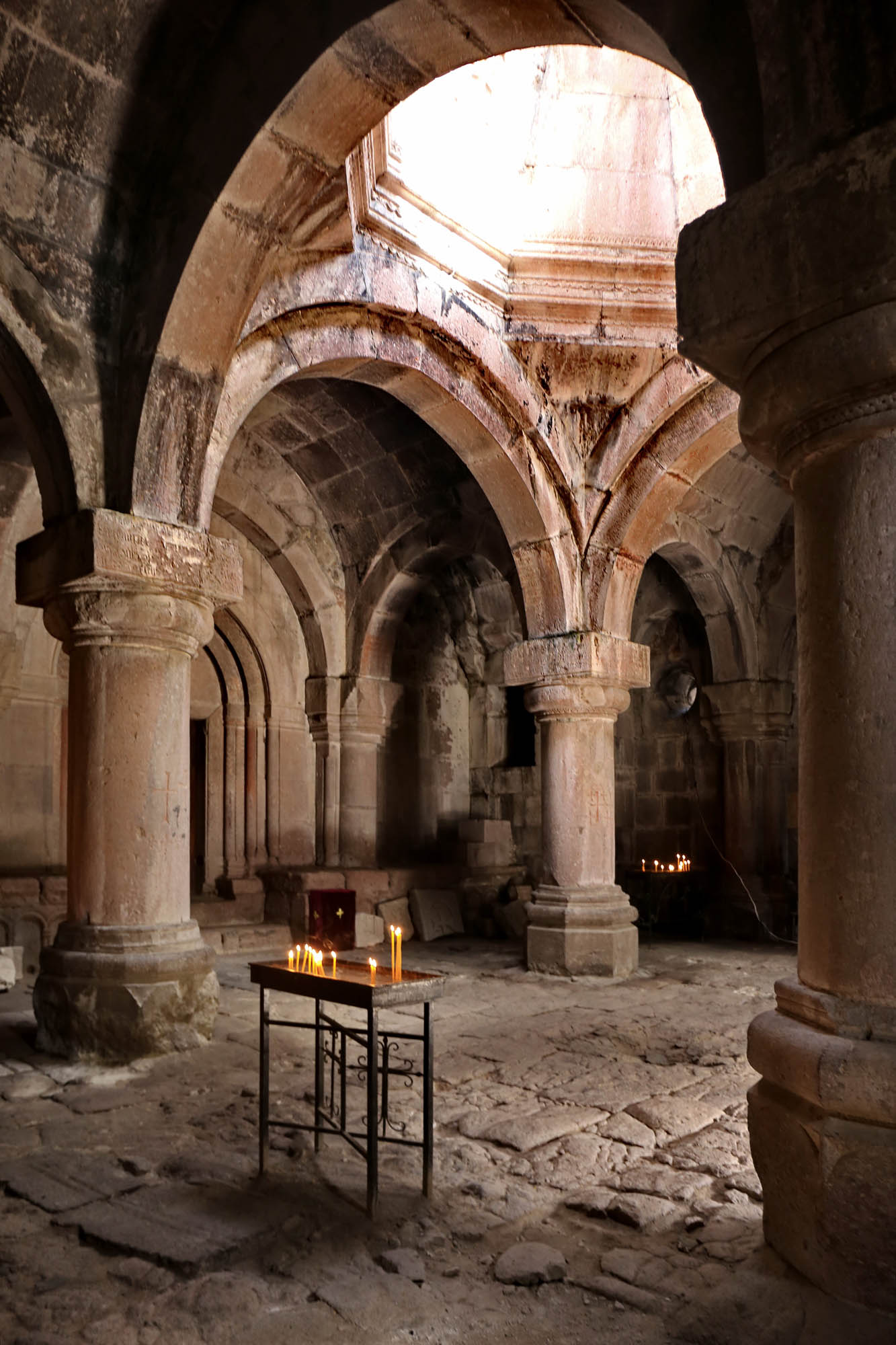 The gavit of the main church at Goshavank
The teaching at the Goshavank academy was revolutionary for Armenian jurisprudence. Previously, disputes had generally been settled ad hoc according to local custom; Gosh’s students, by contrast, issued judgments based on precedent and systematic legal structures. The Armenian legal culture that emerged from this played a crucial role in preserving Armenian identity during the centuries when the Armenians lived without an independent state.
Gosh himself loved this place so deeply that when he felt his death approaching, he had a small Holy Spirit chapel built for himself on the hillside beside the monastery. At his own request, he was buried there as well, so that he might forever look down upon the walls of the school he had founded.
Komitas Vardapet: Der Voghormia (Lord, have mercy), performed by George Livanos (2024)
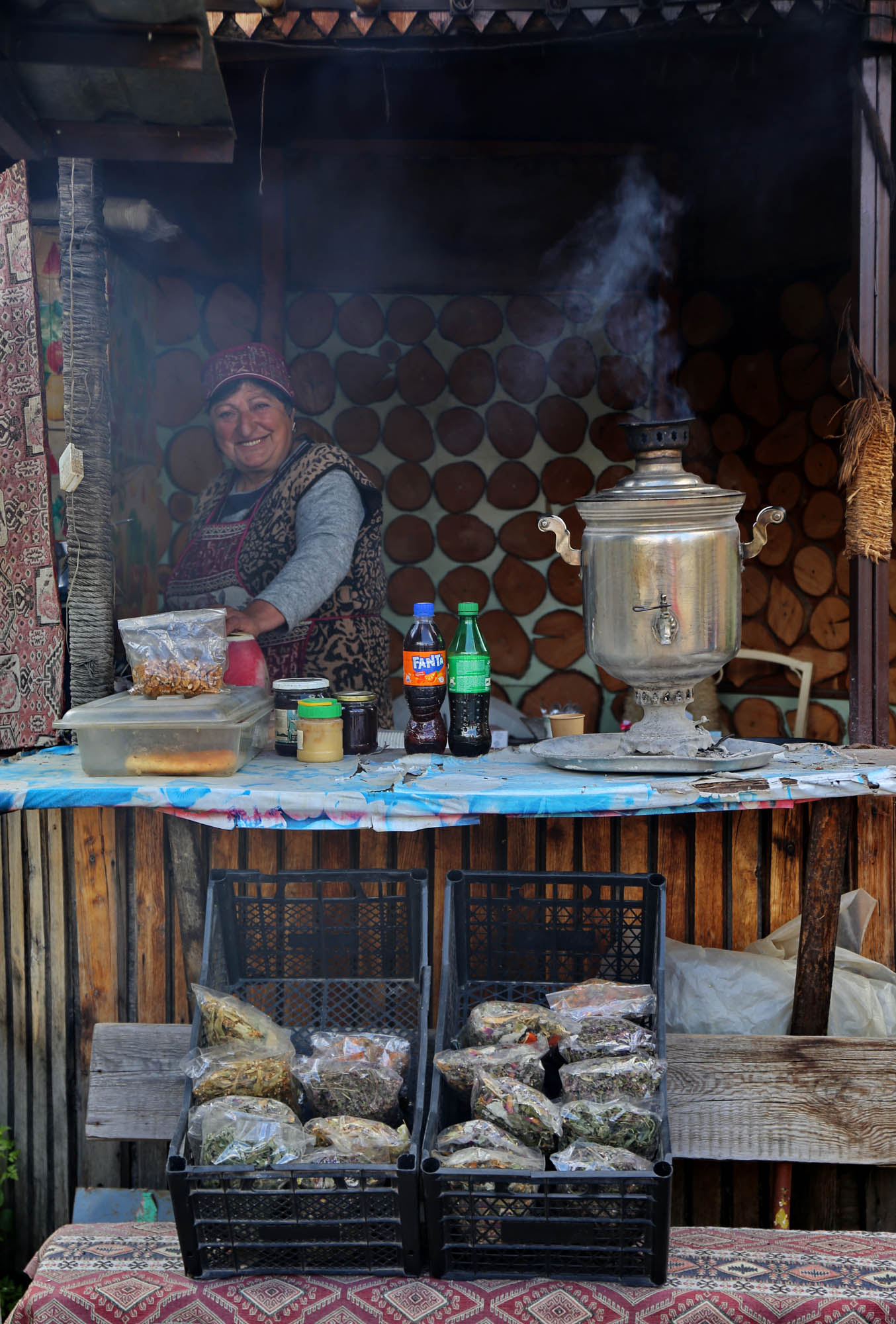 Tea house at the foot of Holy Spirit Hill, with the most perfect view of the monastery



Add comment