

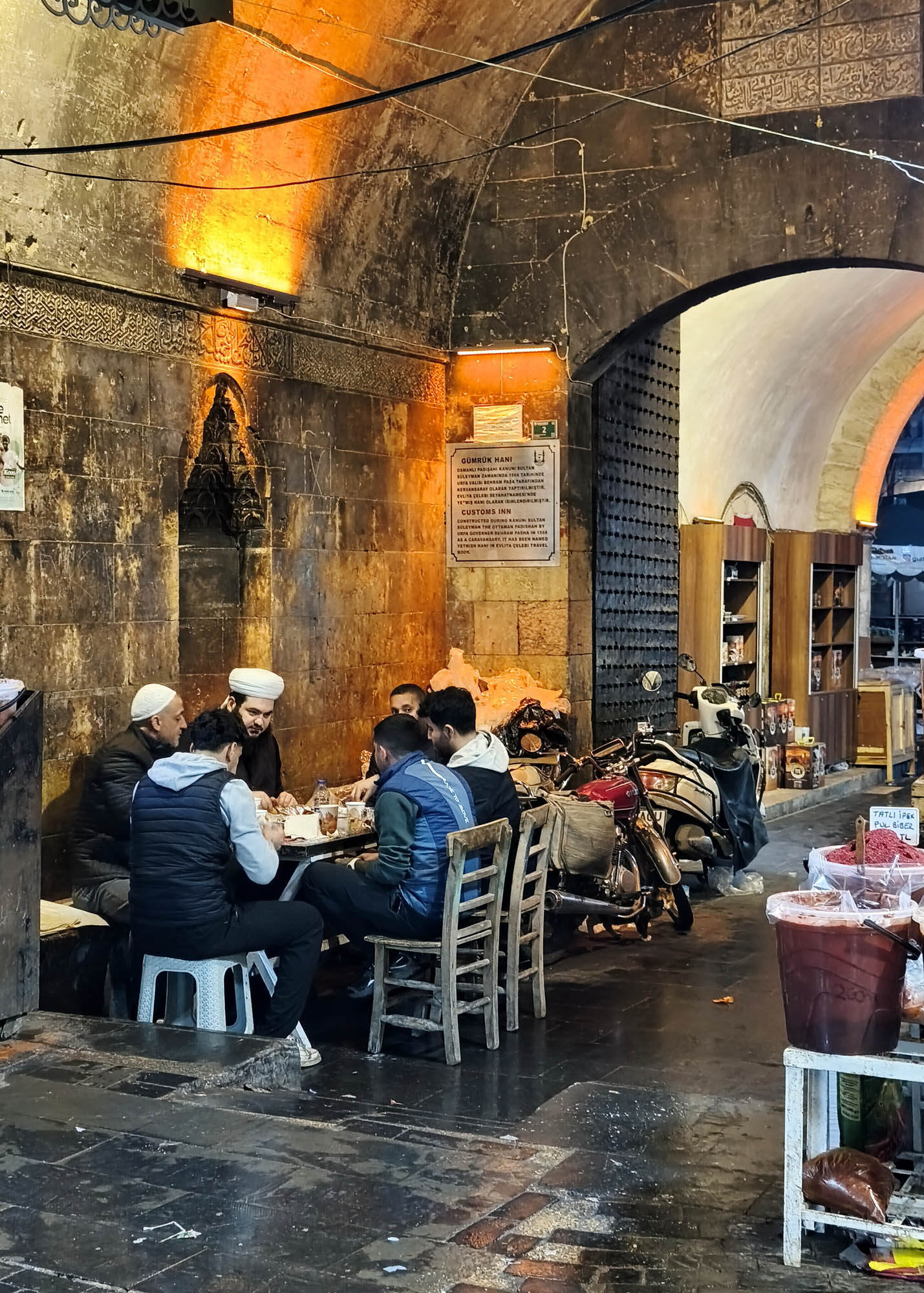
In the Urfa bazaar, people are eating. Not just casually, for pleasure—but as if it were a matter of life and death. At every corner, in every shop and in front of every stall, in every passageway, makeshift tables have been laid out; around them sit shopkeepers, assistants, and customers alike, all eating with complete dedication. It is the last day of Ramadan, the moment to break a day of fasting with a quick rescue meal before the bazaar closes and everyone returns home to gather around the family table and celebrate Eid al-Fitr, the feast of breaking the fast.
As we walk through the bazaar, here and there people beckon us over, offering a bite or even a whole plate. We thank them with an “İyi bayramlar”—happy holidays—and they light up completely at hearing it from giaours.
At the end of the bazaar there is an umbrella seller. I really have to buy a small, foldable umbrella from him—one that fits into a bag—because it’s still raining in Mesopotamia, and the previous one was torn apart by the steppe wind on the hill of Karahantepe. He only has two small ones: a red and a black. I want the black one, but it turns out that it’s his own—he won’t sell it. So I buy the red one instead, and say goodbye with an “İyi bayramlar.” He reacts as if struck by lightning, lifts his head, breaks into a wide smile, and returns the greeting. We walk on for maybe a hundred meters when his young assistant calls out to me from behind. I turn around—he’s holding out the black umbrella: the master will swap it for the red one. İyi bayramlar.



Add comment