

The Leader’s most devoted – or perhaps most hopelessly lost – followers in Georgia still step back into the light on Victory Day, as we have seen. But there are places in the Caucasus where not only the faithful hide away, but Stalin himself prefers to stay out of curious eyes.
Where the road near the Abkhazian border begins to wind uphill along the Inguri River toward Svaneti, we soon stop by the roadside inn of the tiny village of Barjashi, made up of barely three or four houses. This is the Kubdari House, named after the famous Georgian meat pie. While we wait for the kubdari and the ostri to be prepared, we drift into the garden behind the inn. The place proudly boasts a huge private waterfall, a trout farm, and—more importantly—its own historical monument.
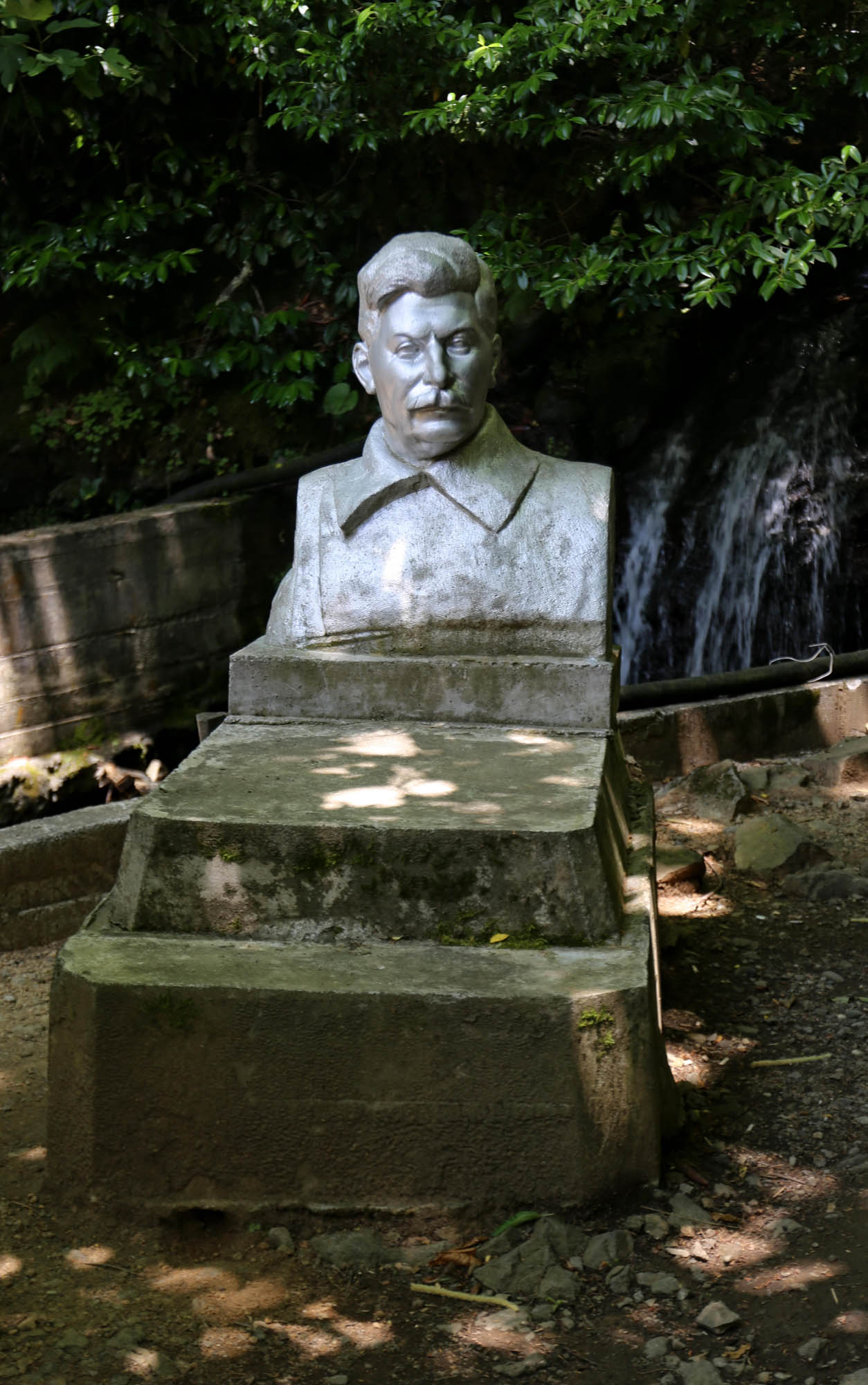
After Khrushchev’s secret speech at the 20th Party Congress in 1956, where he condemned the crimes of Stalinism, Stalin statues all across the Soviet Union were torn down, smashed, or melted away. In Georgia, however—which had suffered particularly heavily under Stalin—the condemnation of the great Georgian was felt as a national insult, and several statues were hidden away in basements or in private gardens of remote mountain villages. In the end, this national outrage even led to the founding of the Stalin Museum in Gori.
According to local memories, this statue once stood in the hall of a public office or collective farm in nearby Zugdidi or Mestia, and was rescued from there in 1956 by a resident of Barjashi. Even ten years ago it was still standing in the corner of the inn’s stable. But as the back garden gradually developed into a summer garden restaurant cooled by the local waterfall—with a stream, trout pond, gazebos, and picnic corners—the statue also found its place there, placed on a small pedestal, not far from a similarly elevated Georgian cross.
Mikheil Saakashvili, who came to power with the 2003 “Rose Revolution,” ordered the removal of all remaining symbols of Stalinism. But the openly Putin-friendly Georgian Dream party, which took power in 2012, quietly tolerated the reinstallation of a few hidden Stalin statues, as long as it happened on private property. That is how, in 2013, Grigol Oniani—an old leader of the Georgian Communist Party and founder of the “International Stalin Society”—was able to erect a full-body Stalin statue in the courtyard of his own family house in the Lower Svaneti village of Sasashi, clearly visible even from the main road.
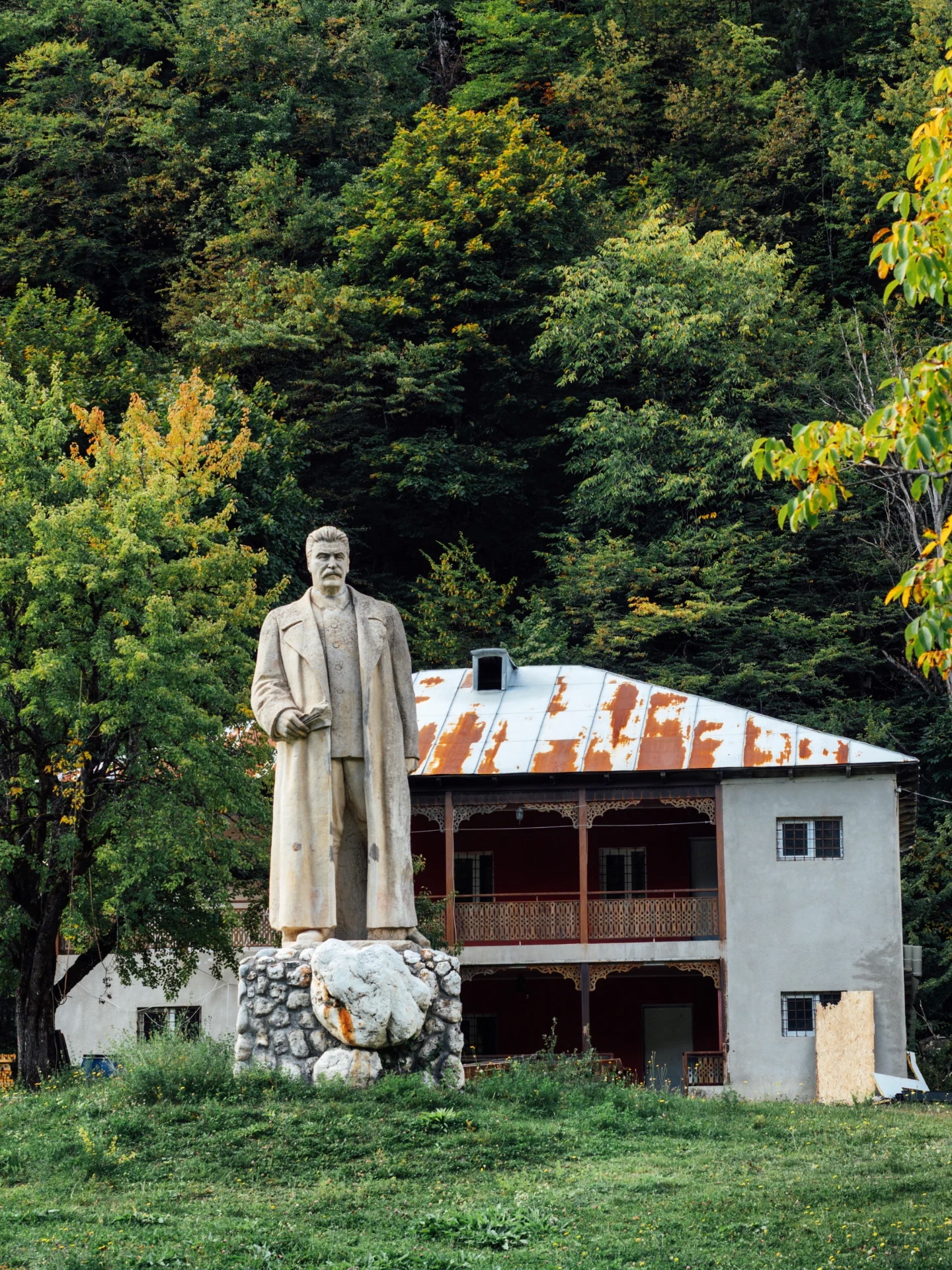
As these examples show, Stalin statues in Georgia are preserved partly out of national pride, and partly from genuine nostalgia for the vanished system. In Armenia, the latter seems to be the stronger reason—I know of only a single example there.
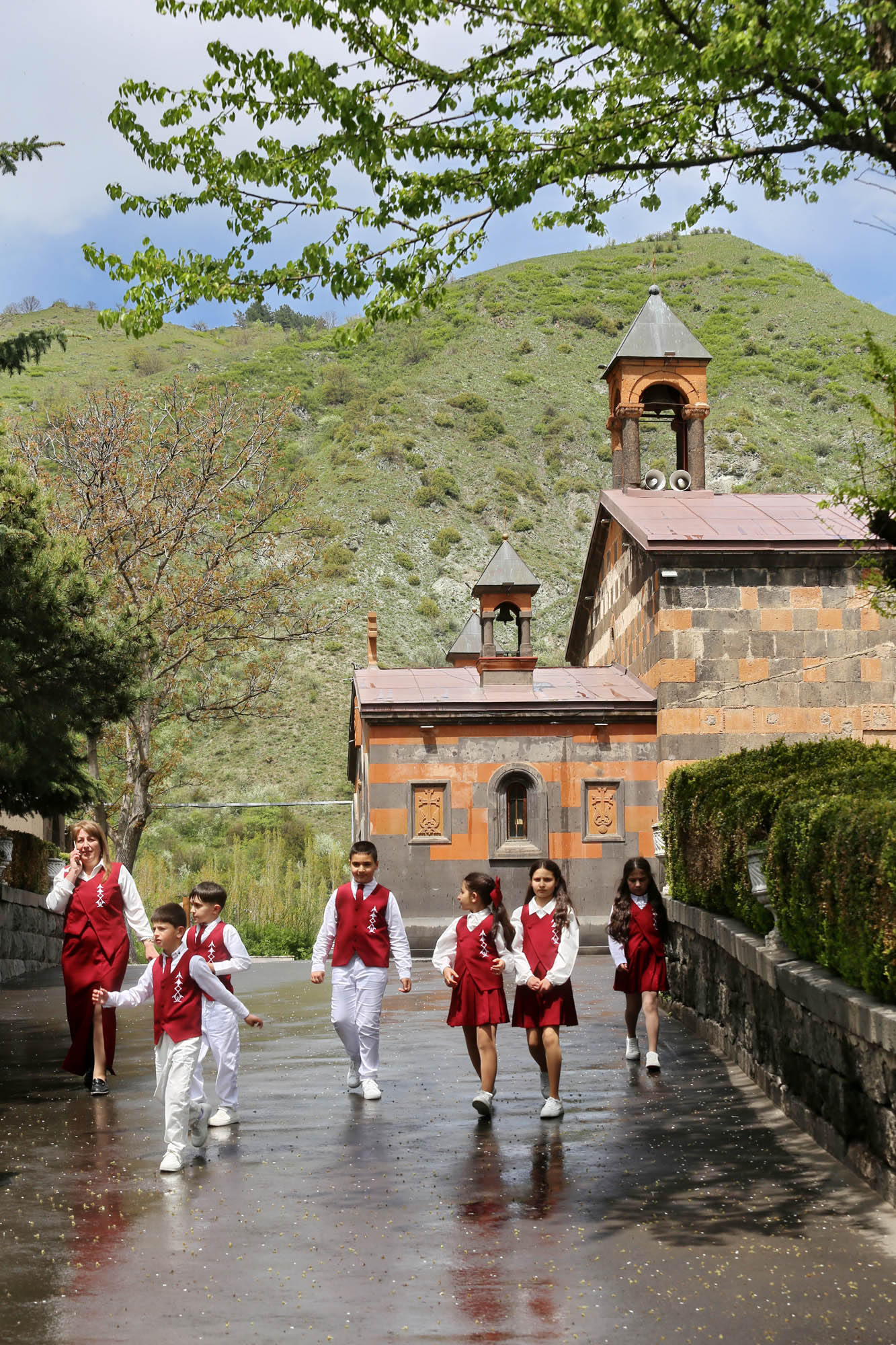
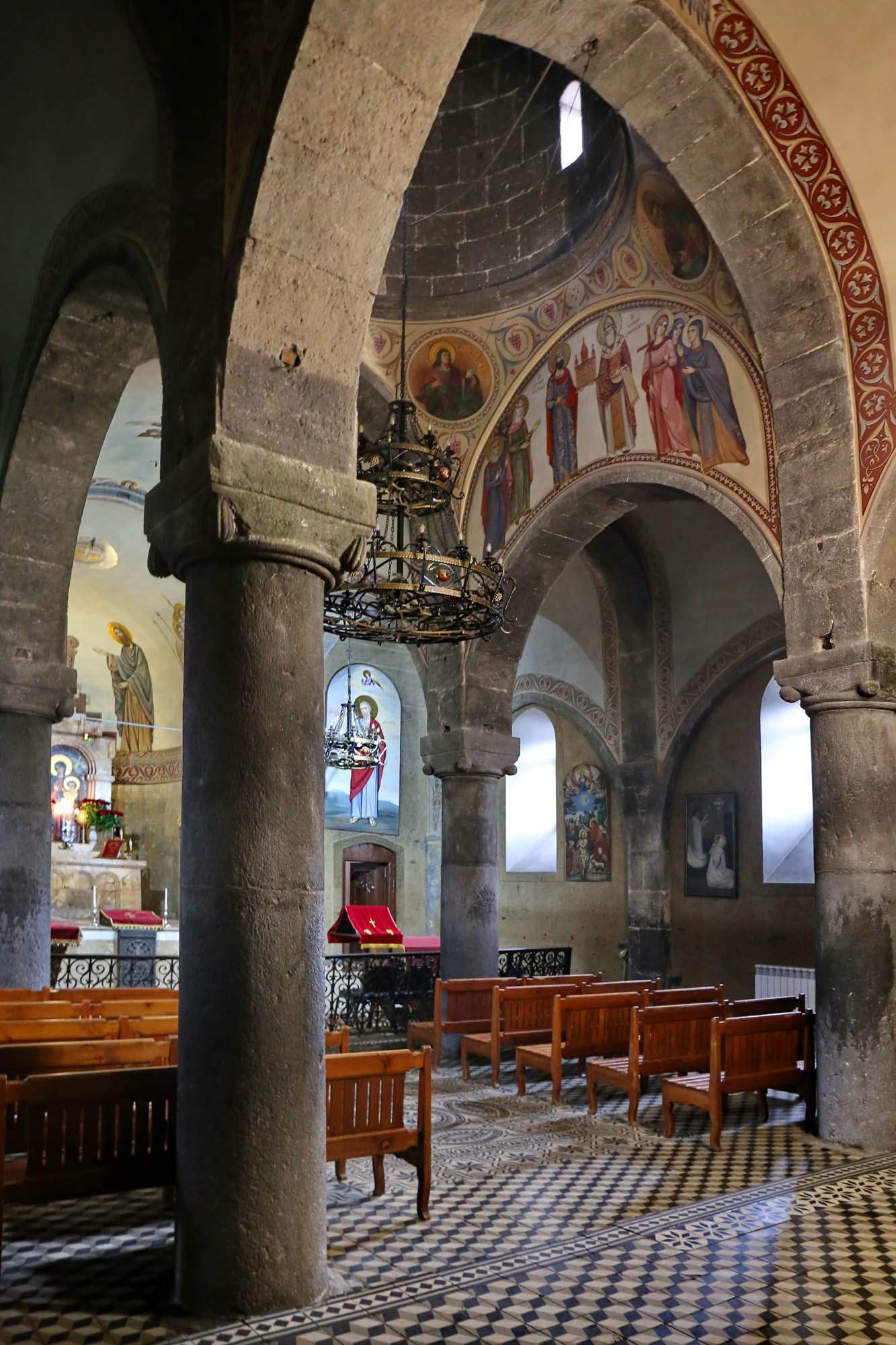
Vanadzor’s Kara Kilisa, the “Black Church,” takes its name from its dark basalt stones. Built in the 13th century under the Kurdish-Georgian Zakarian princes, the medieval church collapsed in the earthquake of 1826, and between 1828 and 1830 it was rebuilt in a more Russian style—larger, and using yellow tufa stones from Gyumri as well. That is where its striking yellow-and-black striped appearance comes from.
In the courtyard, a cheerful crowd of children dressed for celebration is running around. “What holiday is it today?” I ask the teacher, who understands me, but can no longer reply in Russian. A tiny little girl answers for her in perfect Russian: “We’re celebrating that today is our last day of school.” “Do you have a photographer?” I move quickly to practical matters. “No.” “Then gather for a group photo, and I’ll send it by email tonight.”
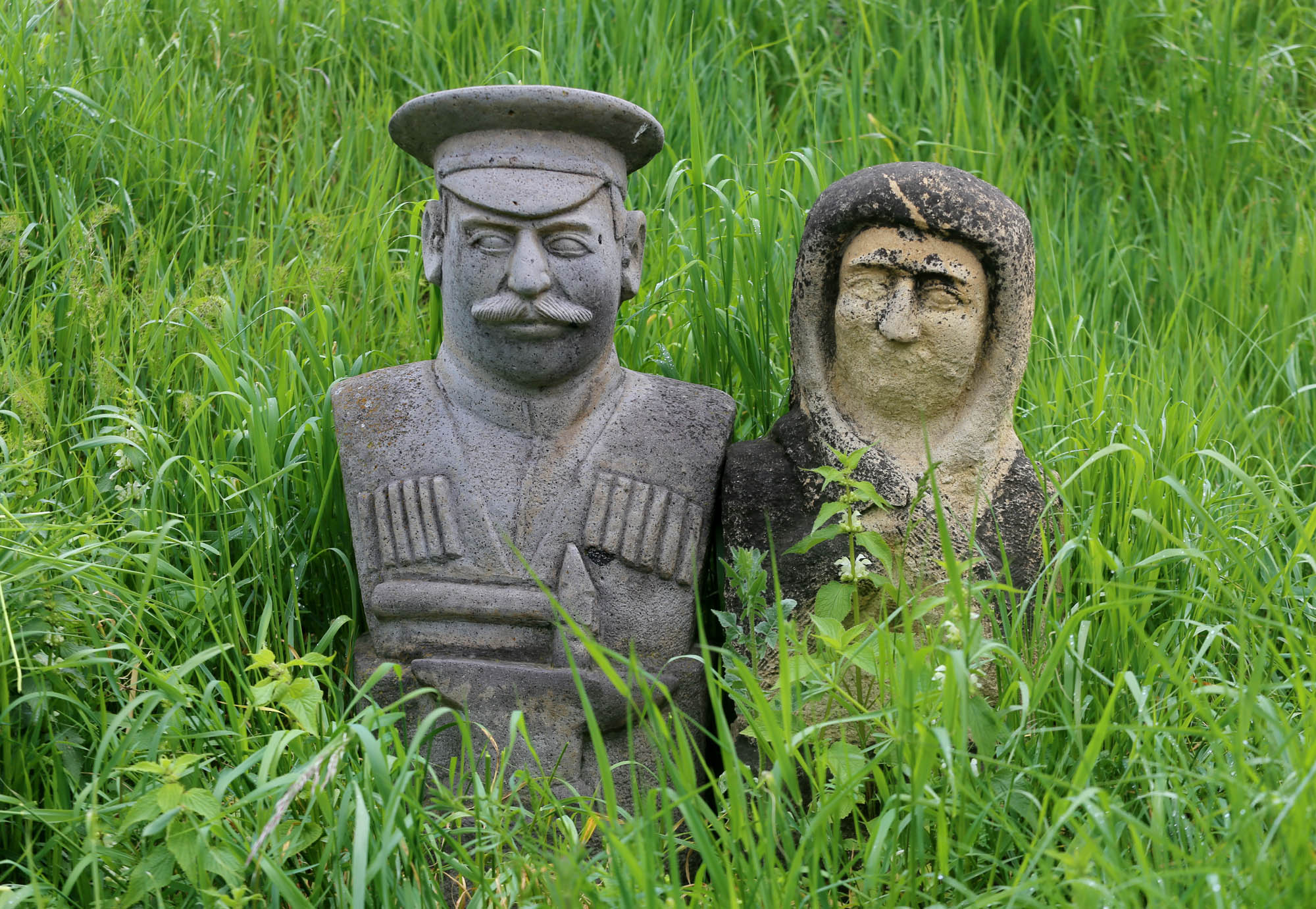
In the church garden lies the cemetery, with many beautiful medieval khachkars—Armenian “living cross” stones—and later gravestones. Among them, like a rabbit sitting in the grass, there is a double bust that is easy to recognize: the man by his military cap, his unmistakable moustache, and the anvil and hammer standing before him, marking him as the Man of Steel and the blacksmith of the new man; the woman because this is exactly how we know Stalin’s mother from their shared photographs.
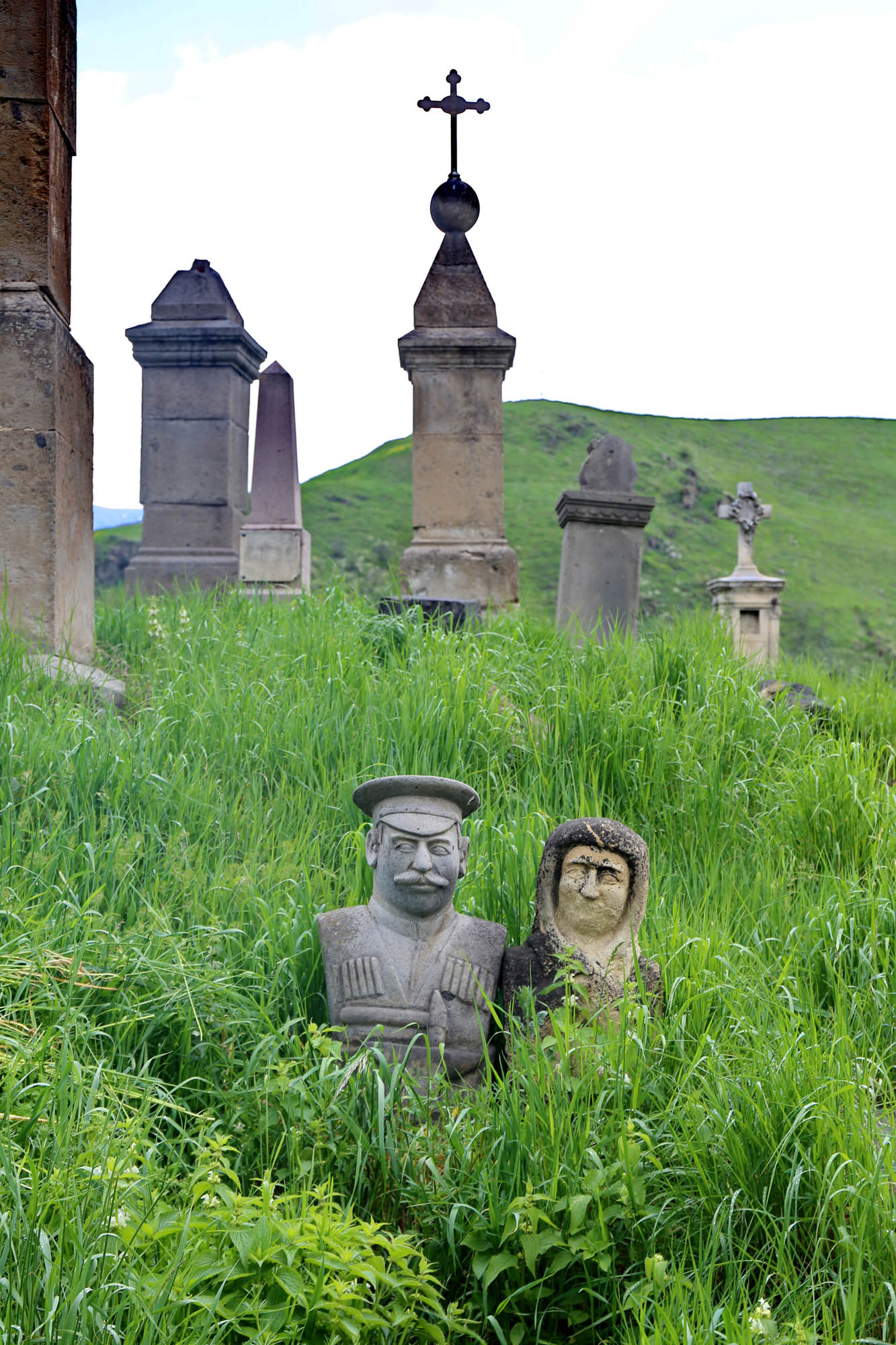
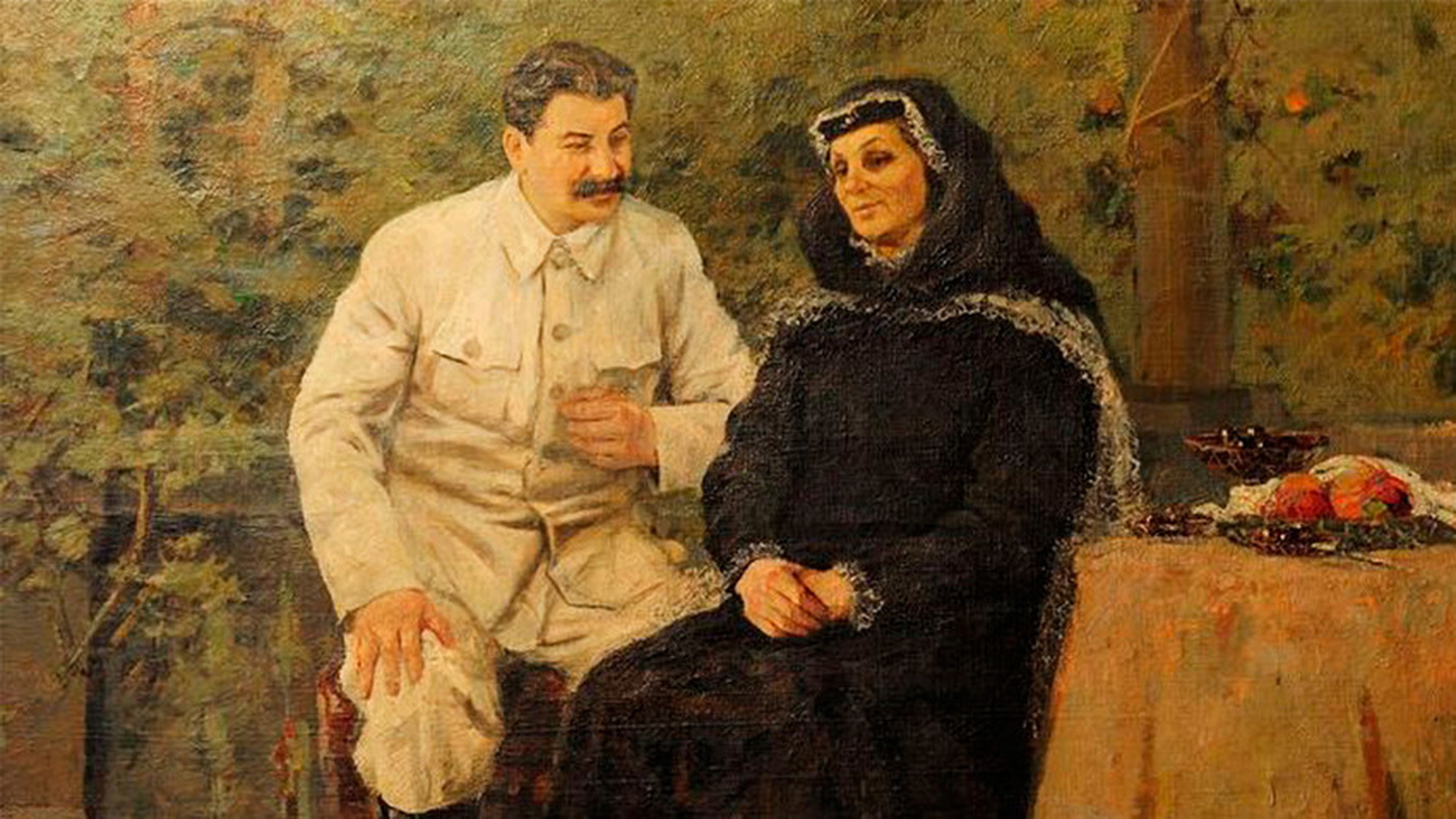
“How did a statue of Stalin and his mother end up here?” I ask the man tending the neighboring grave. “That’s not Stalin,” he looks at me with a sly smile. “It’s a local blacksmith master who carved himself and his wife here.” Looking it up, I do indeed find that the statue was made by the local Varpet (= stone carver) Mehrab, that is, Mehrab Mirzahayan (1894–?). He learned stone carving in Baku, and in the 1930s he also worked on the reconstruction of Yerevan. After retiring, he returned to his hometown, which at the time was called Kirovakan after the Leningrad party secretary Kirov, and here he erected more than 40 richly carved drinking fountains in the surrounding mountains and villages.
Today it can no longer be clarified whether he actually carved Stalin here and gave it his own name so that the statue could survive, or whether he wanted to ennoble his own self-portrait with Stalin’s features. But that the statue is (also) Stalin is certain. Not only because of the identical faces and attributes of the two figures. Not only because Stalin is wearing the distinctly Georgian chokha so typical of him, something an Armenian would never wear. But also because he could hardly have set up his own portrait as a monument—since no grave belongs to it—in such a sacred public place.
This is one of those examples of hidden Stalins where the Leader, like fugitive godfathers, even assumed a foreign identity for the sake of survival.
And finally, one more memorial which, although it does not depict Stalin, has quite a lot to do with him, and stands here in the Vanadzor cemetery, right next to the double portrait.
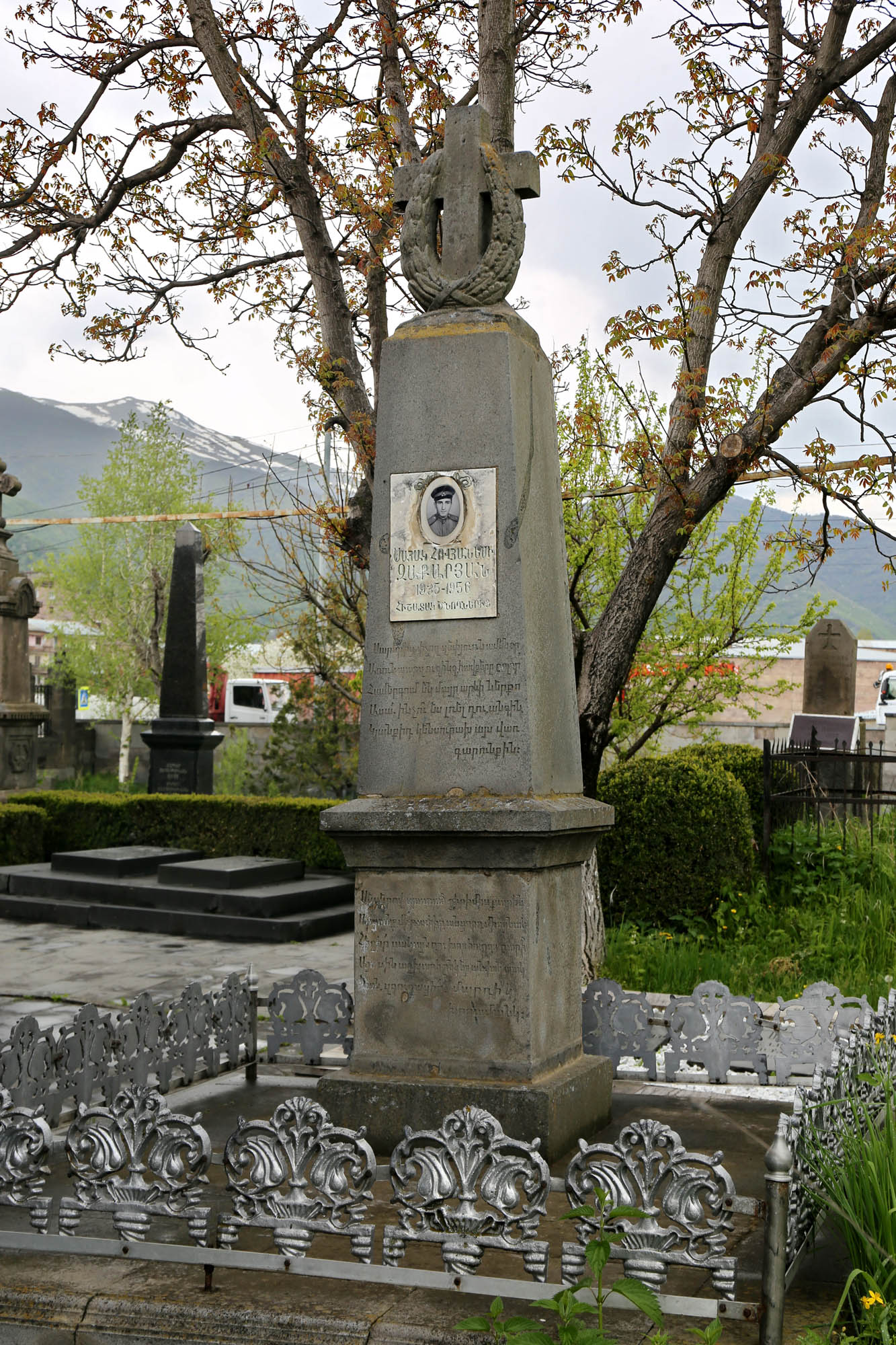
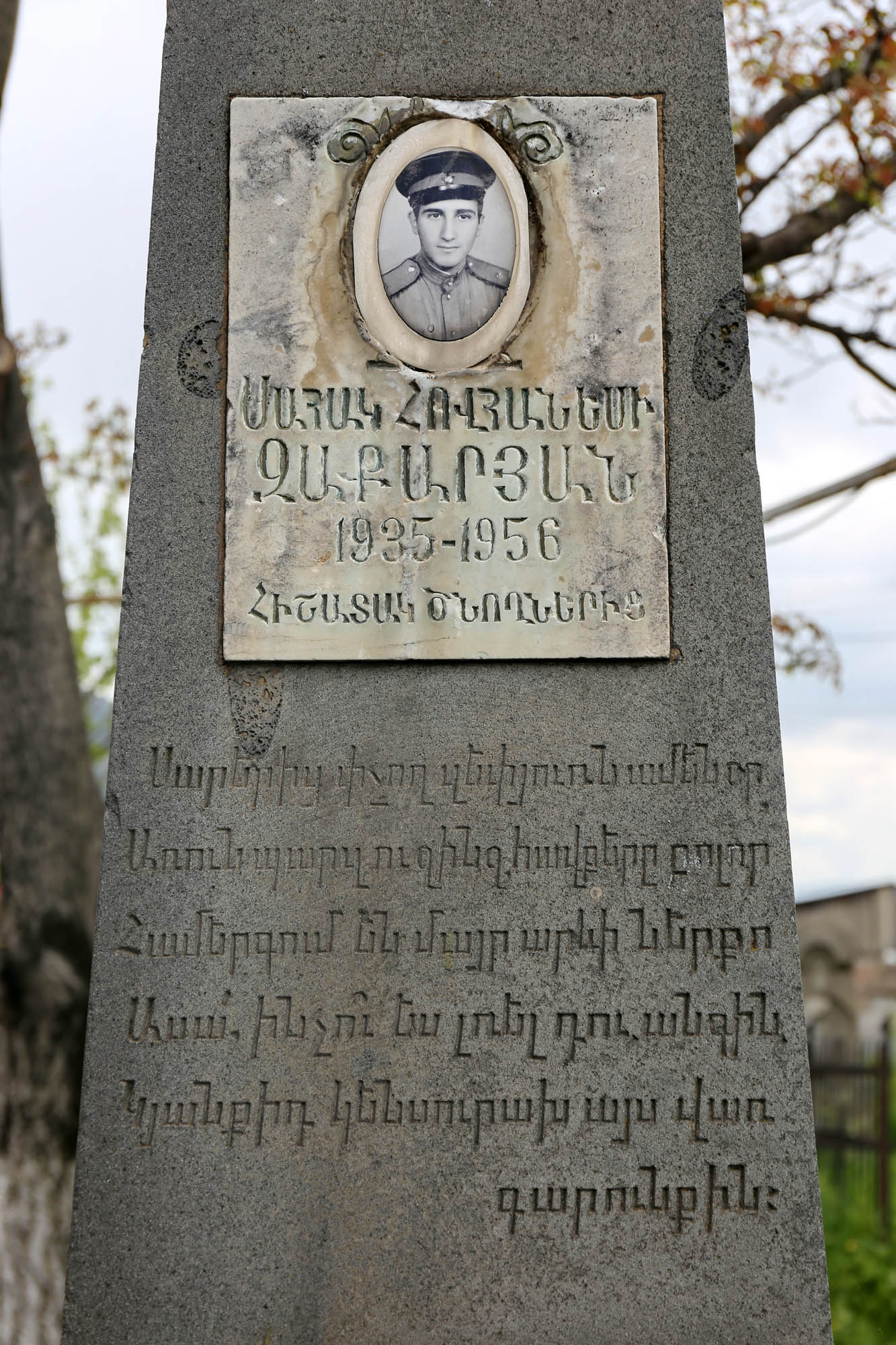
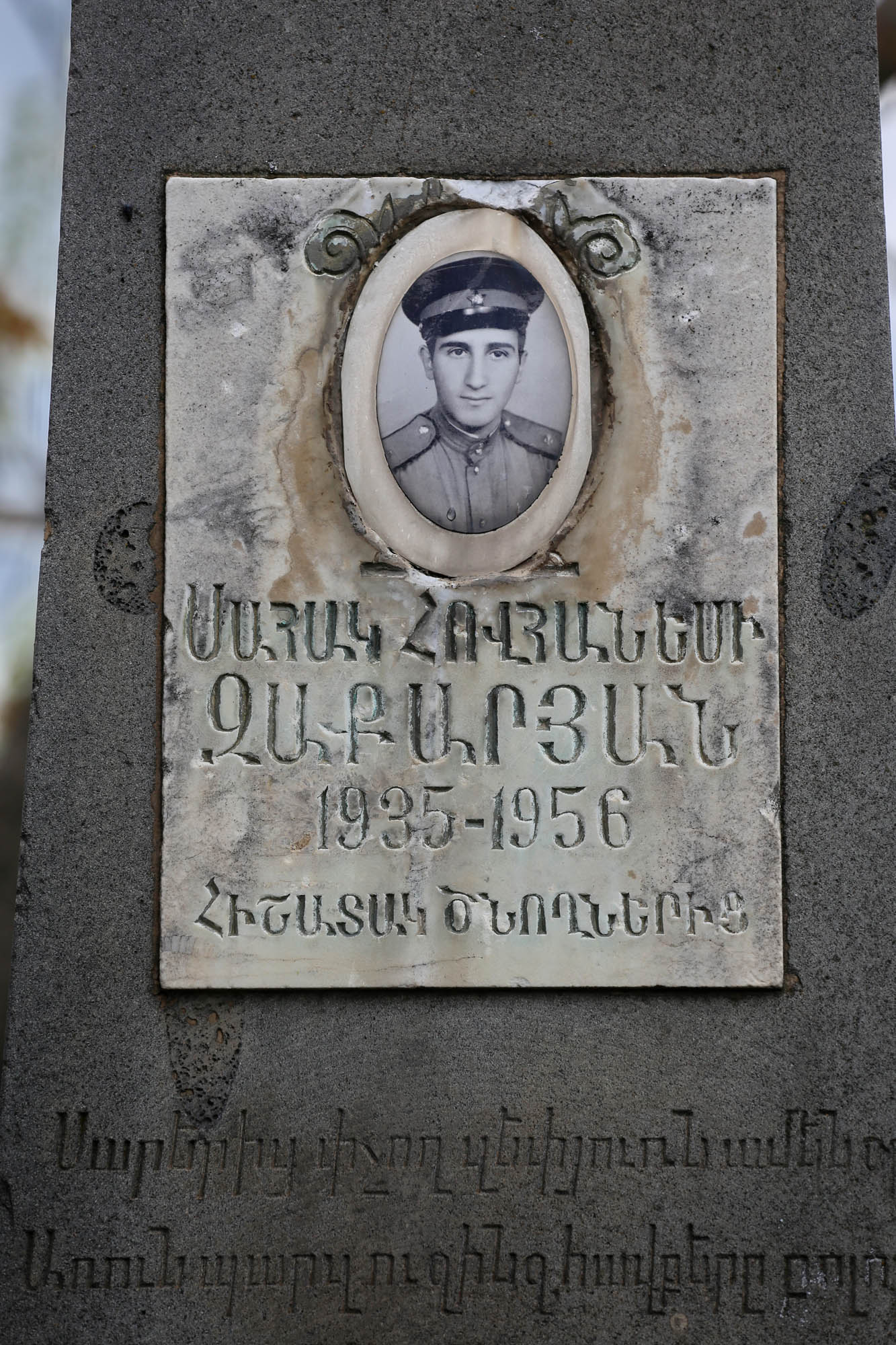
The inscription on the gravestone:
|
ՍԱՀԱԿ ՀՈՎՀԱՆՆԵՍԻ |
Sahak Hovhannesyan |
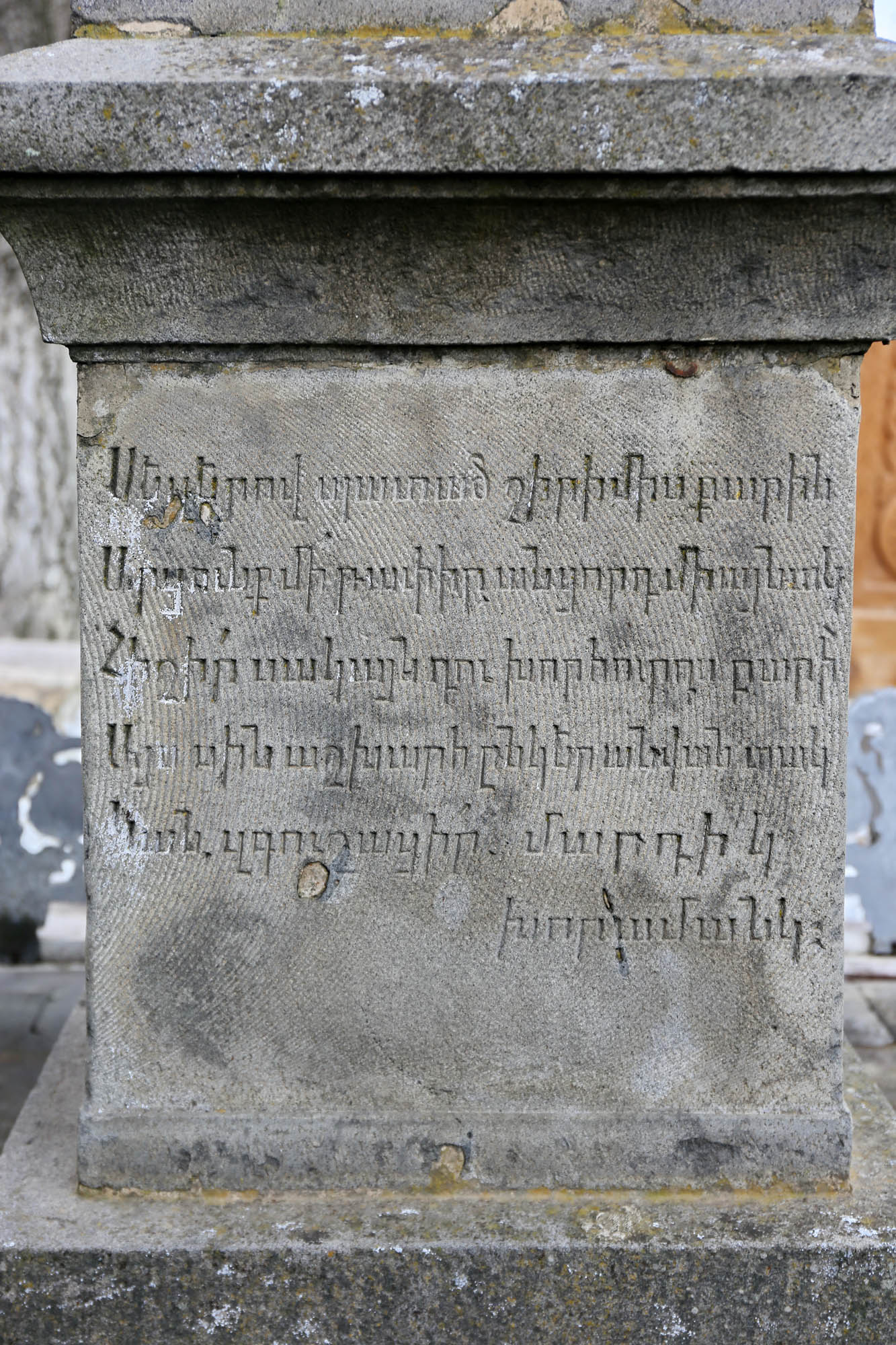
On the base of the column, a grave poem:
|
Մարտիրից փչող զեփյուռն ամեն օր, |
Every blessed day the March breeze blows, |
Sahak Zakaryan truly died in the springtime of his life, at the age of twenty-one, during the years of compulsory military service for Soviet youth, in 1956. The question naturally arises: could it have been in Hungary?
The repatriation and burial of the young soldiers killed during Operation Whirlwind—that is, the crushing of the 1956 Hungarian Revolution—were carried out in the greatest secrecy. Families were forbidden to speak about the circumstances of death or to make any reference to it in the grave inscription. But the year, the age, the uniform, and the sudden death, along with the fact that large numbers of Caucasian conscripts served in the Carpathian Military District units deployed to Hungary, make the place of death quite likely. According to official reports, the Soviet army lost 720 soldiers, and among the lists processed by historians, many Caucasian names appear.
The Soviet military leadership did everything possible to hide the human cost of the Hungarian intervention from the population at home:
• Fallen soldiers were usually transported back to their homeland at night, in zinc coffins marked as “special cargo” (Gruz 2000), after the family had signed complete confidentiality agreements.
• The KGB and military authorities strictly censored what could be written on gravestones, and they were also present at the funerals—held obligatorily in a narrow family circle, at night or early morning—to monitor what was being said.
• The documents of Operation Whirlwind and the files of the losses, unlike the Second World War casualty lists, remain classified to this day.
Alongside Prince Konstantin Bagration-Mukhrani, private Sahak Zakaryan is another example—one among thousands—of those Caucasian soldiers who fell fighting against Hungarians in the service of Russian, this time Stalinist, interests.



Add comment