

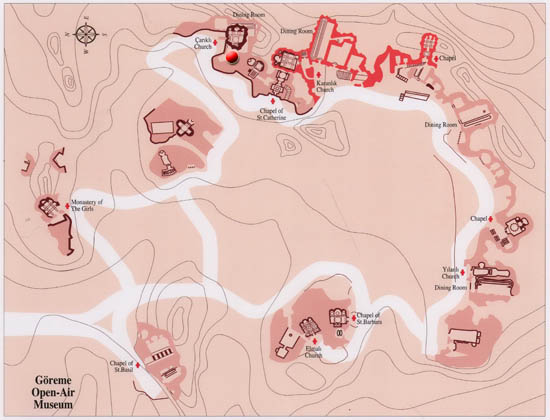
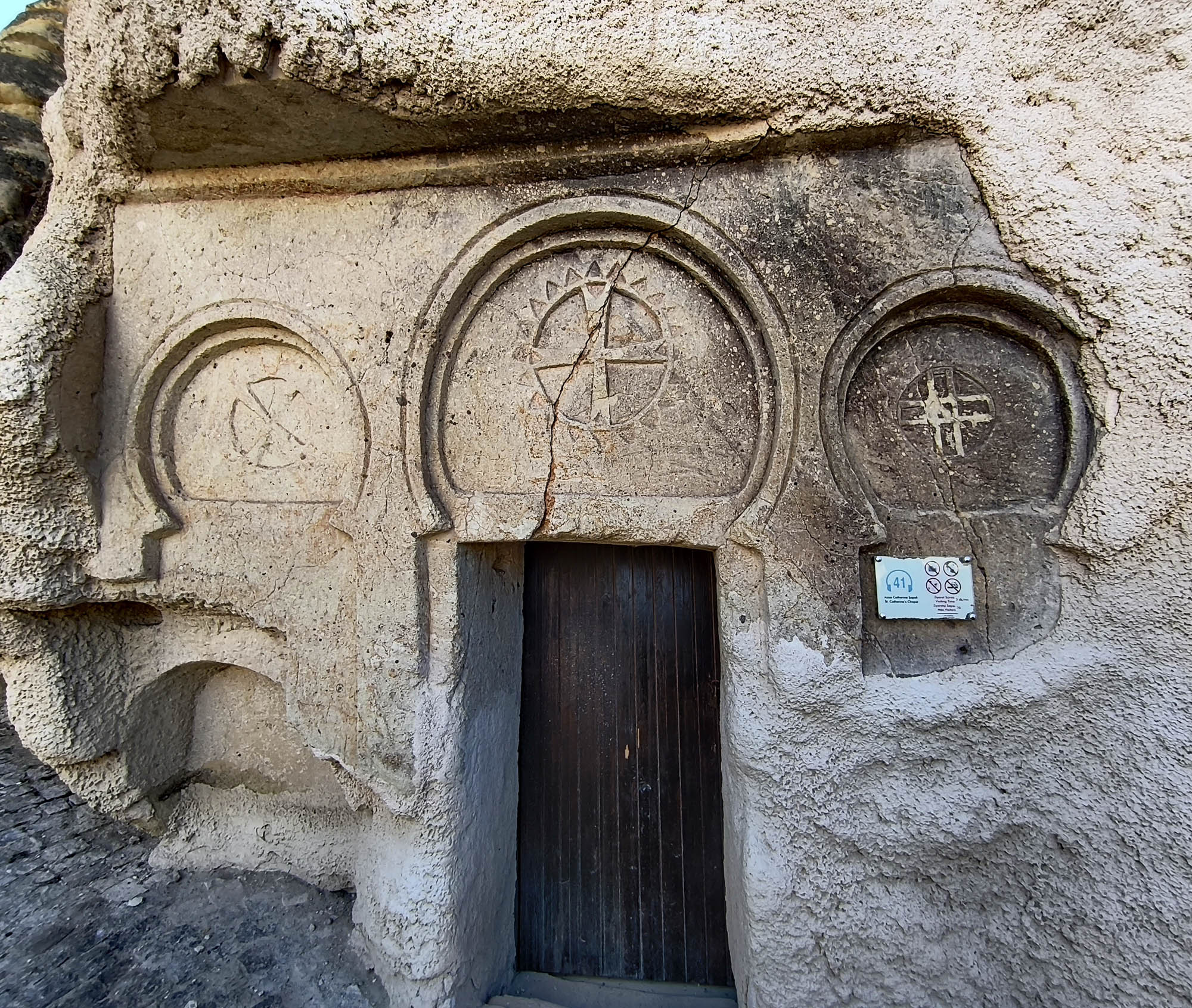
The eighth church of Göreme, dedicated to Saint Catherine, is decorated with 11th-century icon frescoes arranged almost like a patchwork: Christ Pantokrator, the Mandylion, archangels and soldier saints — among them Saint George on horseback — as well as the church’s namesake, Saint Catherine herself. However, much like the Elmalı Chapel, this church is permanently closed to visitors; only the three carved crosses framed in circles above the doorway can be seen.
So until we get the chance to see it in person, we move on to the ninth church: the Çarıklı (Sandal) Church.
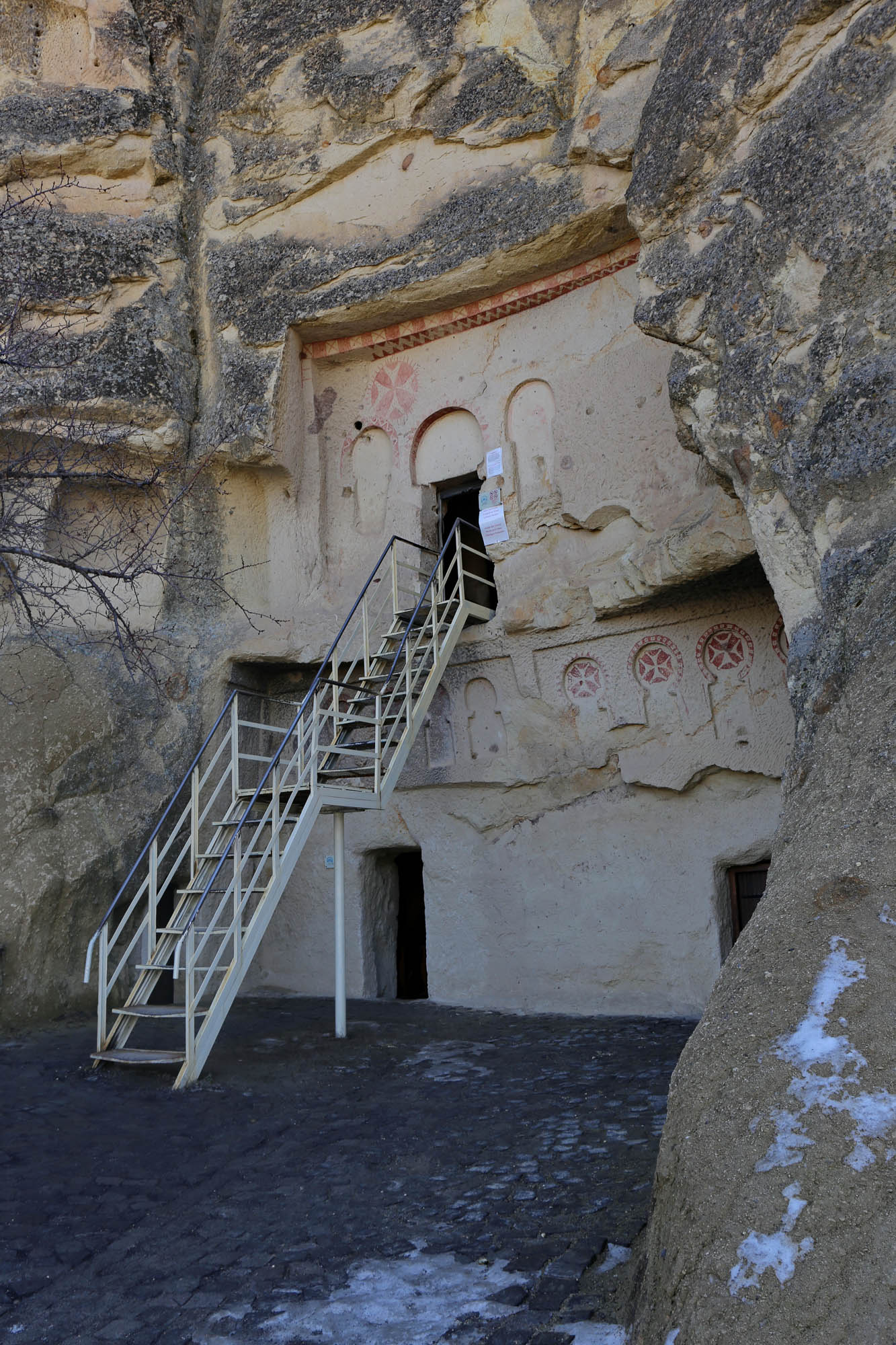
The Sandal Church takes its name from two footprints carved into the floor beneath the fresco of the Ascension of Christ. According to the scholarly literature, however, the church was originally dedicated to the Holy Cross. It once had two levels, but only the upper one has survived in its original form. There was also a spacious narthex, similar to that of the Karanlık Church, decorated with crosses from the so-called “linear period”, but this too has collapsed — today a metal staircase leads up to the upper church.
Like the other “four-column” churches — Elmalı, Karanlık and the church of Çavuşin — its entire interior surface is covered with frescoes, most likely painted by the same Constantinopolitan workshop that decorated the other three, again in the mid-11th century.
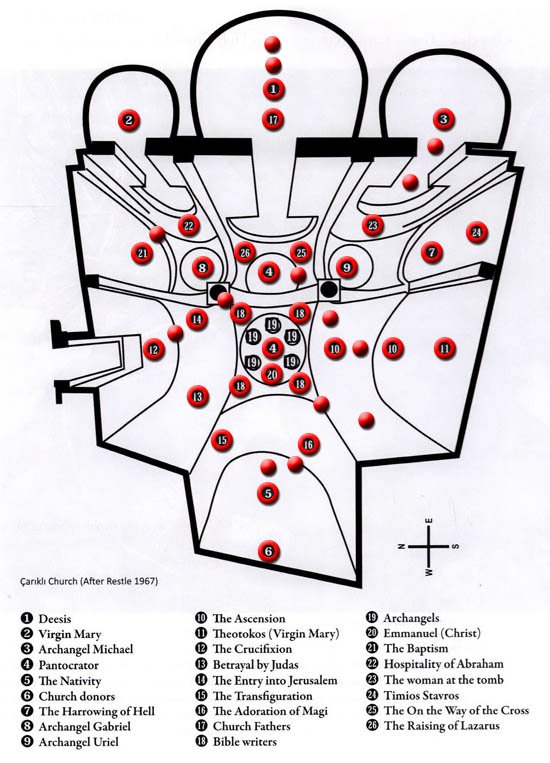
The iconography of the Göreme fresco cycles represents a transition from the early Christian cycles—which depicted scenes from the life of Christ in chronological, long sequences—to the later church cycles that emphasize the twelve major feasts. In the Çarıklı Church, twelve scenes from Christ’s life are depicted—other four-columned churches have more, but this is the smallest, so only this number could fit—yet, as in the others, four of the major feasts are still missing: the Annunciation, the Presentation in the Temple, Pentecost, and the Dormition of the Theotokos.
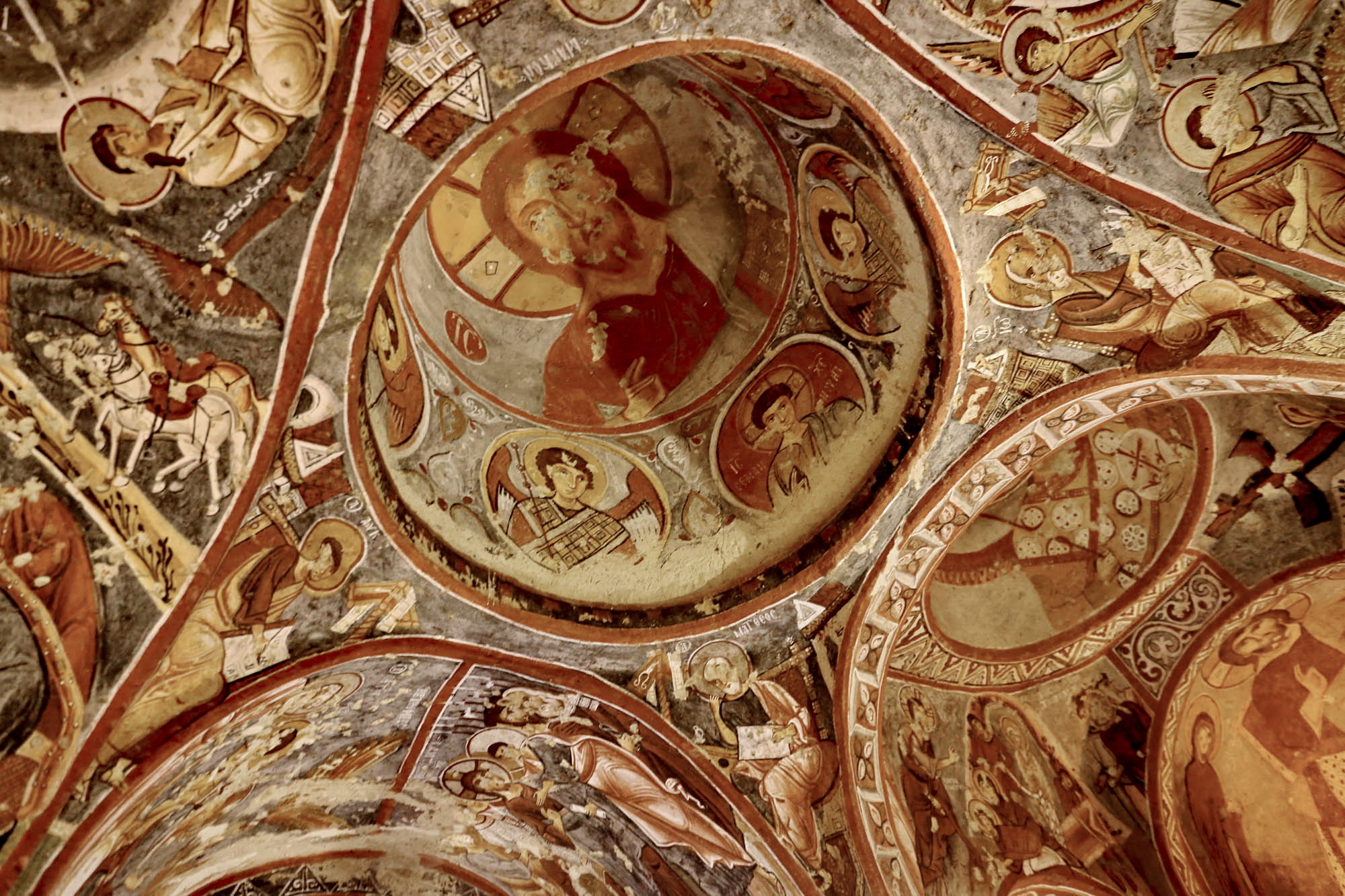
In the dome, the bust of the Pantokrator is surrounded in the drum by five archangels and a smaller Christ-Emmanuel, arranged in six medallions, with the four evangelists depicted on the pendentives.
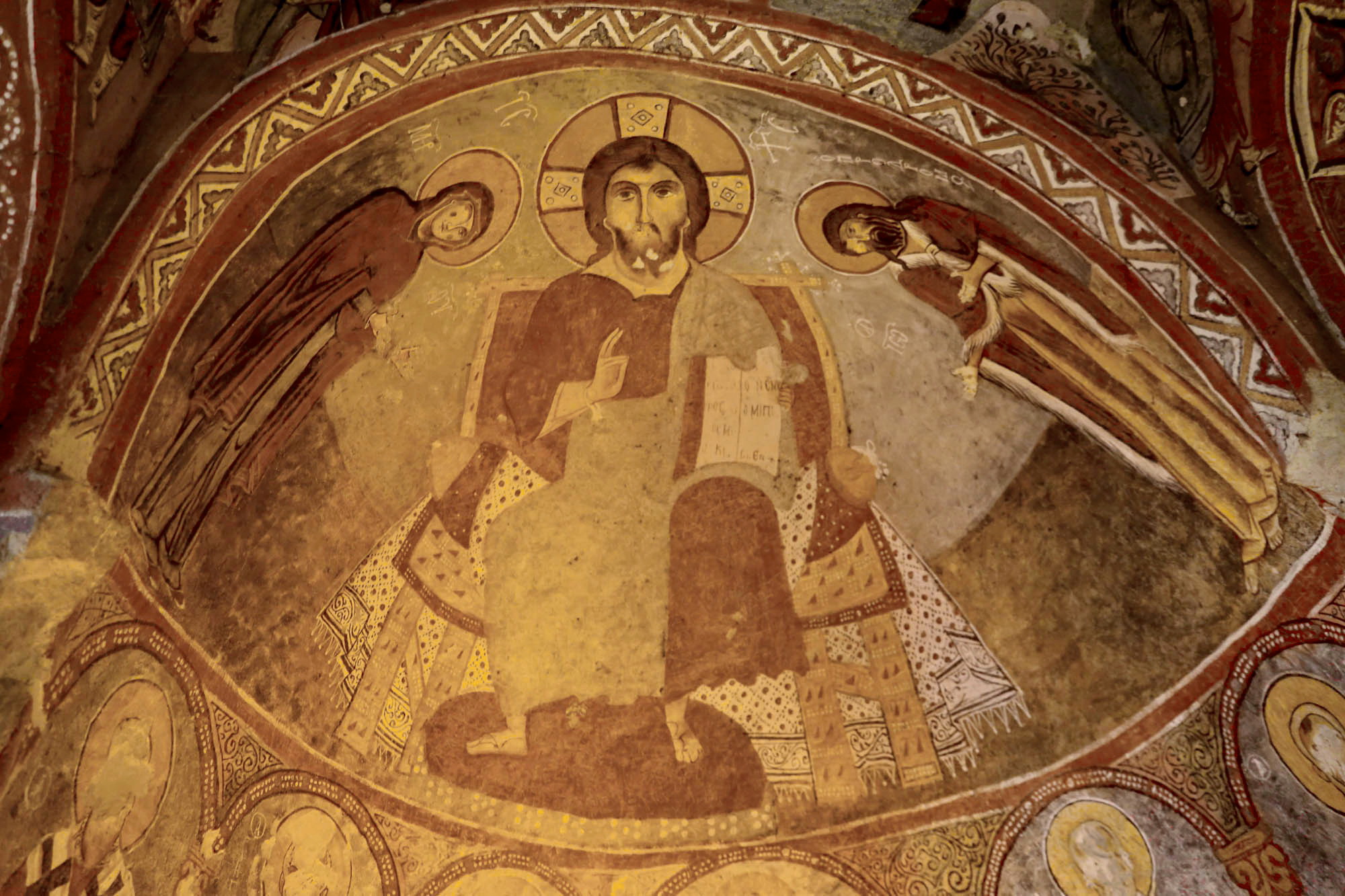
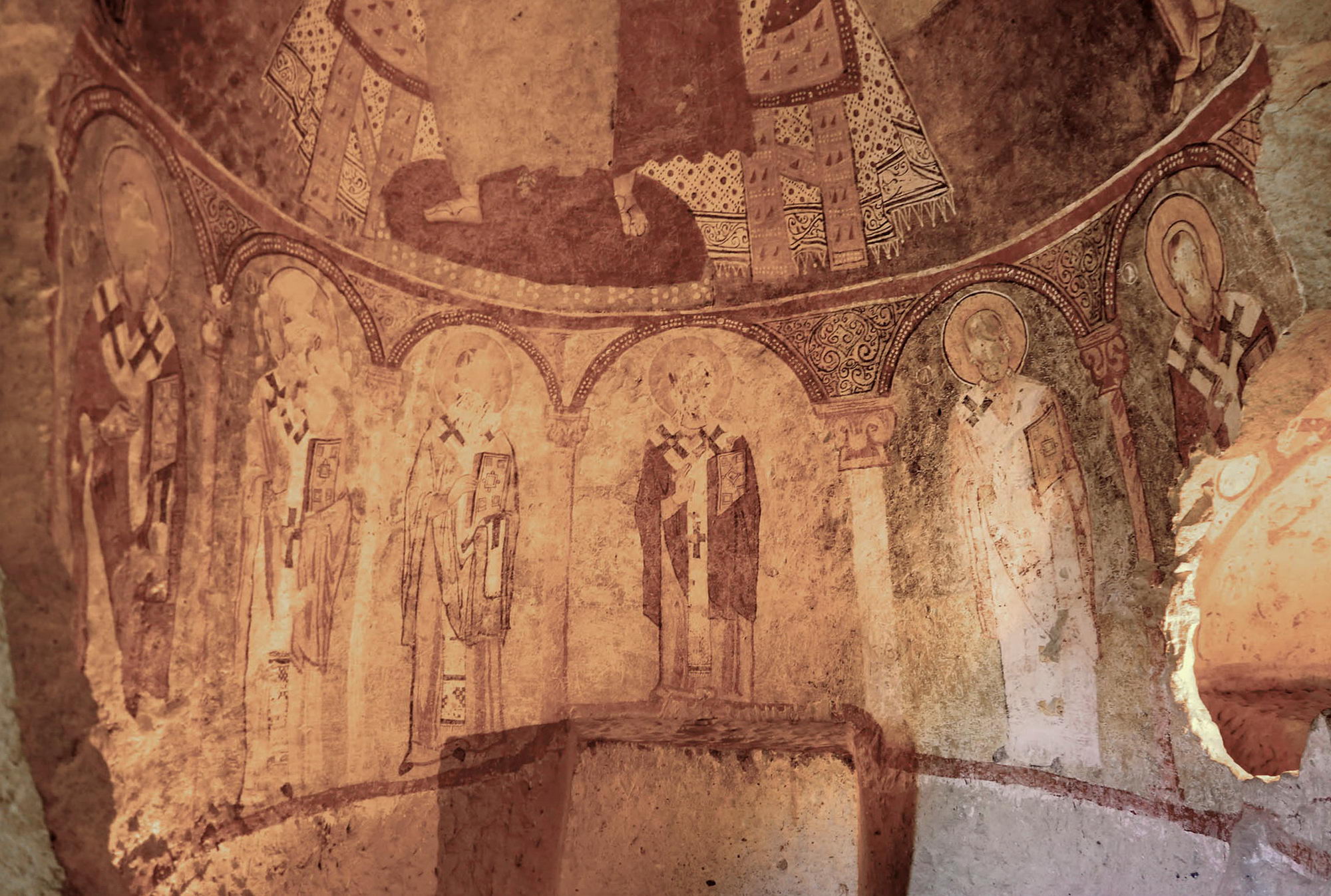
In the sanctuary, above, the Deesis is visible—that is, the enthroned Pantokrator, implored for merciful judgment by Mary and John the Baptist. Below, around the arcade, six Church Fathers are depicted: in the center, John Chrysostom, flanked on the right and left by Saint Basil and Saint Nicholas, on the left by the Theologian Saint Gregory and Saint Blaise, and on the right by Saint Hypatius.
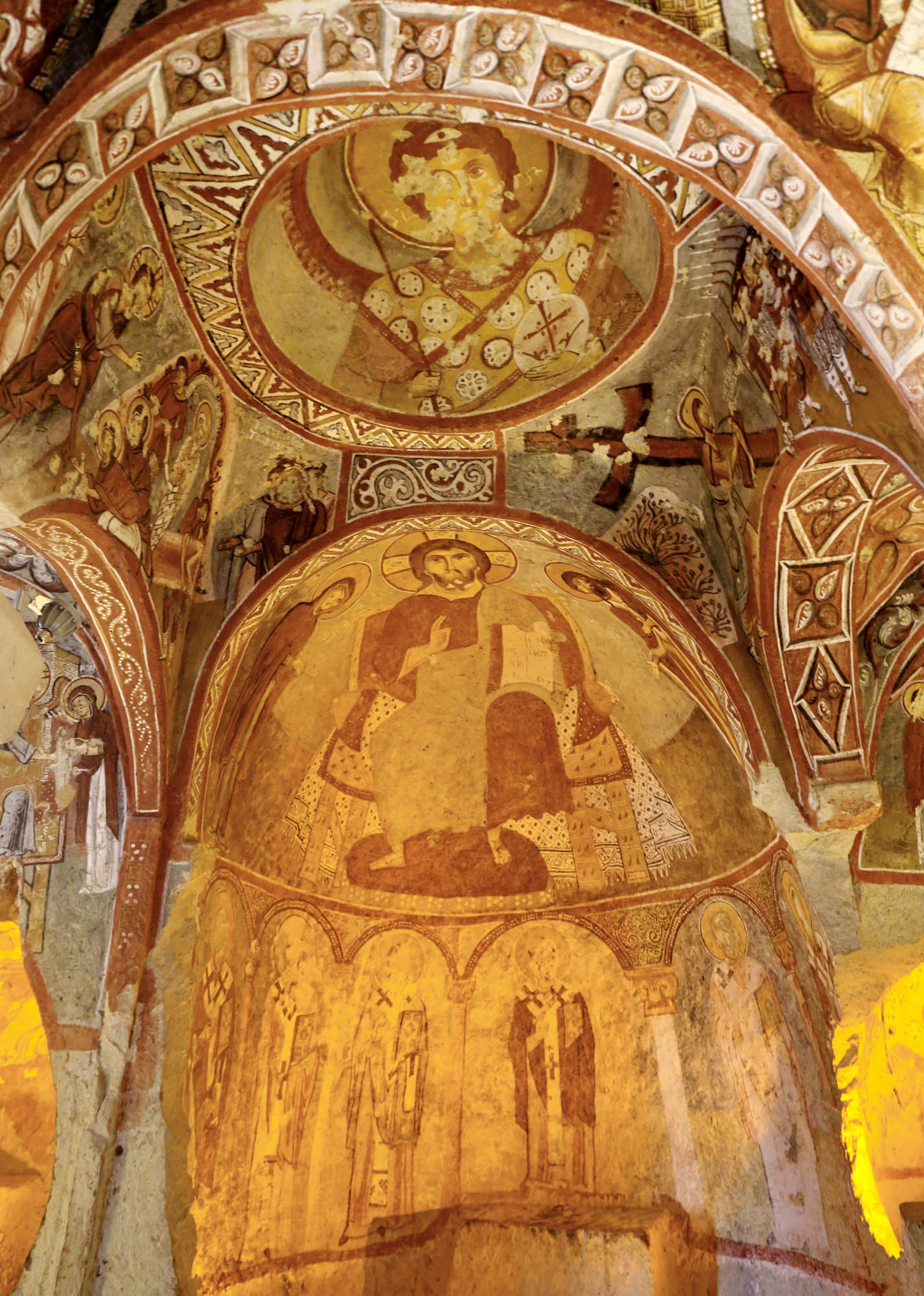
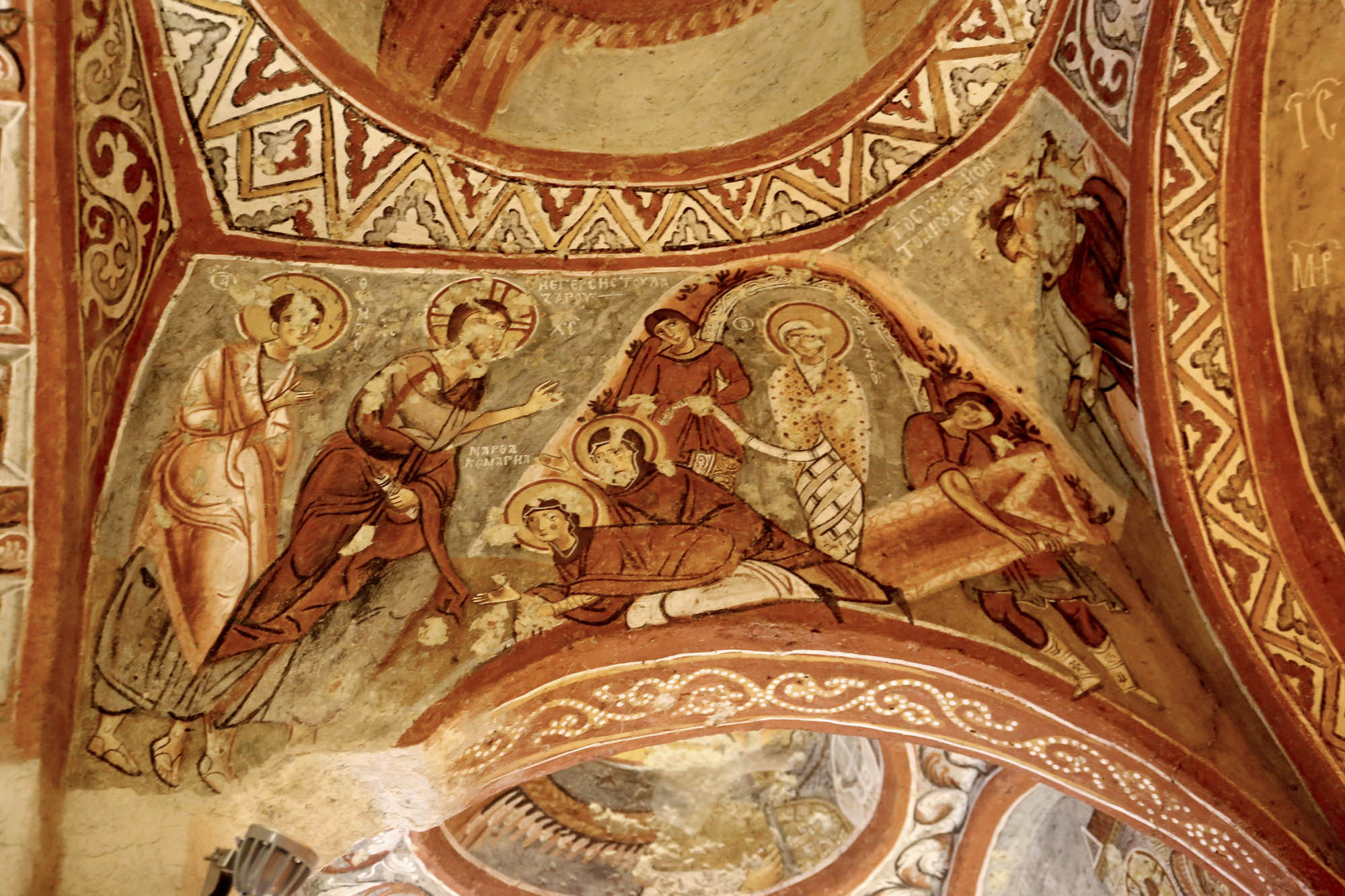
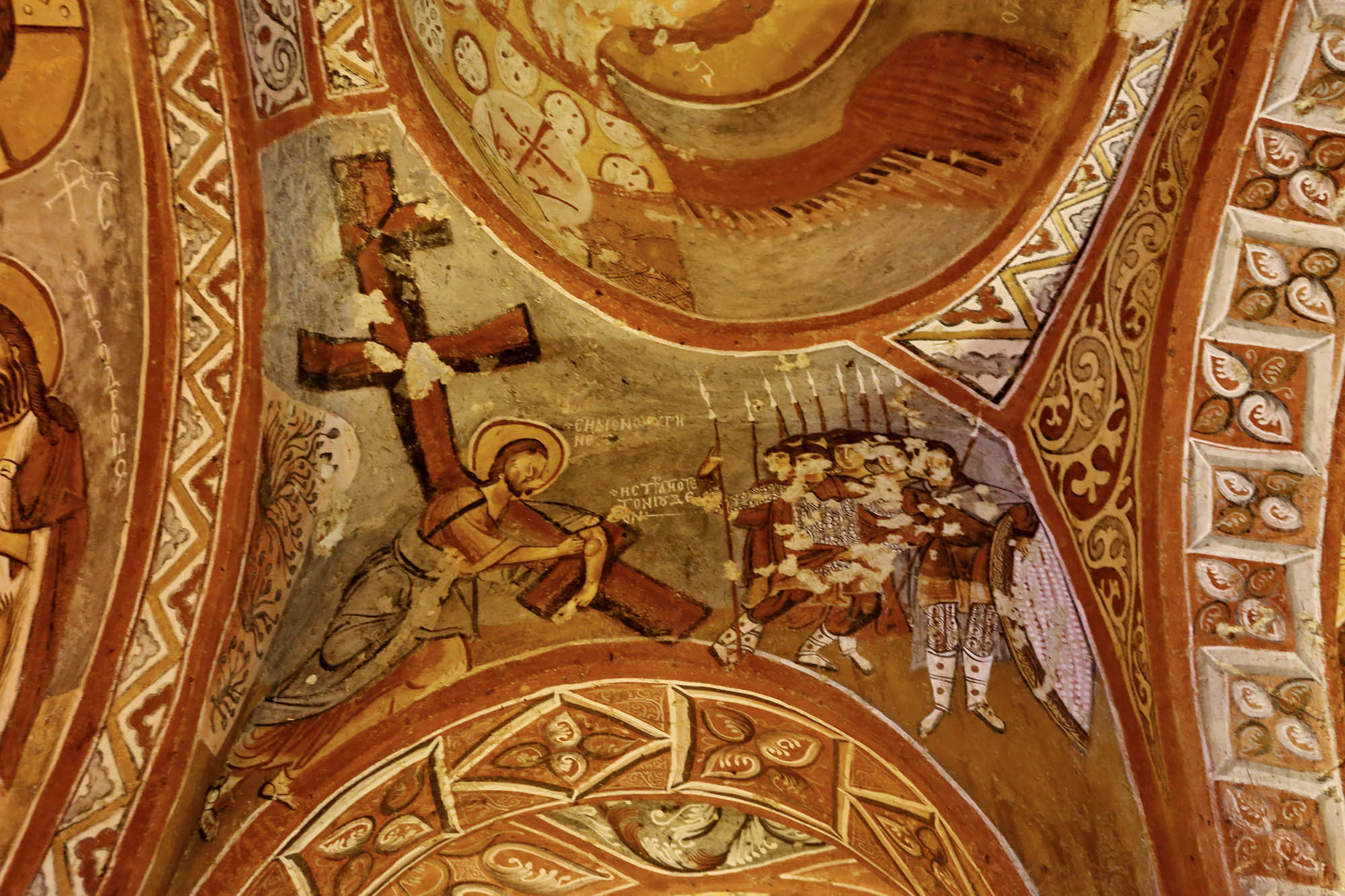
On the façade arch of the main apse: the Raising of Lazarus and the Bearing of the Cross.
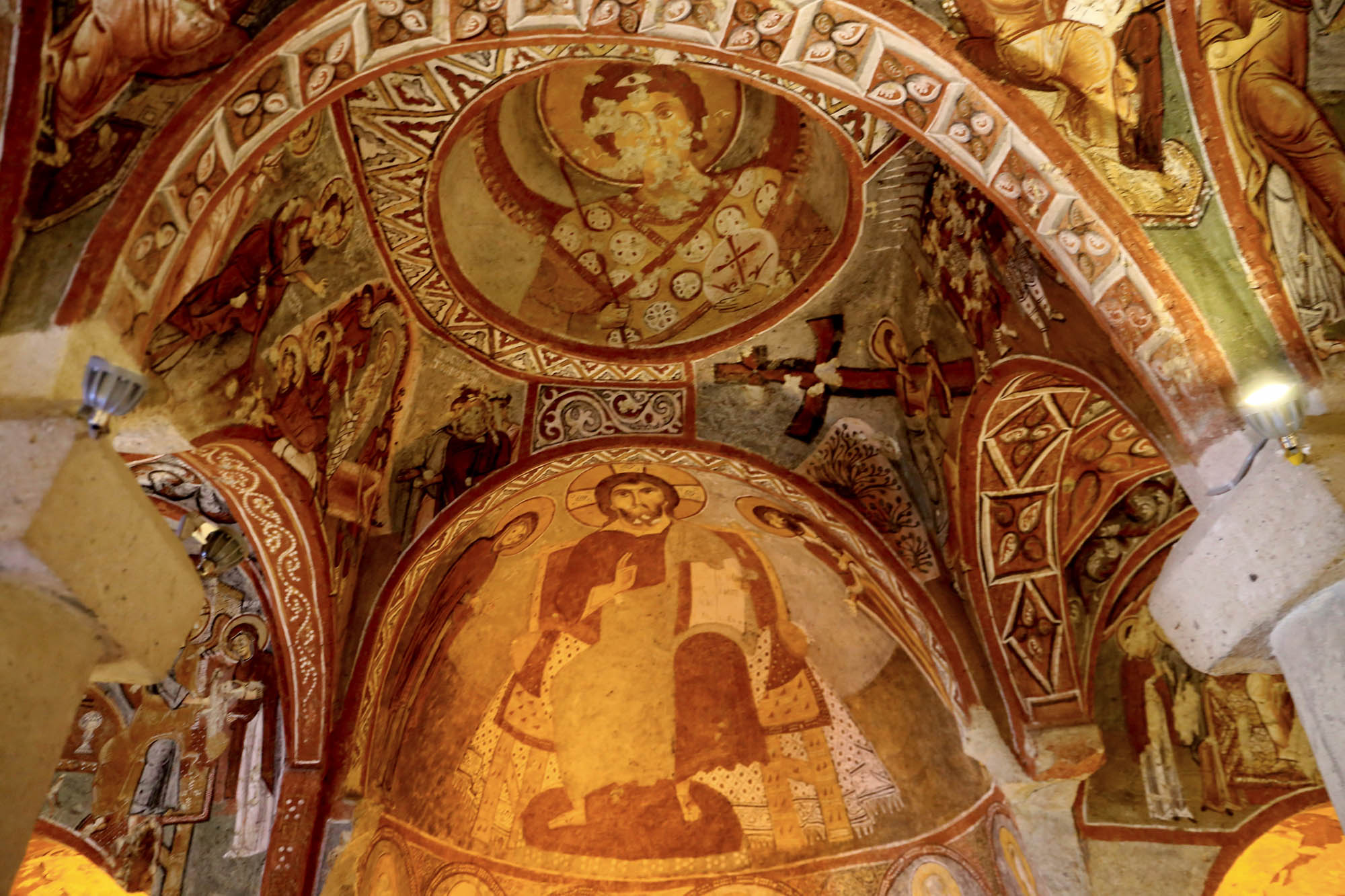
In the two side apses: the Theotokos with Child, and the half-figure of Archangel Michael. In their frontal lunettes: Abraham’s hospitality to the three angels—emphasizing its Eucharistic typology here as in the San Vitale of Ravenna—and the Women at the Tomb. In the latter, the folded shroud is again depicted in a compressed form, as in the Karanlık Church, indicating that both chapels were painted by the same workshop.
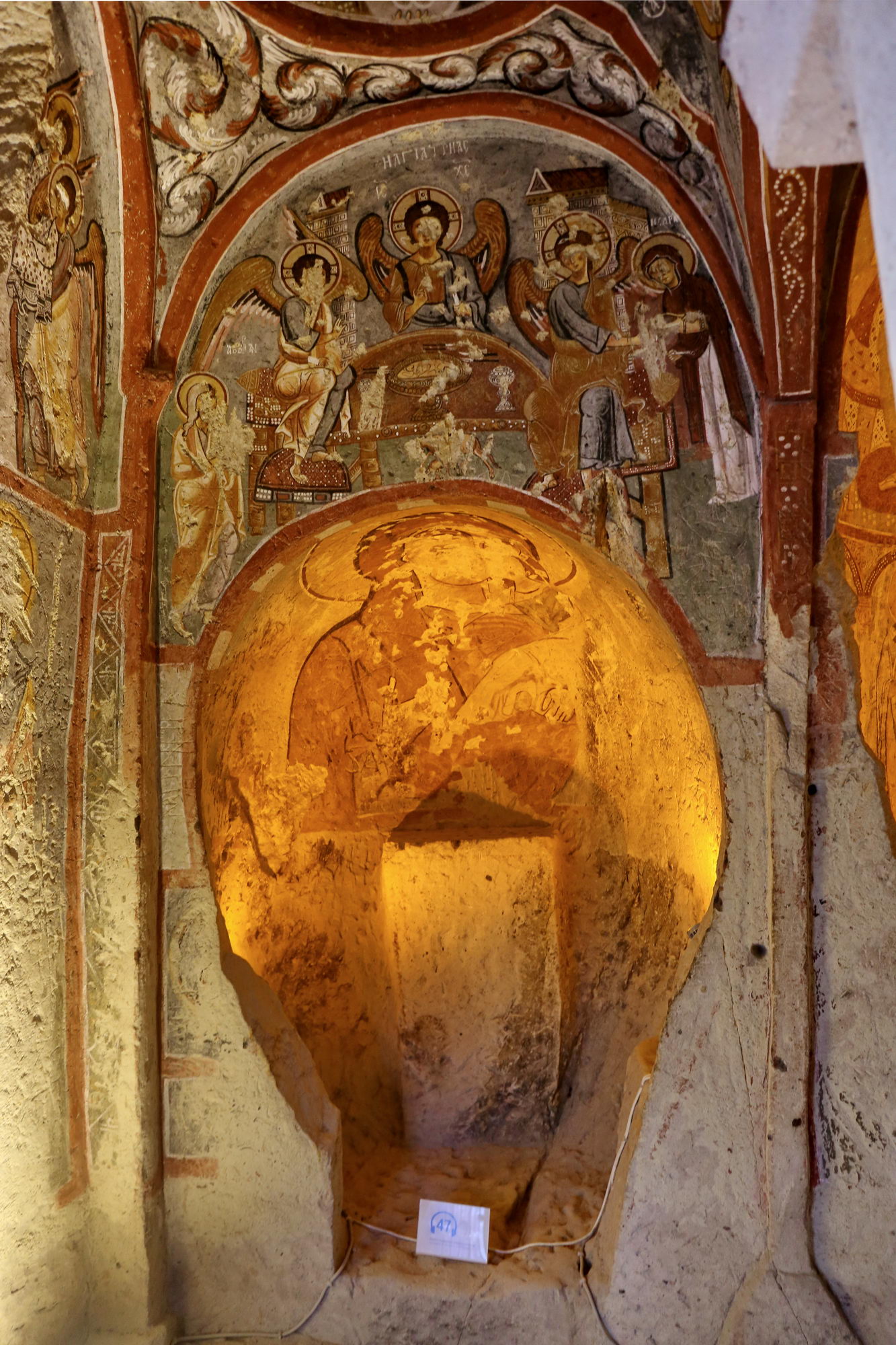
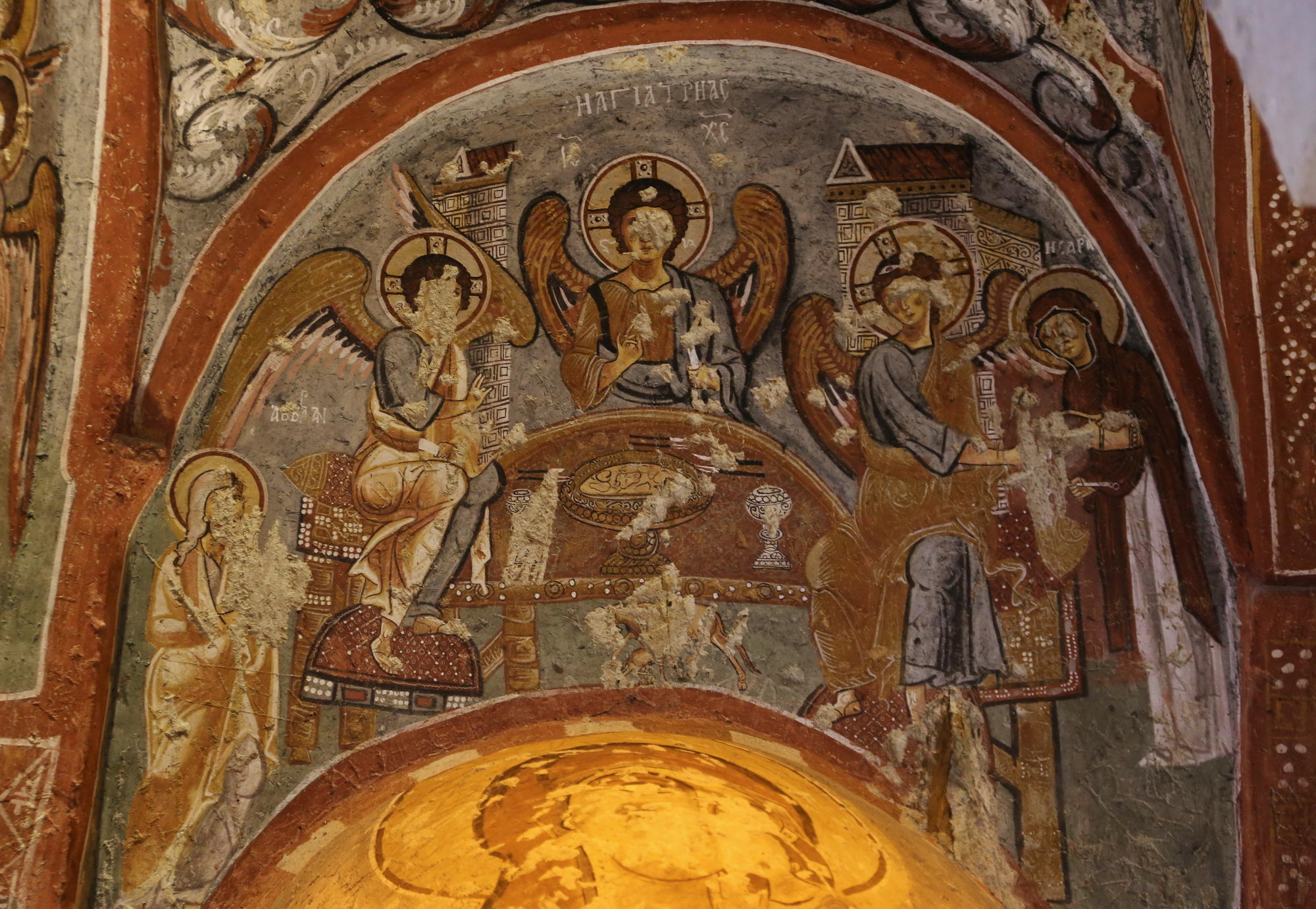
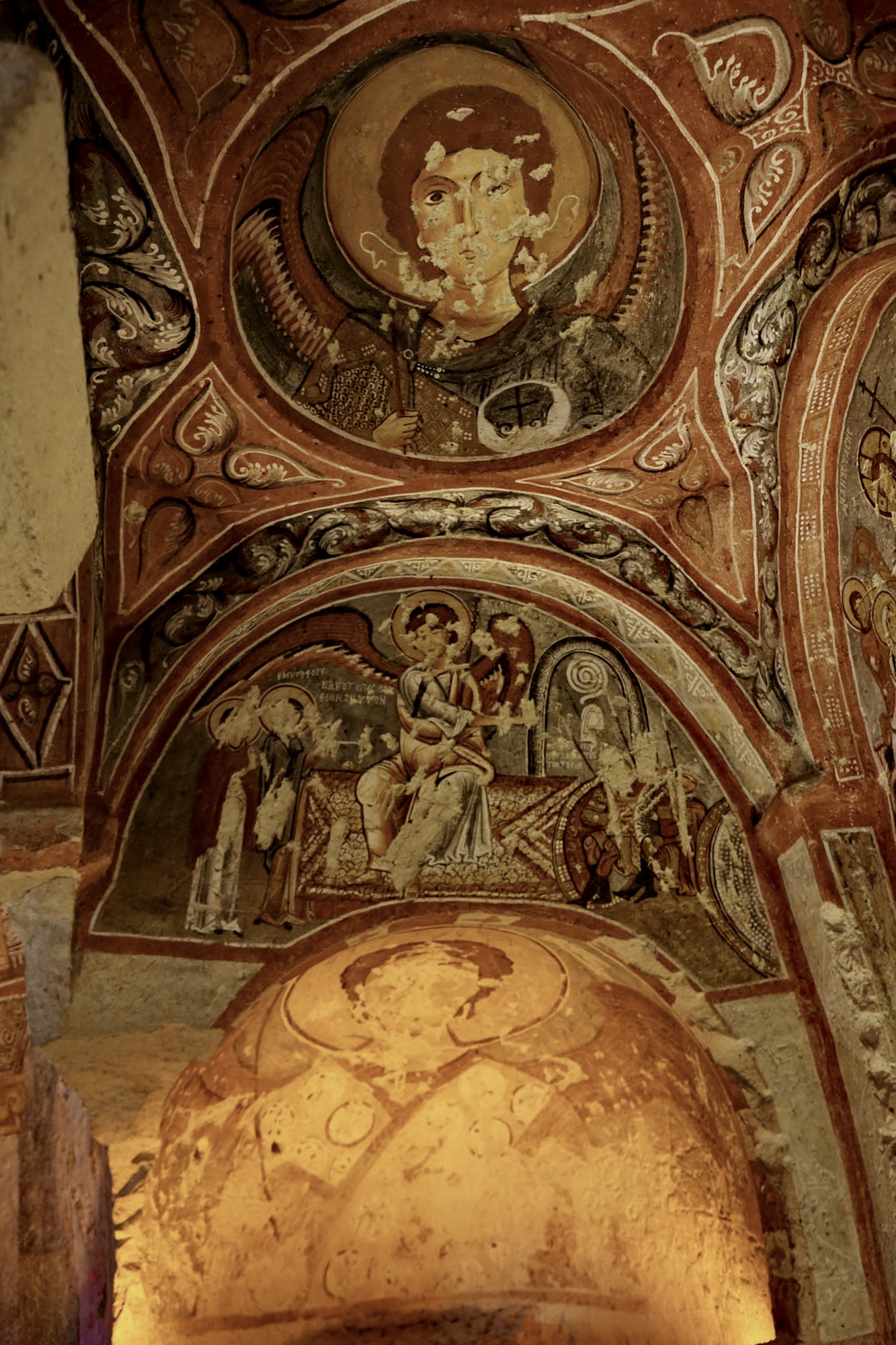
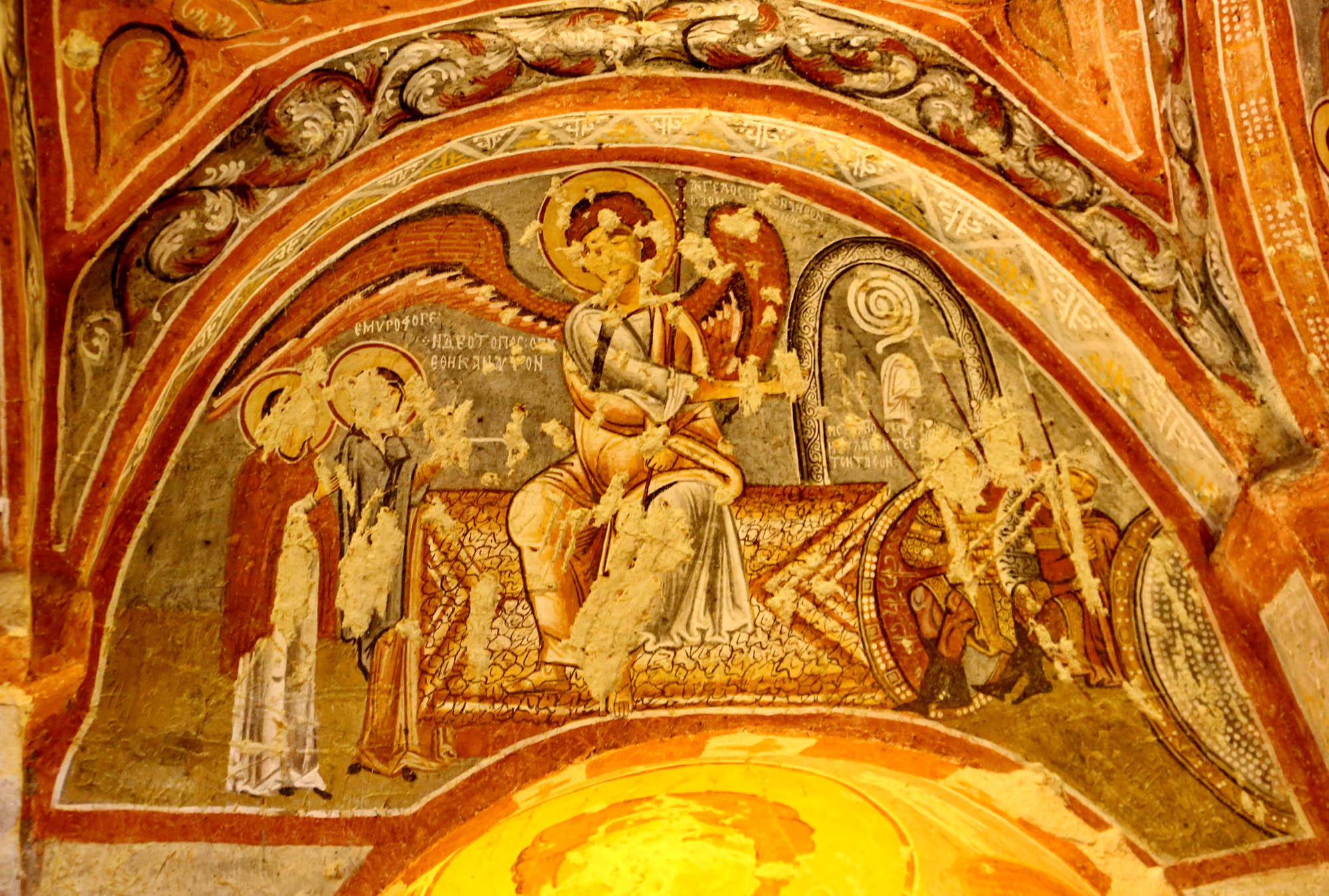
Opposite, on the upper west side: the Nativity of Jesus, in the arch the Adoration of the Magi, and the Transfiguration.
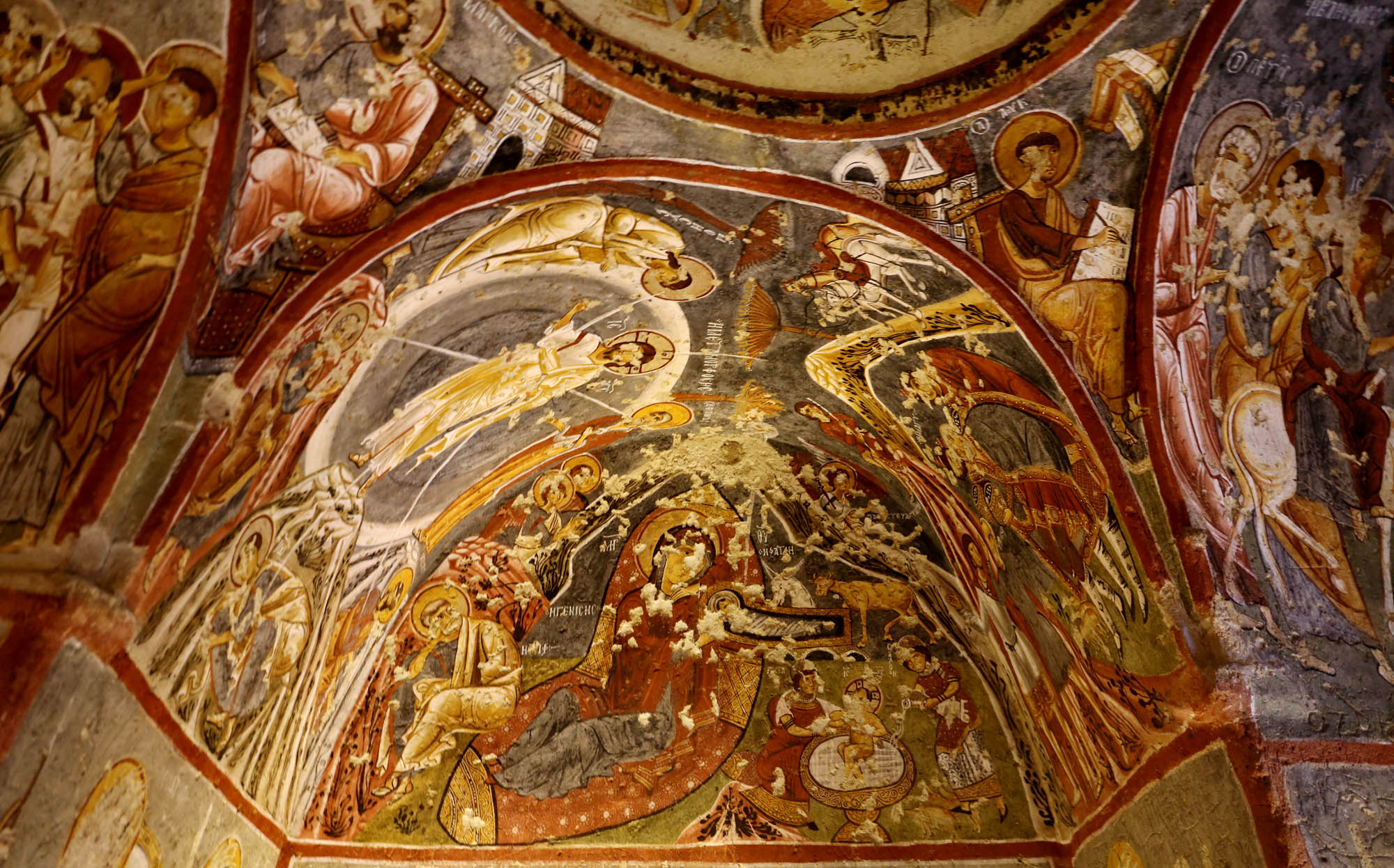
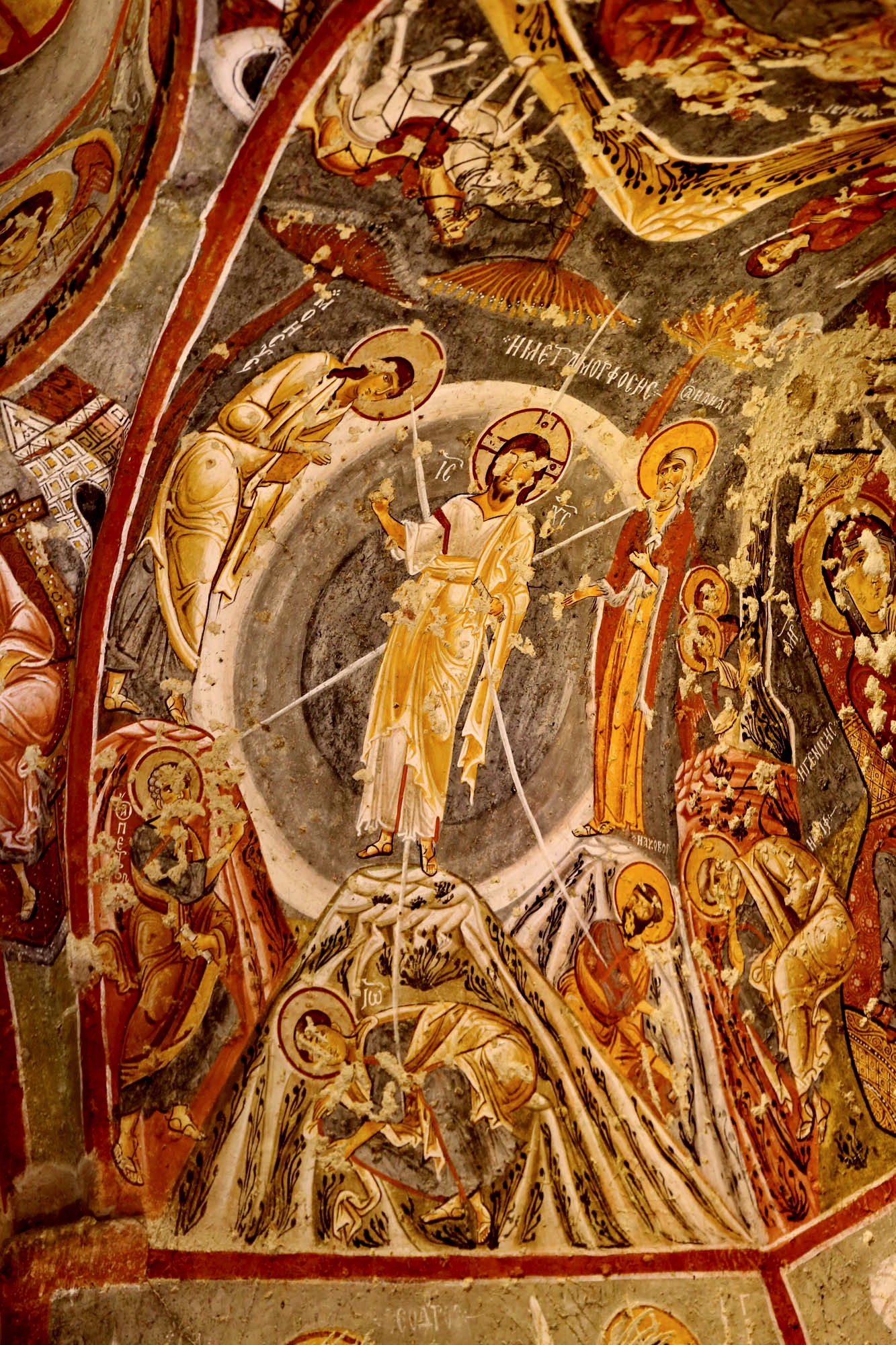
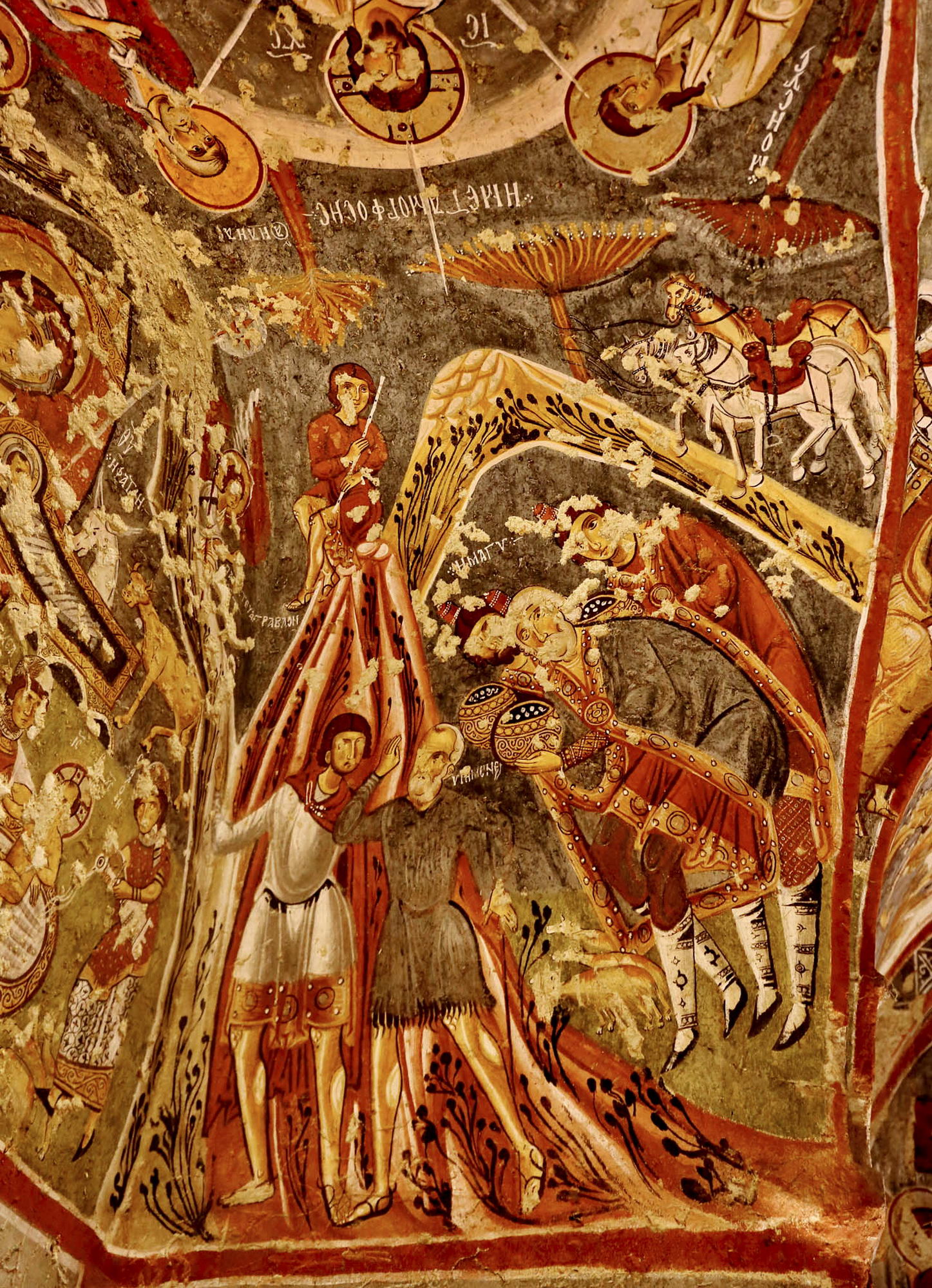
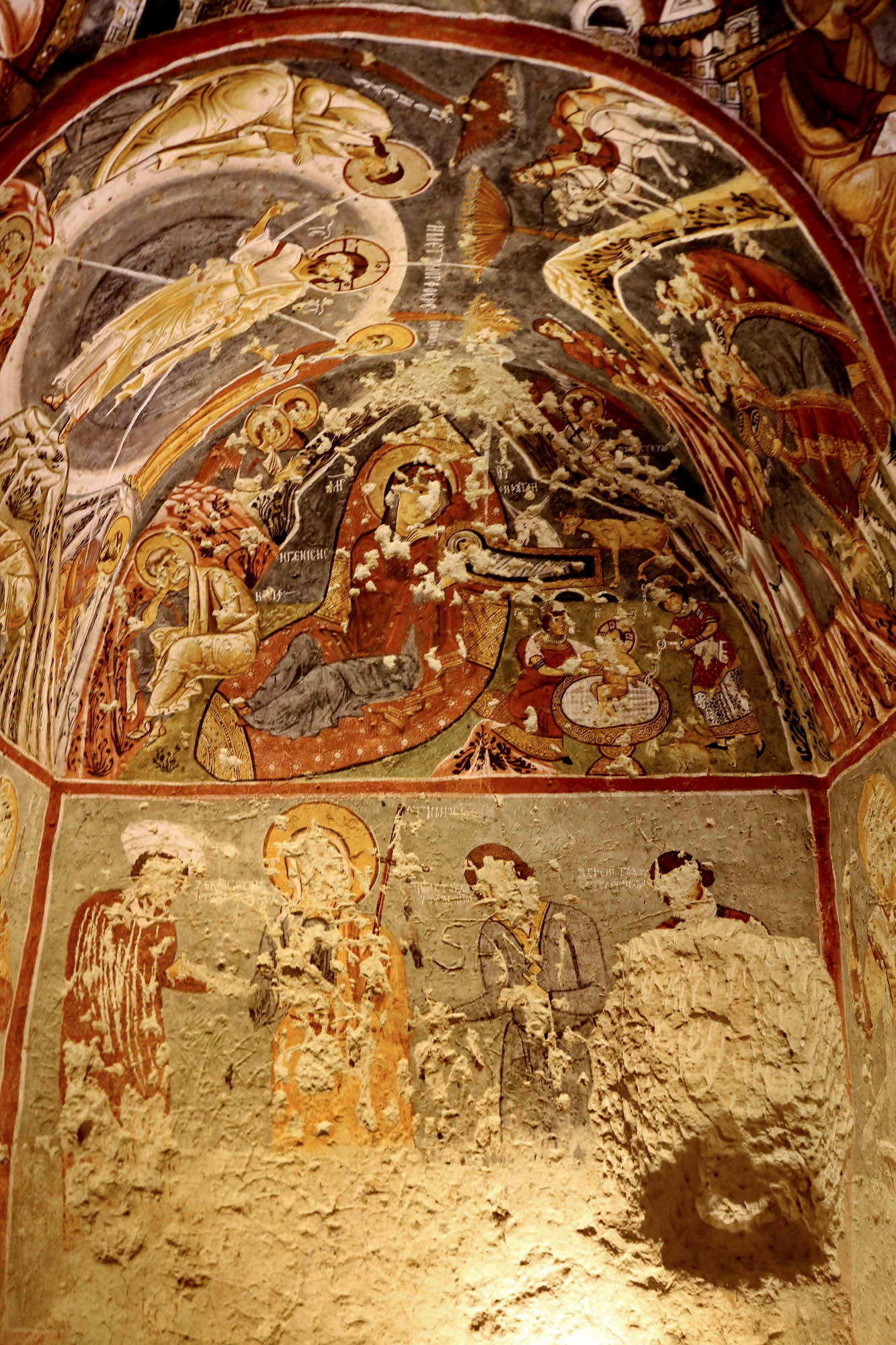
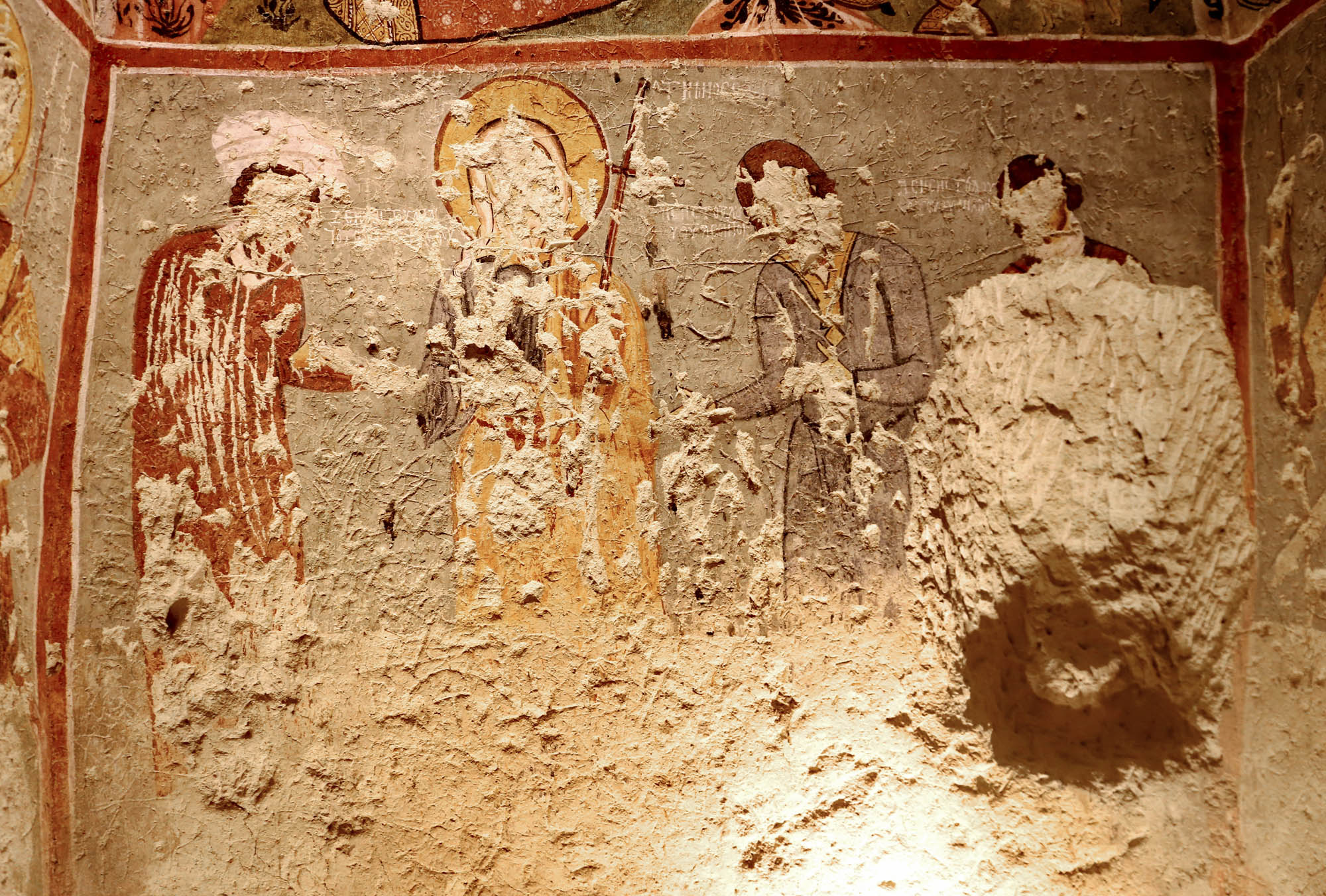
Below the Nativity are the church donors, who, according to their inscriptions, belonged to the Melissenos family. They were mainly military leaders and supporters of the imperial Phokas family. From the Phokas family came Emperor Nikephoros Phokas, who came to Cappadocia in the mid-10th century to clear the border region of Arabs through a military campaign, during which he commissioned and decorated the St. John Church in Çavuşin, serving as a model for other frescoed churches. The donor fresco lists the names Theognostos, Leo, and Michael Melissenos. Among them stands a larger figure with a halo, holding the Holy Cross, labeled "Timios Stavros."
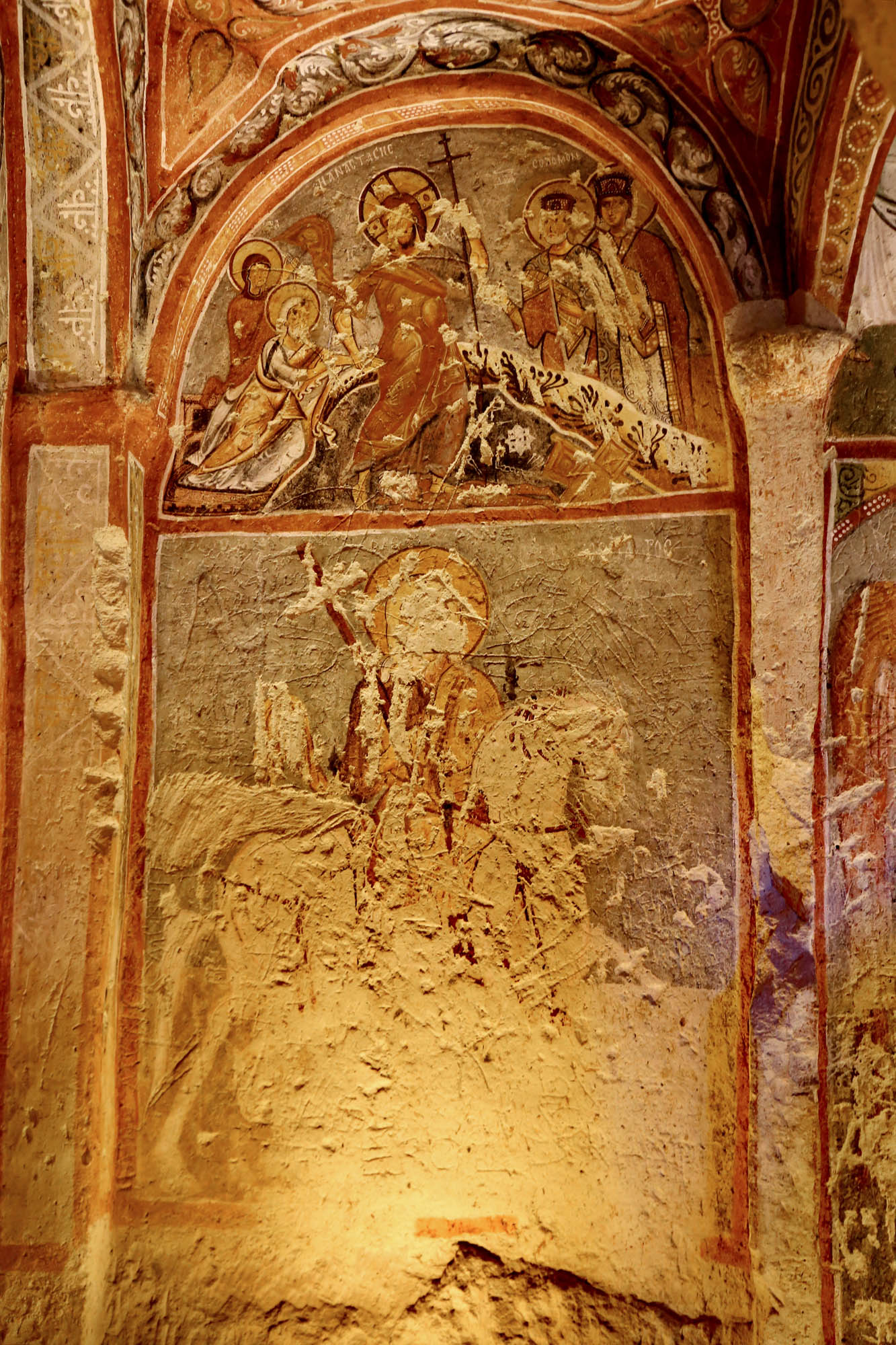
On the south wall, a mounted figure with a halo also carries the Holy Cross, again labeled "Timios Stavros." Scholarship suggests that since the inscription is on the Cross and not its bearer, the standing and mounted cross-bearer may be the same person who brought a piece of the Holy Cross here on behalf of the Melissenos family.
To the left of the Nativity and donor scene, the Ascension of Jesus sweeps across from the south wall. Entering the chapel, this fresco is the first one encountered (as the entrance is on the north side), and it is the most elaborately executed.
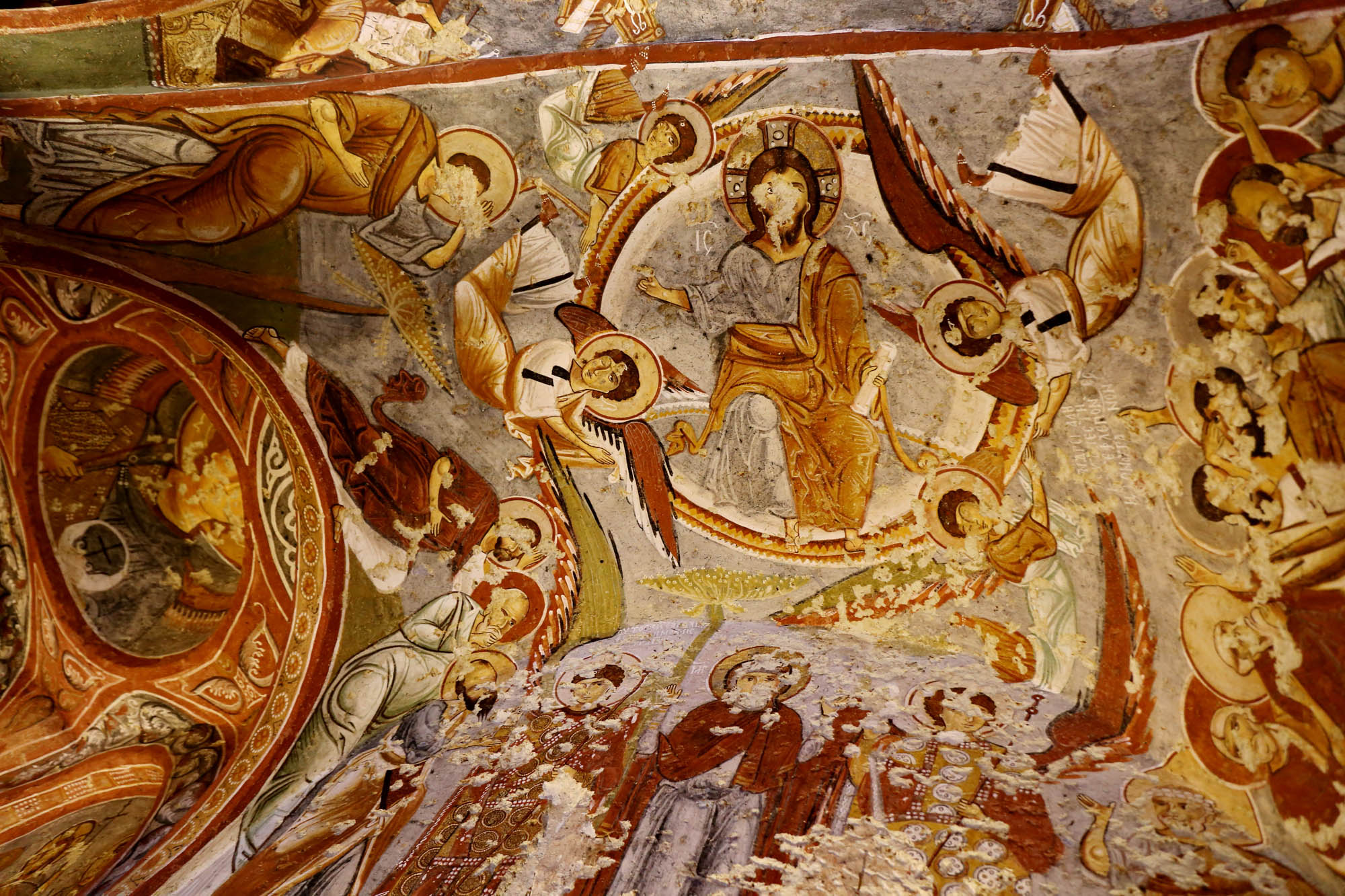
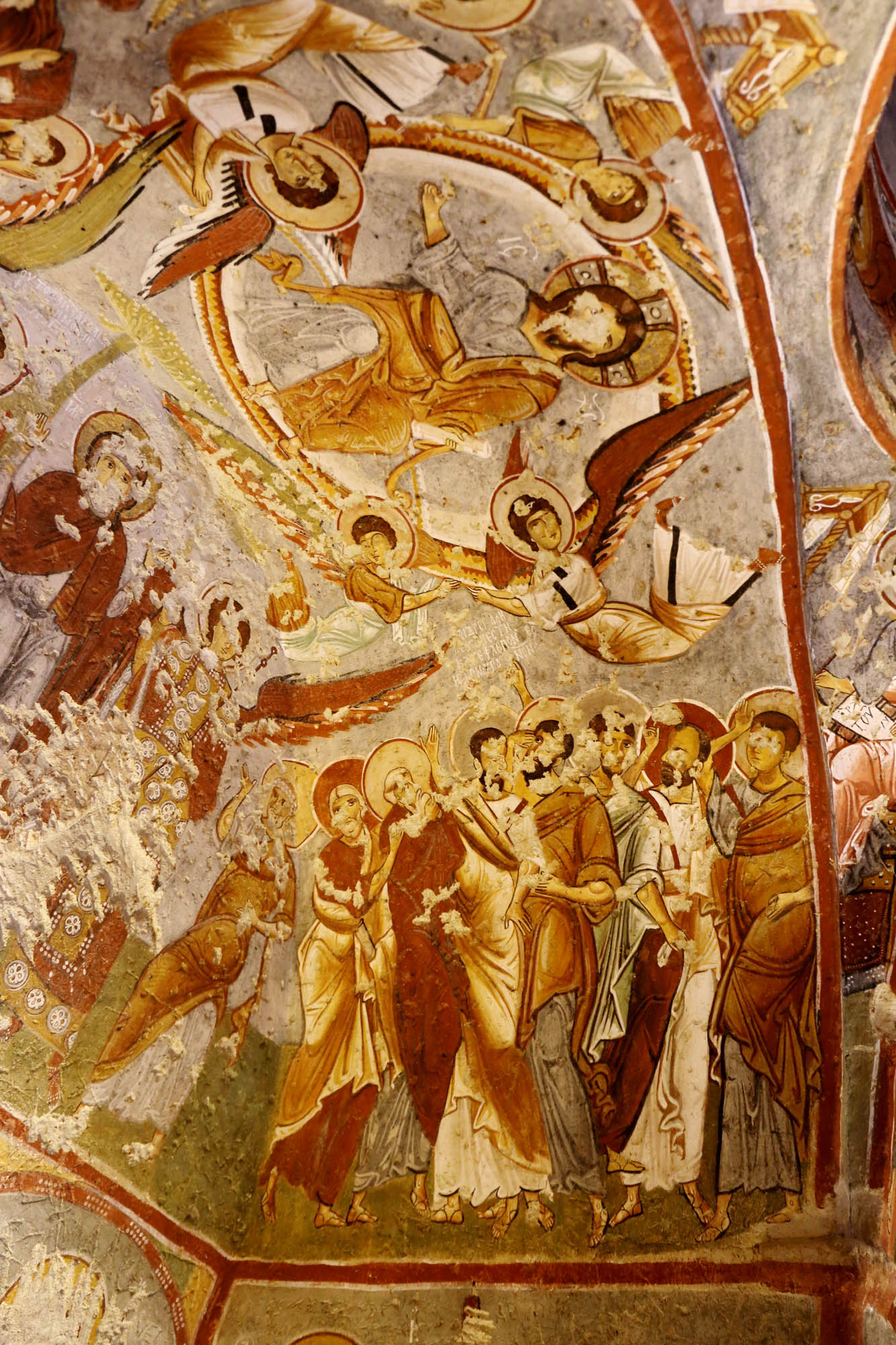
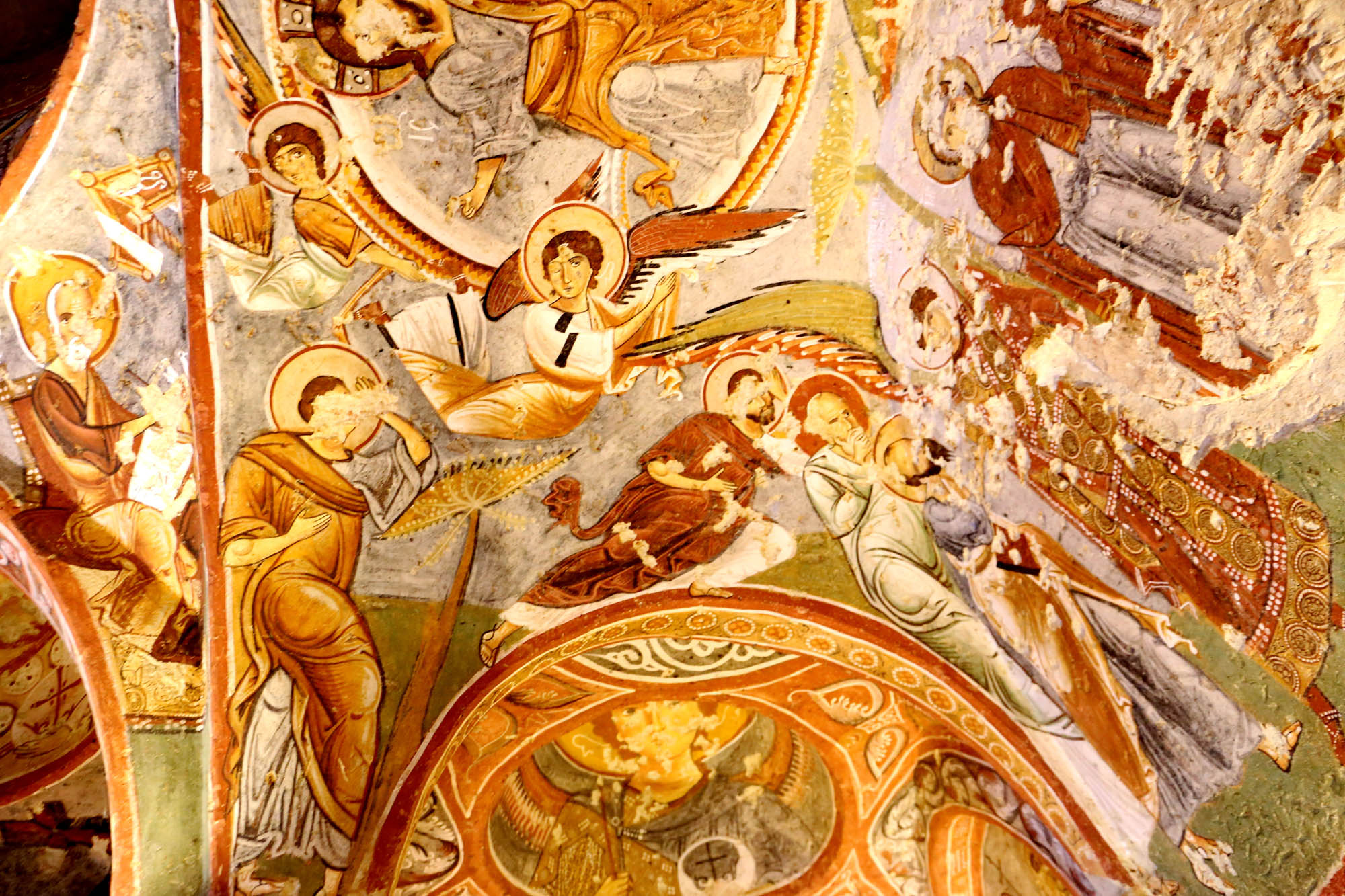
Below the Ascension, the Virgin Mary is flanked by two archangels, with Emperor Constantine and Saint Helena on the sides, holding the Holy Cross.
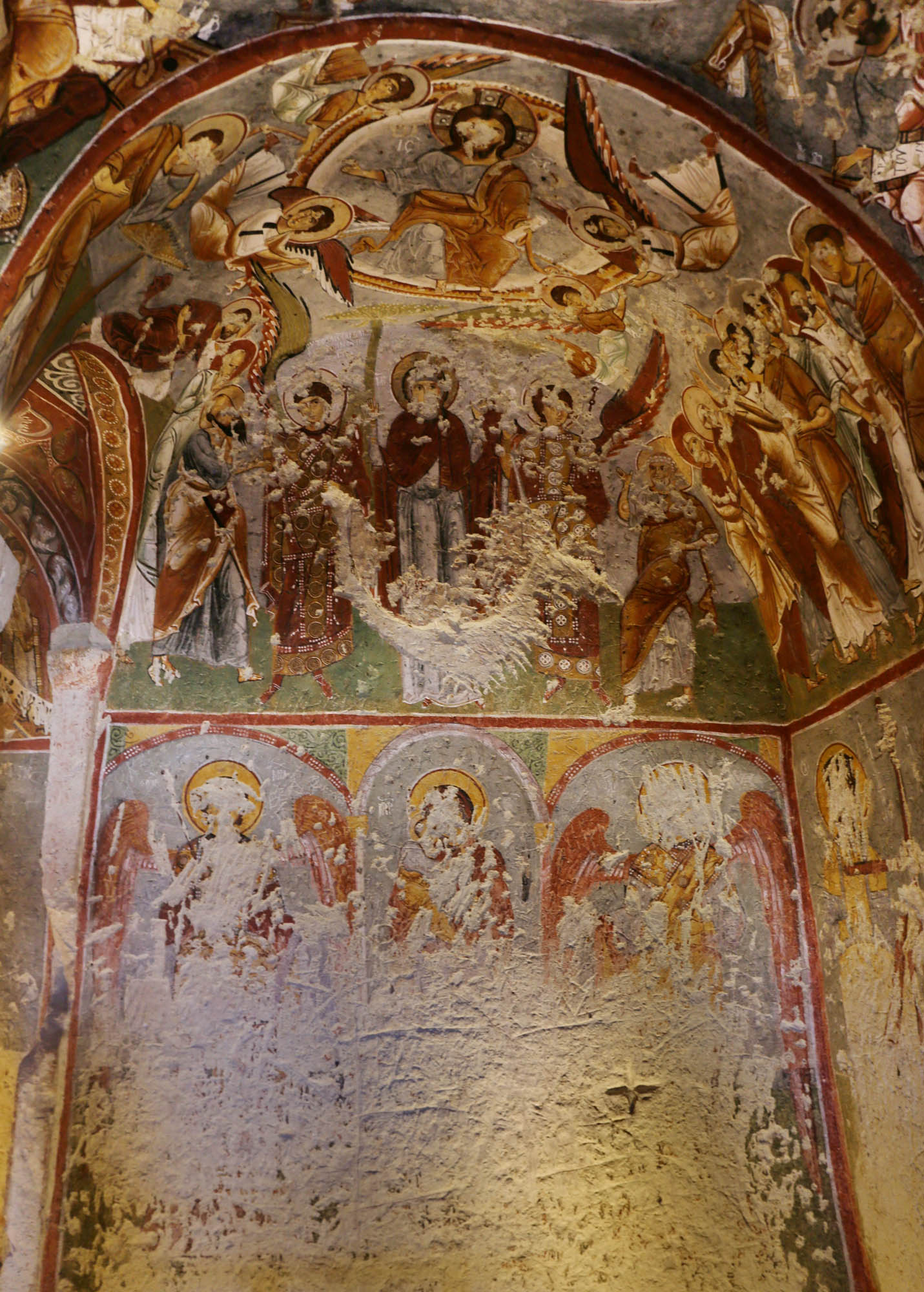
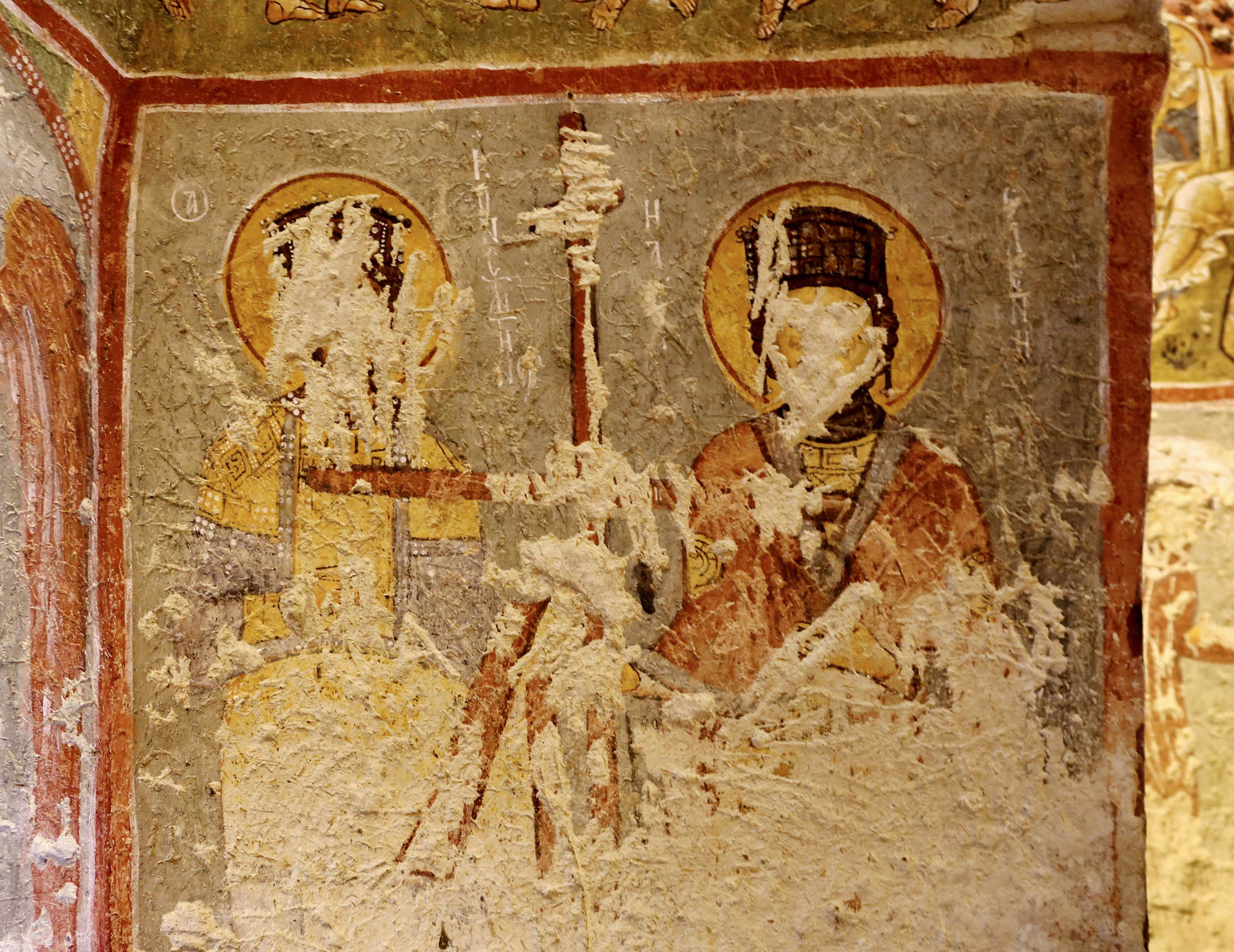
On the wall section closer to the apse: Christ’s Descent into Hell above, and the mounted cross-bearer mentioned earlier below.
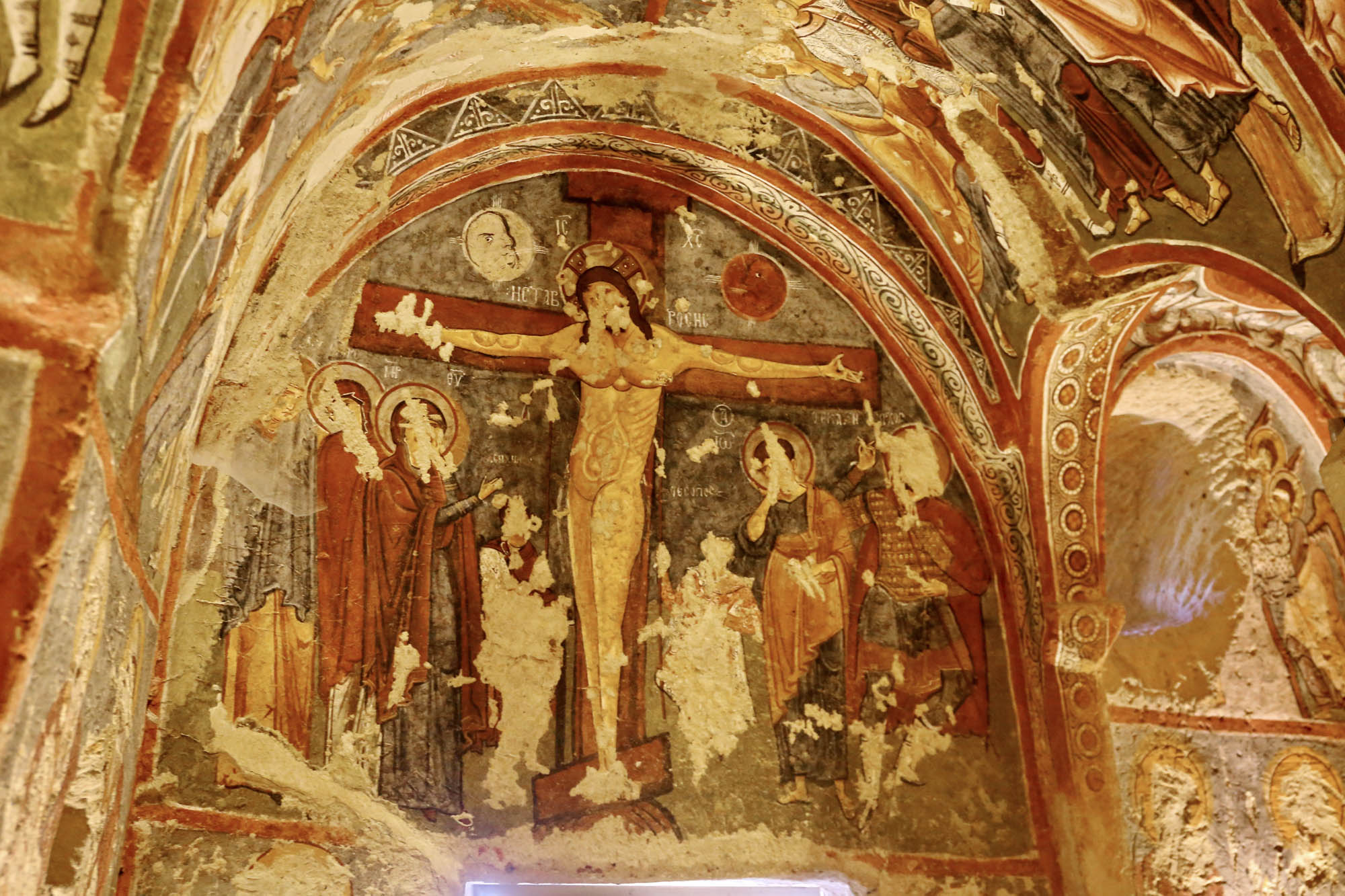
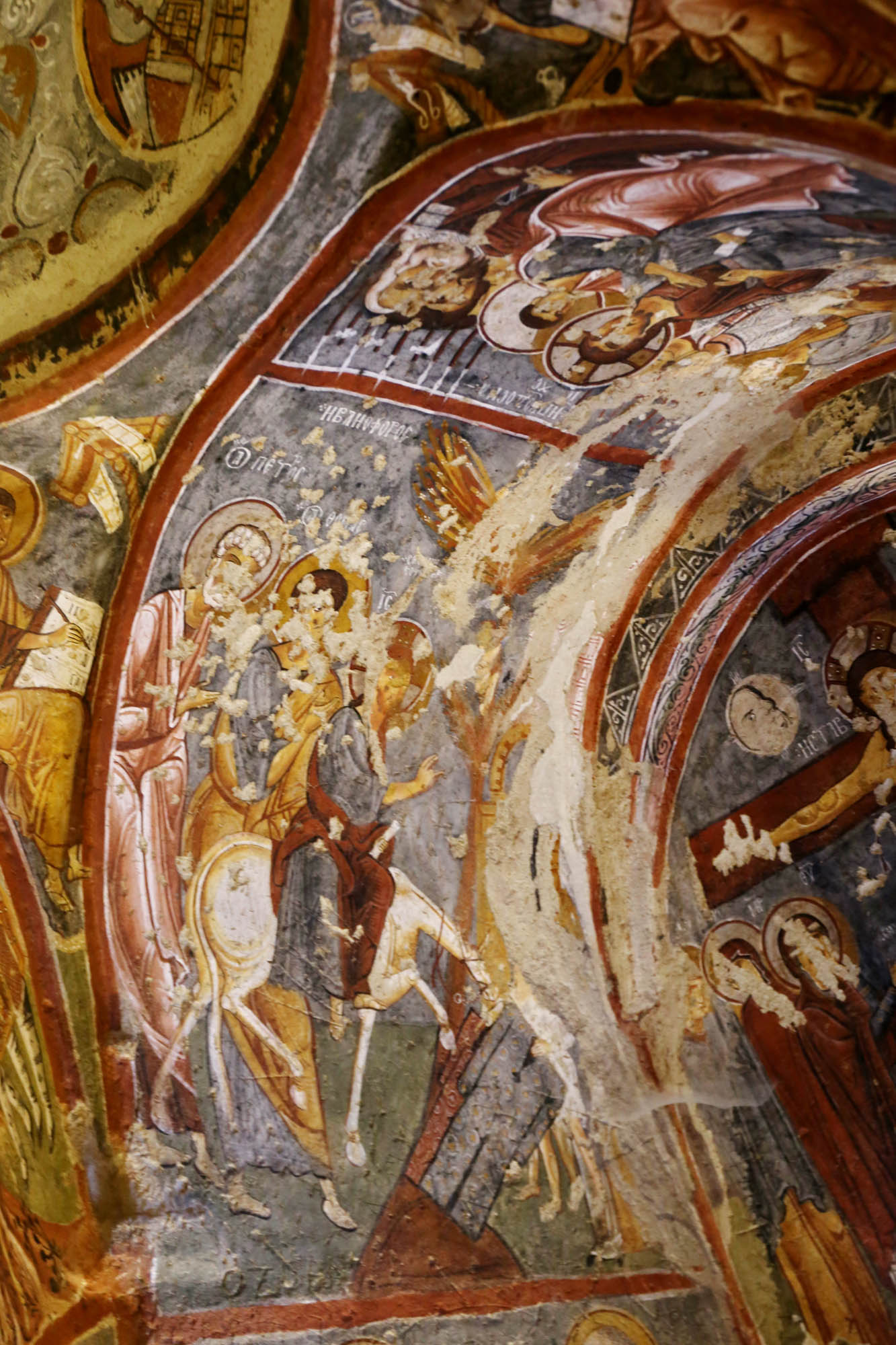
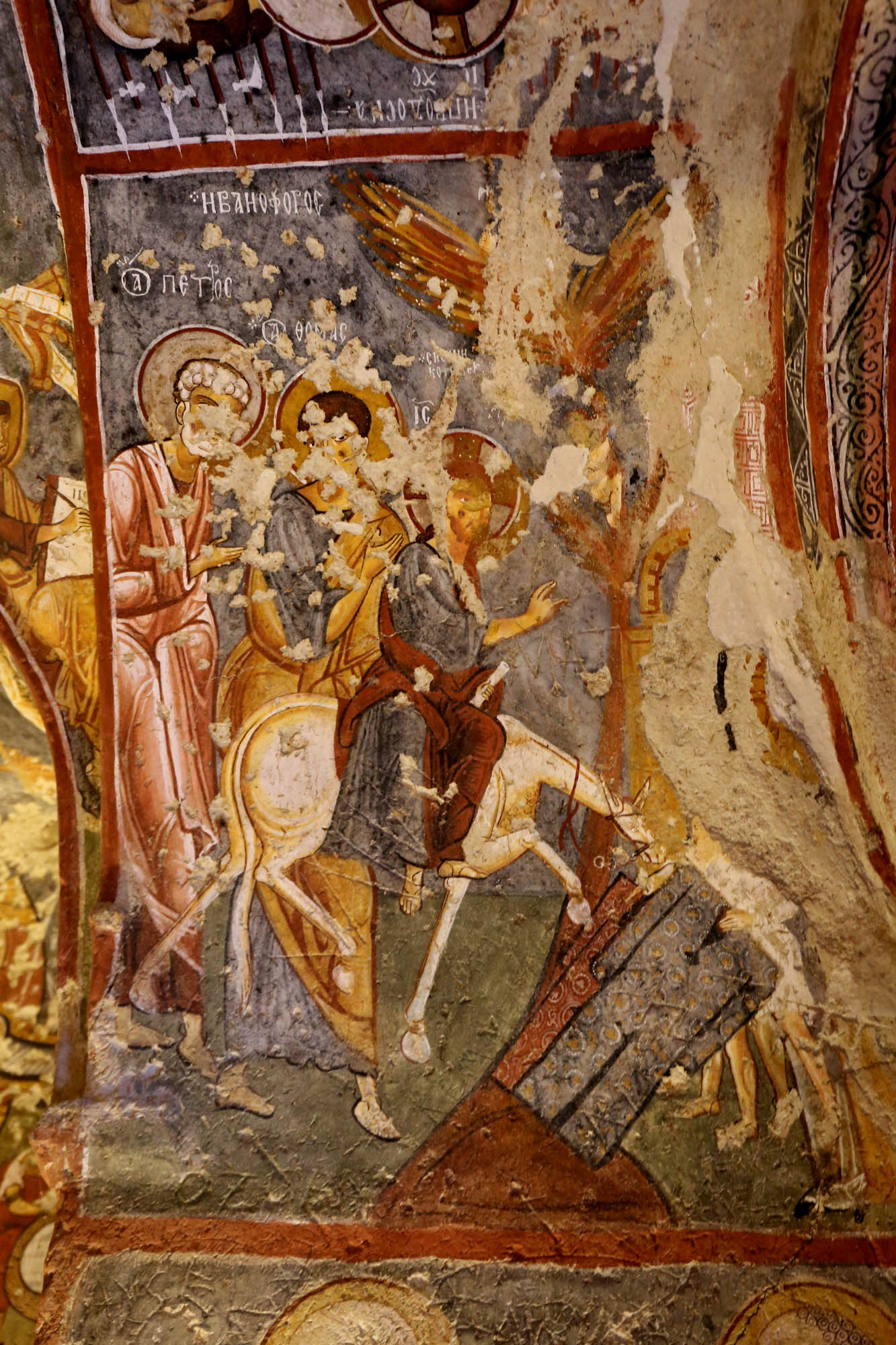
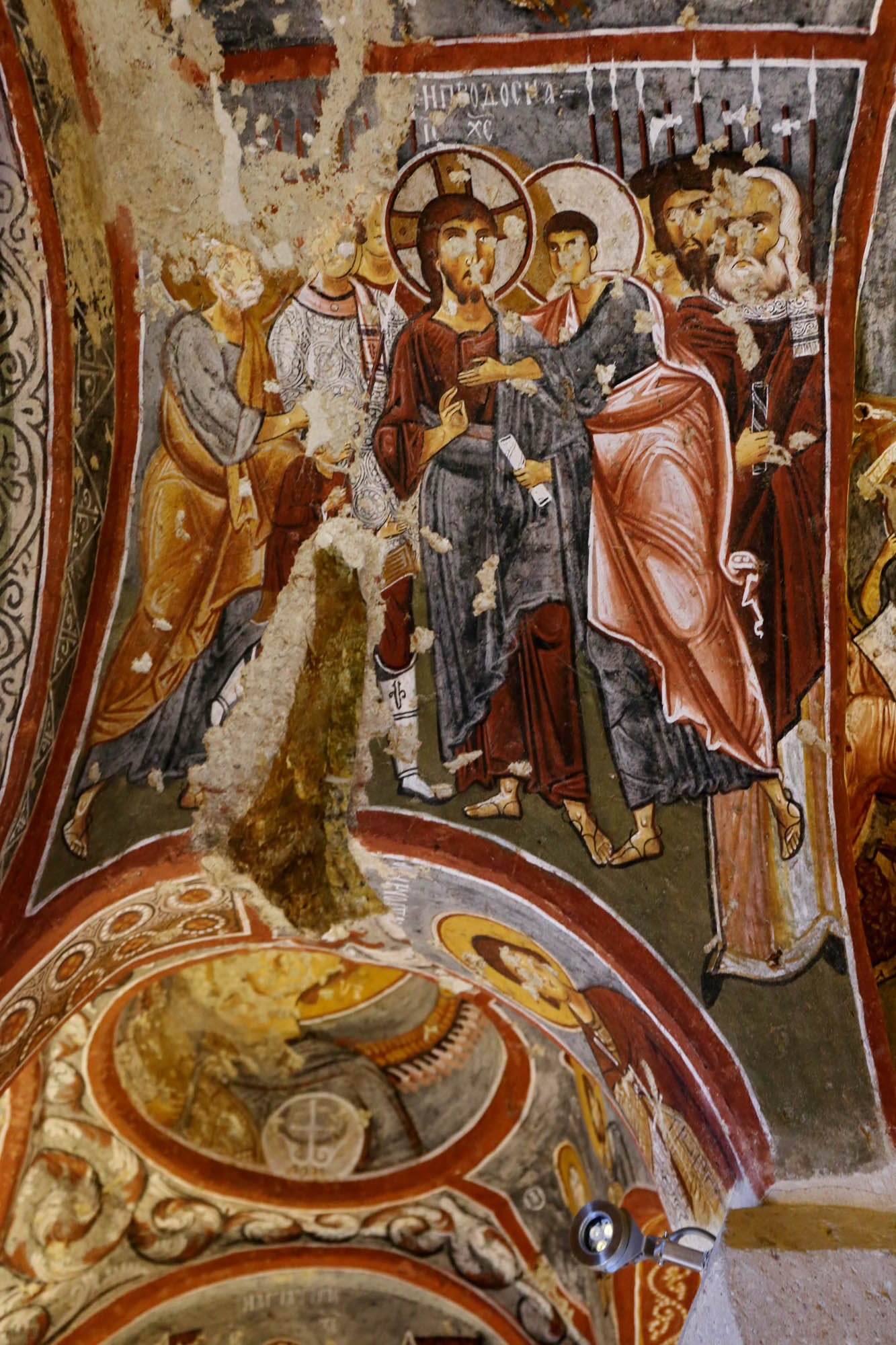
On the north wall around the entrance: the Crucifixion, with the Entry into Jerusalem and Judas’ betrayal in the arch above.
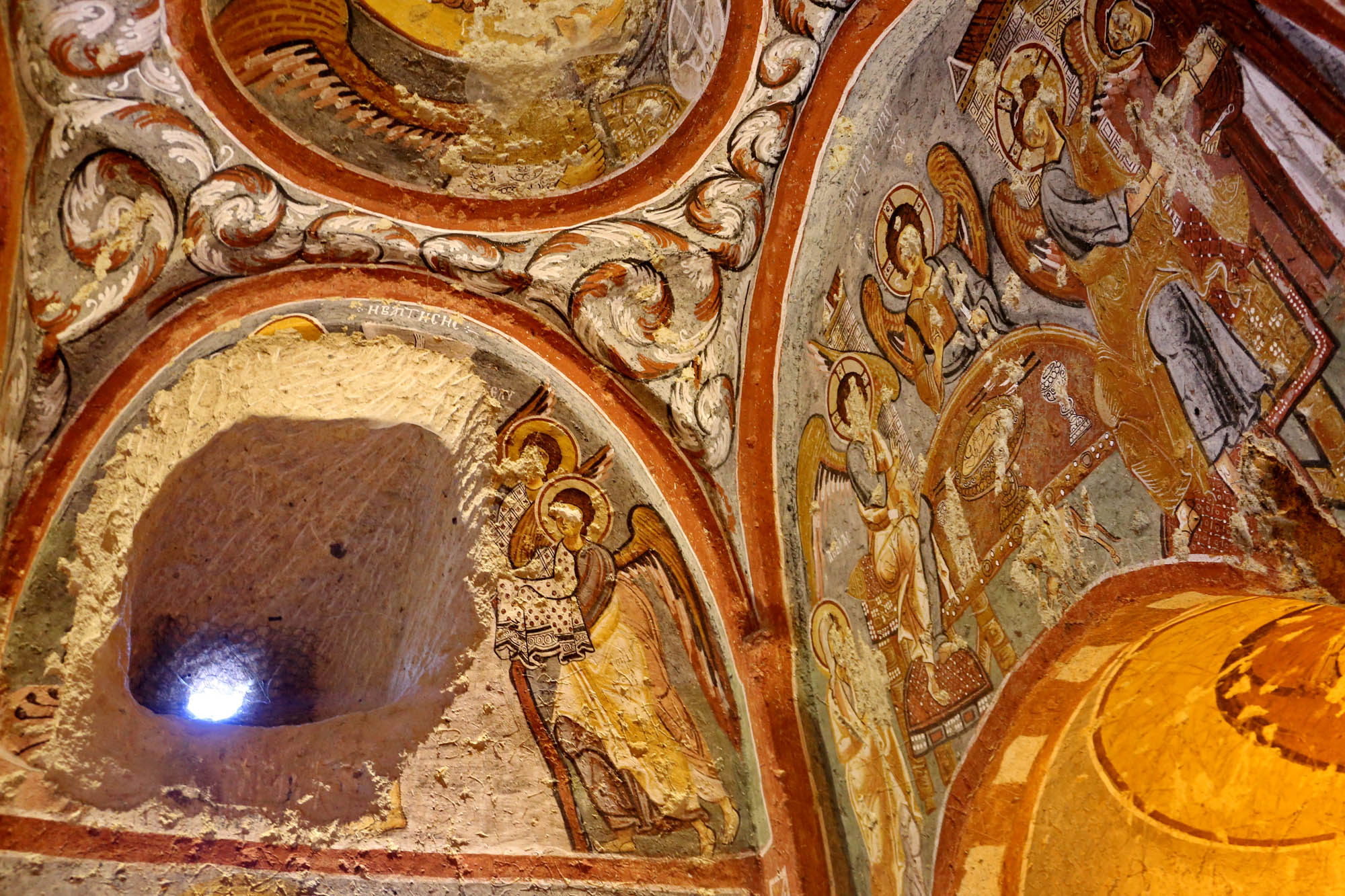
On the wall section nearer the apse: the Baptism of Christ. Only the angels holding towels are visible because a window was cut into the lunette. Below, Saint Barbara and Saint Eudochia.
The church is much smaller than the Karanlık chapel, so the cycle contains fewer frescoes. Scenes from Jesus’ life, already emphasized in Karanlık, are further reduced here to twelve—though not yet the twelve that will constitute the Orthodox liturgical calendar. It is clear that the same workshop executed them, in the same style and with identical iconographic-compositional solutions, highlighting especially the donors’ major relic, the Holy Cross.
|
☞ Next church |



Add comment