

Over the past decade and a half, Turkey’s museums have undergone a dramatic transformation. From dusty, provincial exhibition halls, they have one after another turned into world-class, elegantly designed and well-equipped 21st-century presentation spaces. On our most recent trips alone, this included the Zeugma Museum in Gaziantep, showcasing Roman mosaic floors from the Euphrates region; the Şanlıurfa Museum devoted to Göbeklitepe and other “-tepe” sites; the Van Museum dedicated to Urartian culture; the Nicaea Museum focusing on Greek sarcophagi; and many other similarly impressive collections opening from Istanbul to the Iranian border.
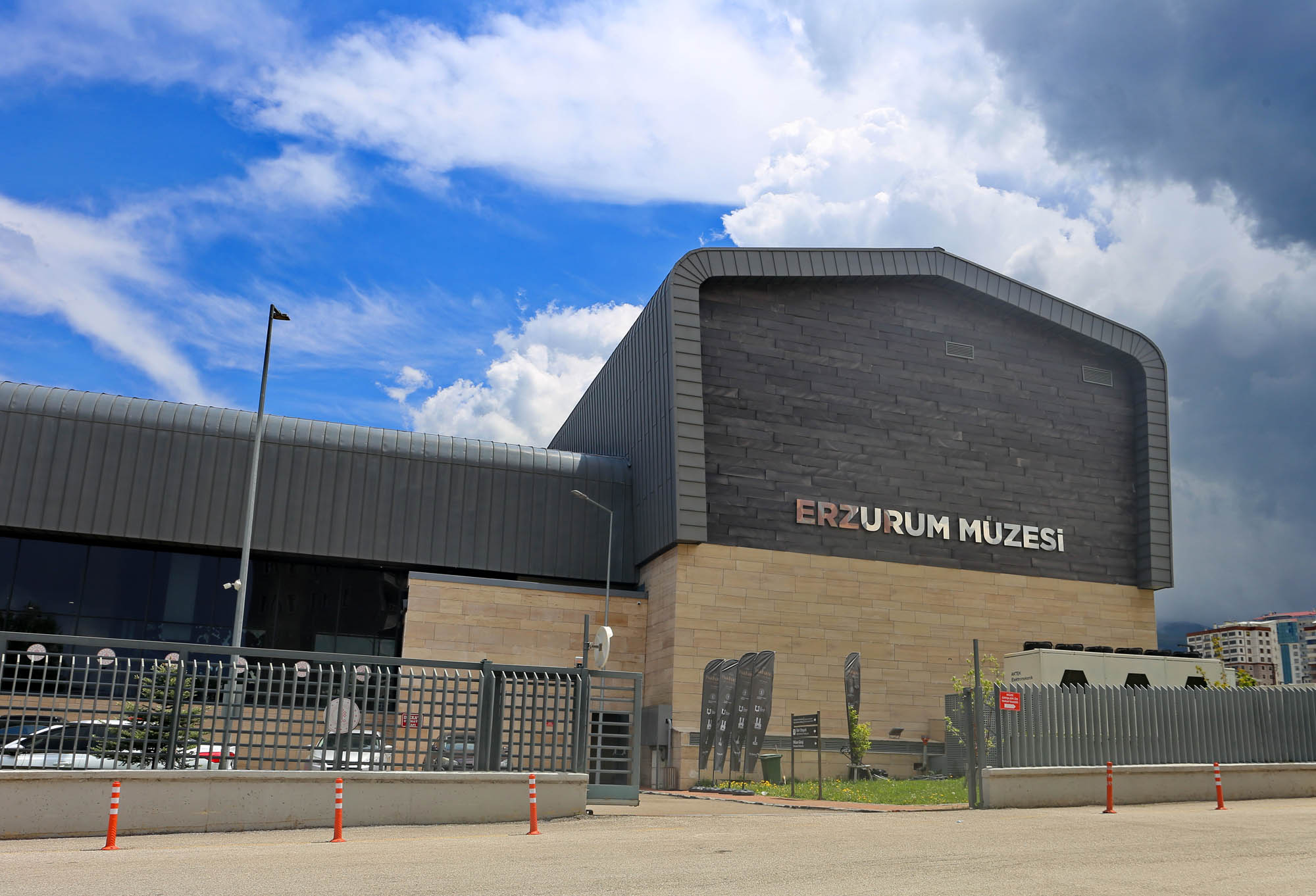
In 2023, such a modern museum also opened in Erzurum in northeastern Turkey. As the previous list suggests, the Turkish state tends to invest in the construction of such museums primarily when they are meant to showcase particularly representative material. What, then, is so special about Erzurum?
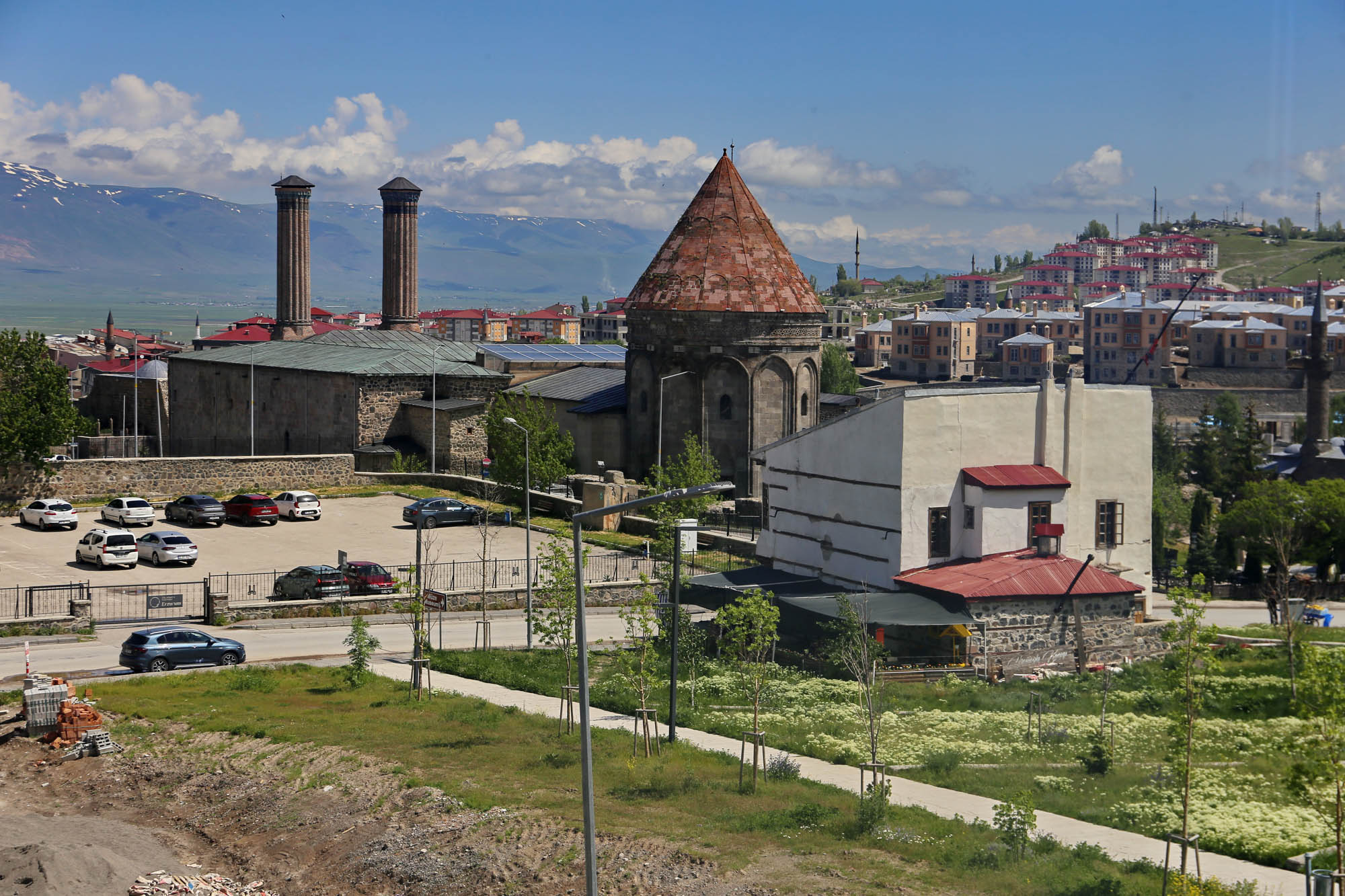
When work began in 2018 on the new building of the Erzurum Museum, it was primarily because the previous structure had been declared earthquake-prone and had to be demolished. Erzurum is above all known for its Seljuk heritage, as a city that became the first capital in Anatolia of the Seljuk Turks after their victory over the Byzantines at the Battle of Manzikert in 1071. This heritage, however, is not primarily preserved in museum objects but in 12th–14th-century architecture. The new museum was deliberately built in such a way and location that its large glass windows constantly frame these monuments.
However, the vast majority of the museum’s objects consist of ceramics and stone tools from the Early Bronze Age Karaz culture. And although this culture was highly significant in its time (ca. 3500–2000 BC), spreading from the Erzurum region as far as the South Caucasus and down to present-day Israel, one has to admit honestly that these displays alone are unlikely to excite either the casual visitor or the ministry official responsible for allocating development funds.
But as construction of the new museum began, a star artifact arrived, as if it had been waiting for the allocation of a dignified new home. In 2020, on the pasturelands of Ormanlı (Şenkaya), north-east of Erzurum, local shepherds came across a stone figure protruding from the ground, which turned out to be a 2,500-year-old anthropomorphic stele: a male figure wearing a broad belt and raising a vessel to his mouth. The discovery became a major sensation in the Turkish press, and it did not take long before experts interpreted the statue as related to the steppe Turkic “stone balbals” (Taş Baba, stone-carved ancestral figures), and as evidence of the early Anatolian presence of Turkic peoples (“Kipchaks,” the well-known magic word also appeared here) *.
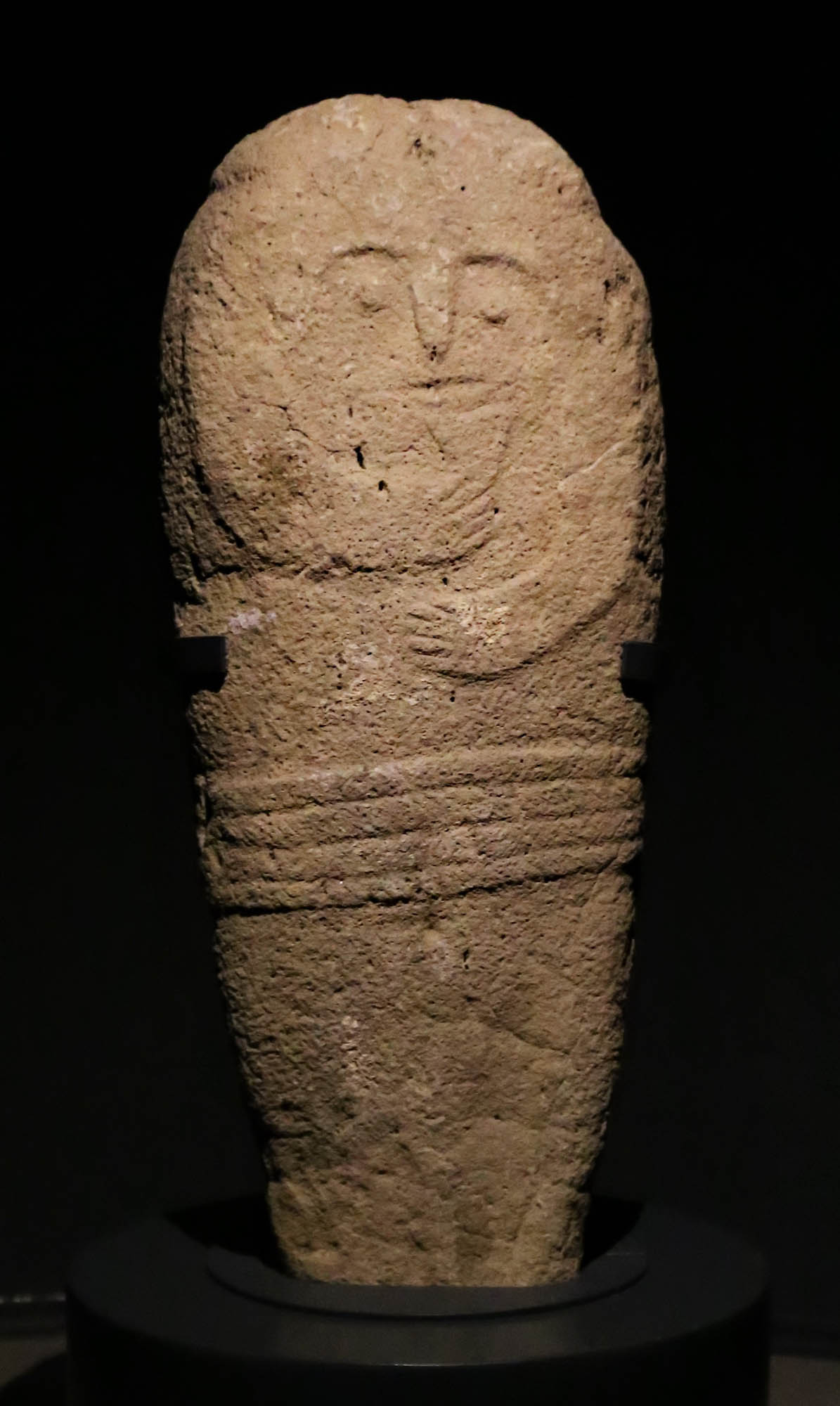
International scholarship received these identifications with skepticism. On the one hand, there are no sources on the presence of the Turks on the East Asian steppe before the 4th–5th centuries AD, i.e. roughly a thousand years after the supposed date of the Erzurum stele. On the other hand, similar stelae are known from across the steppe in the millennia preceding the appearance of the Turks, from the Altai to Eastern Europe. These were erected by the Scythians over the graves of their leaders. Their characteristic features — the belt, often carrying weapons, and the offering vessel raised to the mouth with one or both hands, and in many cases even the slightly oval shape of the stele — correspond exactly to the Erzurum example. It is another matter that the Turks who later replaced the Scythians on the steppe began to imitate this type of stele in the form of “stone balbals” appearing from the 6th century AD onward — but projecting this late development back millennia earlier is like claiming that the Roman Pantheon is Hungarian because its columns resemble those of the National Museum in Budapest.
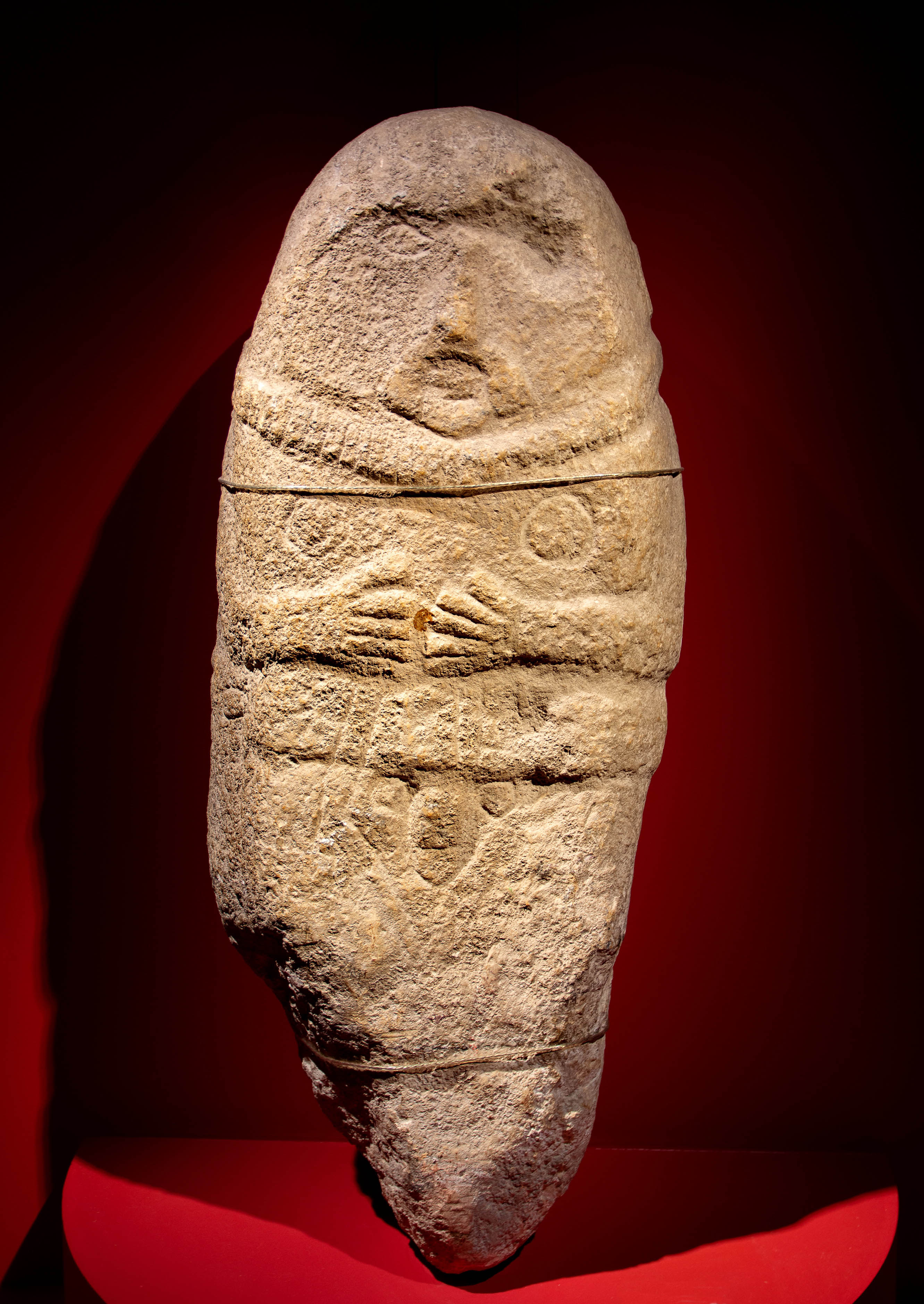 Scythian funerary stele from the 6th–5th century BC in the Constanța Museum
The appearance of the Scythians in 7th–6th century BC Eastern Anatolia is described by Herodotus, who records that they broke in from the steppe, and for twenty-eight years held all of Western Asia under their domination, even clashing with the Egyptians. Eventually, the Median king Cyaxares put an end to their power in the region, after which they withdrew back to the steppe. Archaeological evidence also attests to this: characteristic Scythian bronze arrowheads have been found in their thousands embedded in the walls of Urartian fortresses in northeastern Anatolia. The river valleys leading from the present-day Georgian border toward Erzurum—as our current journey also confirms—formed easily passable corridors for nomadic horse-riding peoples invading from the South Caucasus. The fact that the statue was found precisely in such a corridor suggests that it may have been erected by Scythian conquerors for a high-ranking leader who died here—the width of the belt points to his status.
The museum curators were clearly in an awkward position. On the one hand, due to official Turkish identity politics and the ministry responsible for development funding, they had to emphasize the statue’s Turkic origin. On the other hand, they did not want to appear completely foolish in the eyes of foreign colleagues. In the end, they resolved the presentation and labeling of the stele in a remarkably ingenious way.
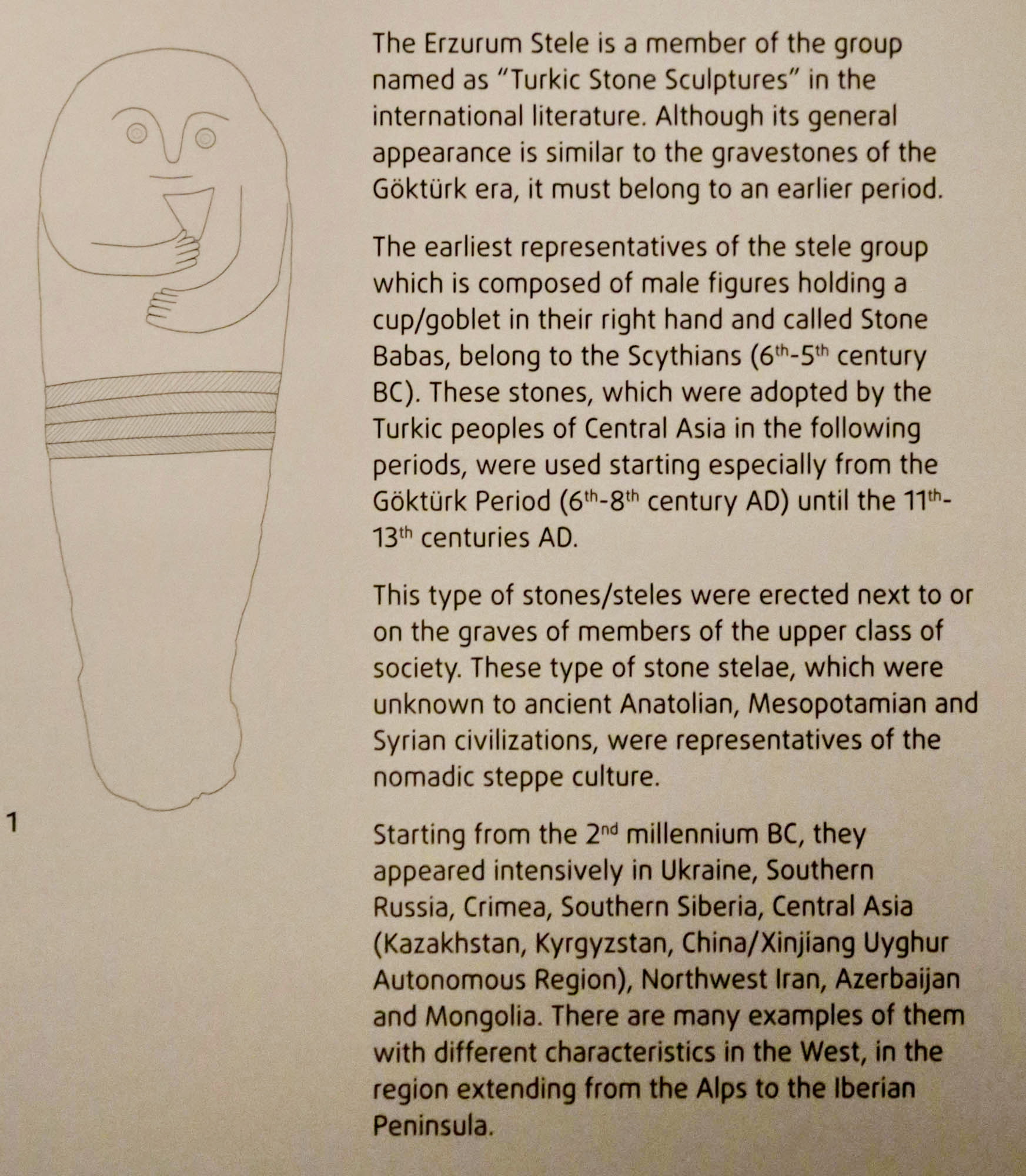
The first line of the label states that “the Erzurum stele is a member of the group known in international scholarship as ‘Turkic stone statues’.” But then it immediately sails into calmer waters: “The earliest representatives of male figures holding a goblet in their hands were created by the Scythians in the 6th–5th centuries BC. These were later adopted by the Central Asian Turkic peoples, who used them especially from the Göktürk period (6th–8th c. AD) through to the 11th–13th centuries.”
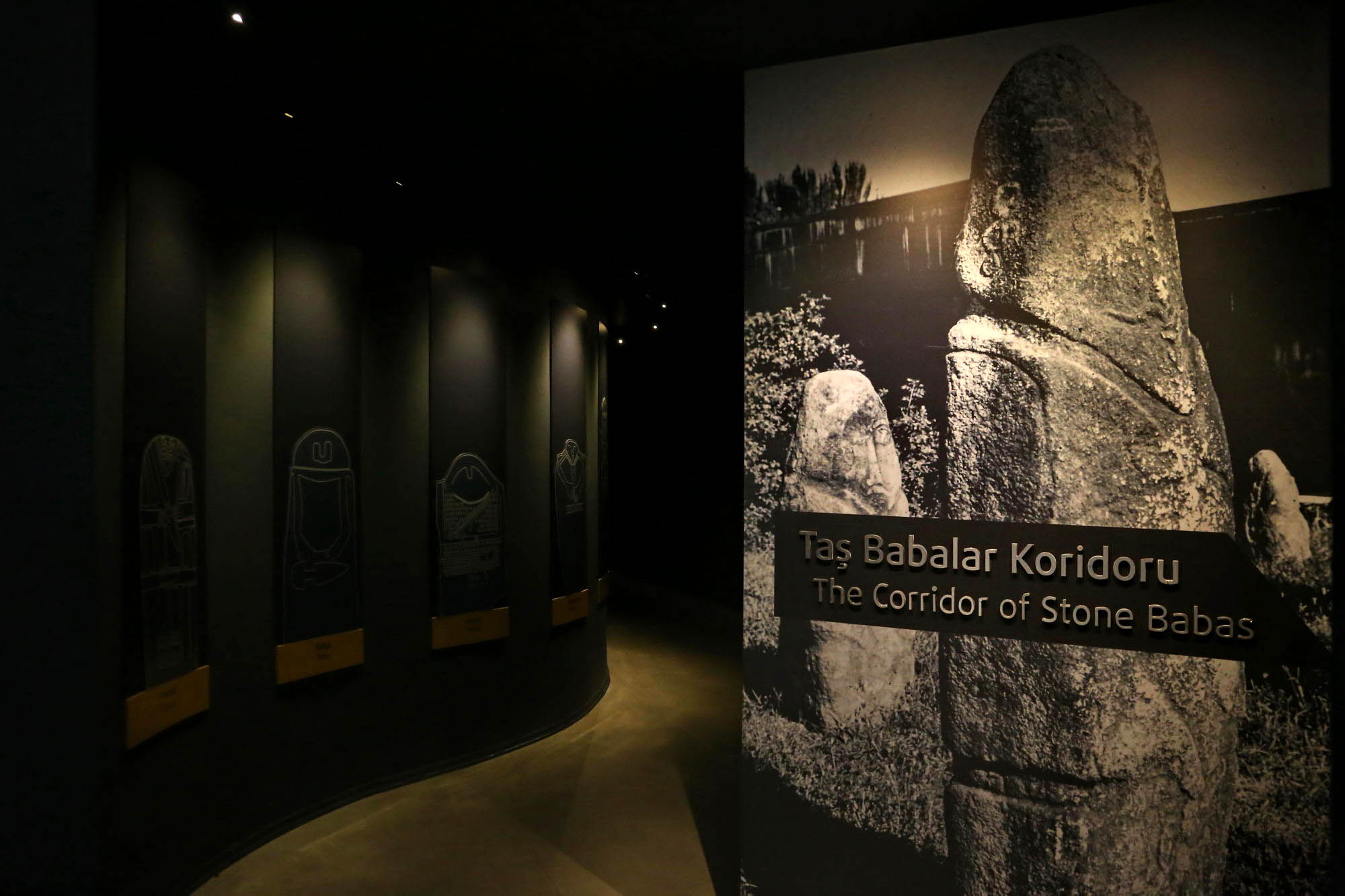
And the most remarkable part is the exhibition itself. The stele naturally stands at the very center of the new museum. However, one must reach it through a winding, dimly lit corridor introduced by a large photograph labeled “The Corridor of the Stone Balbals.” The image shows a 6th-century Turkic balbal near the Burana Tower in Kyrgyzstan, serving as a visual bridge linking the Şenkaya mountains with the thousands of kilometers-distant Turkic tribal territories of Central Asia. The walls of the corridor are rhythmically lined with graphic representations of famous anthropomorphic stelae, like apostle statues in the nave of a church, stretching from China to Spain—with the dominance of steppe Turkic stone balbals—leading, as the fulfillment of their prophecy, to the Erzurum stele standing in the circular sanctuary at the end. A large map on the wall shows the distribution area of such anthropomorphic stelae: the territory they cover appears to merge the Turkic linguistic sphere with the actual or imagined borders of the Ottoman Empire.
Mozart: Turkish March. Performed by the Mehteran Ottoman military band
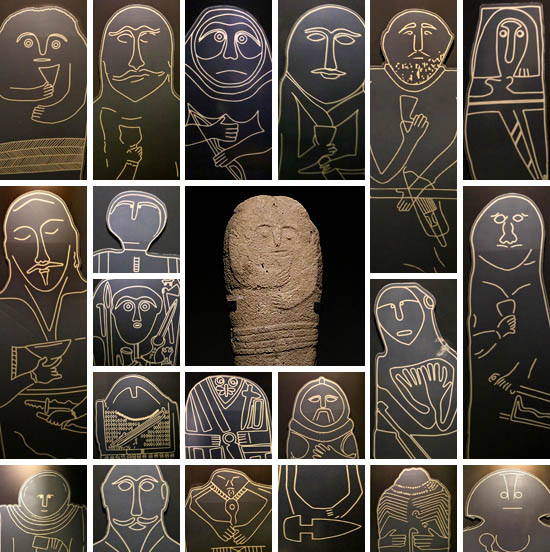
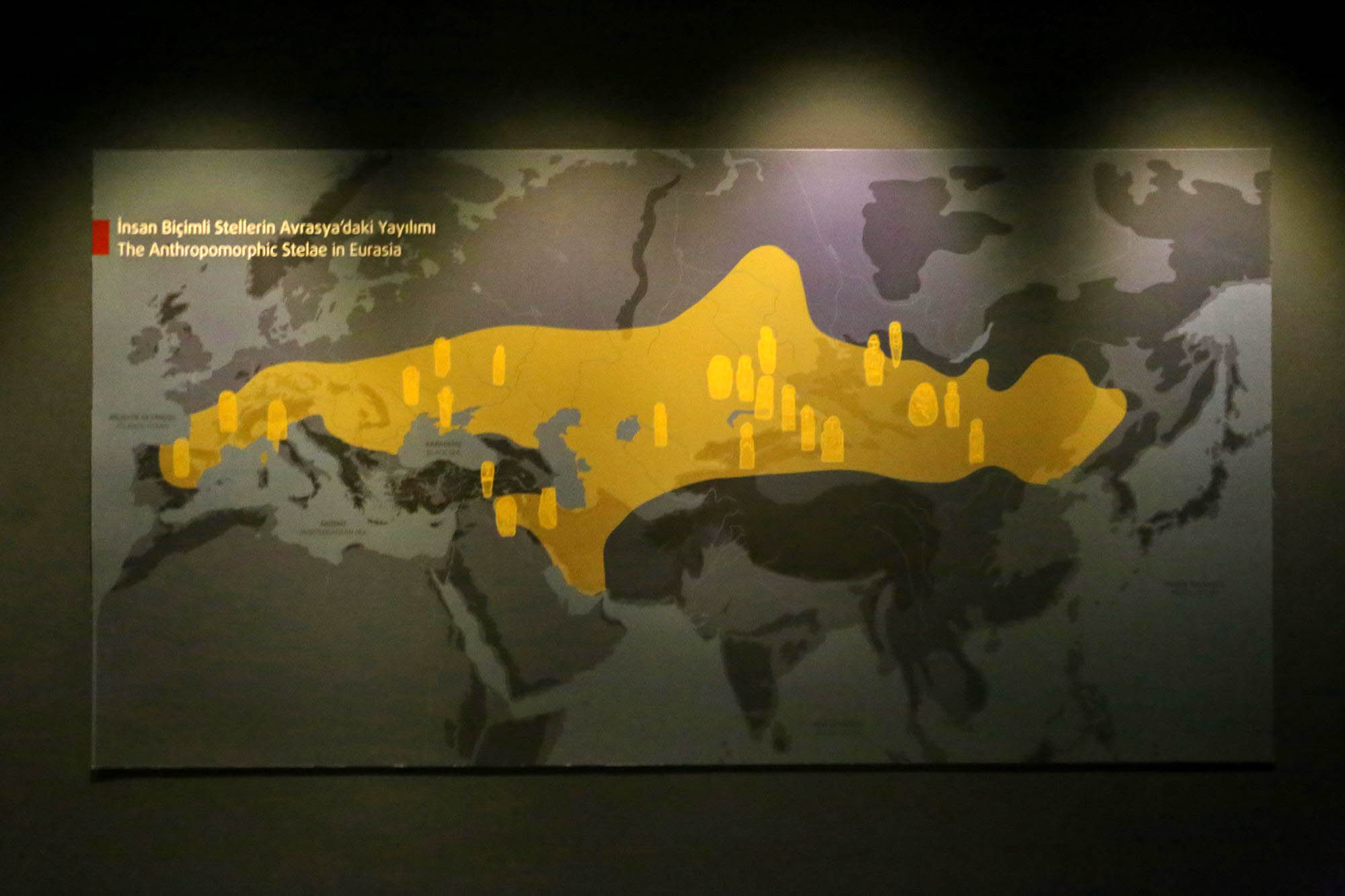
The installation does not state anything explicitly, and therefore suggests to everyone what they already tend to believe: that the Erzurum stele, and the Turkish stone balbals, belong to a vast spatio-temporal context stretching from the 4th millennium BC to the 14th century AD, and from China to Hispania; or that anyone in Eurasia who ever erected a stone and carved a face with eyes and a mouth was therefore Turkic—or even Kipchak. A familiar pattern.
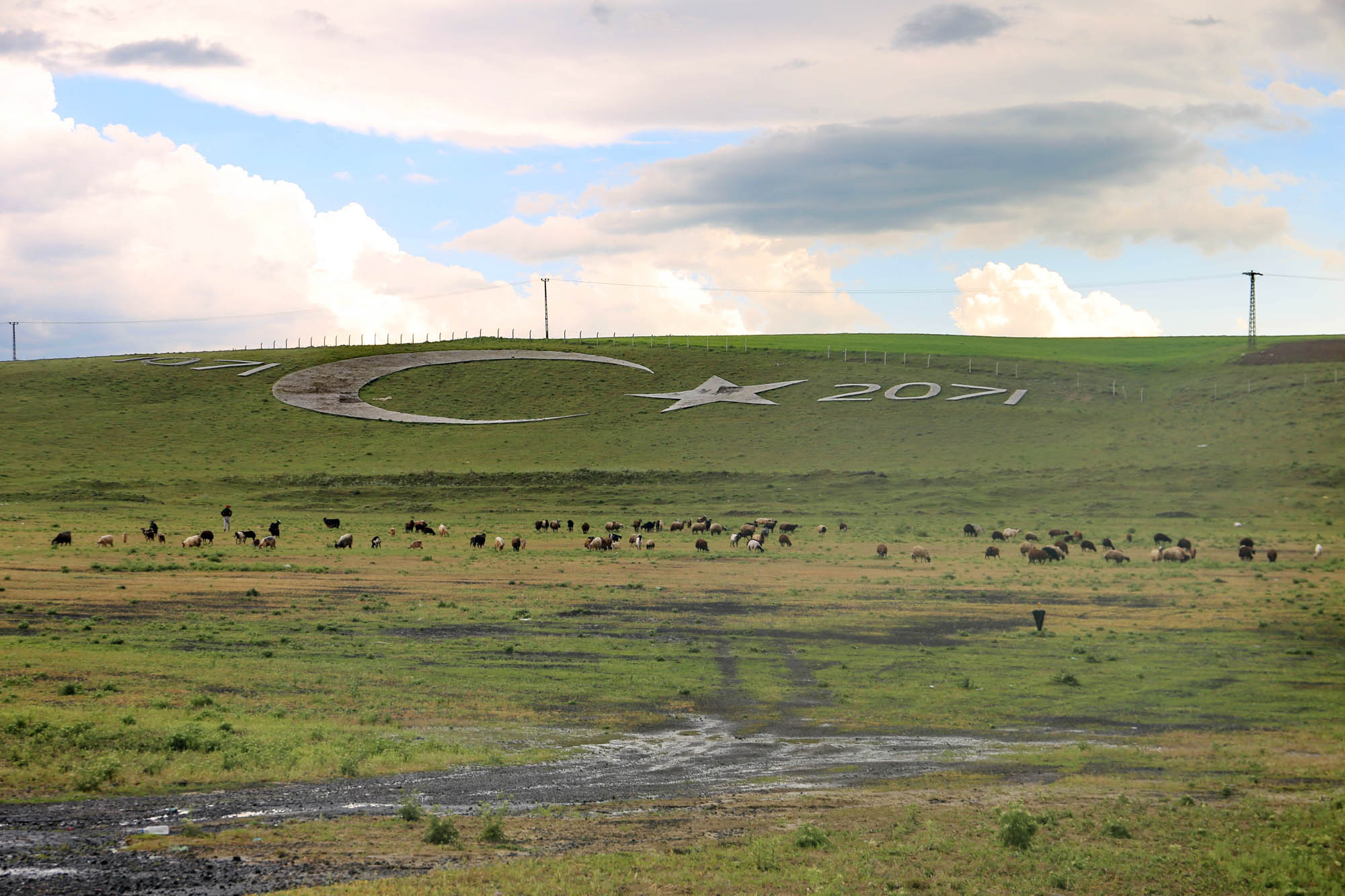 If the future can be extended, so can the past. A deliberately pre-constructed commemorative geoglyph for the 1000th anniversary of the Battle of Manzikert (1071).



Add comment