

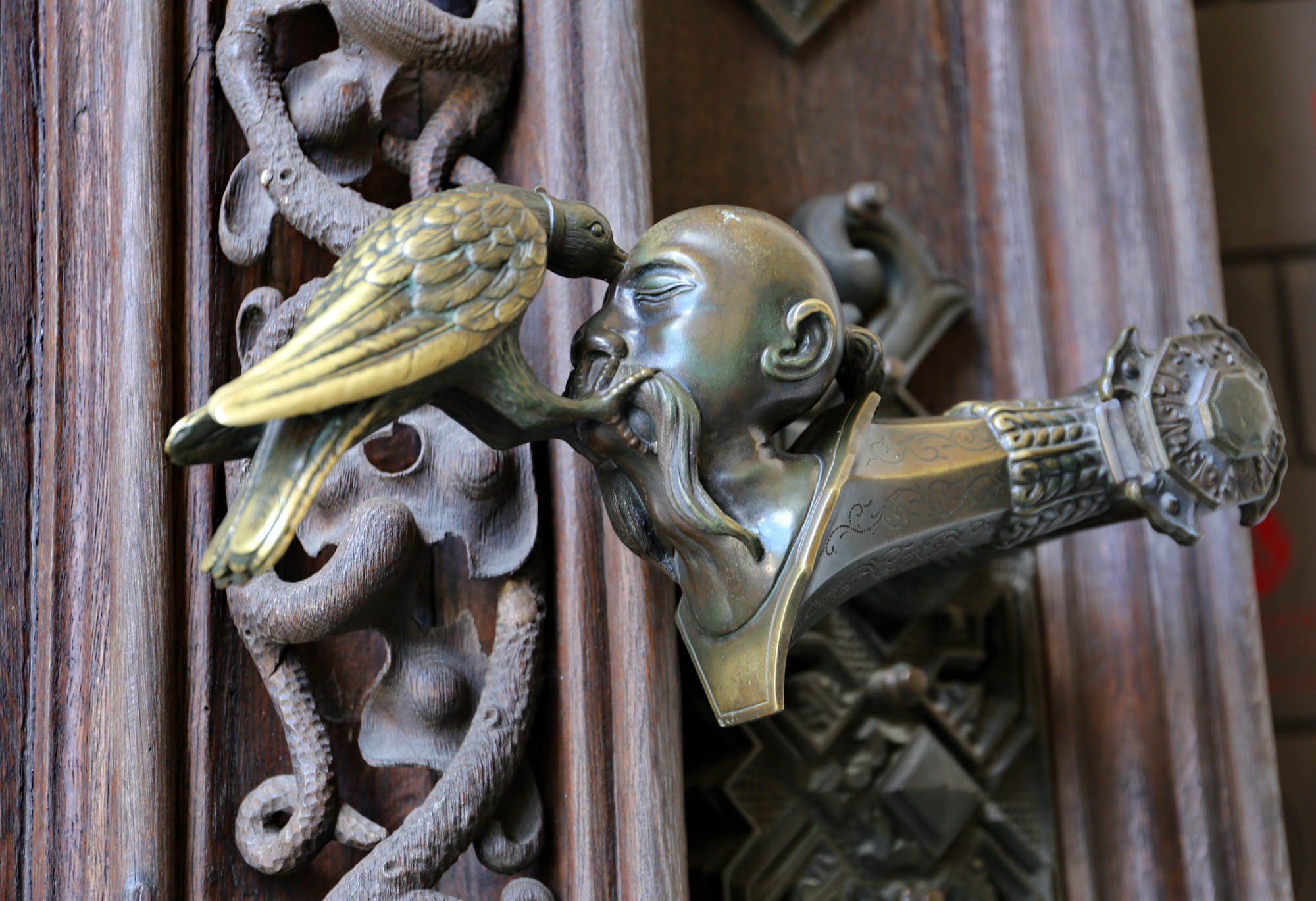
While writing the previous post, I considered using this door handle from Hluboká Castle to illustrate the execution of Záviš beneath its walls. But on the one hand, the monks of Vyšší Brod rescued Záviš's head from the humiliation of becoming food for ravens; and on the other, this door handle opens the door to another magnificent story—one that deserves a post of its own.
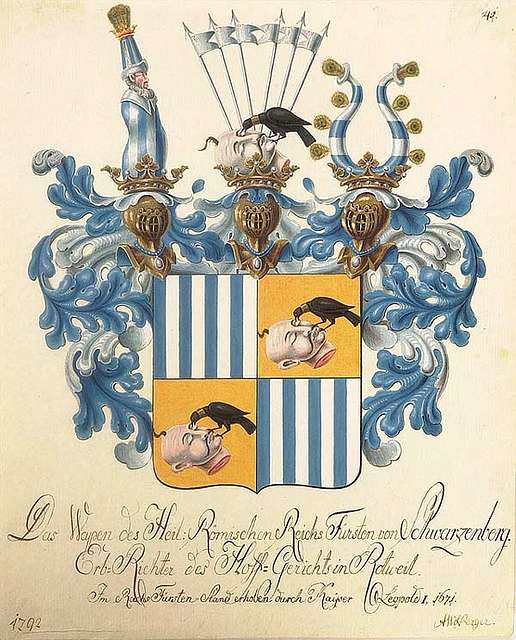
In 1660–1661 the Austrian Schwarzenbergs began building up their Bohemian estates, which by the twentieth century would make them the largest landowners in the country—on almost exactly the same territory once occupied by their predecessors as Bohemia's greatest magnates, the Rosenbergs. The first step was the acquisition of the town of Třeboň (Wittingau), followed by the purchase of Hluboká (Frauenberg) Castle, where they placed in the courtyard the family's coat of arms: a raven feasting on the severed head of a Turk.
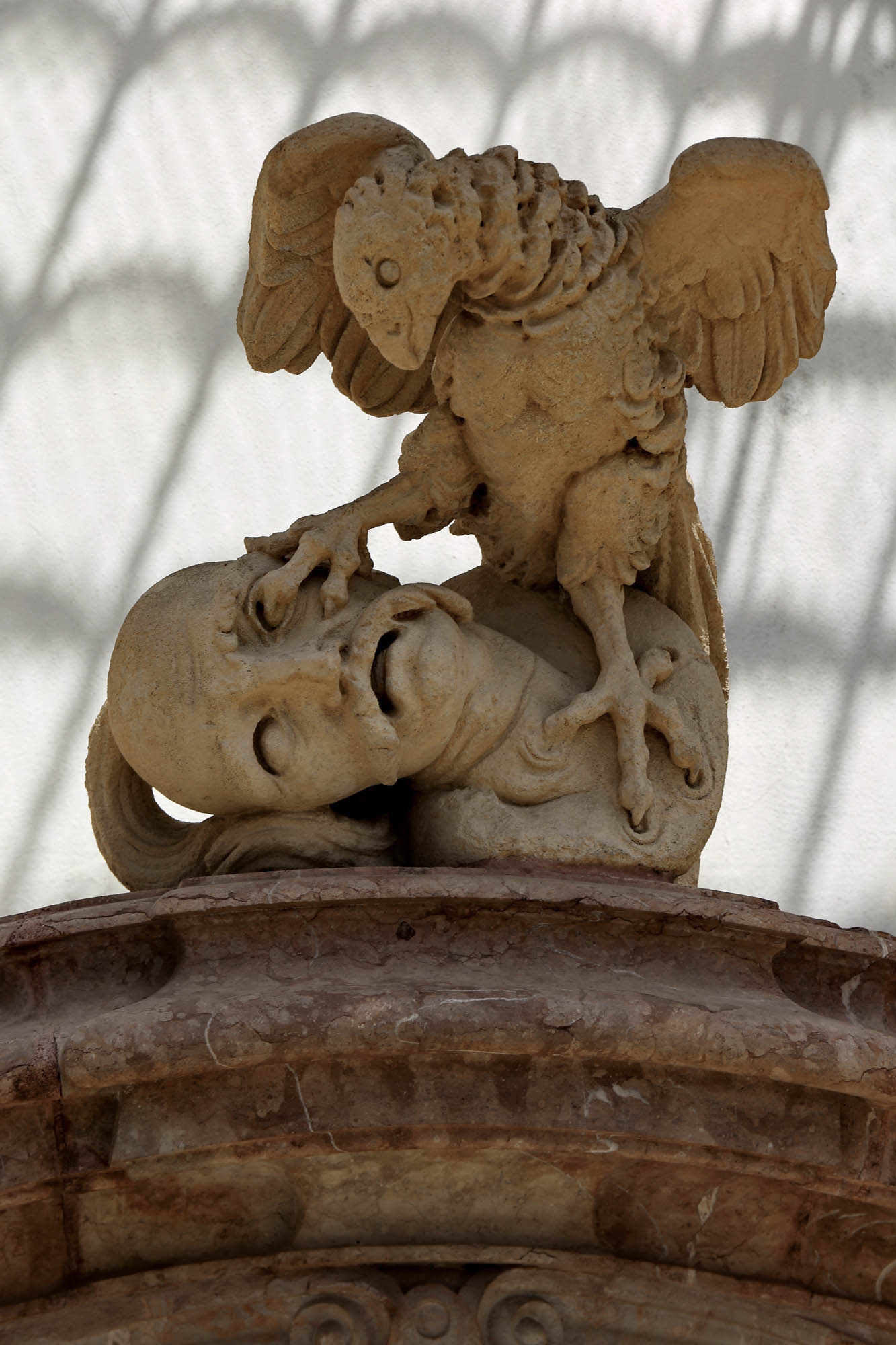
Between 1840 and 1871 the castle was gradually transformed by their descendants into a romantic historicist residence, and numerous medieval-style reliefs were incorporated into the courtyard walls. Among them appears once again the raven gouging out the eye of the Turk.
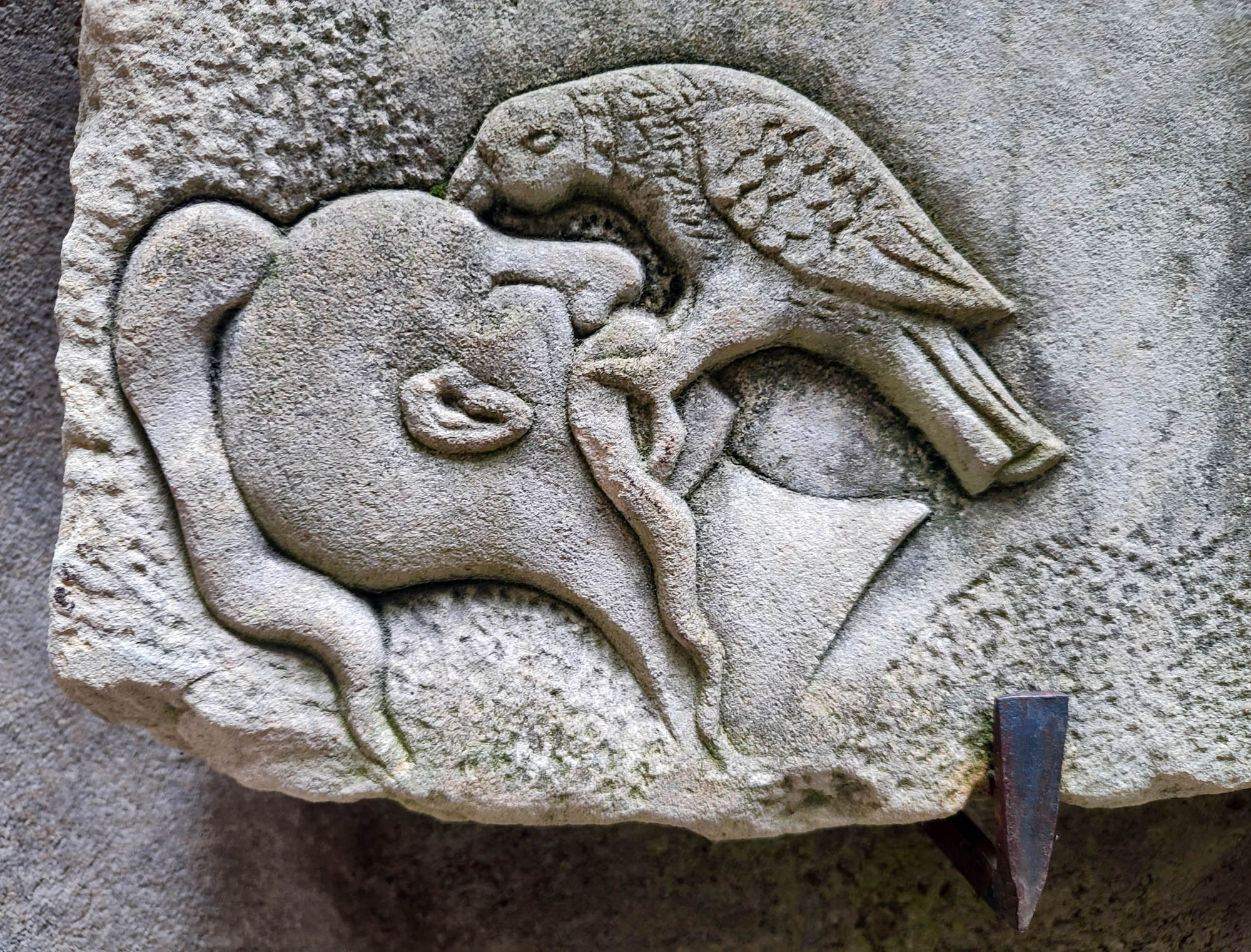
Why were the Schwarzenbergs granted such a gruesome coat of arms?
On 16 June 1595, the people of Vienna gathered in great numbers on Am Hof Square to witness a spectacular public execution. Count Ferdinand von Hardegg was put to death for surrendering the fortress of Győr to the Ottomans. The “traitor” first had his right hand cut off, and only then was he beheaded. Even this was considered an act of imperial clemency, for the original sentence had been death by hanging.
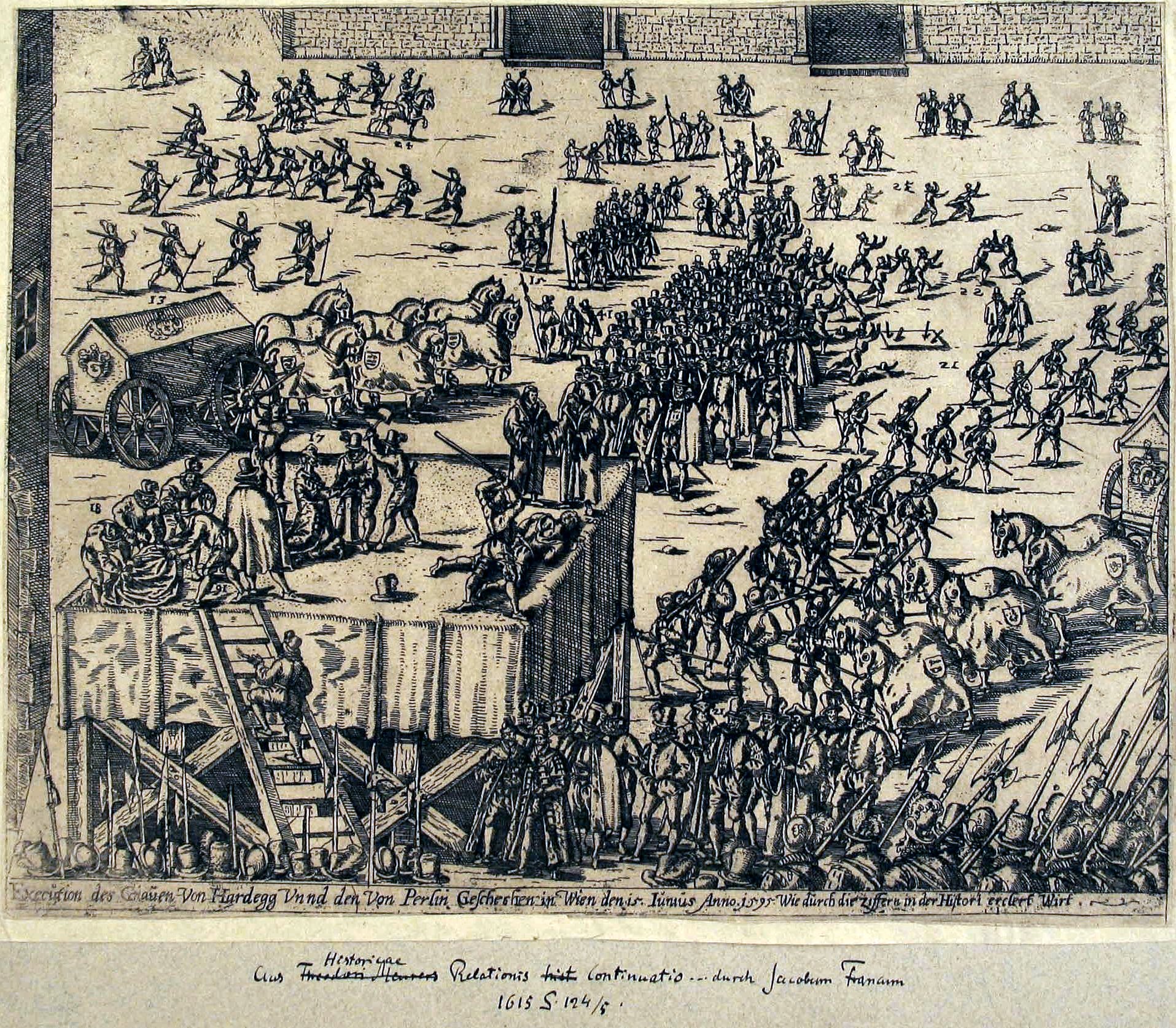
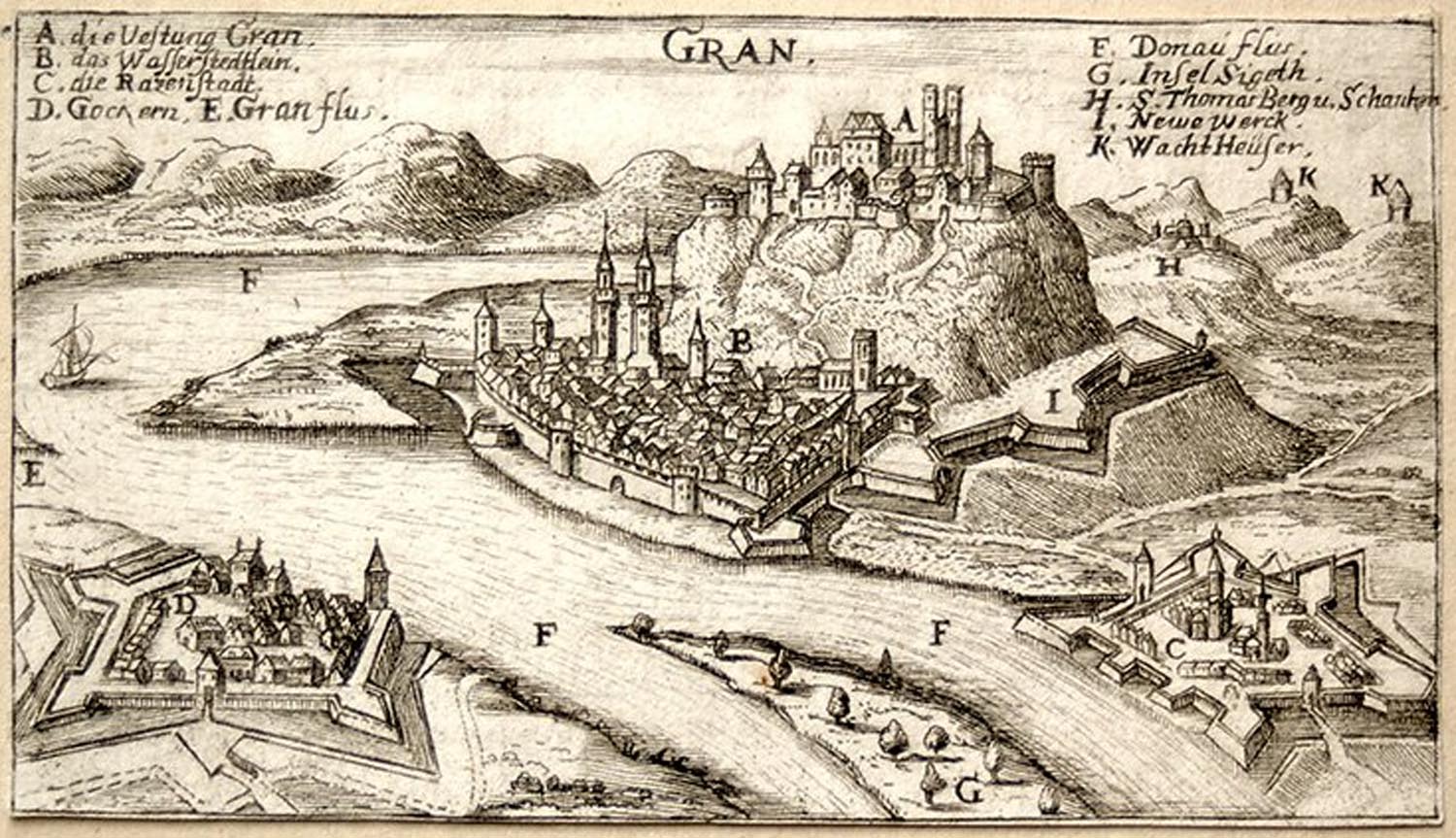
The fortress of Győr was regarded as “the key to the Empire,” one of the principal strongholds of the eastern frontier system. Hardegg defended it with five to six thousand men against the army of Koca Sinan Pasha, numbering well over one hundred thousand, for sixty-one days, from 31 July until 29 September 1594. He surrendered the fortress only after receiving news that the Christian relief army assembling in the Szigetköz had been decisively defeated by the Ottomans, making the fall of the fortress inevitable. In return, he secured safe passage for his garrison.
Archduke Matthias, the newly appointed and inexperienced commander-in-chief of the Habsburg armies in Hungary, was unimpressed by this explanation. Although it was he who had failed, במשך sixty-one days, to send relief to a fortress that had been expected to survive for only a few weeks at most, he needed a scapegoat for the loss so that the confidence of the imperial estates in the effective use of the “Turkish tax” they paid would not be shaken. The death of a Protestant count was not considered too high a price for restoring that confidence.
Adolf von Schwarzenberg, a German Freiherr (Baron), was appointed to command the much-publicised campaign to recapture the fortress. He had already demonstrated both his Catholic zeal and his military abilities in the wars against the Protestant rebels of the Low Countries under Philip II and against the French Huguenots fighting the Catholic League. Shortly after Hardegg's execution he proved himself in Hungary as well, recapturing the fortress of Esztergom from the Ottomans on 2 September 1595.
Estergon Kalesi (“The Fortress of Esztergom”), an Ottoman folk song about the loss of Esztergom, performed here in Barış Manço's Anatolian rock adaptation (1974).
|
Estergon Kalesi su başı hisar, |
Fortress of Esztergom, stronghold upon the riverbank; |
The task of recapturing Győr was entrusted jointly to Schwarzenberg and Miklós Pálffy, Captain General of Upper Hungary, who served as commanders of equal rank. Together they devised and executed the stratagem that brought victory. Learning that a convoy of supplies was on its way from Buda to the Ottoman garrison of Győr, they quickly assembled a convoy of their own. It was led by Hungarian hussars fluent in Turkish, who, on the night of 28 March 1598, requested urgent admission to the fortress, claiming that they were being pursued by the giaours. The Ottoman defenders lowered the drawbridge. As soon as the disguised hussars had entered, they blew open the Székesfehérvár Gate with a petard, allowing the troops of Miklós Pálffy to storm into the fortress. Fierce street fighting continued until dawn, ending in the destruction of the Ottoman garrison.
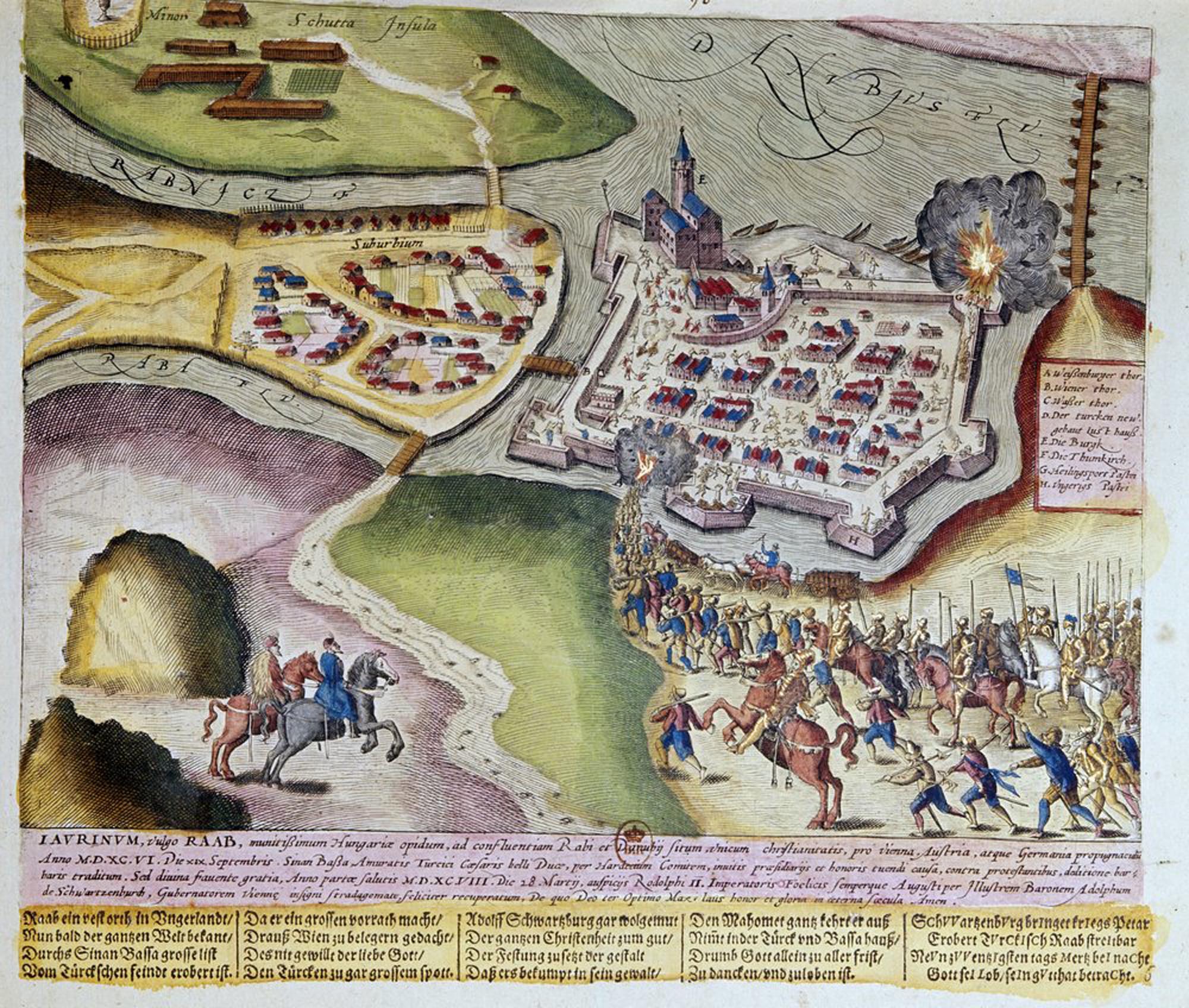 Franz Hogenberg: The Capture of Győr in 1598 (1653)
The recapture of Győr resonated throughout the Christian world almost as powerfully as the recapture of Buda would a century later. Celebrations and thanksgiving Masses were held, broadsheets were printed from the Low Countries to Italy, and the victory was commemorated on medals and in paintings.
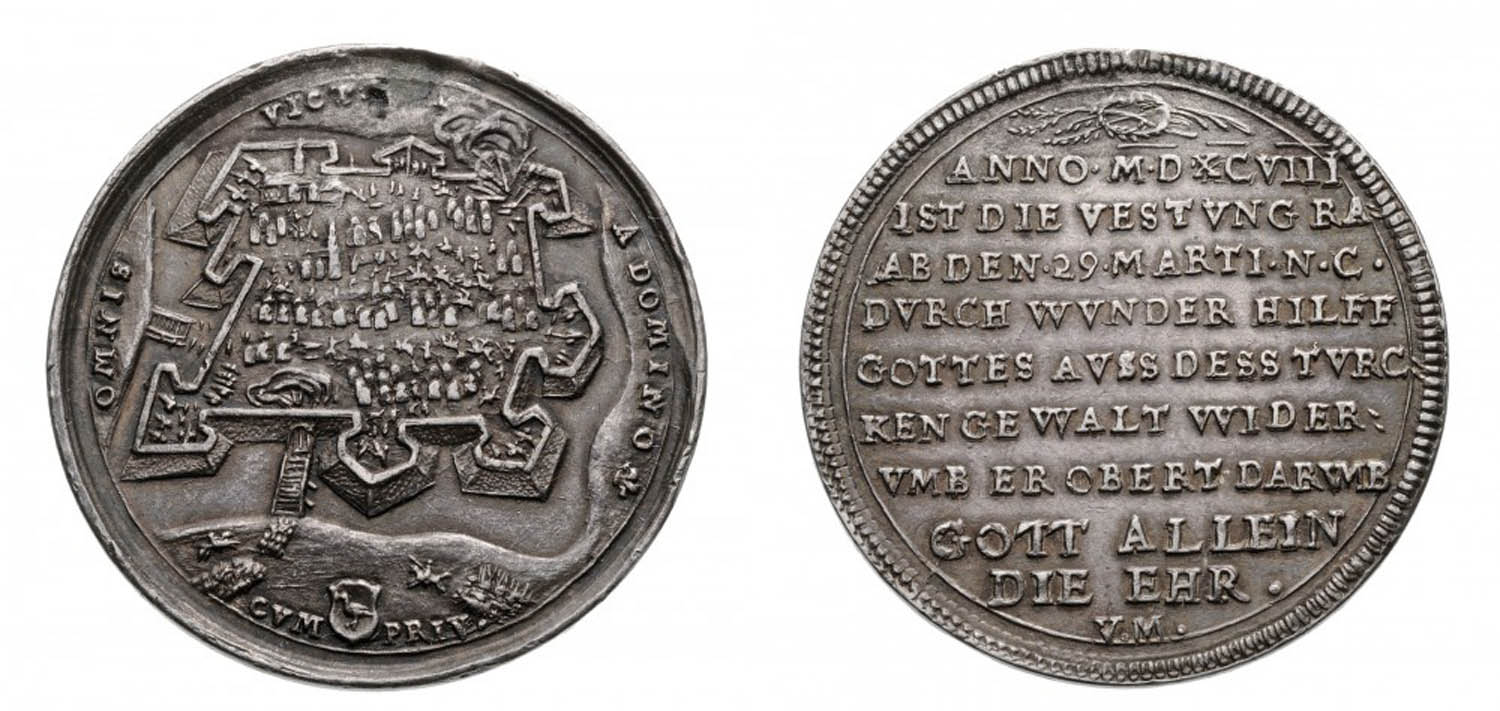 Commemorative medal of Emperor Rudolf II celebrating the recapture of Győr, by the Nuremberg medallist Valentin Maler.
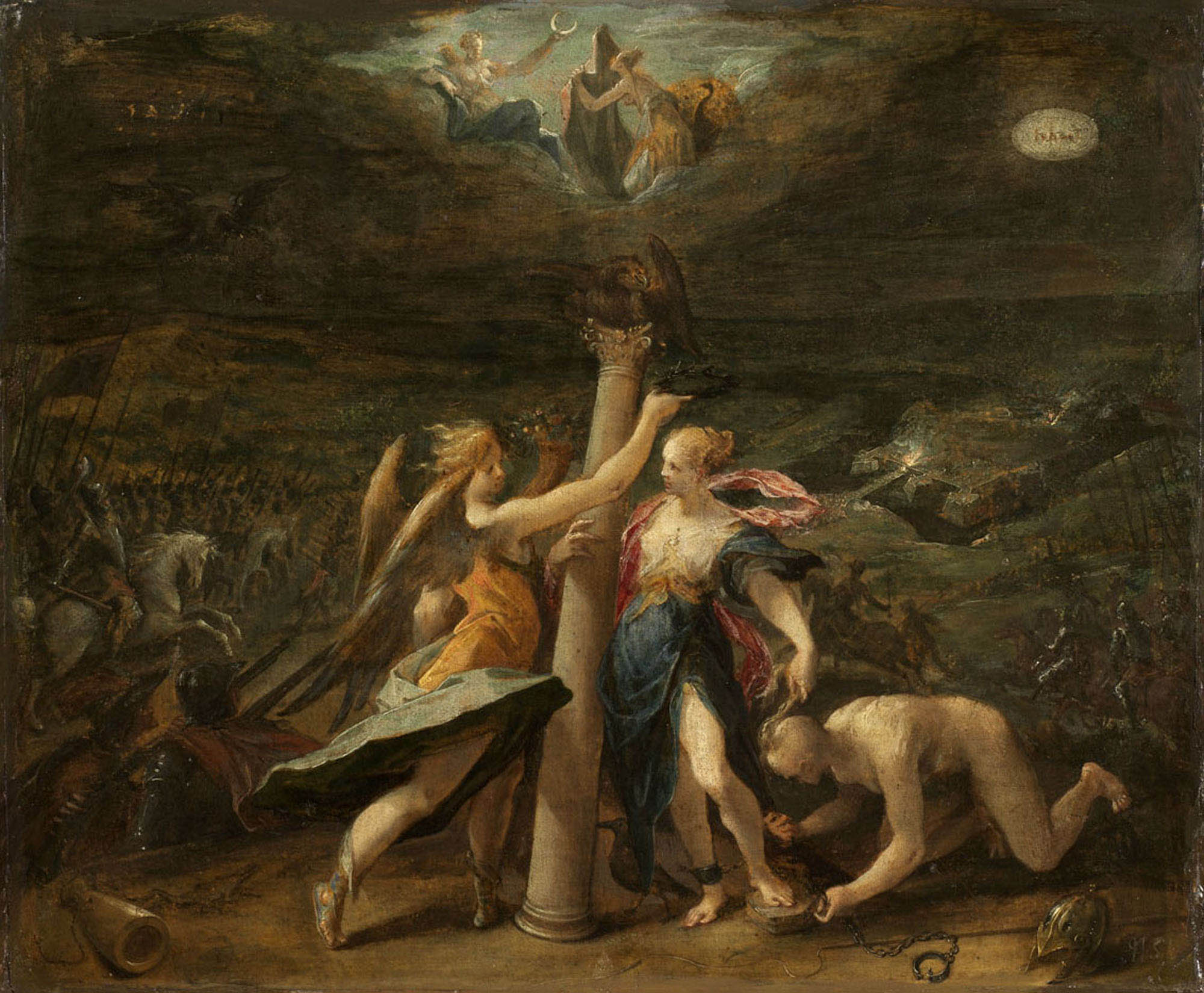 Hans von Aachen: Allegory of the Recapture of Győr, 1603–1604 (from his series celebrating the victories of the Long Turkish War).
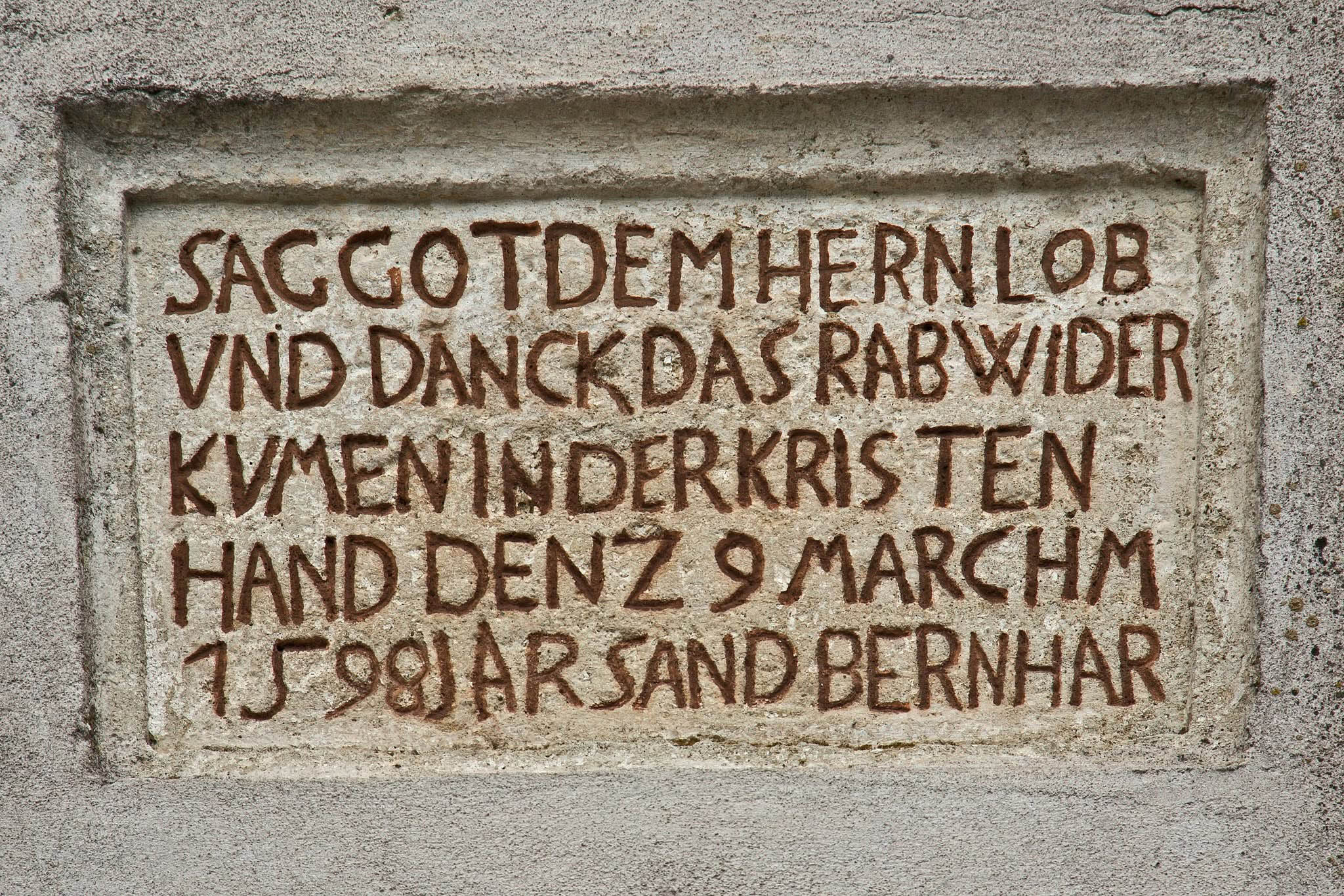
To ensure that the joyful news reached ordinary people as well, Emperor Rudolf II issued an imperial patent (an open decree) on 25 April ordering roadside votive crosses and wayside shrines throughout his realms to be erected—or restored—bearing the following inscription:
|
Sag Gott dem Herrn Lob und Danck |
Give praise and thanks to the Lord, |
The original patent speaks of crosses and shrines that had “collapsed or been cast down by evil men and iconoclasts,” making the decree a distinctly Counter-Reformation measure as well. These so-called Raaberkreuze (“Győr Crosses”) can still be found in large numbers throughout Austria.
The two commanders, Adolf von Schwarzenberg and Miklós Pálffy, were both elevated to princely rank. Schwarzenberg, however, received something more: a new coat of arms depicting a raven (Rabe) feasting upon the severed head of the defeated Ottoman commander of Győr (Raab). This heraldic device, built upon a German pun, appears throughout Hluboká Castle, from the reliefs in the courtyard to the very door handle at its entrance.
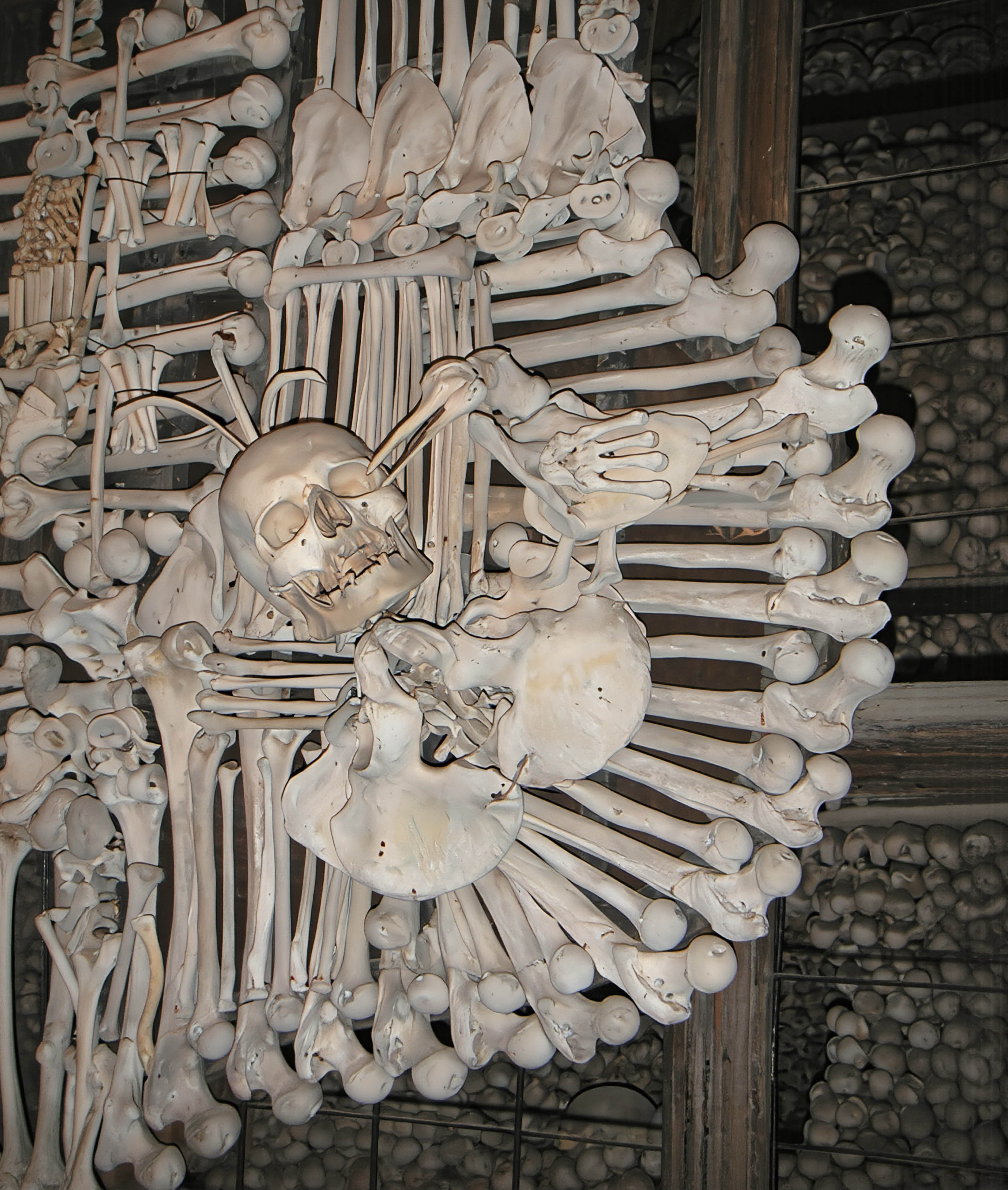
And as if this already bizarre iconography were not strange enough, it takes on one final twist—quite literally a ghostly one. The same raven appears on another Schwarzenberg estate: the ossuary of the Cistercian monastery at Sedlec. It was King Ottokar II himself who had a cartload of earth brought here from Golgotha, after which the cemetery became one of the most sought-after burial places in Central Europe. By 1870, the monastery ossuary contained approximately seventy thousand bones. It was then that the Schwarzenbergs commissioned the woodcarver and master carpenter František Rint to put the bones in order.
Rint proved unable to resist the imperative of art. Instead of merely arranging the bones, he breathed a strange new life into them, creating a series of extraordinary artistic compositions. The most famous is the Schwarzenberg coat of arms suspended above the entrance, where the raven—now itself transformed into a skeleton—pecks at the eye socket of a human skull, à la recherche du temps perdu.



Add comment