

For the brief period between 26 June and 26 July 2026, the Hungarian Museum of Ethnography is hosting an exhibition of Azerbaijani carpets. According to the museum’s introduction, the exhibition presents “the rich heritage of Azerbaijani carpet art and its contemporary legacy.”
The core of the exhibition consists of seventeenth- to twentieth-century carpets selected from the collection of the Azerbaijan National Carpet Museum. This distinguished selection fills the first large gallery.
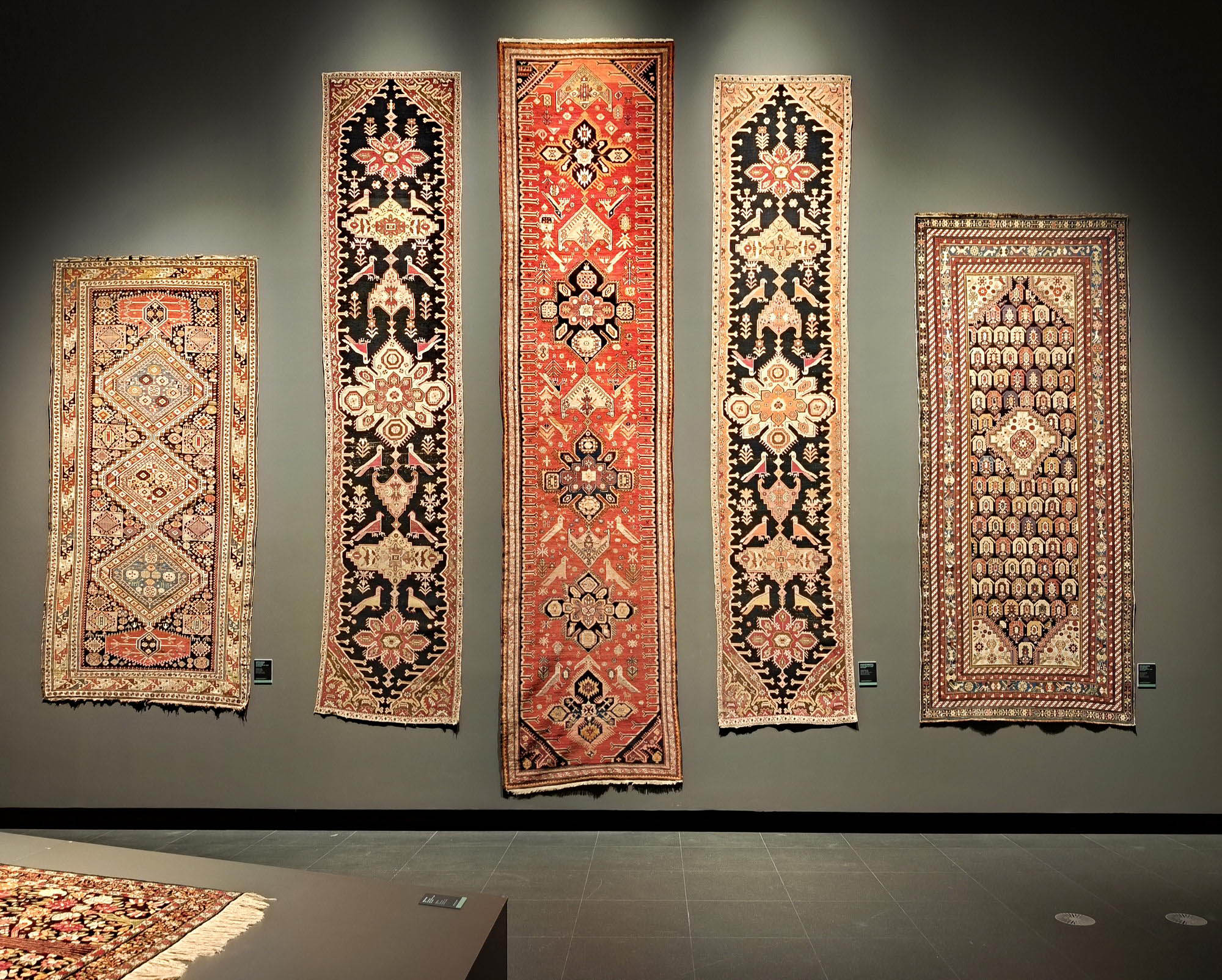
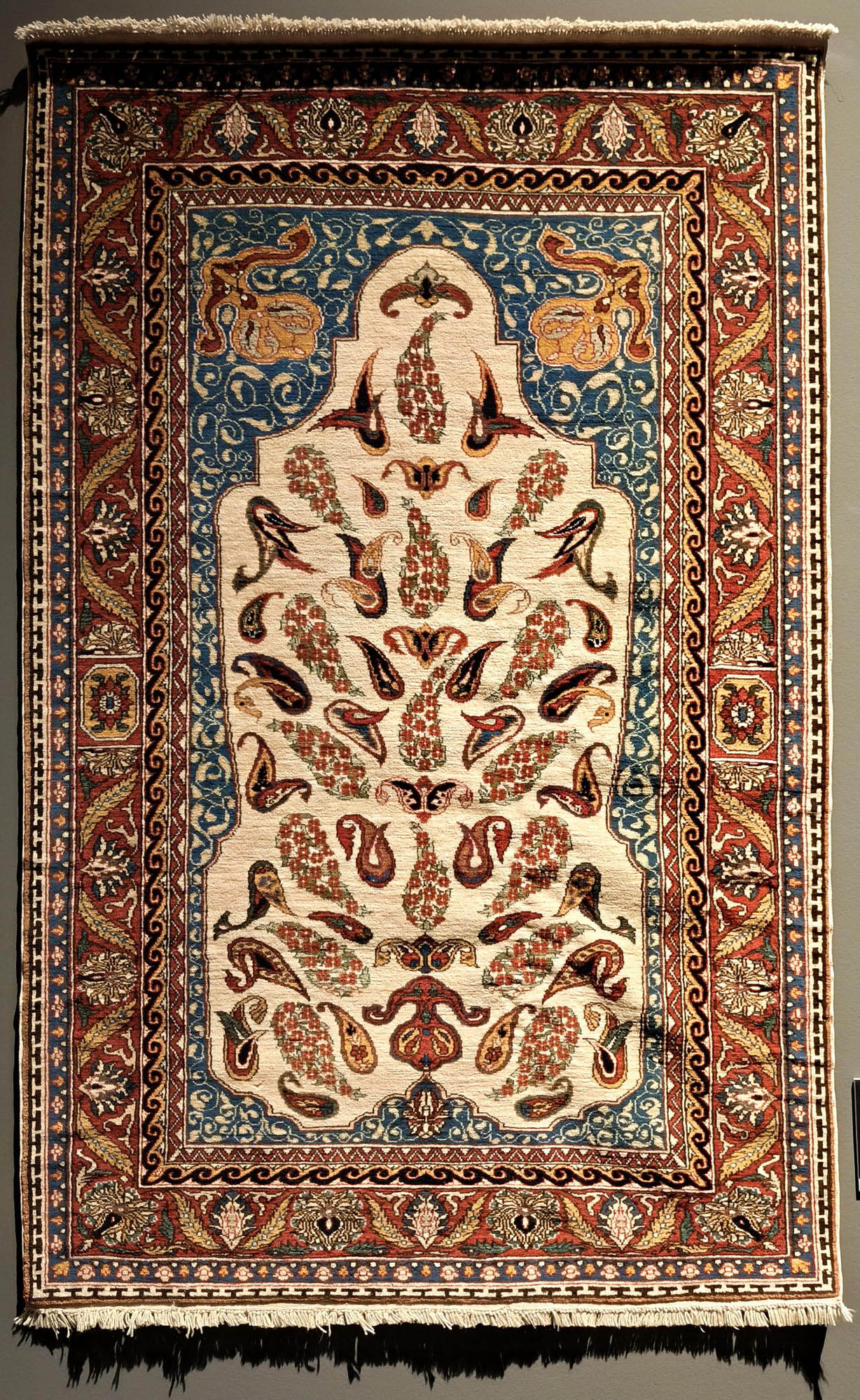
On the large wall opposite the entrance, a group of five runners introduces the exhibition’s main theme: the three major groups of Azerbaijani carpets. On the left is a geometric Shirvan (north-eastern Azerbaijani) runner; on the right, an Absheron Peninsula (Baku region) carpet decorated with boteh (flame-shaped) motifs; while the three central pieces are Karabakh runners featuring large floral designs.
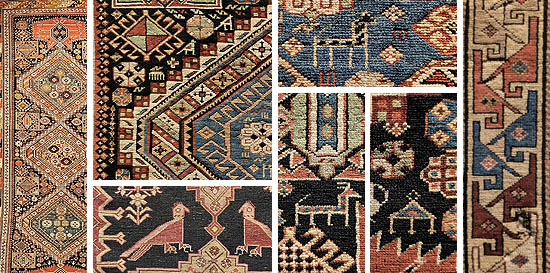
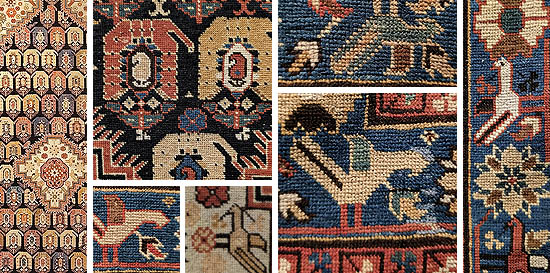
Shirvan carpets are characterized by their strict geometry and symmetry, with diamond-shaped medallions arranged one beneath another against backgrounds filled with tiny geometric motifs and small animals, much like the “Ararat carpets.” Their characteristic colours are vivid yellow or ivory white set against a red ground.
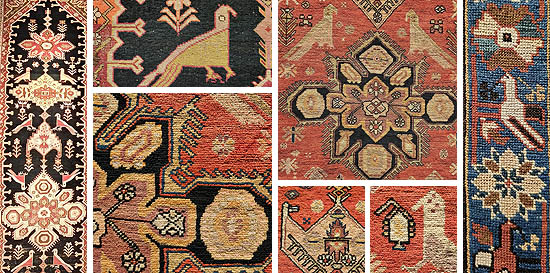
Karabakh carpets are the most monumental and the most painterly among Azerbaijani carpets. They favour large floral compositions inspired by Persian art, along with bold figurative motifs: peacocks, doves, horses, and hunting scenes. Their colours are exceptionally vivid and fiery, with scarlet red and deep black backgrounds occurring frequently. Of the three Karabakh runners displayed here, the two with black backgrounds originally formed a pair, placed side by side or on opposite sides of a room. The large red runner in the centre, woven in the characteristic style of the village of Malibeyli, arranges stylised lakes along a central axis, surrounded by ducks, stylised clouds, and peacocks, evoking the themes of rain and gardens.
A characteristic motif of carpets from the Absheron Peninsula and the Baku region is the boteh (or buta), a Persian word meaning “bud.” In the West it became known as the “paisley” pattern, named after the Scottish weaving town, and later emerged as one of the defining motifs of the psychedelic revolution of the 1960s. Originally representing a tongue of flame, it also symbolized human figures, the budding of plants, the tip of the cypress tree (a symbol of eternal life), and served as an amulet against evil.
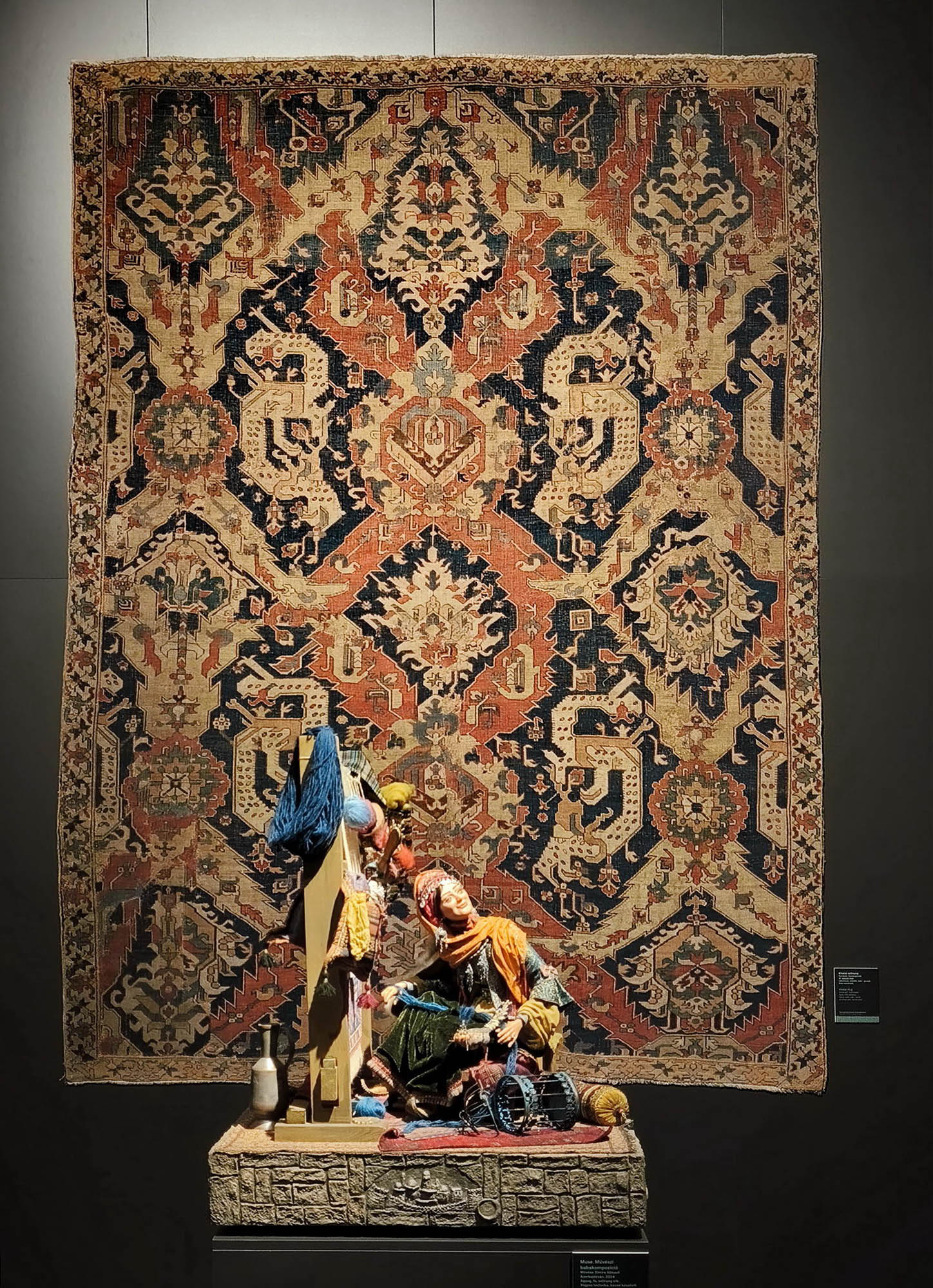
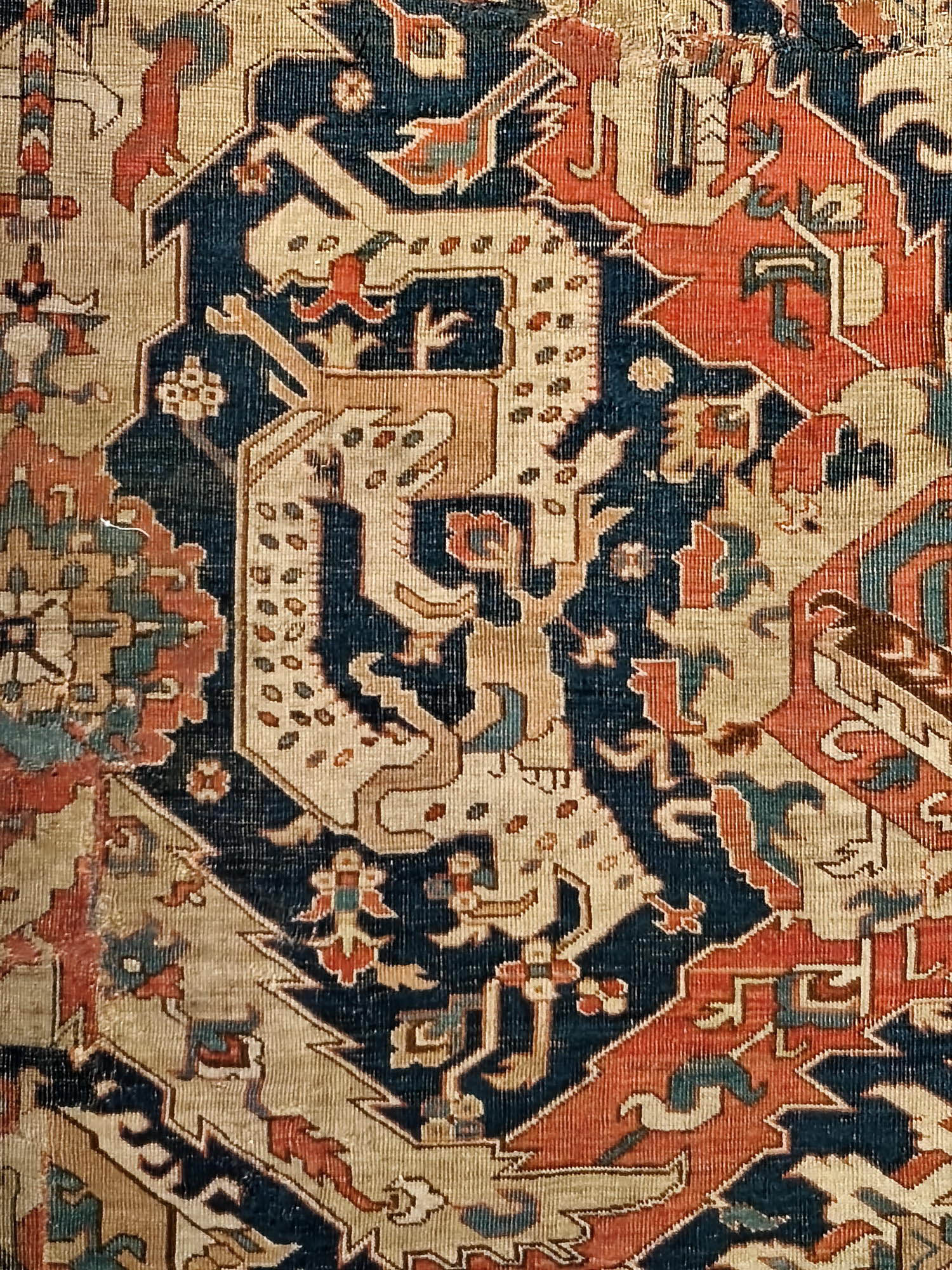
At the centre of the gallery stands a monumental Karabakh carpet. It is the oldest piece in the exhibition, dating from the late seventeenth century, the golden age of monumental palace carpet weaving under the Safavid dynasty and the local khanates. Within the black fields of its red-and-yellow diamond lattice, stylized dragons wind their way in S-shaped curves. They are bringers of rain and abundance, powerful guardians of the home and its treasures.
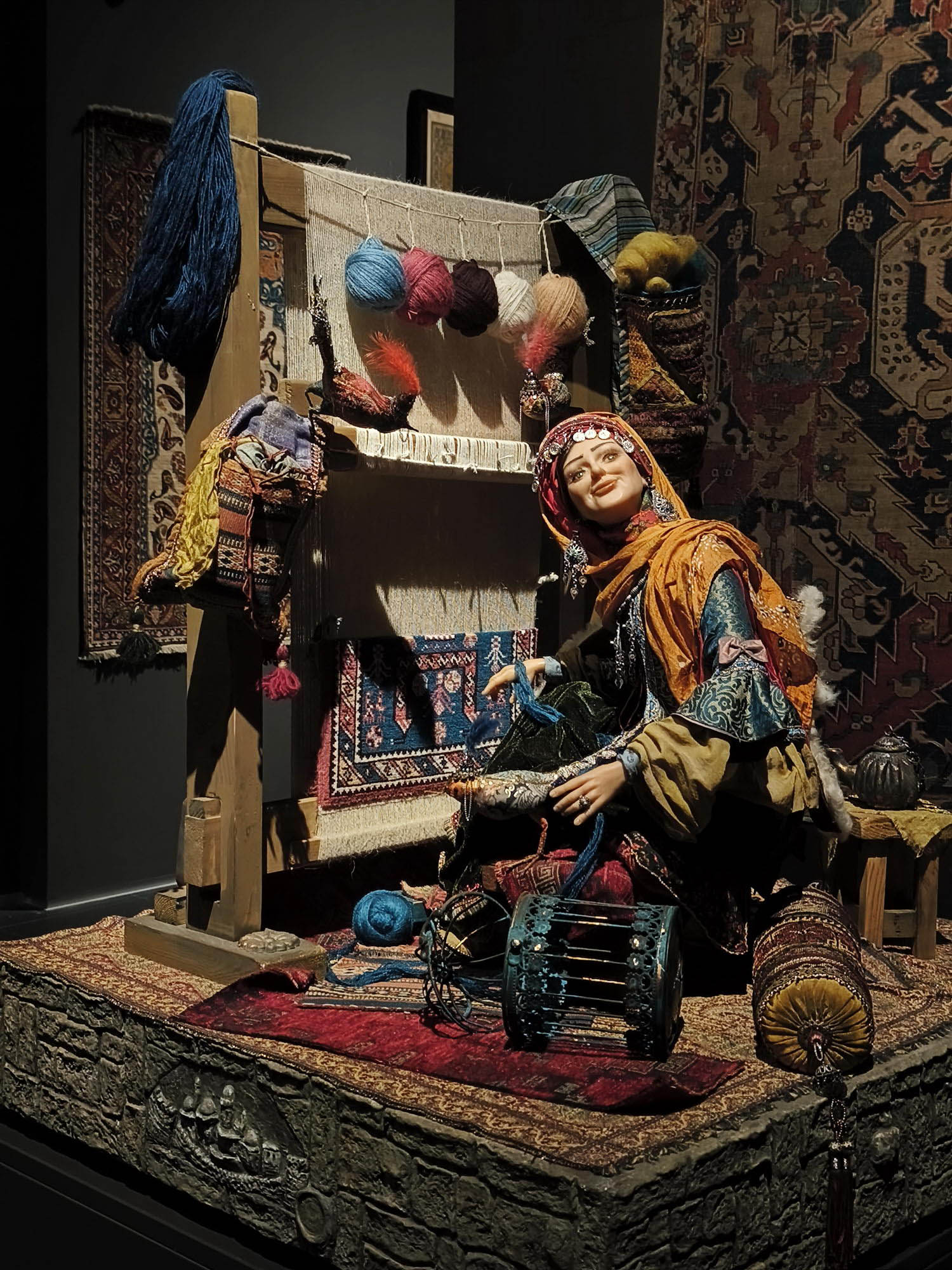
In front of the carpet stands a small upright urban loom (hana), of the type used in city workshops to weave carpets of this size. A weaver sits before it, while the hanging skeins of yarn and the partly completed knots vividly illustrate the process of carpet making. Interestingly, although the large carpet is from Karabakh, the piece being woven on the hana is in the geometric Shirvan style.
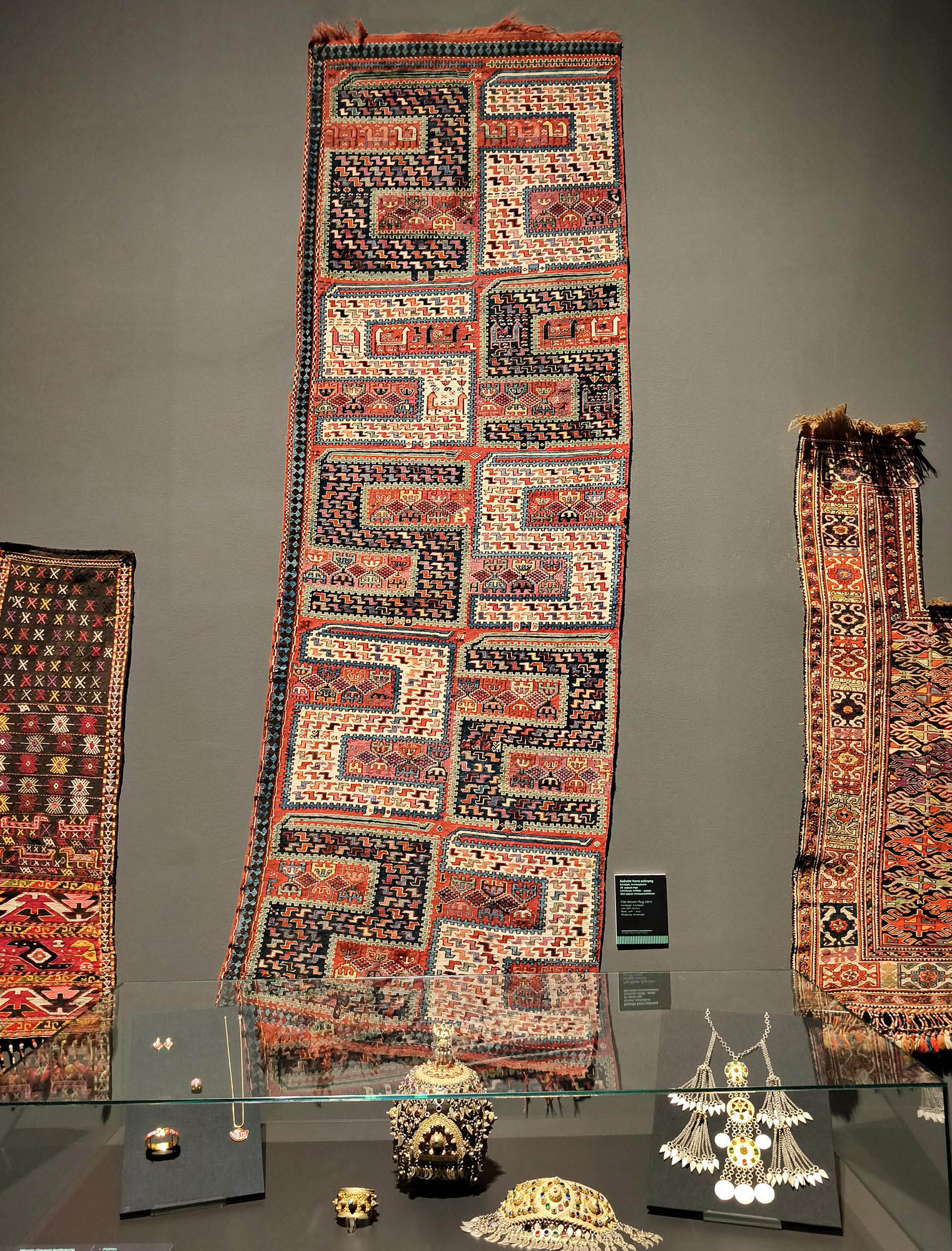
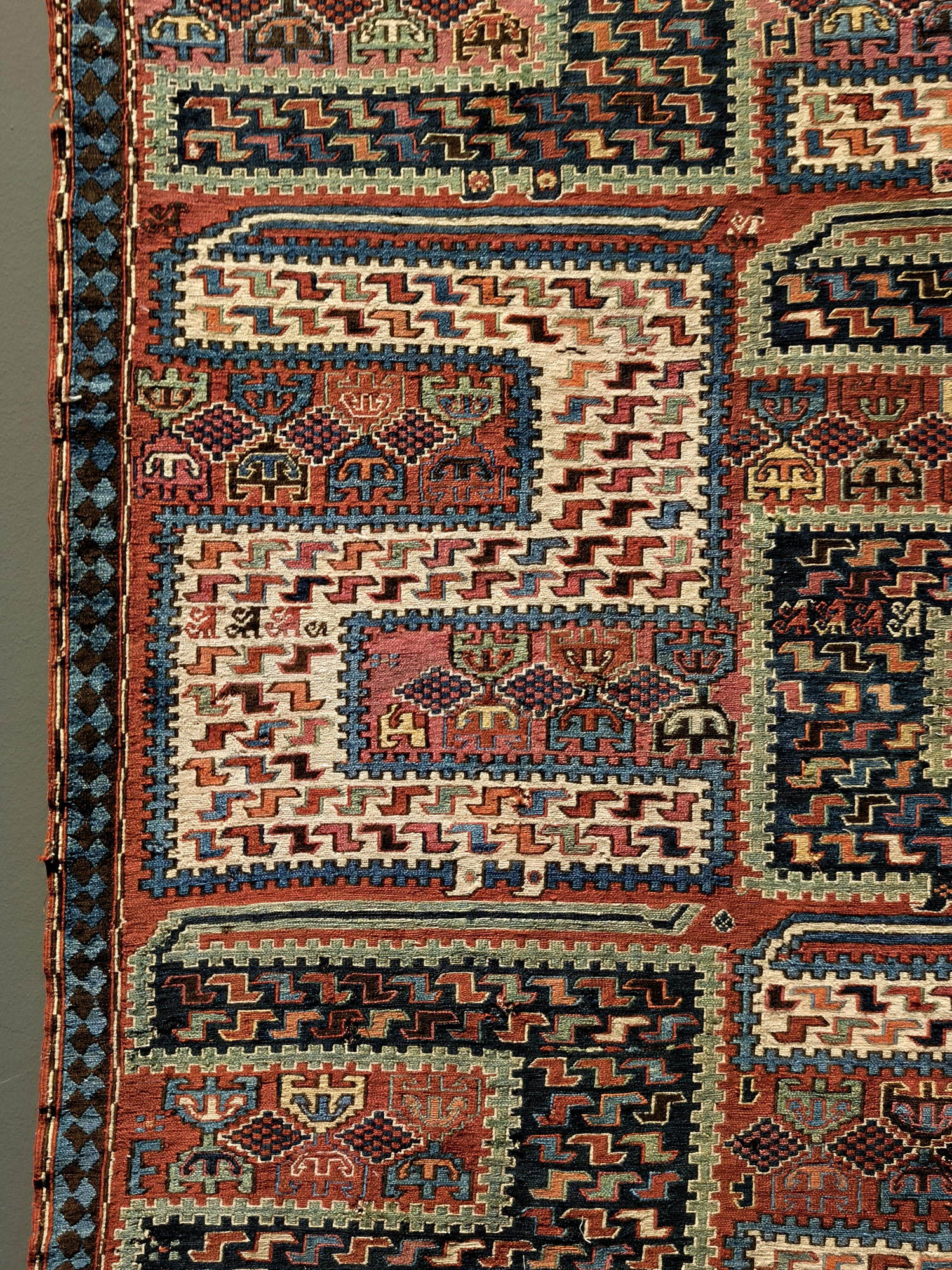
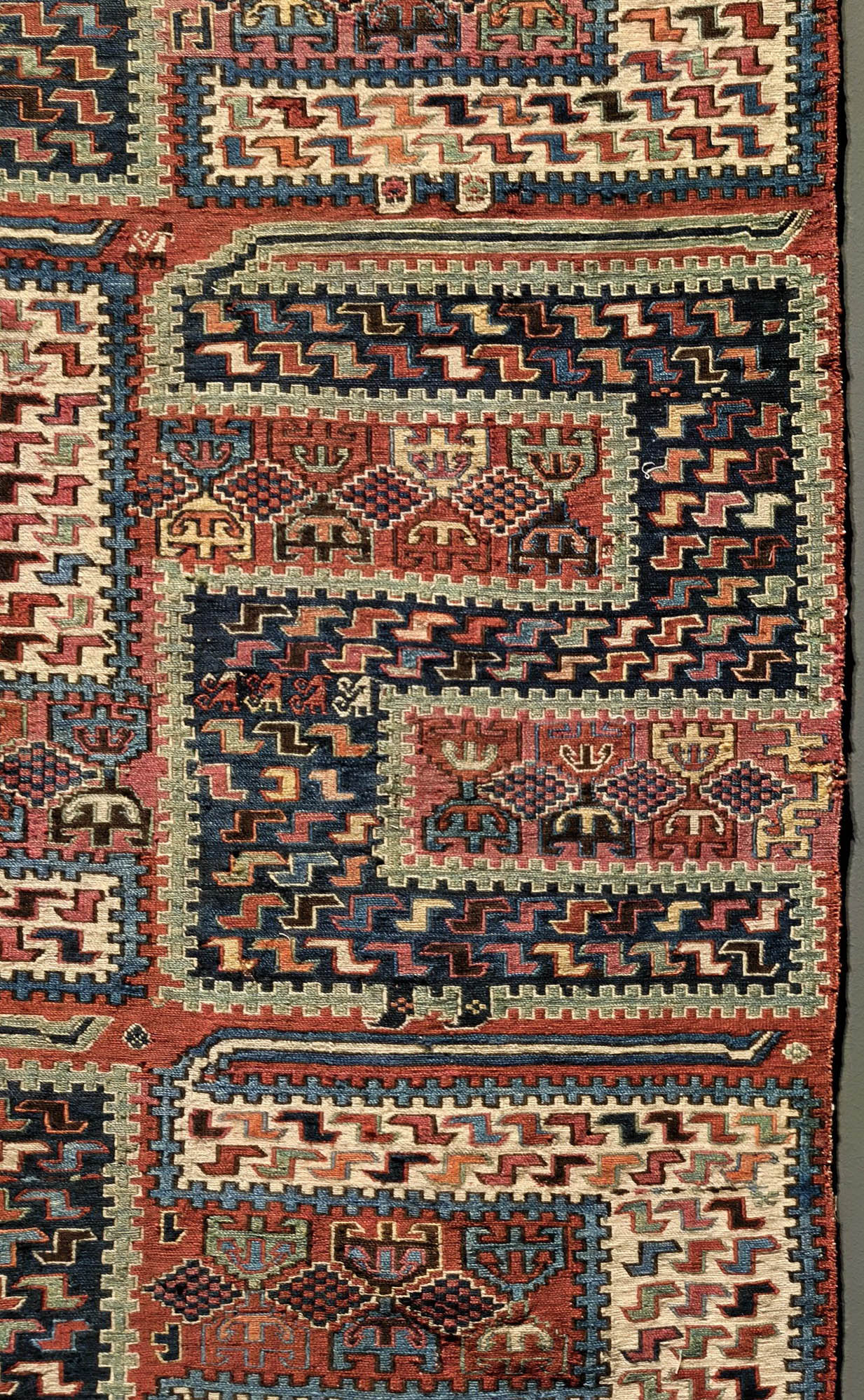
The exhibition also includes nomadic textiles that were woven rather than knotted, such as this monumental Karabakh Varni kilim, whose large S-shaped motifs stylize dragons, their coils enclosing the gardens they protect and water. The piece originally formed part of a textile travelling chest (mafras), later taken apart. Such chests were used by nomads to transport their valuables, and the dragons were believed to guard these possessions as well.
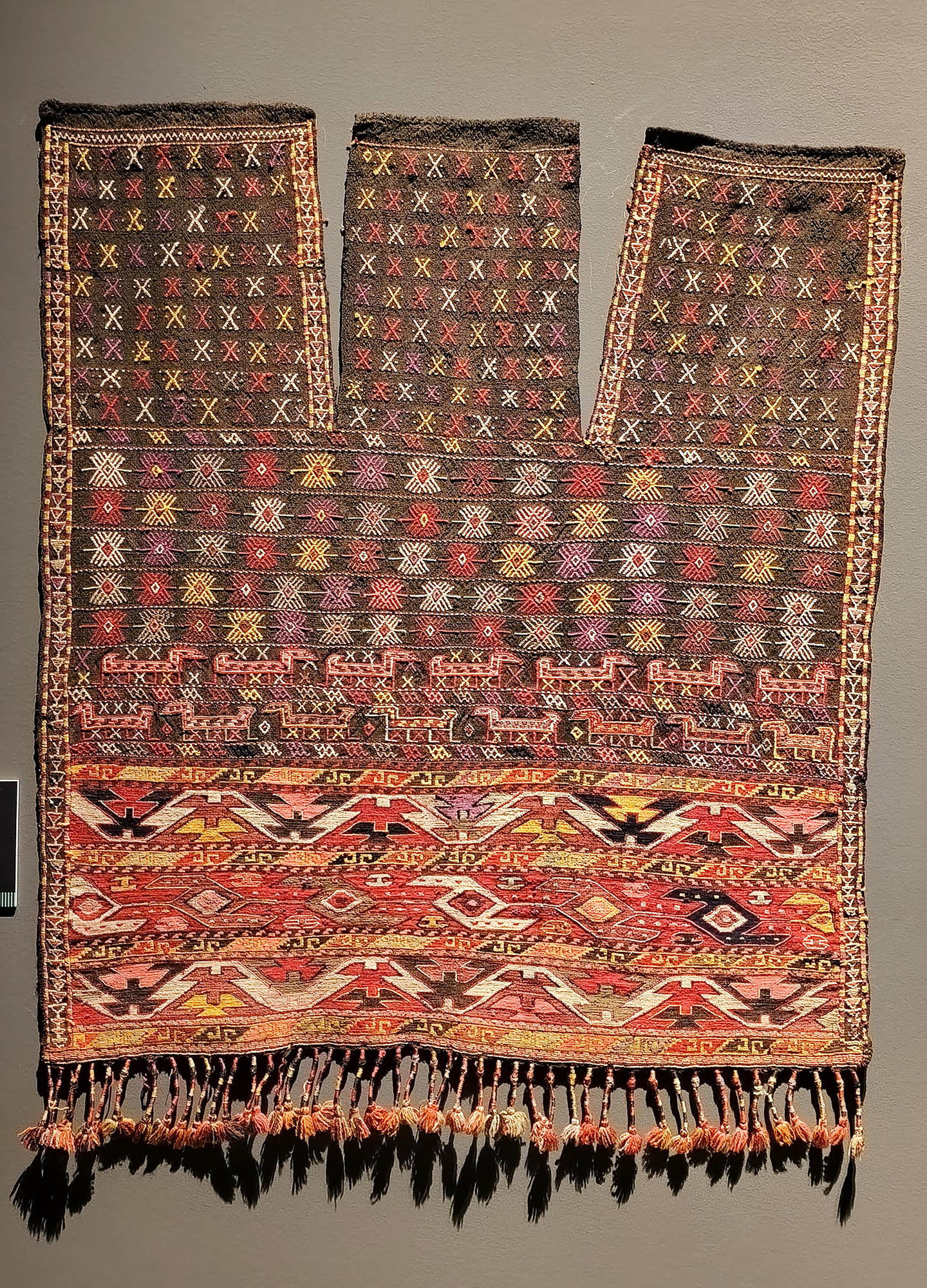
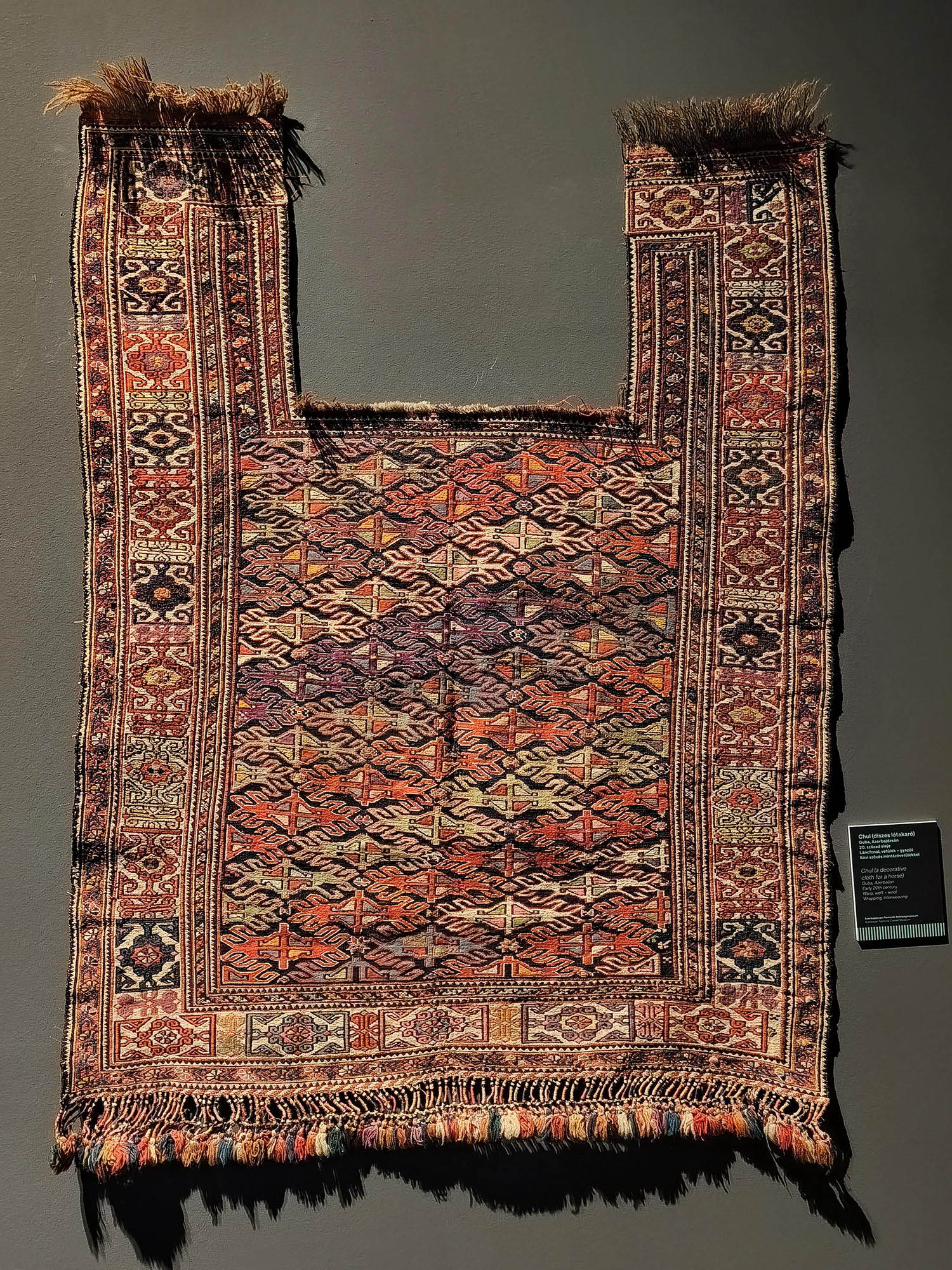
Flanking the great kilim are two nomadic chul horse covers from Karabakh, whose cut-away upper centre was designed to drape over the horse’s neck. Karabakh was renowned for its magnificent horses, and on his wedding day the groom’s horse was adorned with the finest chul woven by the bride. The cover showcased the young woman’s weaving skills and her family’s wealth to the community.
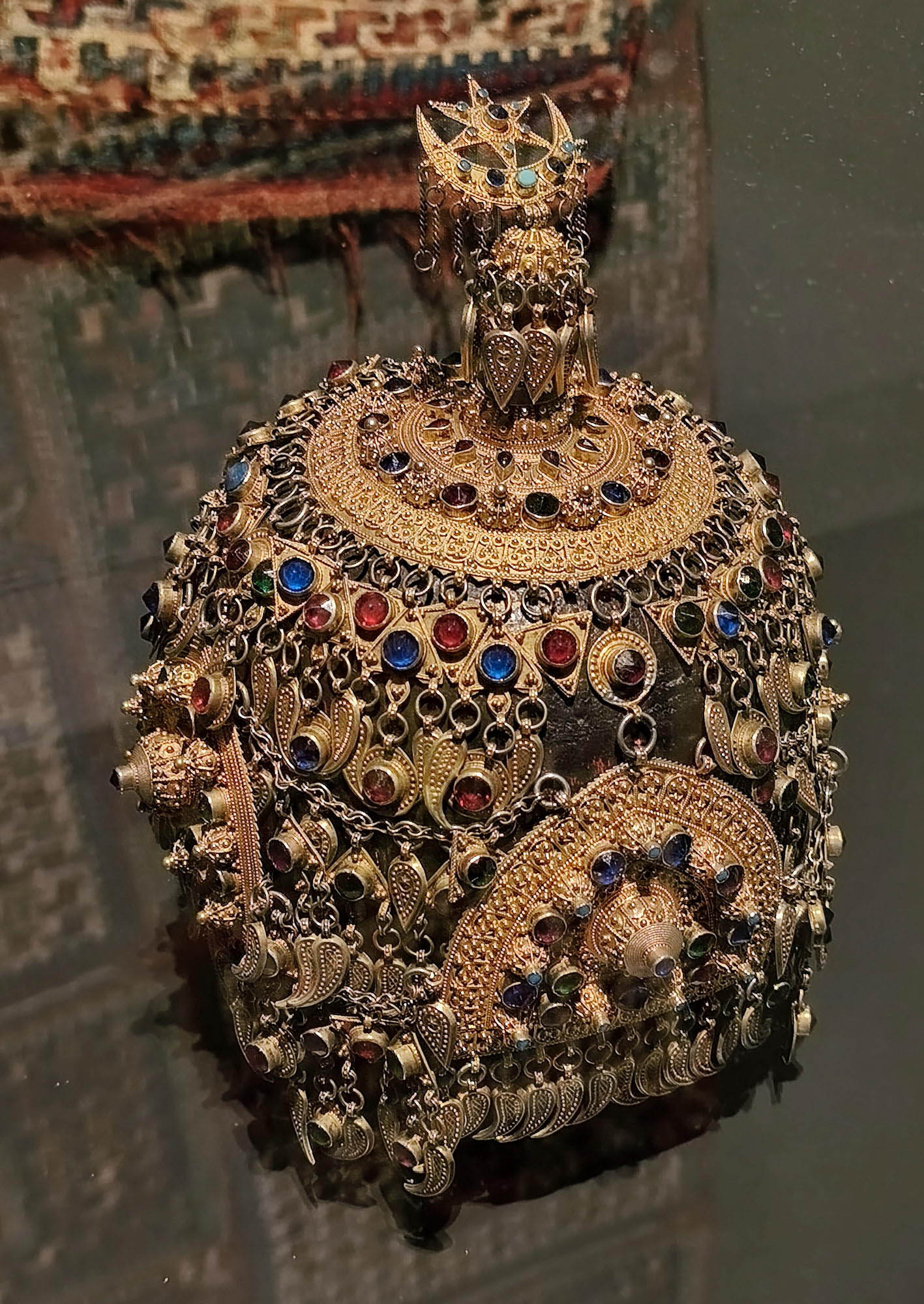
In front of the nomadic carpets are displayed pieces of jewellery that, although worn by nomadic women, were crafted by urban goldsmiths. The filigree bridal headdress (tadj), adorned with semi-precious stones, served as the bride’s crown. After the wedding day it was worn only on major festivals, such as Nowruz, before eventually being passed down to the eldest daughter or daughter-in-law.
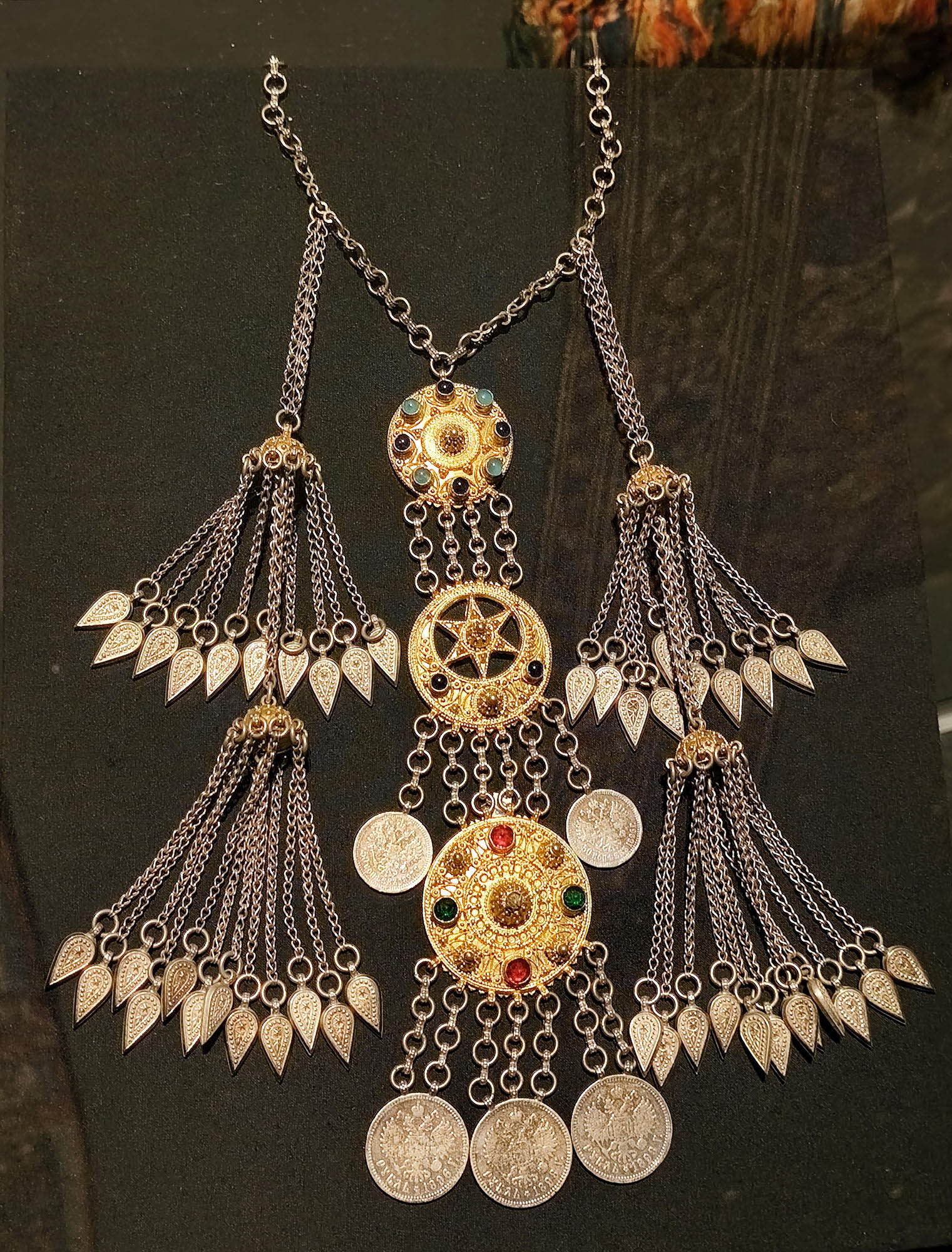
The elaborate breast ornament (sinabandi), incorporating silver coins, likewise formed part of festive and bridal attire. The six-pointed star set into the ornament represents the Seal of Solomon in the Islamic world—a symbol of mastery over the forces of nature and the spirit world, believed to protect its wearer from evil.
The exhibition’s second section, housed in a smaller gallery, presents the work of several contemporary carpet designers who continue to employ the techniques and motifs of traditional weaving. None of this would have been possible without Latif Karimov (1906–1991), the great saviour and modern reviver of Azerbaijan’s carpet-weaving tradition. It is under his “patronage” that this gallery stands, and the exhibition was also organized to mark the 120th anniversary of his birth.
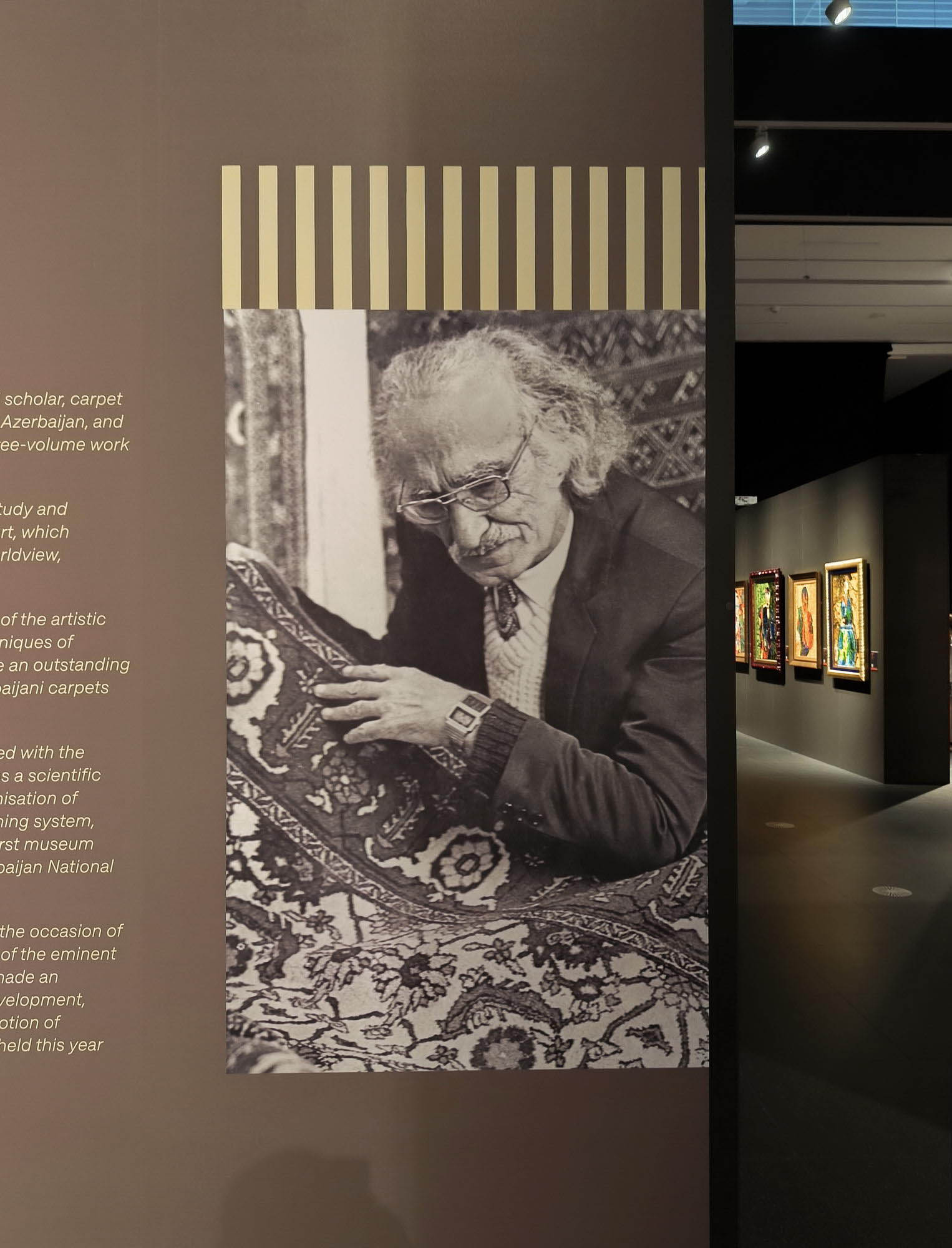
Latif Karimov was born in Shusha, Karabakh, the son of a distinguished carpet weaver. As a child he moved with his family to Mashhad in Iran, where he worked in carpet manufactories. Returning to Azerbaijan in 1929, he founded traditional carpet-weaving schools in Shusha, Quba and Baku in an effort to preserve the craft from the pressures of industrialization. For decades he travelled through the villages of the Caucasus collecting patterns, which eventually formed the basis of his monumental three-volume encyclopedia The Azerbaijani Carpet (1961–1983). In 1967 he also founded the Azerbaijan National Carpet Museum, from whose collection these magnificent historic carpets have come.
Karimov’s school is represented in the exhibition by one direct and one indirect disciple. Eldar Mikayılzadə (1956–), a student and collaborator of Karimov, often transforms classical Persian poetry into carpets woven with traditional Azerbaijani motifs. Examples include On the Night of Separation, where flame-shaped boteh motifs sprout from the tree like leaves, and Məcnun (Majnun, the young lover driven mad by love), in which the flame-like boteh motifs stand in disciplined rows behind the bars of madness.
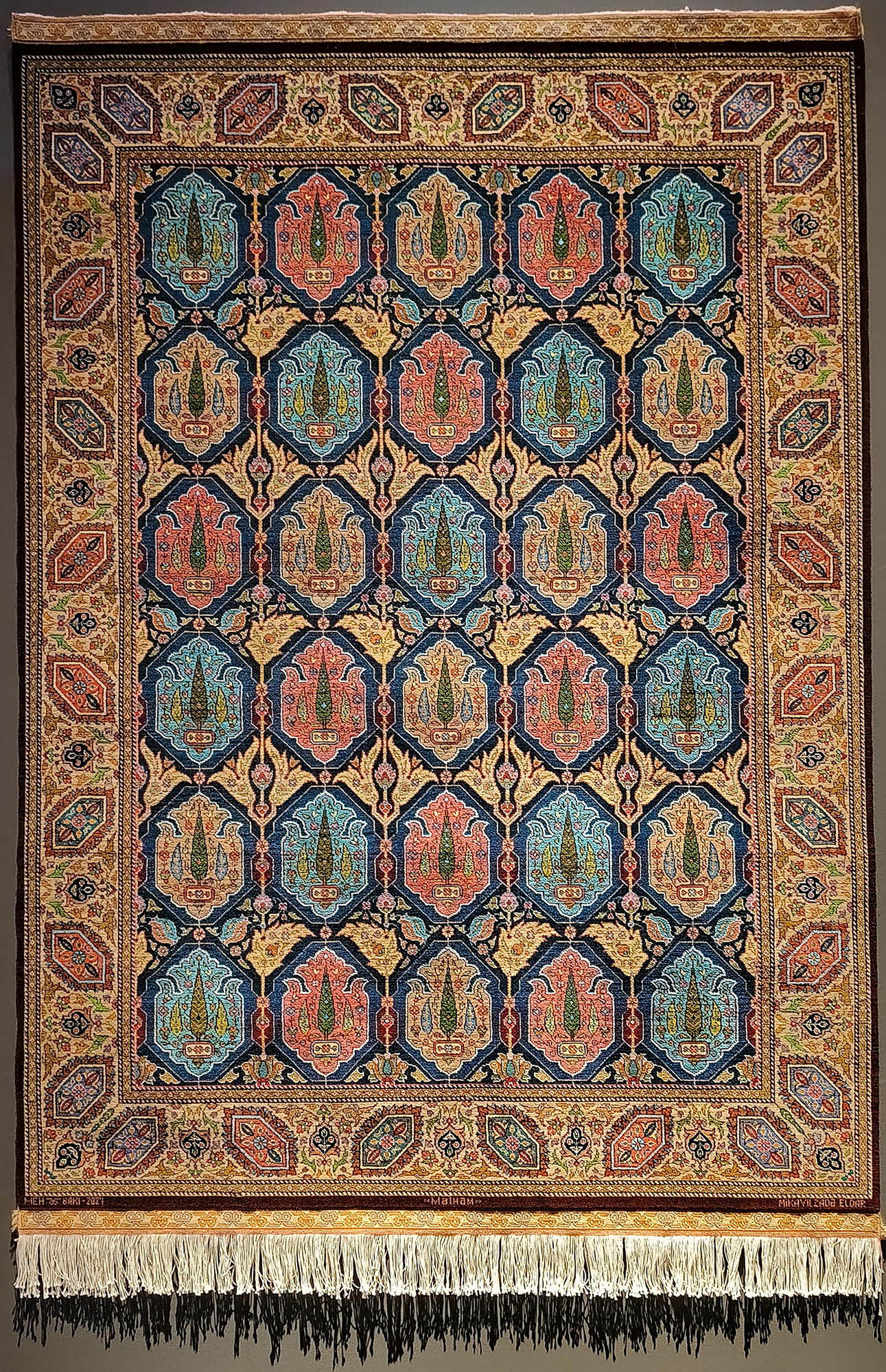
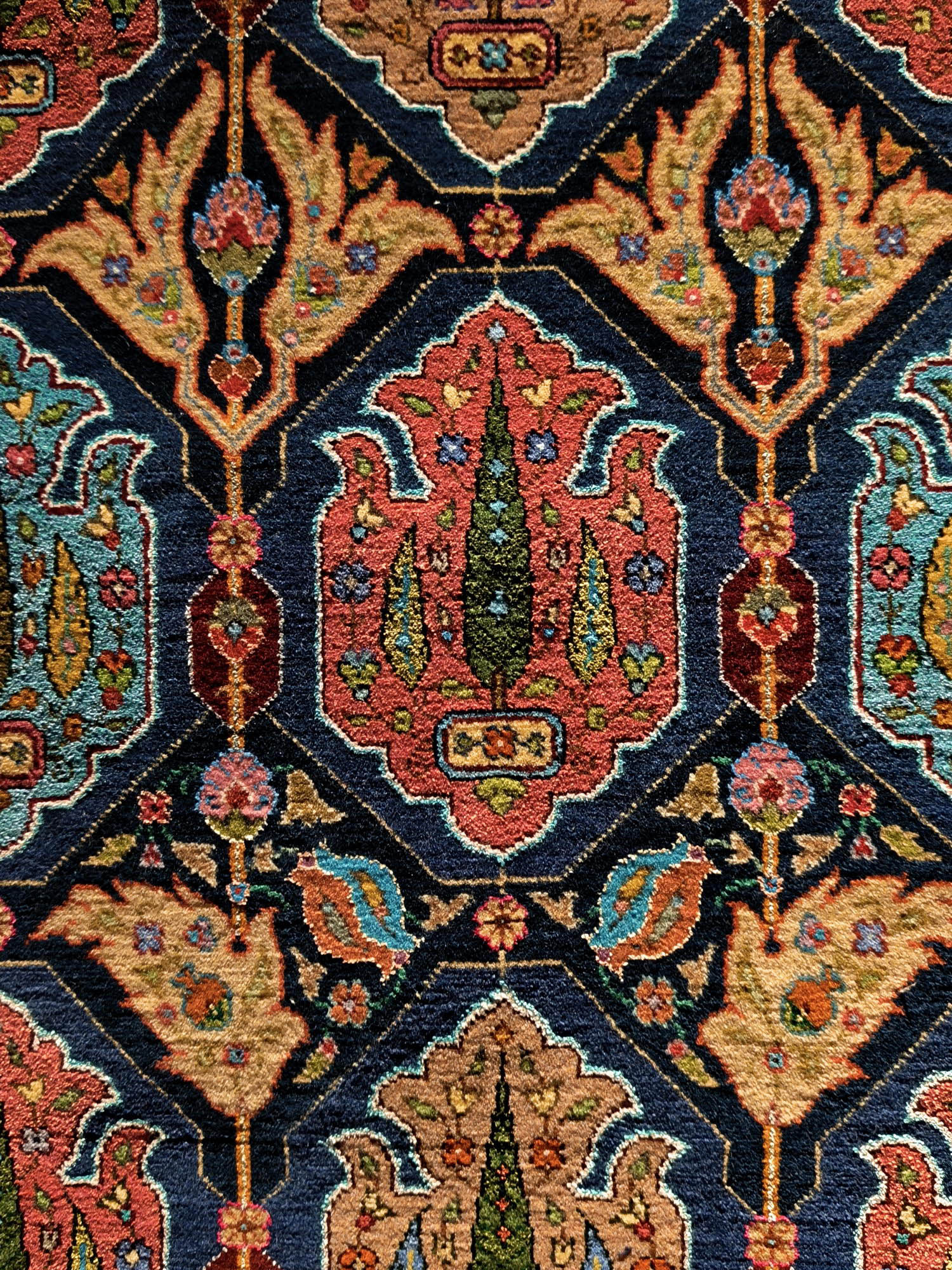
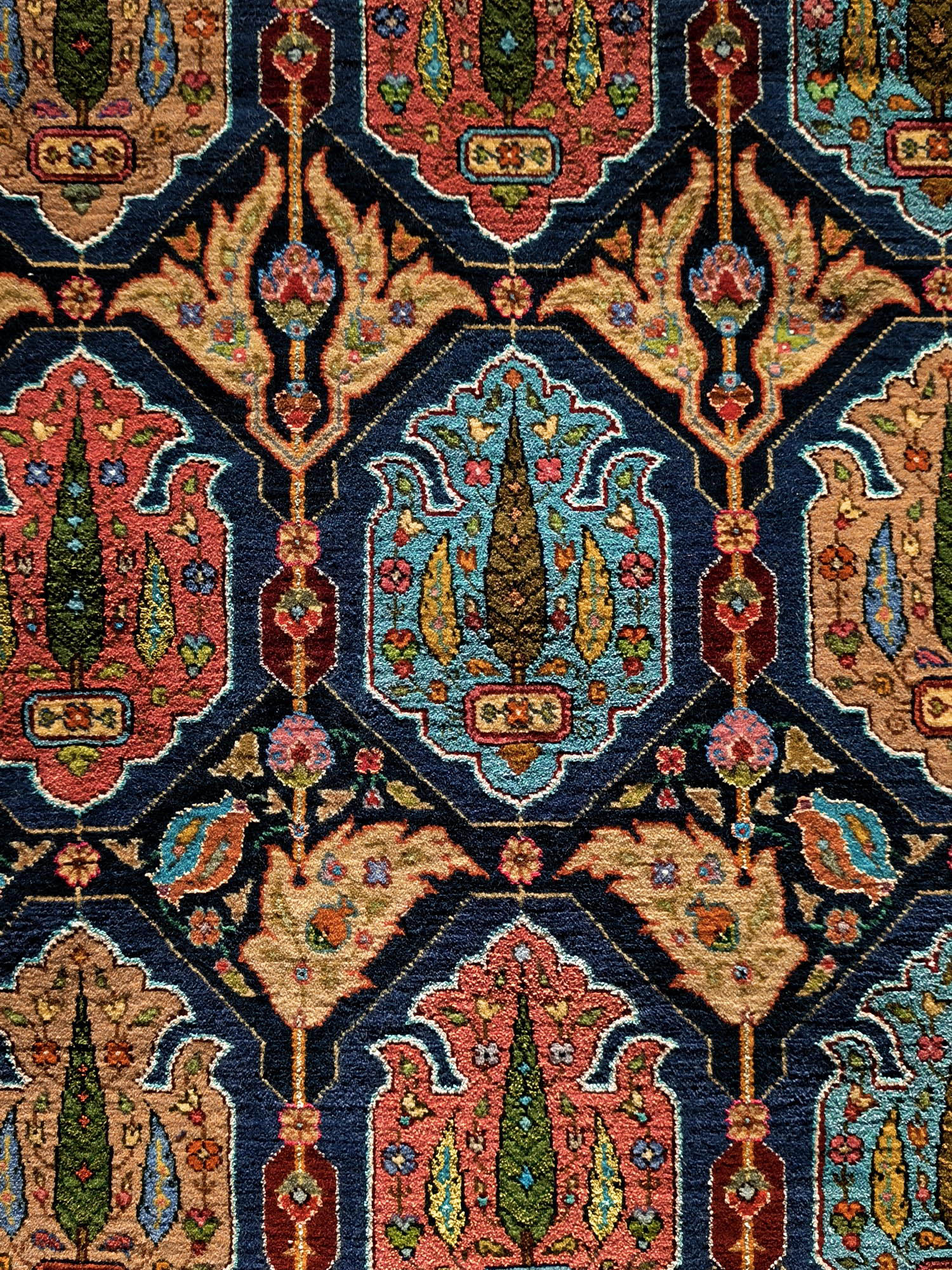
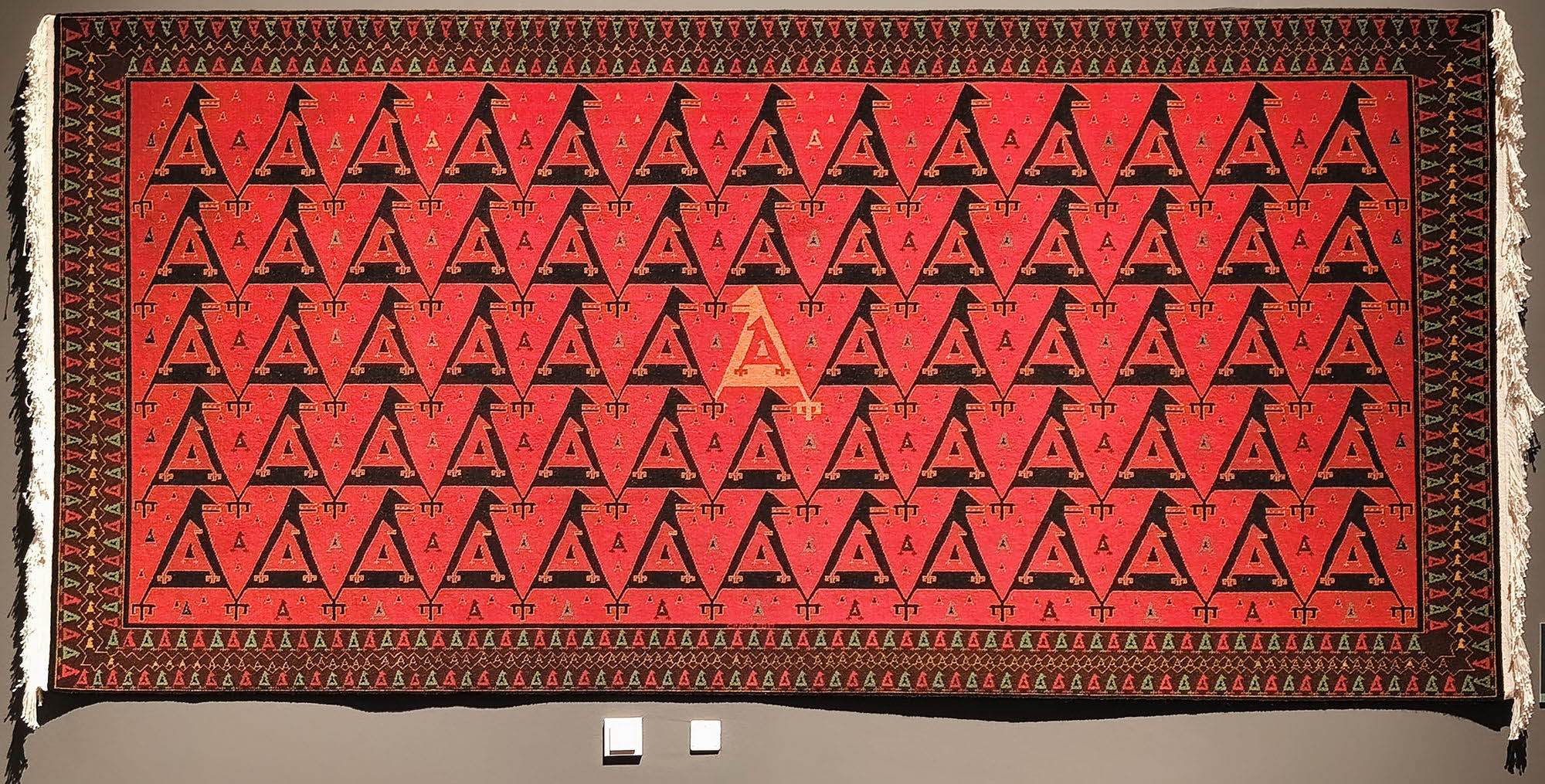
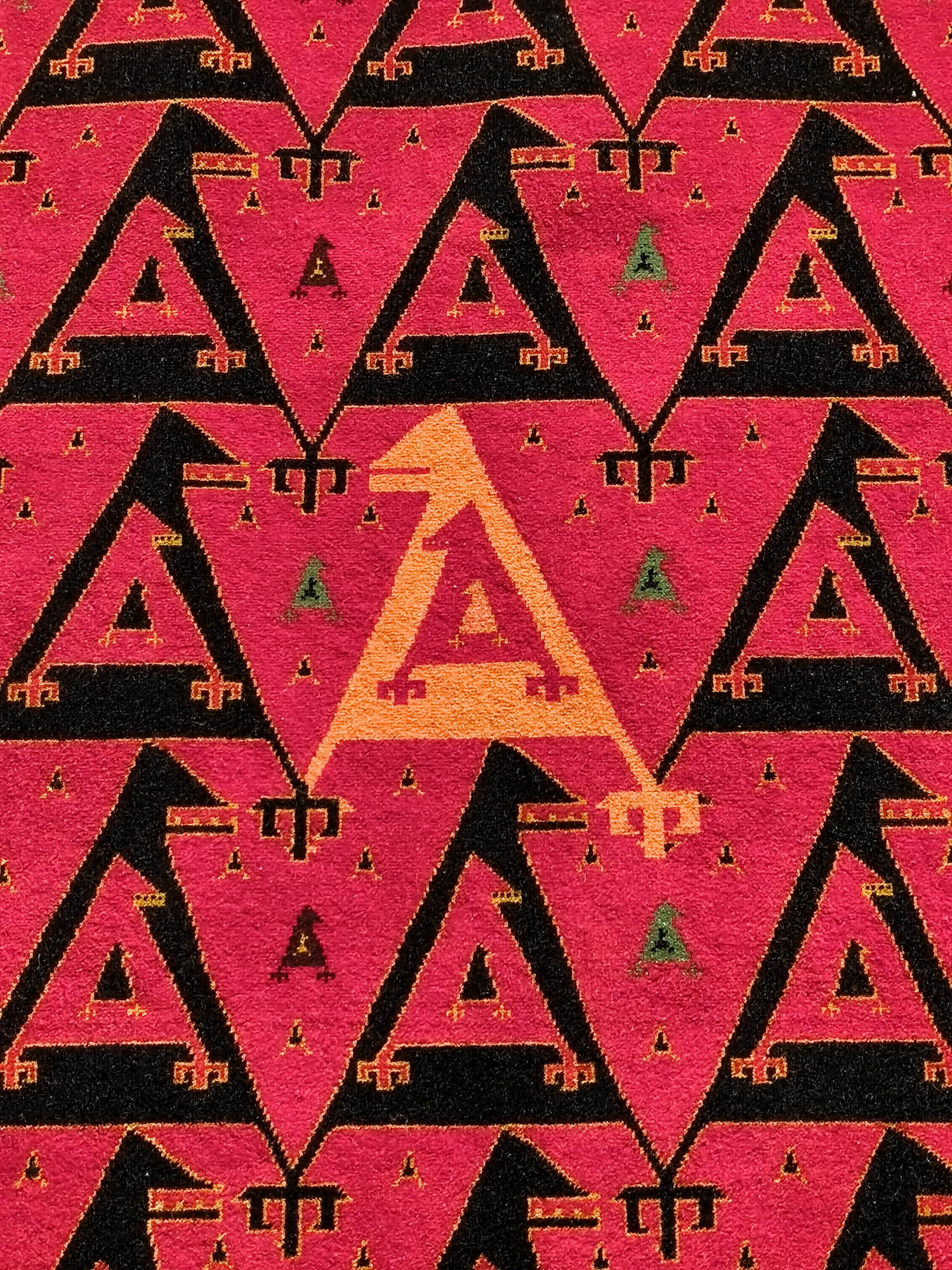
Chingiz Babayev (1964–) employs a method of deconstruction: he takes the traditional motifs, built according to strict mathematical principles, analyses them down to their very foundations, and then reassembles them. This is the case in the carpet Resistance (a rather daring title in Azerbaijan), where the central motif is the inverse of all the others, both in colour and in orientation. He exhibits regularly at the Venice Biennale and at other venues throughout the West.
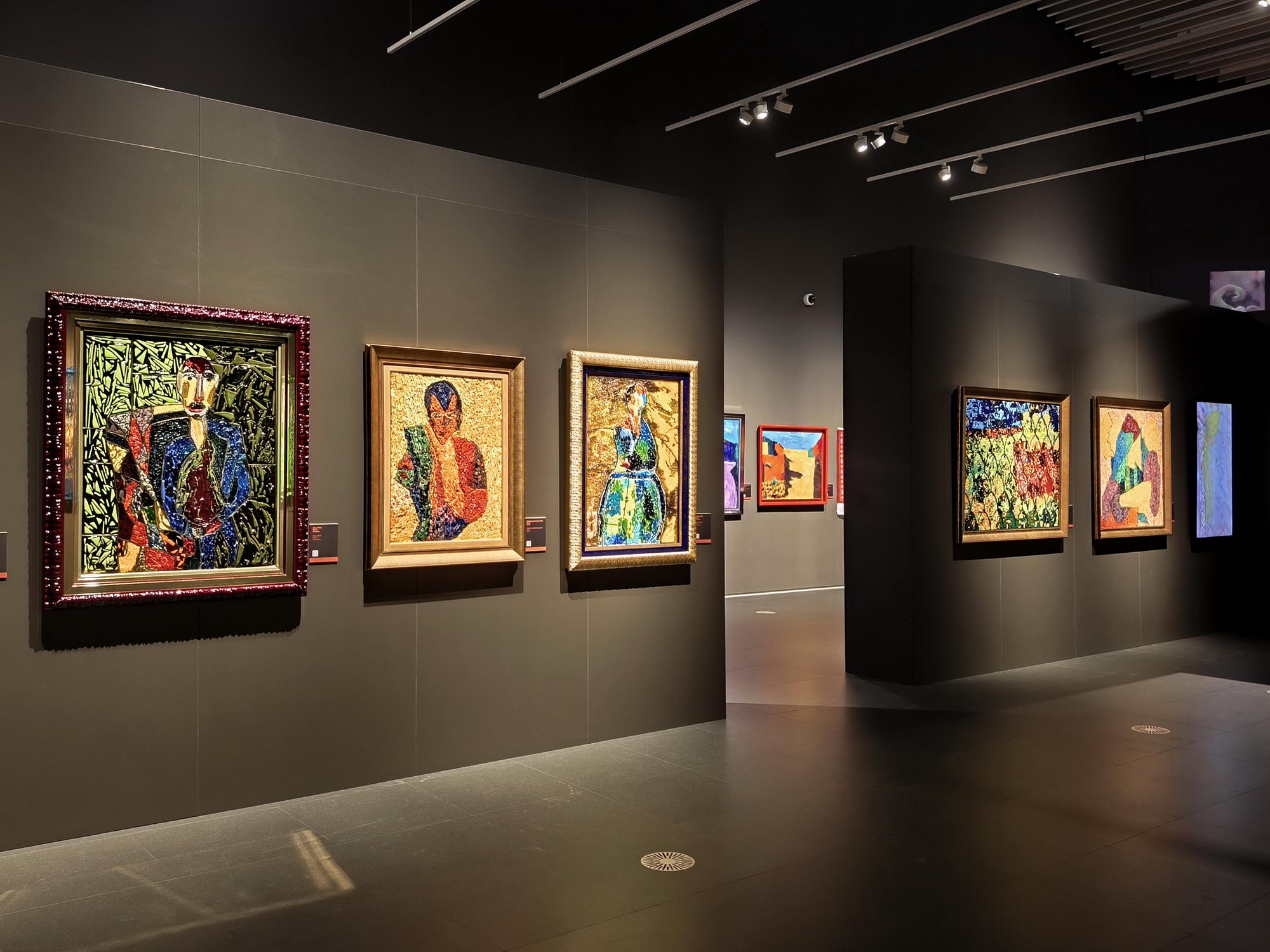
Yet the largest section of the exhibition, both in terms of gallery space and the number of works displayed, is devoted to a third, younger female artist. This gallery is larger and contains more works than the other two sections combined. The imbalance is so striking that one cannot help wondering whether the previous two sections merely serve as a prelude and a framework for this final one.
Moreover, the works themselves—paintings, carpets and mosaics based on those paintings, together with digital pieces—fall well below the standard set by the previous two artists, to the point where seeing them side by side is almost painful. Compared with the Azerbaijani children’s drawings whose exhibition I reported on from Baku fifteen years ago, they clearly draw on the same tradition of vivid, saturated colour, yet virtually every single work in that children’s exhibition was more inventive and more compelling than these. One cannot help asking: if such a section had to be included, why not invite those artists instead?
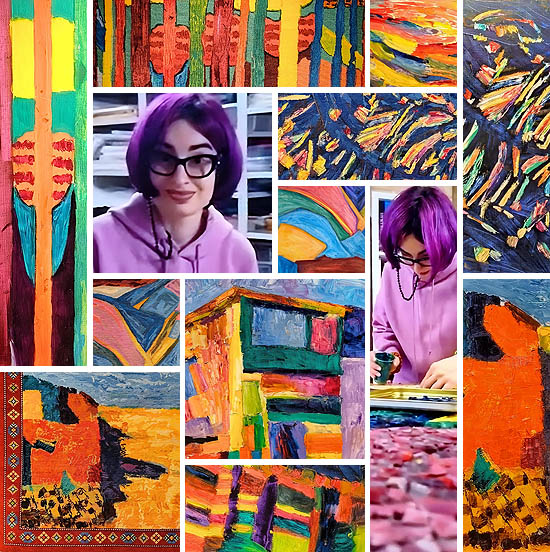
The artist is known simply as Medina, and the omission of her surname answers the question why. Medina Kasimova is the daughter of the billionaire Azerbaijani art collector and technology investor Ulvi Kasimov, who maintains close ties with the Baku political establishment and whose family and business network is deploying its full influence to advance Medina’s international career on the global stage. The principal organizer of the present exhibition is the Heydar Aliyev Foundation, established by the Azerbaijani president in memory of his father, and the exhibition opening was attended by the highest-ranking representatives of Azerbaijani diplomacy.
When the Orbán government extradited the Azerbaijani axe murderer Ramil Safarov to Azerbaijan in the summer of 2012, where he was immediately celebrated as a national hero, Novruz Mammadov, then head of foreign policy at the Azerbaijani Presidential Administration, declared the very next day that the cultural opening toward Hungary pursued over the preceding years—including Azerbaijani exhibitions, cultural events, book publications and, of course, economic promises—had all formed part of a carefully planned strategy designed to secure the murderer’s extradition. Ever since, whenever I encounter an Azerbaijani cultural programme in Hungary, the same question comes to mind: whose interests does it really serve?
Medina’s presence in this exhibition offers an excellent case study of how cultural patronage by Azerbaijan’s contemporary elite, the global digital marketplace, and diplomatic representation have become intertwined.
Her parents’ companies have even built a substantial public-relations campaign around their daughter’s personal trauma. Medina was born with oxygen deprivation and grew up with severe speech and communication difficulties, from which art therapy helped her recover. Although the story of trauma and healing is entirely genuine and deserves respect on a human level, her parents have incorporated this personal narrative directly into the business PR strategy of the .ART domain registry they own. An ordinary artist facing similar challenges would have no chance of accessing the extraordinary global marketing machinery that stands behind her. Her presence in international museums—including this exhibition at Budapest’s Museum of Ethnography—together with multimillion-dollar promotional campaigns and her position within the international art-and-technology scene, is supported entirely by her parents’ political and financial capital, reinforced by the backing of Azerbaijan’s ruling elite through the Heydar Aliyev Foundation.
I have no doubt that the first and second sections of the exhibition are the result of genuine scholarly and curatorial work on both the Azerbaijani and the Hungarian side. That makes it all the more unsettling to consider that they may ultimately serve merely as a prestigious pedestal for the exhibition of a nepo baby whose works cannot be compared in artistic weight either with the traditional Azerbaijani carpets or with the later artists who creatively reinterpreted their motifs.
And it brings to mind these lines by Okudzhava:
|
А всё-таки жаль — |
And yet it is a pity that so often |



Add comment