

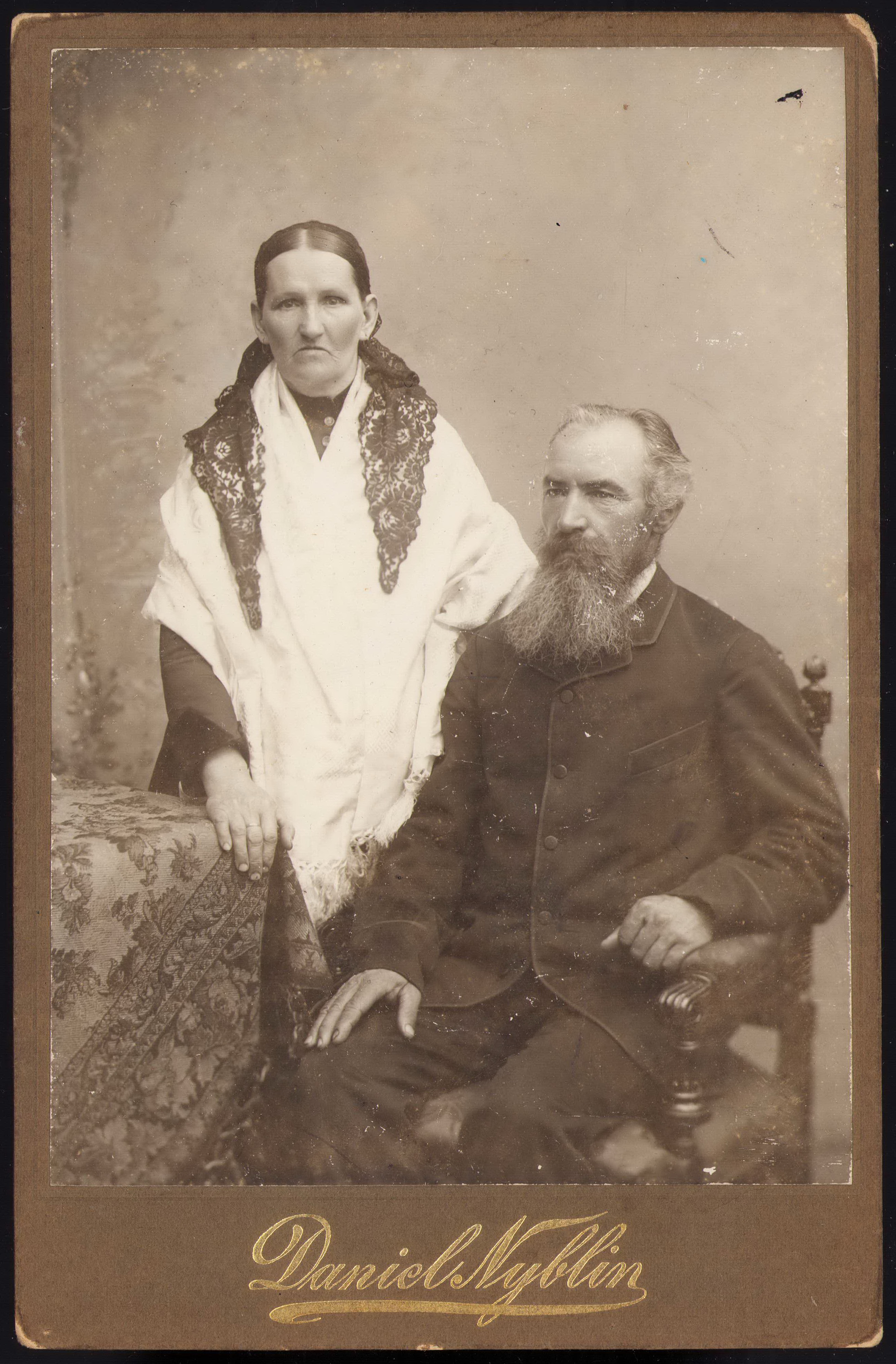
I bought this photograph at the Dry Bridge flea market in Tbilisi. The albumen print is mounted on premium-quality cardboard, embossed in gold foil with the name of Daniel Nyblin.
The Norwegian-born Daniel Nyblin (1856–1923) founded his photographic studio in 1877 in Helsingfors, then part of the Russian Empire and today known as Helsinki. Through this studio—and through his many other efforts to promote photography—he earned the title of “the father of Finnish photography.” His studio, which still operates today, was frequented by Finland’s social elite and artistic circles, as were the branch studios he later established in Viborg, Turku, and Porvoo.
The photograph was probably taken in the late 1880s or the 1890s, when photographers commonly used heavy embossed card mounts that protected the print from warping while also giving it a sense of prestige through their substantial weight. More likely, however, it dates from the 1890s, when dark-toned mounts became fashionable, replacing the cream-coloured and white card stock that had previously been the norm.
In keeping with the prestige of the studio, the portrait depicts an elderly couple belonging to the bourgeois elite of the period. Numerous visual elements emphasize their distinguished social status.
Perhaps the least obvious of these is the carpet draped over the table. It recalls the expensive Oriental carpets that Netherlandish painters—such as Vermeer—depicted not on the floor but spread across tables. In Finland’s increasingly bourgeois society, such a studio table carpet conveyed the message that the photographed couple belonged to an elegant and prosperous household.
Such studio carpets were manufactured mainly in England and Germany between 1850 and 1890, before falling out of fashion with the arrival of Art Nouveau. They were typically produced in deep red, burgundy, or golden-brown tones, as the photographic plates of the period reproduced these warm, dark colours with the greatest richness and contrast. Their dense ornamental patterns broke up the monotony of dark clothing while adding texture to the composition. They also concealed inexpensive studio tables and provided convenient support for sitters, helping them remain motionless during the relatively long exposure times.
Painted landscape or architectural backdrops were also common in photographic studios of the period. Daniel Nyblin, however, rejected such settings and worked exclusively with clean, neutral backgrounds. There were several reasons for this.
• Nyblin was a respected visual artist who maintained close ties with the leading Finnish realist painters of his day. The essence of realism was the truthful depiction of the individual, and artificial illusions would only have distracted attention from the sitter’s face and character.
• The neutral, subtly graduated background made it possible to employ classical painterly light-and-shadow effects, such as the so-called Rembrandt lighting seen here. The background is brighter on the left and gradually fades into darkness toward the right. Light falls upon the couple from the side and slightly above—through a north-facing skylight—at an angle of roughly 45 degrees. This lighting emphasizes the texture of their faces and clothing while lending the portrait depth and dramatic atmosphere. At the same time, a reflector—a sheet of canvas or paper—was placed on the darker side to softly bounce light back onto the shadowed half of the subjects’ faces.
• By the 1890s, painted backdrops had increasingly become a feature of provincial studios, where they served to impress rural customers, while elite studios were turning instead toward Scandinavian minimalism and aristocratic simplicity.
Resting her right hand on the carpet covering the table, the elderly lady wears a dark silk or wool dress with a light-coloured shawl draped over her shoulders. The dark dress proclaims the bourgeois virtues of seriousness, sobriety, and thrift, while the shawl, made of exceptionally fine and expensive fabric and finished with handmade lace, serves as a sign of refined taste and prosperity. On her head she wears a black lace cap (mantilla), which falls gracefully over her shoulders and elegantly frames her face.
The mantilla was originally a Spanish and Catholic garment, but by the end of the nineteenth century it had become fashionable throughout Europe among elderly, respectable middle-class women. In the Finnish Lutheran Church, women were expected to cover their heads in church and on formal occasions, such as a representative studio portrait. The black lace symbolized decency and a God-fearing life.
The lady’s posture is remarkably upright and dignified, with one hand resting calmly on the table. This pose reflects the upbringing of the period: bourgeois daughters were taught to maintain strict control over both their emotions and their bodies, especially in public—or in front of a camera.
Contrary to popular belief, the fact that the woman is standing while the man is seated does not signify her subordination. Rather, it presents her as “the pillar of the family,” the loyal and steadfast companion standing beside her husband. At the same time, the man, with his full broad beard and dark lounge jacket, already carries considerable visual weight even while seated. Had the woman also been seated, the lower half of the composition would have become too dense. By standing, her white shawl and vertical silhouette beautifully elongate the composition and bring the image into balance.
Although the introduction of dry plates in the 1880s dramatically reduced exposure times, photographers still preferred to err on the side of caution during studio sittings. Behind standing subjects there was almost certainly a heavy cast-iron headrest stand. This device was positioned to support the sitter’s neck securely while remaining hidden from the camera. It ensured that the subjects could not move even accidentally, resulting in the remarkable sharpness and fine detail of the portrait.
Considering her age, the woman’s face and hands appear almost porcelain-smooth, providing direct evidence of meticulous manual studio retouching. This work was carried out on the large glass negative itself by carefully modifying the gelatin emulsion, often requiring days of painstaking labour.
Her long, slender fingers demonstrate that she was a lady of means who had never performed heavy physical or manual labour.
The deliberate positioning of the hand resting on the table carpet and turned towards the light serves to draw attention to the only piece of jewellery she wears: her wedding ring, the visible symbol of her married status.
By contrast, no wedding ring is visible on the man’s hand. It is true that the position of his hand conceals his ring finger (in Finnish nimetön, literally “the nameless finger”). Yet if he had been wearing a ring, it would almost certainly have been displayed just as prominently as his wife’s.
In nineteenth-century Northern Europe, both partners exchanged engagement rings at the time of their betrothal. Upon marriage, however, only the bride received—and thereafter wore—a wedding ring, which signified her new marital status. Wedding bands did not become commonplace among men until the first half of the twentieth century, particularly during the First World War. Soldiers leaving for the front began wearing rings as symbols of fidelity to the wives and homes they had left behind.
By placing her ringed hand directly upon the table carpet—a symbol of prosperity—the composition visually links her marriage with affluence. Her ringed hand seems almost to “claim possession” of this emblem of bourgeois comfort, suggesting that she is the mistress of a wealthy and well-ordered household.
The gentleman wears an elegant, tailored dark wool lounge jacket. His principal mark of distinction is his full, carefully groomed beard, a symbol of wisdom and patriarchal authority. In the age of National Romanticism, men in Scandinavia and Finland commonly grew this so-called Monarch or Patriarch beard—rather than the trimmed mutton chops fashionable in Western Europe—as an evocation of their Viking heritage. Within Lutheran culture, such a beard also symbolized the authority and moral integrity of the biblical patriarchs.
The meticulous grooming and impeccable orderliness of the beard formed an essential part of the ideal of the gentleman and required considerable daily care.
A middle-class gentleman of this standing visited the barber at least once a week, and often several times. The barber would shave the upper line of the moustache, the cheeks, and the neck clean with a straight razor, while carefully trimming the ends of the beard with scissors.
At home, a stiff boar-bristle brush was used to untangle and straighten the beard. The handles of these brushes were often made of fine wood, silver, or horn. For more delicate grooming and for combing the moustache, gentlemen used finely crafted horn combs with closely spaced teeth, polished by hand and valued because they did not generate static electricity in the hair.
In the harsh northern climate, a long beard could easily become dry and coarse, so it was treated with a variety of grooming products. Oils based on almond, jojoba, or macadamia were rubbed into the beard, often scented with botanical extracts. Popular fragrances included sandalwood, cedarwood, bergamot, and pine—all distinctly masculine, natural aromas.
To prevent the moustache from drooping over the mouth and to preserve its elegant shape, it was set with beeswax and gum arabic. The wax was gently warmed, applied with the fingers, and then shaped with a small moustache comb.
The most devoted gentlemen even protected their facial hair while sleeping. Special moustache guards, made of silk or leather and secured behind the ears, were available for this purpose (mustache trainers). These devices held the moustache and the upper part of the beard in place throughout the night, preventing them from becoming dishevelled during sleep and ensuring that the barber’s carefully crafted shape remained intact until morning.
This level of care clearly shows that, for the elderly gentleman portrayed here, his beard was far more than mere facial hair: it was a serious daily investment and a faithful proclamation of his social standing.
The gentleman’s appearance, his carefully groomed long beard, and his elegant attire suggest that he belonged to Finland’s educated and governing elite (säätyläiset, the estate-based bourgeoisie). He may have been a senior civil servant or church official—a university professor, lawyer, judge, or high-ranking Lutheran clergyman—a prosperous merchant or industrialist involved in the rapidly developing commercial and industrial sectors of cities such as Helsingfors, Turku, or Vaasa, or perhaps a wealthy rural landowner (patruuna or kartanonherra), who, following established custom when visiting the capital, called at Nyblin’s studio to commission a formal family portrait.
The photograph immortalizes the ideal couple of Finland’s late nineteenth-century social elite: the respected, wise patriarch and head of the family, alongside the dignified, God-fearing, and honourable matron. Every detail of the image—from the beard to the lace shawl—proclaims stability, order, and bourgeois prosperity to future generations. The portrait stands as an exemplary expression of late nineteenth-century Finnish middle-class self-confidence and economic security: it presents a married couple who earned the respect of society through honest work or inherited wealth, and who gaze proudly into posterity.
A question frequently asked today about people in old photographs is why they always appear so serious. To modern eyes it seems strange that nobody smiles. According to the etiquette of the time, however, broad smiles and the display of one’s teeth were associated with madness, drunkenness, or low social standing—for example, with fairground entertainers. Respectable members of the bourgeoisie were expected to present themselves before the camera with dignity, composure, and self-control. Photography was also regarded as a more affordable equivalent of painted portraiture. People did not smile in painted portraits either, for such images were intended to endure for eternity.
The photograph was taken during the period of the so-called First Russification of the Grand Duchy of Finland, then part of the Russian Empire—a period known in Finnish as sortokaudet, “the years of oppression.” The movement of passive resistance was led largely by the prosperous bourgeois and intellectual class represented by the couple in this portrait. Daniel Nyblin’s studio served as a meeting place for Finland’s cultural elite. This image was therefore created at a moment of calm before the storm, when the Finnish bourgeoisie sought to affirm its own culture, Nordic identity, and aspirations for independence—even through a formal, disciplined family portrait such as this.
The photographic format itself—the cabinet card—belongs to a closed chapter in the history of photography, flourishing from the 1860s until the early twentieth century. When Kodak introduced the Brownie camera in 1900, photography became a popular hobby for the masses, and ordinary people began developing their own pictures on small photographic prints. The age of elaborate studio portraits mounted on heavy decorative card was coming to an irreversible end.
On what occasion might this photograph have been taken?
In the late nineteenth century, an elderly couple did not visit a photographic studio on a whim; it was a social and family ritual.
Within bourgeois culture, families customarily sent grandparents to the town’s most distinguished photographer to commemorate their silver wedding anniversary (twenty-five years of marriage) or their golden wedding anniversary (fifty years).
The deep emotion and solemn dignity visible on the couple’s faces, together with the deliberate emphasis on the woman’s wedding ring, strongly suggest that this portrait too was made to commemorate such a milestone anniversary. In the eyes of contemporary society, the photograph thus became a monument to marital fidelity, perseverance, and the continuity of the family.
Once the elderly couple had collected their finished cabinet cards from Daniel Nyblin’s studio, the photographs embarked upon an entirely new, ritual journey. By the end of the nineteenth century, photography had transformed private life and given rise to a distinctly bourgeois culture of family memory.
These cabinet cards, mounted on stiff cardboard, were generally not framed and hung on walls. Instead, they were placed in luxurious family photograph albums designed specifically for this purpose. Considered luxury objects in their own right, these large and heavy volumes were bound in leather, plush, or velvet, with brass or silver corner fittings and clasps. Inside, thick cardboard pages contained precisely cut pockets into which the cabinet cards fitted perfectly. Even the rounded corners of the cards were designed to slide smoothly in and out of these pockets. The characteristic “album wear” caused by this storage method can still be seen along the edges and surface of the photograph. Its remarkable state of preservation and the unchanged richness of its tones likewise suggest that it spent the past one hundred and thirty years protected in such an album.
The opening pages of these albums were always reserved for the oldest and most respected members of the family—such as the grandparents or great-grandparents shown here. They were followed by the parents, and then by the children and grandchildren. A portrait like this granted the elderly couple a form of “eternal life” within the family’s collective memory. Day after day, children and grandchildren would see the dignified faces of their forebears, reinforcing a sense of continuity and belonging across the generations.
The album was kept in the most important room of the house—the parlour or drawing room—usually displayed on the coffee table. Whenever visitors arrived, the family would leaf through the album together with their guests. This was a social ritual of its own: through the photographs they presented the extent of their family, their honourable ancestors, and their social achievements.
Moreover, cabinet cards were rarely ordered as single prints. Most customers commissioned a dozen copies. The elderly couple would send their portraits to children living far away, who proudly displayed them on their own mantelpieces or placed them in their own family albums.
Perhaps this photograph reached Tiflis from Helsingfors in just such a way. It is entirely possible that one of the couple’s children or grandchildren was transferred to the cosmopolitan Caucasian metropolis as a high-ranking imperial civil servant or military officer, taking the portrait along—or receiving it there from parents or grandparents. Since there is no inscription whatsoever on the reverse, it most likely survived the turbulent decades protected inside a family album, the contents of which were eventually dispersed from an estate and sold by the antique dealers of the Dry Bridge market. I was fortunate enough to acquire only the final surviving photograph—but it was almost certainly the very first image in that long-lost family album.




Add comment