

“My seven spirits set out, my seven paths unfolded... In the form of a bear I roam the forest, in the form of a fish I swim the waters, on the wings of a bird I cleave the sky.” (Nenets–Khanty shamanic chant from Siberia, collected by Vilmos Diószegi)
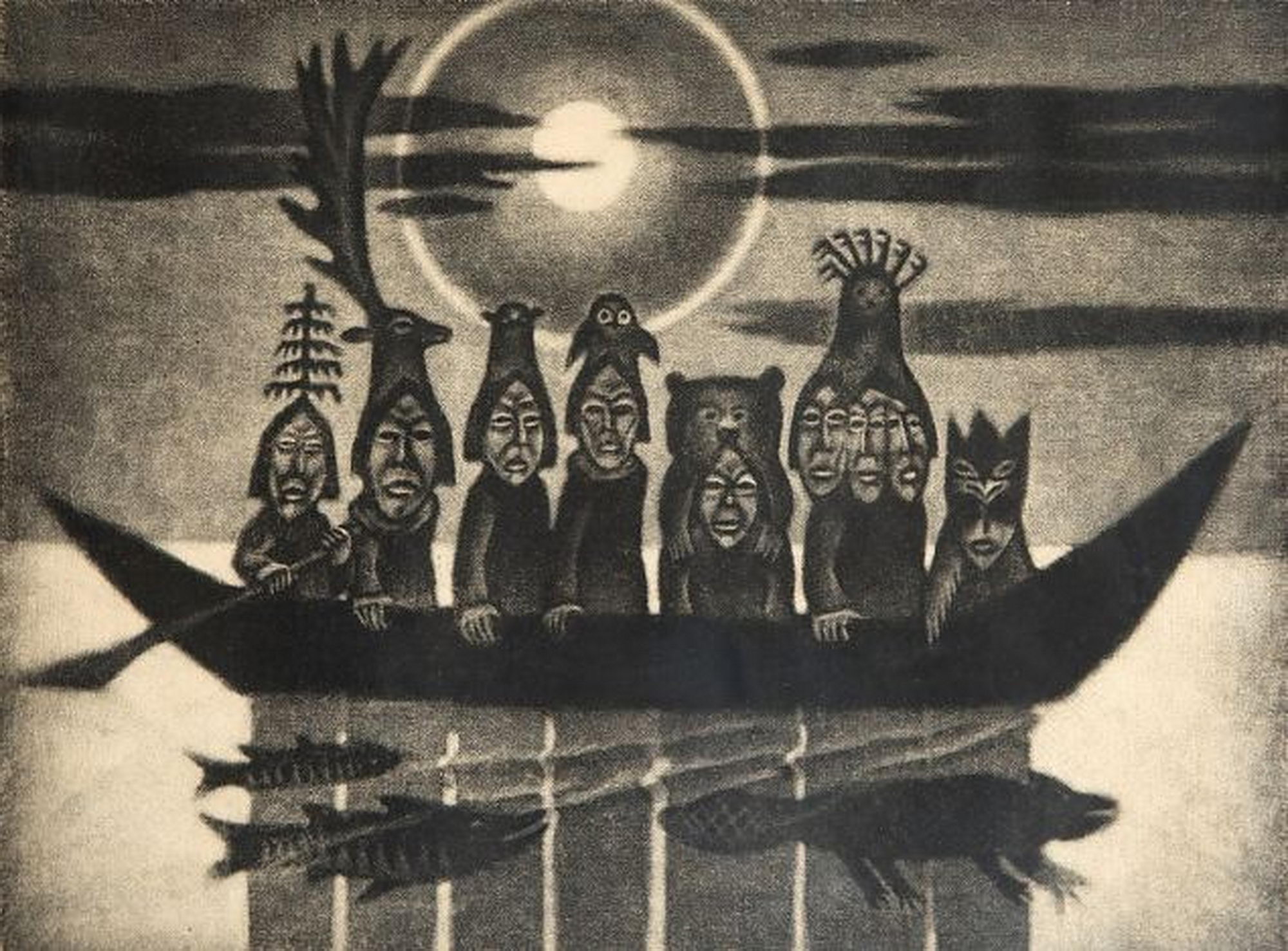
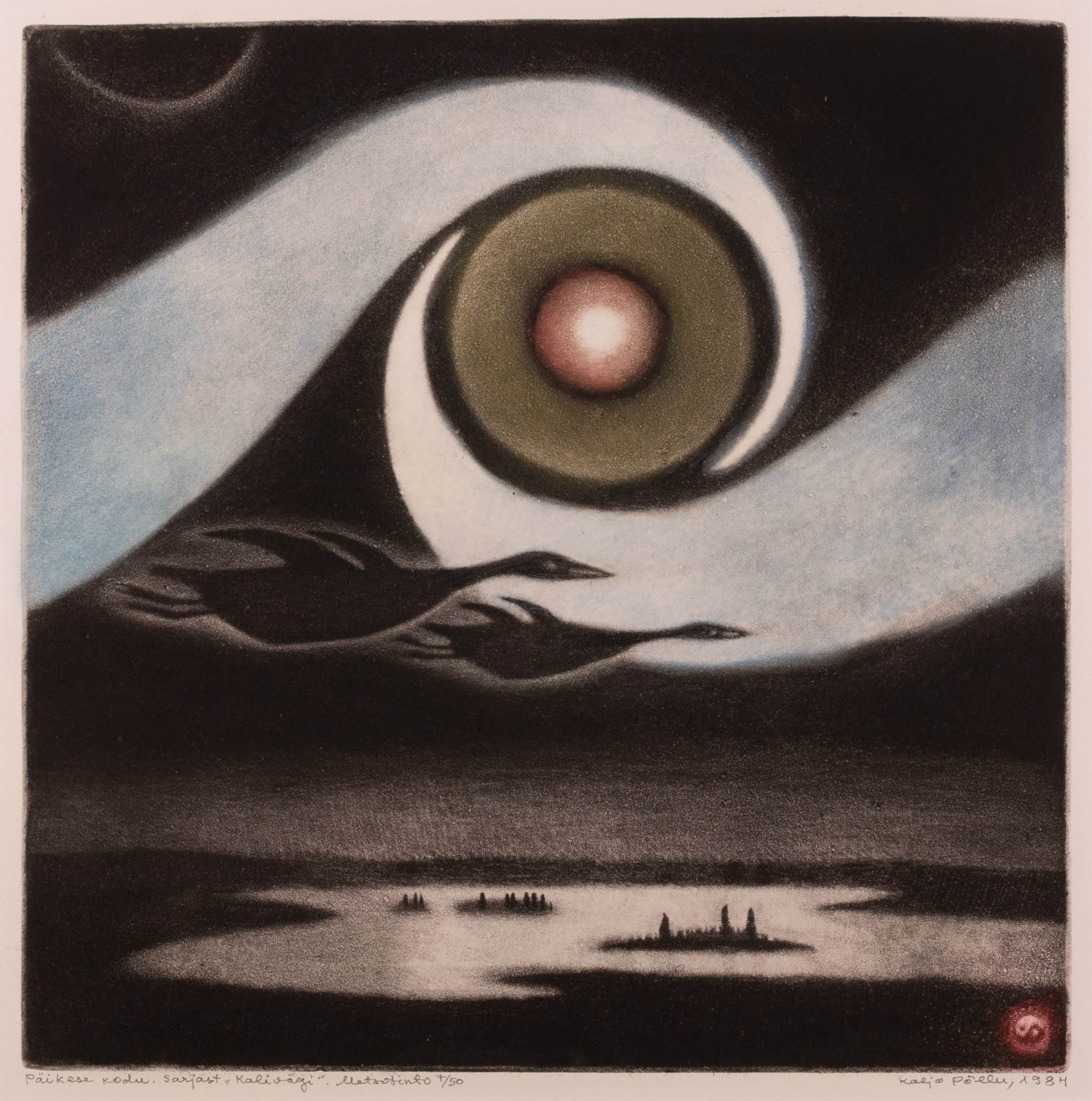
I opened my previous post, in which I wrote about the unique Estonian fantasy mythology of Andrus Kivirähk, with this graphic by Kaljo Põllu. Yet the image itself deserves a post of its own, for it beautifully illustrates how another Estonian artist created another Estonian mythology—one that exerted a profoundly liberating influence on his contemporaries and on later generations, including Andrus Kivirähk himself and Jüri Arrak, whom I introduced earlier.
The title of the work is Päikesevene—The Sun Boat. It is the boat which, according to Finno-Ugric mythology, carries the Sun back to the east during the night along an underground river through Toonela, the realm of the dead. The figures seated in the boat, the Sun’s companions, are the most important totem animals of this mythology, or the spiritual and natural forces appearing in animal form, as well as the ancestors and shamans who assume their shapes. The Bear, the ancestor of humankind and the son of the lord of the sky. The Moose, which bears the Sun upon its antlers. The birds, which guide the souls of the dead along the Milky Way, known in Estonian as Linnutee, the Road of the Birds. The Owl, which sees even in the darkness and watches over the boat’s journey across the night waters. The helmsman, with the World Tree rising from his head at one end of the boat, and the eagle—or another bird of prey—at the other. And perhaps the most intriguing figure of all stands to the right of the Bear: the three-faced being, which on the one hand represents the three souls of ancient Finno-Ugric anthropology (the body-soul, the shadow-soul, and the free-soul), and on the other the three faces of the shaman, who in a state of trance gazes simultaneously into the three worlds.
Beneath the boat, the fish and the beaver symbolize the Lower World, while at the same time serving as characteristic mediators between worlds: the beaver by virtue of its amphibious way of life, and the fish because the shaman frequently assumes its form when descending into the underworld. In this context, they are also psychopomps, guiding the ancestors of the tribe along the spiritual path.
Above the boat, the radiant circle embraces three celestial bodies at once: the Sun itself, travelling eastward; the luminous disk of the Moon—which in Finno-Ugric mythology is the gateway to the Upper World—and the Cosmic Egg, from which the Earth was born.
The seven animal figures seated in the boat do not merely represent the animals themselves, but rather the shamans who have assumed their forms. Their rigid, wooden-statue-like faces may be masks of the kind shamans—or participants in the Bear Festival—often held before their faces, while at the same time vividly reflecting the ritual atmosphere of the ceremonies, in which the members of the community, led by the shaman, stepped out of linear time and entered the timeless realm of myth.
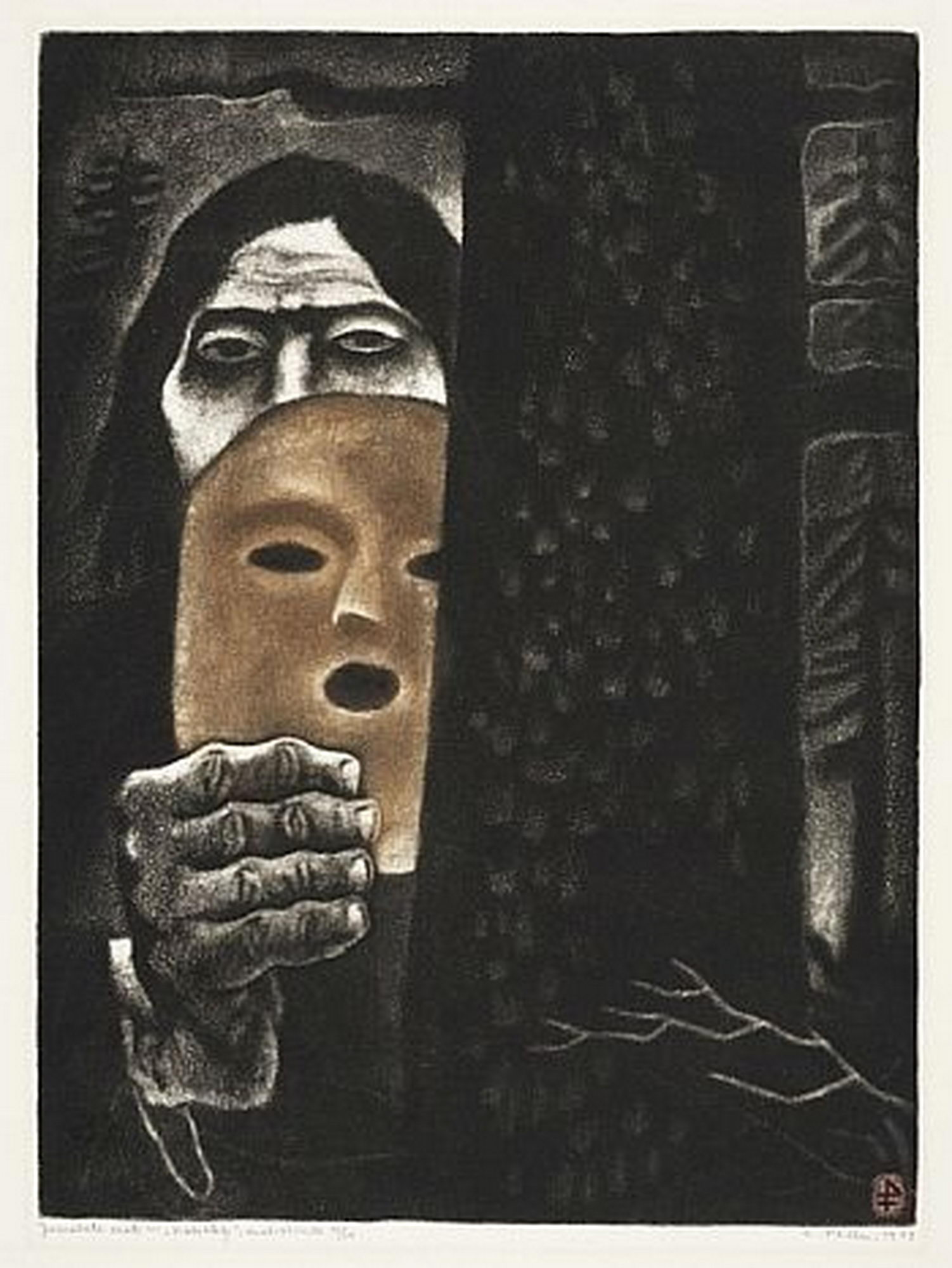
In his youth, Kaljo Põllu (1934–2010) was one of the leading figures of the Estonian avant-garde—pop art, op art, and kinetic art. He taught at the University of Tartu, where Western art publications were smuggled in and translated, and artists experimented with cosmopolitan, abstract forms in opposition to Soviet realism. By 1972, however, he had come to feel that this path was no longer sufficient. He moved to Tallinn and, leaving behind his colourful geometric period, embarked on a complete reimagining of Estonian and Finno-Ugric mythology using the mezzotint technique.
The essence of the mezzotint technique is that the artist first roughens the surface of the copper printing plate with a finely serrated steel tool. Then, using a scraper and a burnisher, he gradually smooths the plate wherever he intends the highlights to appear. The technique allows for exceptionally subtle tonal transitions and perfectly conveys the mystical atmosphere of the northern taiga, the mist, and the Finno-Ugric spirit world.
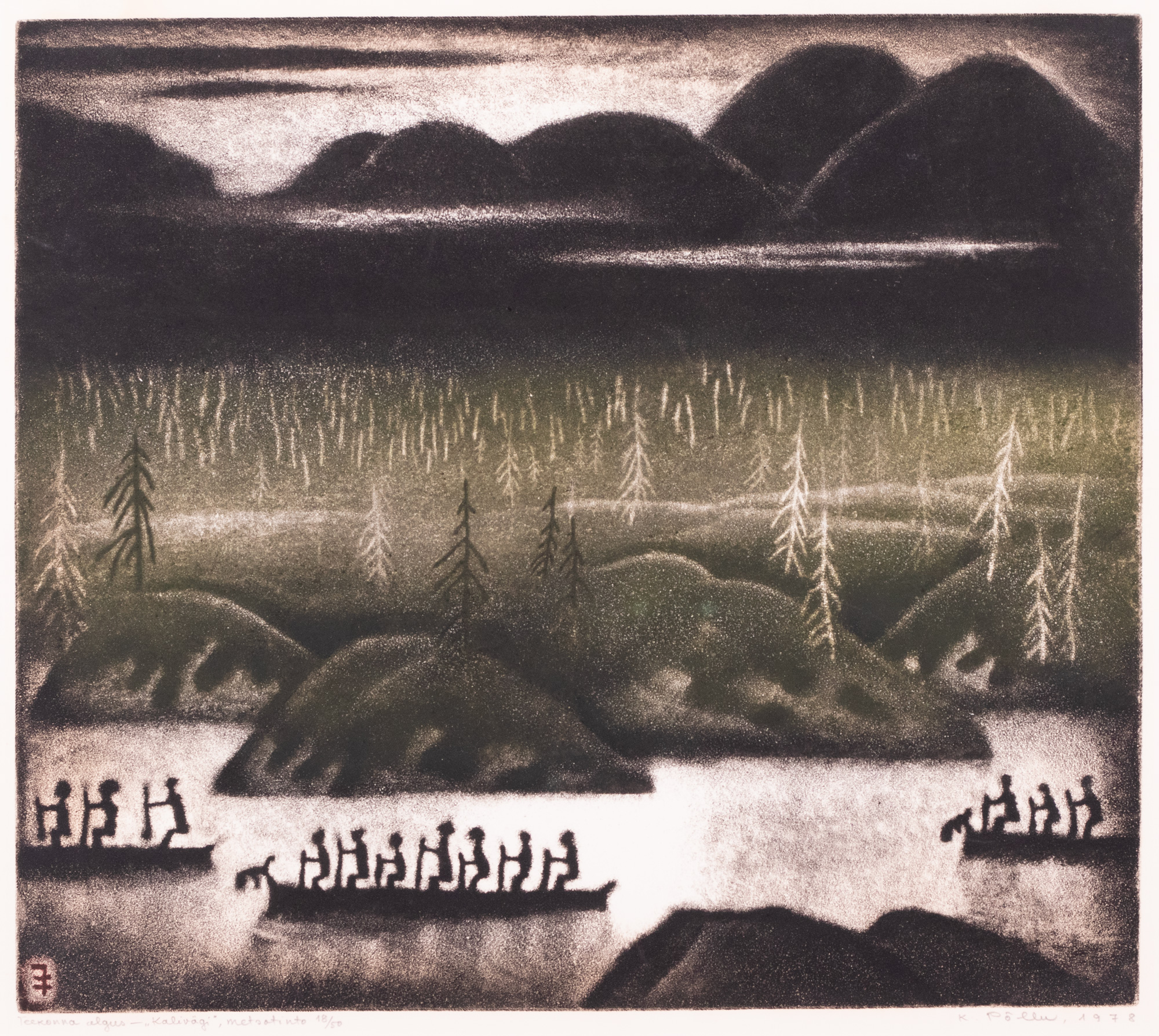
Very little has survived of Estonian mythology as it existed before the crusader conquest. Beginning in the 1840s, two Baltic German scholars, Faehlmann and Kreutzwald, set out to compile the never-before-existing “Estonian national epic,” the Kalevipoeg. Besides the few authentic mythological motifs preserved in runic songs and folktales, they also drew inspiration from German legends and the Kalevala. The final work was, for the most part, Kreutzwald’s own creation. This was by no means unusual in European Romanticism: at roughly the same time, Arnold Ipolyi similarly “recreated” ancient Hungarian mythology.
Kaljo Põllu resolved to dig deeper than this, down to the very roots of the most ancient Finno-Ugric mythology. He gathered every accessible motif from the smaller Finno-Ugric peoples and, beginning in 1978, led expeditions with his students to visit them: the Sámi, the Khanty, the Mansi, the Udmurts, the Komis, and the Karelians. Living among them, they studied first-hand the daily lives and material culture of the indigenous peoples, as well as the prehistoric rock carvings of the Ural region.
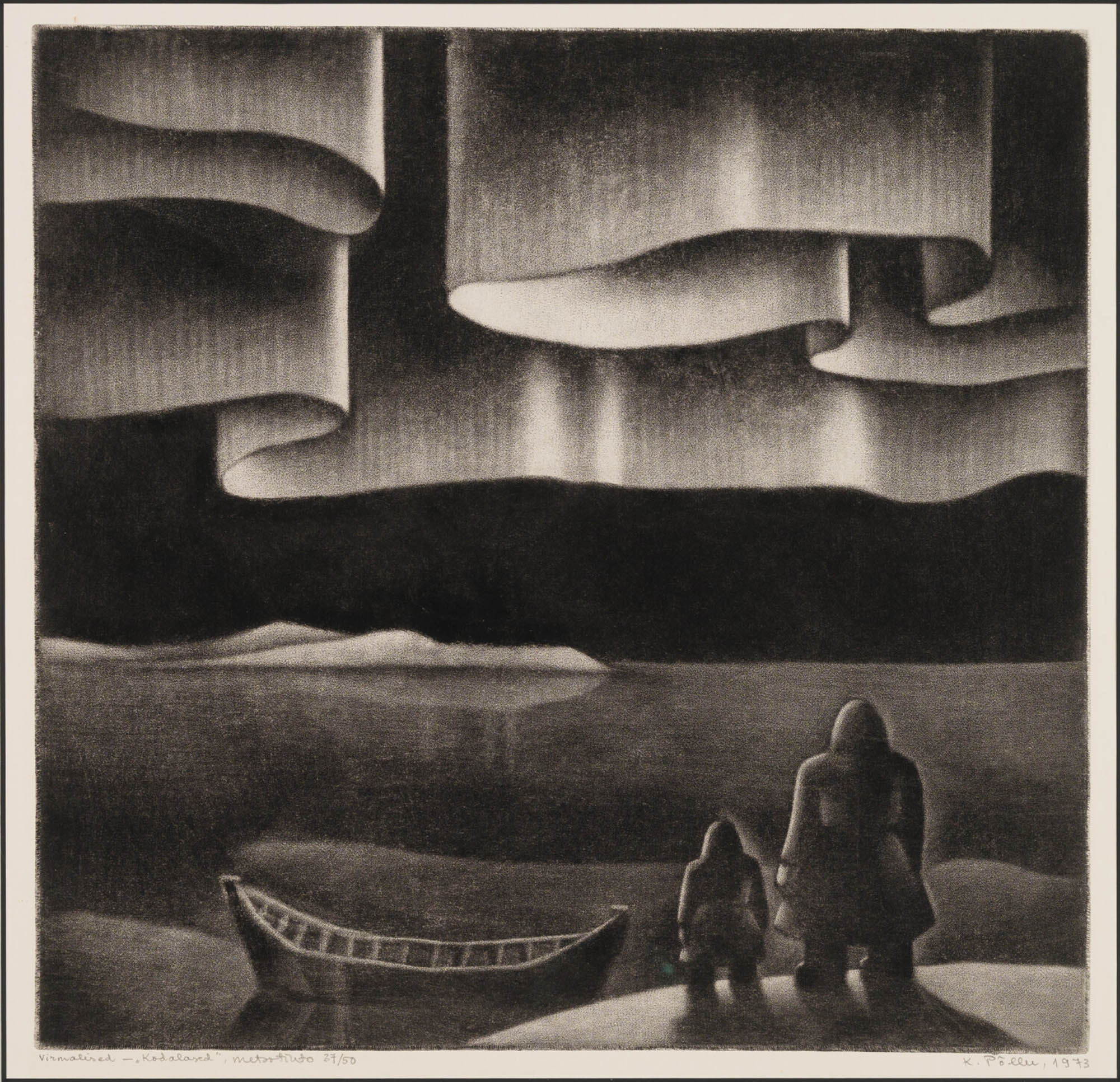
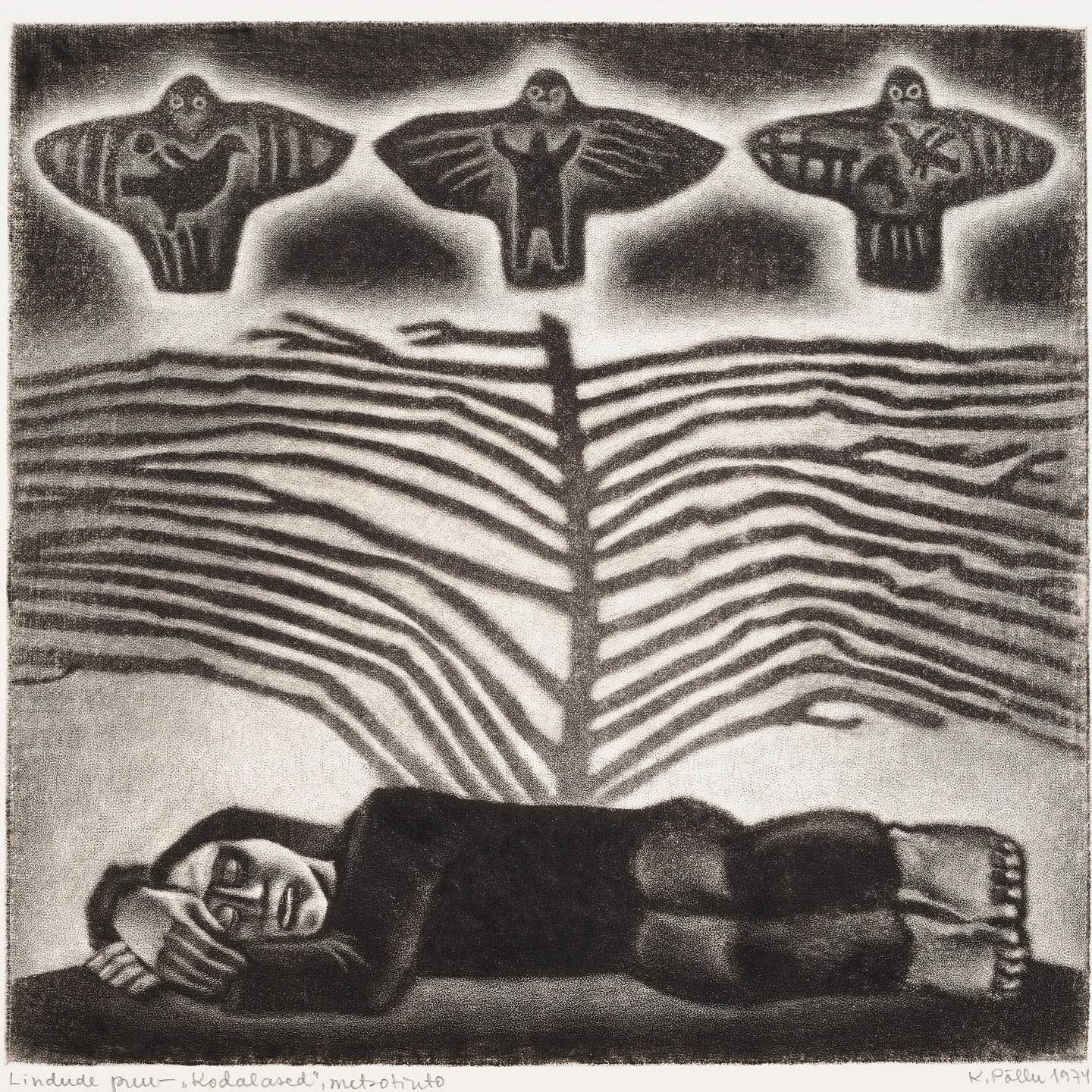
These expeditions gave rise to Põllu’s four celebrated graphic series: Kodalased (The Aborigines, 1973–75), Kalivägi (The People of Kalev, 1978–1984, based on Baltic legends), Taevas ja maa (Heaven and Earth, 1987–91, a synthesis of Finno-Ugric creation myths), and the great culminating cycle, Mitoloogilised lood (Mythological Stories, 1997–2000).
The Aborigines, to which The Sun Boat belongs, was created before these expeditions began. In its twenty-five prints, Põllu still relied on reproductions of ancient Finno-Ugric artefacts. The Sun Boat, for example, is based on an image engraved on the reverse side of a bronze mirror discovered in 1886 near Surgut, in the Khanty-Mansi region, at the site of the Istyak yurts, from which the so-called Istyak Treasure takes its name. The original is preserved in the Hermitage Museum—so well preserved, in fact, that I could not find a single photograph of it anywhere, only sketches made from it.
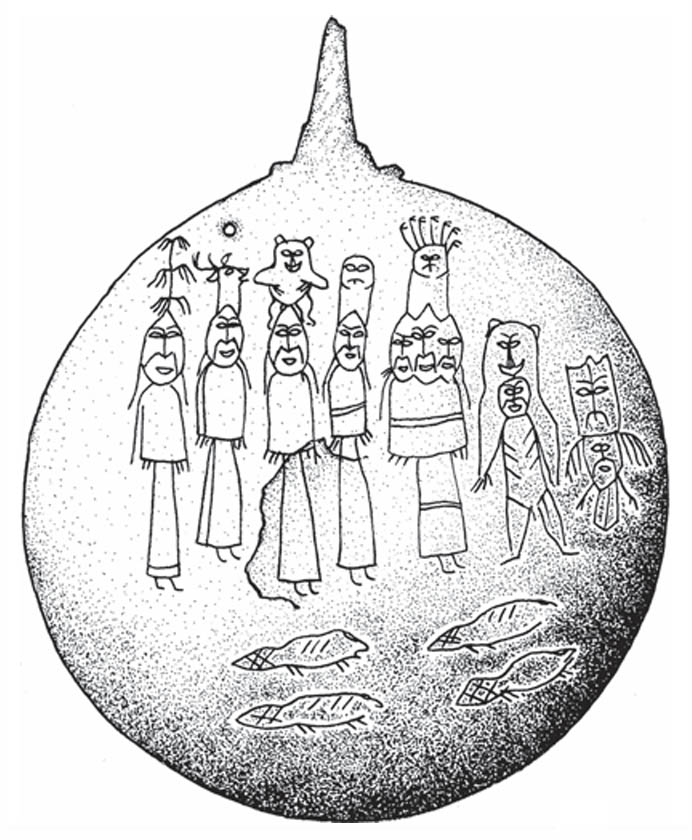
The Istyak Treasure was created by the craftsmen of the so-called Kulay culture (Кулайская культура), which flourished between the 5th century BC and the 5th century AD. It was one of the most mysterious and advanced Early Iron Age civilizations of the northern and western Siberian taiga. This unique hunting- and fishing-based society matched the great Scythian and Sarmatian powers of the southern steppes in weaponry, metallurgy, and fortification building. They maintained close contacts with these southern neighbours and adopted many of their artistic motifs. The people of the Kulay culture were the ancestors of the early Khanty, Mansi, and Samoyedic peoples. Their artefacts depict numerous figures from early Finno-Ugric mythology, including the seven totemic animal-ancestor-shamans whom Põllu would later place aboard the Sun Boat.
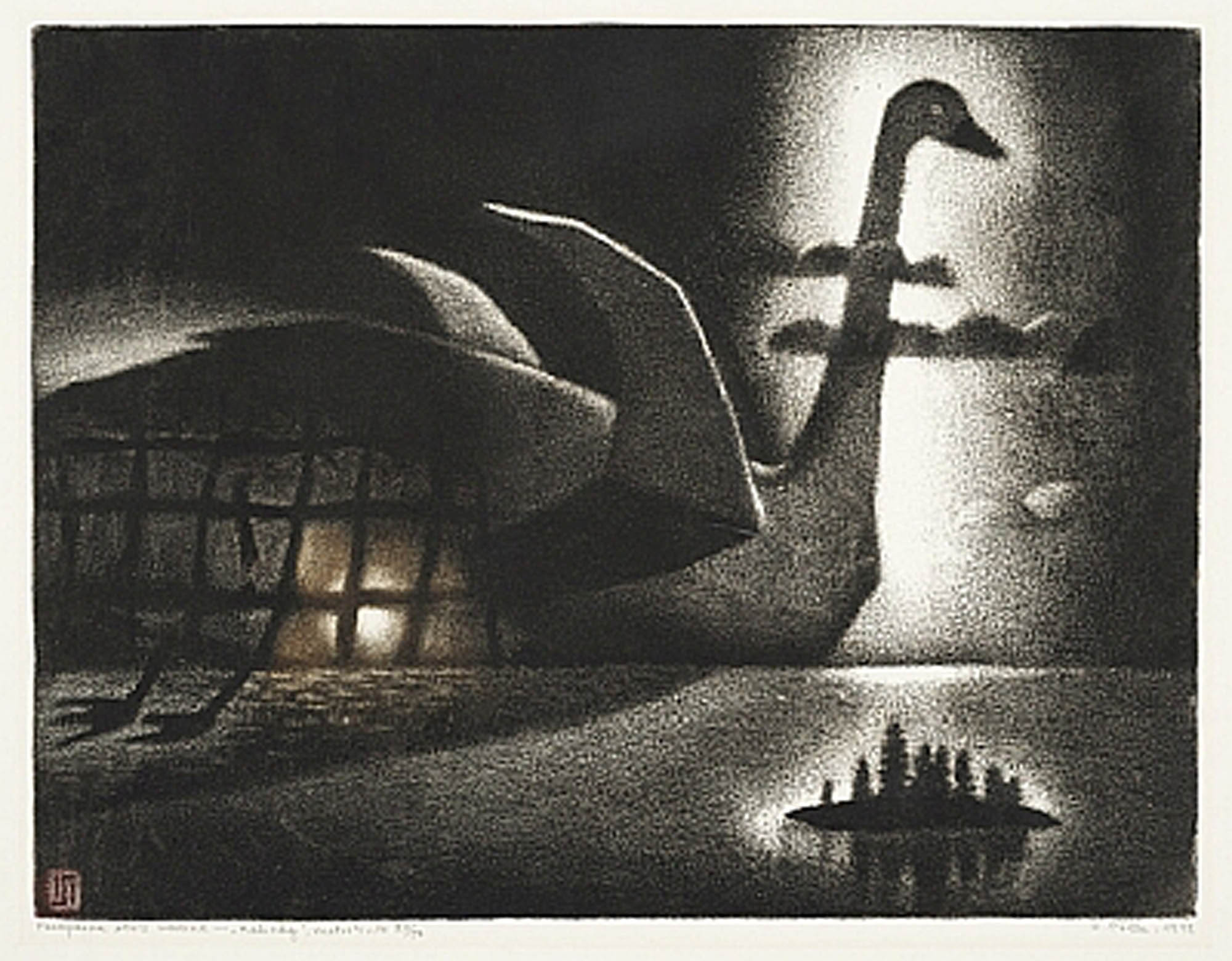 According to Finno-Ugric belief, the Sun is sometimes carried back to the east not by a boat but by great water birds.
The Istyak bronze mirror inspired one other artistic reconstruction as well: an illustration by M. A. Lobyrev for A. I. Solovyov's excellent book Оружие и доспехи. Сибирское вооружение от каменного века до средневековья (Weapons and Armour: Siberian Arms from the Stone Age to the Middle Ages, 2003). The illustration accompanies the chapter on the Kulay fortresses, whose remarkable strength and sophisticated design Solovyov describes with great admiration, especially considering that they were built not by an agricultural society but by a population of hunters and fishermen. The caption beneath the illustration, which brings the Istyak mirror to life in an imagined sacred grove, reads:
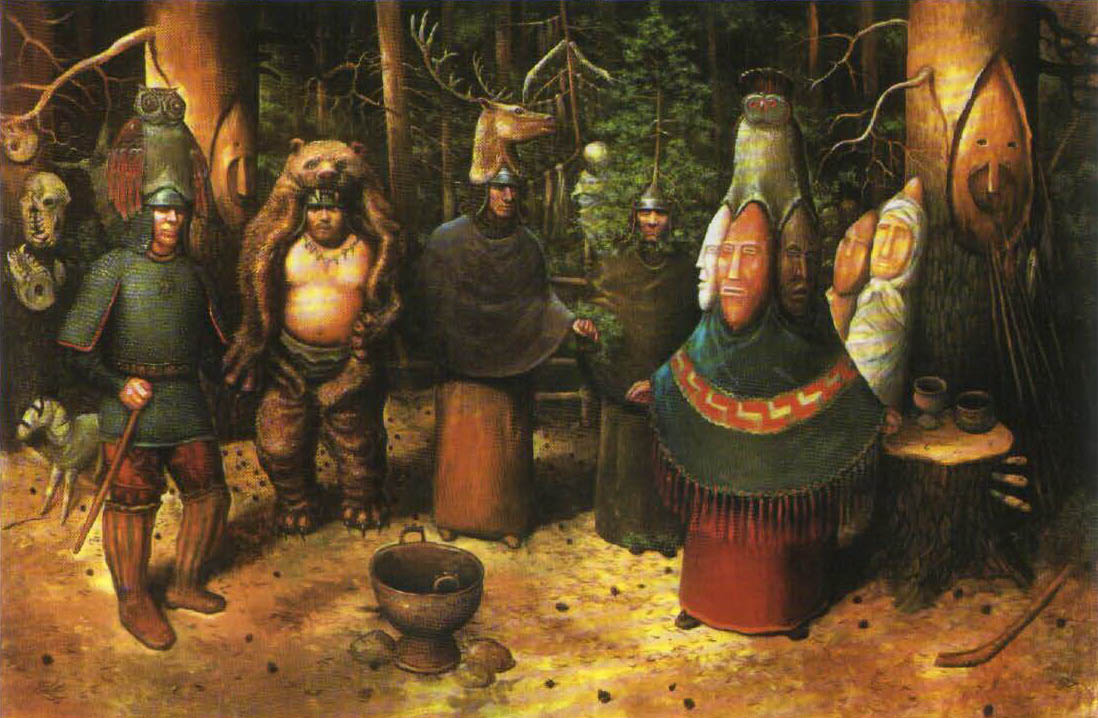 “These ancient traditional societies (especially the Ob-Ugrians) lived in close harmony with nature, regarding the spirit world as an integral part of it. For this reason, the spirits of the dead could readily become embodied in natural objects, stones, or animals. The boundary between the world of the living and the Otherworld was permeable. Through rituals, communities maintained contact with their ancestral protectors, a relationship considered essential to the well-being of the tribe. These ceremonies, in which participants represented ancestral beings possessing both human and animal (zooanthropomorphic) characteristics through pantomime, were performed in secluded totemic sanctuaries in order to keep malevolent spirits at bay. Elements of these archaic rituals have survived in the dramatic performances of the Bear Festival.”
Kaljo Põllu’s graphic works, in which he did not so much reconstruct the lost Estonian mythology as creatively recreate it on the basis of Finno-Ugric parallels, achieved a truly cathartic success in Estonia. His work was not merely an artistic phenomenon, but became one of the cornerstones of national resistance to the Soviet occupation, the search for identity, and Estonia's cultural rebirth.
During the Soviet regime, the direct use of Estonian national symbols was prohibited or subjected to strict control. Põllu’s genius lay in reaching back to the remote prehistoric Finno-Ugric past, to the spiritual world of the ancestors, under the guise of “Soviet ethnographic research” and “the documentation of the material culture of the northern fraternal peoples.” Estonian society immediately understood this as a veiled political message. In opposition to Soviet ideology, the return to indigenous roots became a symbol of the longing for freedom and of national survival. These prints came to be regarded as a secret visual language proclaiming: “We were here before Christianity and before the Soviets, and we shall still be here after them.”
Executed in the mezzotint technique, with its dark, mystical tonalities, and in a monumental style reminiscent of prehistoric rock carvings, these prints made Estonia's own mythology tangible and visible to its people. They brought ancient archetypes such as the Sun Boat, the totem animals (the Bear and the Moose), and the harmonious, unspoiled relationship between humanity and nature into the collective consciousness. Today, Kaljo Põllu’s graphic works are regarded in Estonia as windows onto the collective subconscious of the nation—works that helped the Estonian people endure the decades of Soviet oppression while strengthening their cultural identity.
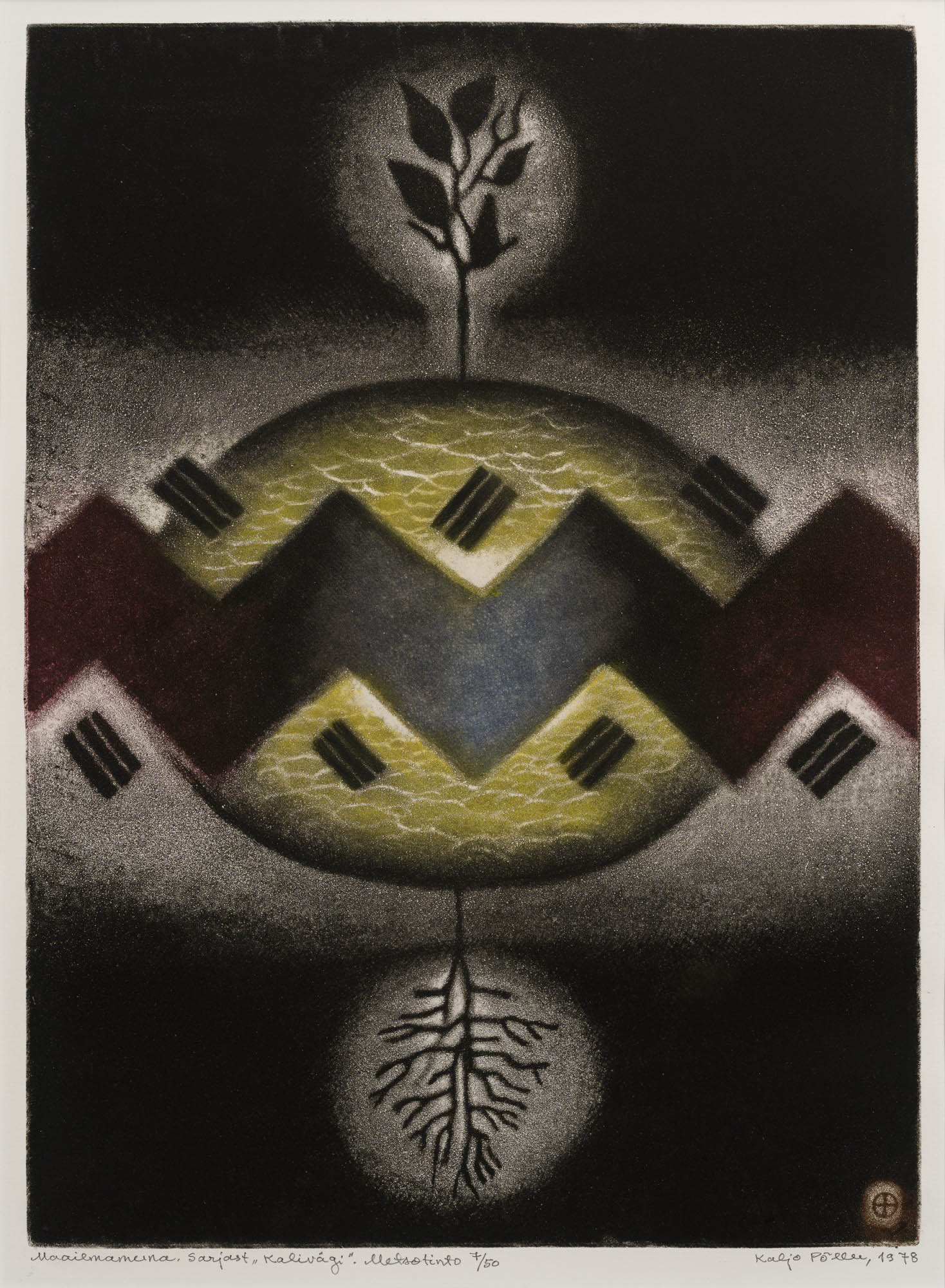
It was under the influence of Põllu and his students that the Estonian movement known as “ethnofuturism” emerged in the 1980s. Going beyond the national Romanticism of the nineteenth century and the earlier Germanic and Scandinavian influences, it sought to reconnect with the prehistoric Finno-Ugric and Estonian past while expressing that heritage through the most modern artistic forms, so that it would remain a living tradition rather than become a mere open-air museum.
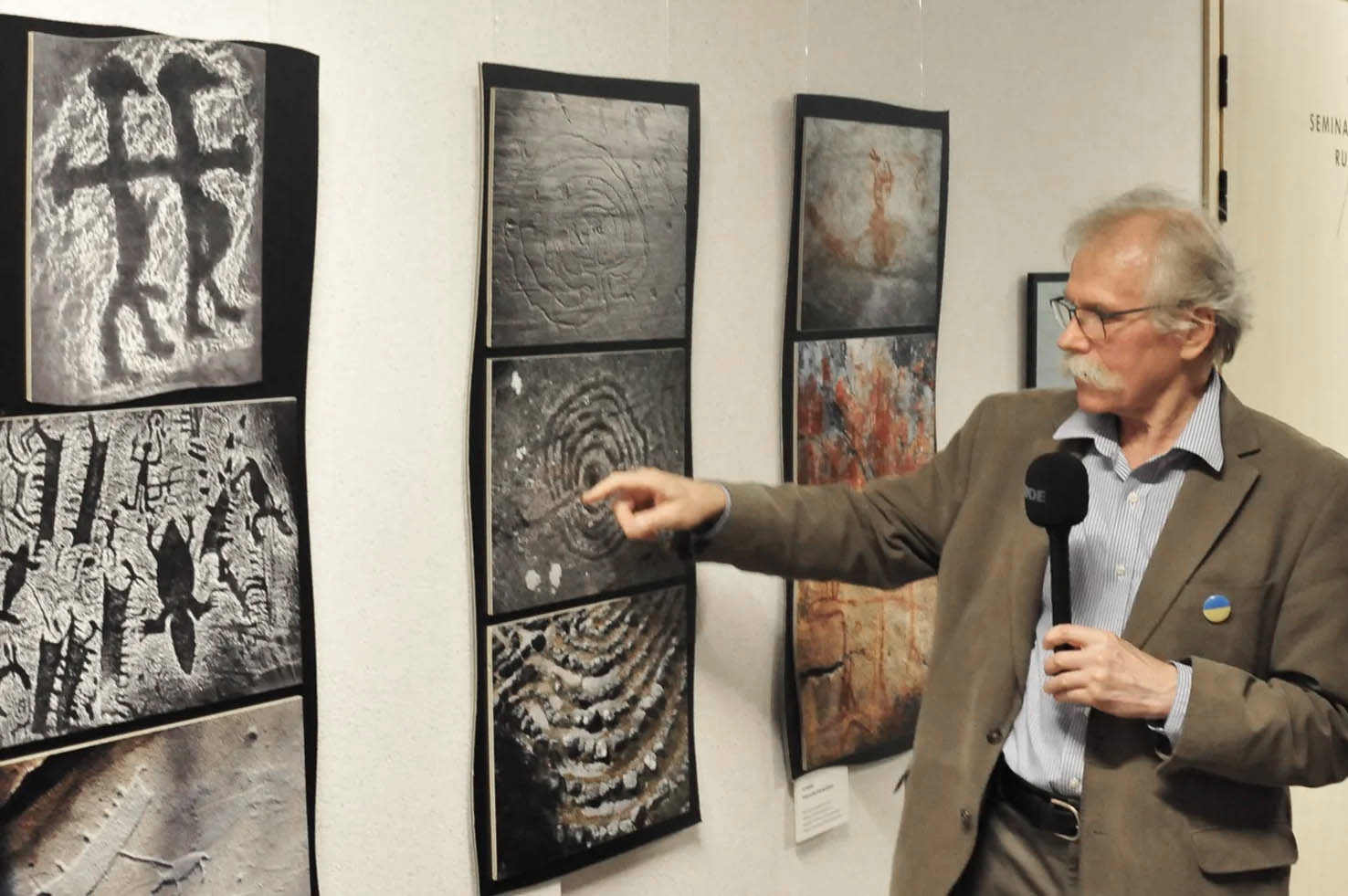 At a 2023 exhibition by the ethnofuturist painter Lot Jõekalda
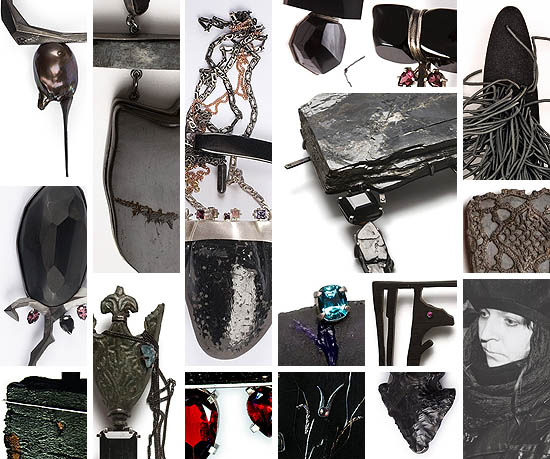 Kadri Mälk etnofuturista ékszerei
The movement soon spread beyond the visual arts into literature and music as well, becoming an inspiration for many other small peoples of the Soviet Union, including the Udmurts.
The ethnofuturist metal band Metsatöll: Ema Hääl Kutsub (“The Call of the Mother Tongue”) and Ballaad Punastest Paeltest (“Ballad of the Red Ribbons / The Marsh Spirit’s Temptation”), from the albums Äio (“Dream Spirit”, 2010) and Katk Kutsariks (“The Plague as Coachman”, 2019)
|
Öö peidab külma ja tumma vett
Kõnni mu järgi, mul valge on juus
Su juus lõhnab värskelt kui kastene hein
Vaata kui pehme on laukane pind
Leek sinu peos on kui kiskja kulm
Soosamblal külma ja tumma verd |
The night conceals cold and silent waters;
Follow me; my hair is fair,
Your hair is fragrant like dew-drenched hay,
Look how soft the surface of the bog is;
The flame in your hand is like the gaze of a beast of prey;
Upon the marsh moss lies cold and dark blood. |



Add comment