


 We have just learned the melodious word “huehuetlahtolli” in the volume of essays edited by Roxana Recio, Traducción y humanismo: Panorama de un desarrollo cultural (Soria: Vertere. Monográficos de la revista Hermeneus, 2007). It is in Nahuatl, and it is composed by huehue (ancient) and tlahtolli (word, discourse, account, proverb, warning), so that its literal traduction would be “ancient word”. However, it would be more proper to translate it as “word – or testimony – of the ancients”, as it refers to a sort of simple didactic texts, written in beautiful verses and provided with delicate metaphors, which were used to inculcate the moral principles of civilization upon the youth. This is how it is explained in the analysis by Librado Silva Galeana, «Los huehuetlahtolli recogidos por fray Andrés de Olmos, publicados después por fray Juan Bautista. Algunas dificultades que presentó su traducción» (pages 173-185 of the book quoted).
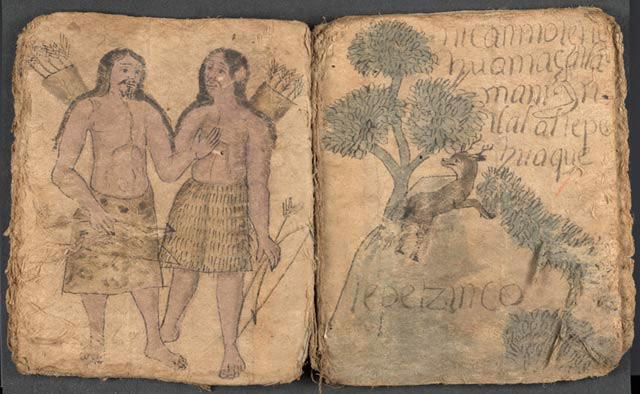 Don Andrés, Aztec notary: Techialoyan land records, in Nahuatl (17th c.)
These texts include that few that has been preserved from the culture of the ancient Mexicans. In the surviving compilations we can feel the efforts of the last Pre-Colombian generation done in a moment when their world has already been forever annihilated, and the dominion of the conquerors has become unequivocally palpable.
From here, far in space and time we believe that the ancient Nahuatl are also “our ancestors”. They began to become that in the very moment when Spain reached to them and the two people started to blend, and their word should be heard by us with the same attention dedicated to our European forefathers. Unfortunately, in the Spanish universities these themes are generally ignored. After the immense and grotesque publicity campaign dedicated by the Spanish government to the celebrations of the Fifth Centennary in 1992, we have fallen into the most absolute disdain in confront of the American culture (obviously, there are always small exceptions). What most vigorously survives from those solemnities are the sometimes vitrioline critical essays dedicated by Rafael Sánchez Ferlosio to them as well as to the relation of Spain with America.
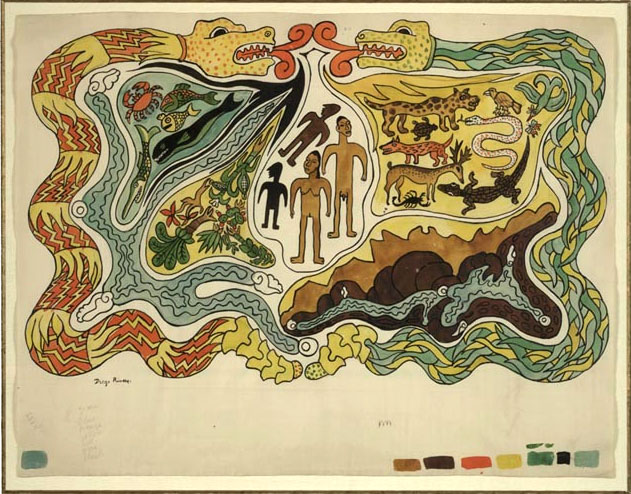 Diego Rivera (1886-1957): The Creation. Illustration to Popol Vuh, ca. 1931
The occasion that moves us to write this commentary is the fresh shock of having seen the extremely distorted view of history of the Apocalypto perpetrated by Mel Gibson. It was the more irritating as with the means at his disposal he could have made of this theme something really good. True, we were delighted to hear the dialogues en Maya, but these spectacular simplifications of history create topic that stick to the mind of the spectator like a tick, forever blocking the way to any more subtle approach.
Anyway. Now our main task is to find this book: Fray Juan Bautista Viseo, Huehuetlahtolli: testimonio de la antigua palabra. Ed. Miguel León-Portilla. Trad. Librado Silva Galeana. México: Comisión Nacional Conmemorativa del V Centenario del Encuentro de Dos Mundos, 1988 (and México: Fondo de Cultura Económica, 1991).



Add comment